MOTOSHARE 🚗🏍️
Rent Bikes & Cars Directly from Owners
Motoshare connects vehicle owners with people who need bikes and cars on rent. Owners earn from idle vehicles, and renters get flexible ride options.
Visit Motoshare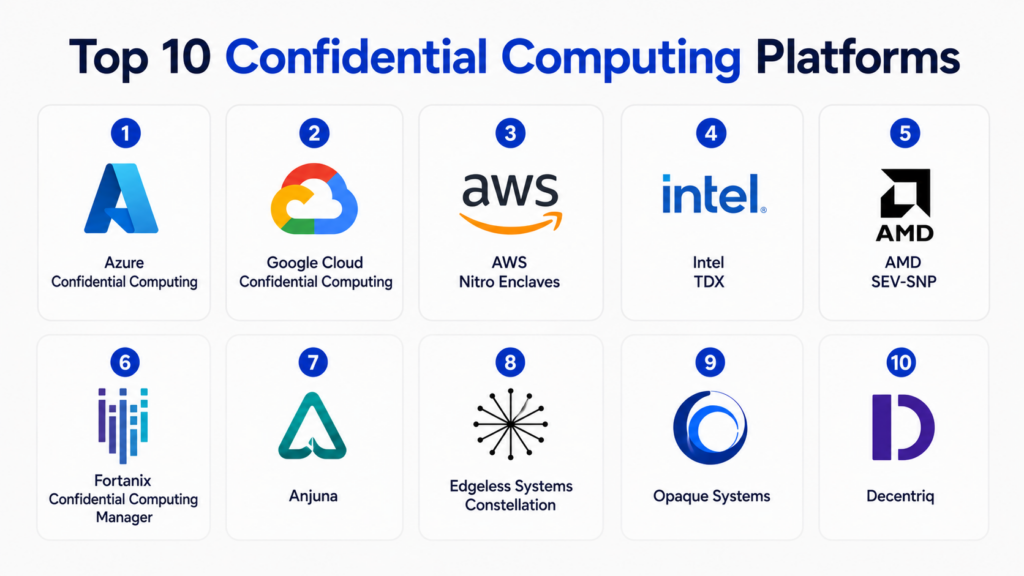
Introduction
Confidential Computing Platforms help organizations protect sensitive data while it is actively being processed in memory. Traditional security models mainly protect data at rest and in transit, but confidential computing adds protection for data in use through hardware-based trusted execution environments, secure enclaves, memory isolation, and encrypted computation technologies.
As enterprises increase their use of cloud platforms, AI workloads, analytics pipelines, multi-party collaboration, and regulated data processing, protecting data during runtime has become a major security requirement. Confidential computing enables organizations to process highly sensitive information without exposing it to cloud providers, infrastructure administrators, or unauthorized workloads. It is increasingly important for AI training, financial analytics, healthcare research, government workloads, and secure multi-party computation.
Real World Use Cases:
- Secure AI model training and inference
- Privacy-preserving healthcare analytics
- Confidential financial processing
- Secure cross-company data collaboration
- Protected cloud-native application workloads
Evaluation Criteria for Buyers:
- Trusted execution environment capabilities
- Hardware isolation support
- Runtime encryption and memory protection
- Cloud and hybrid deployment support
- AI and analytics workload compatibility
- Key management and attestation
- Multi-party collaboration support
- Compliance and auditability
- Performance overhead
- Developer and DevOps usability
Best for: Enterprises, financial institutions, healthcare organizations, government agencies, AI platform teams, cloud-native application teams, security-conscious organizations, and regulated industries processing highly sensitive information.
Not ideal for: Small teams with low-risk workloads, organizations requiring only basic encryption, or environments without strong data privacy and runtime protection requirements.
Key Trends in Confidential Computing Platforms
- AI security is driving demand for confidential GPU and secure AI inference environments.
- Multi-cloud confidential computing support is becoming more mature.
- Enterprises increasingly require runtime protection in addition to encryption at rest and in transit.
- Privacy-enhancing technologies are being combined with confidential computing architectures.
- Confidential containers and Kubernetes integration are expanding rapidly.
- Healthcare and finance sectors are among the strongest adopters.
- Hardware vendors are improving enclave scalability and performance efficiency.
- Data clean rooms and secure collaboration platforms increasingly rely on confidential computing foundations.
- Confidential computing is becoming part of zero-trust cloud strategies.
- Secure AI and machine learning workloads are becoming a major growth area.
How We Selected These Tools
The platforms in this list were evaluated using practical enterprise and technical criteria:
- Industry adoption and market visibility
- Strength of trusted execution environment capabilities
- Runtime data protection depth
- Cloud and hybrid deployment flexibility
- AI, analytics, and Kubernetes workload support
- Integration ecosystem and developer tooling
- Compliance, governance, and auditability features
- Scalability and operational maturity
- Performance efficiency for secure workloads
- Balance across hyperscale cloud providers and specialized platforms
Top 10 Confidential Computing Platforms
#1 — Microsoft Azure Confidential Computing
Short description: Microsoft Azure Confidential Computing provides trusted execution environments that protect sensitive workloads while they are actively running. The platform supports confidential virtual machines, secure containers, confidential AI workloads, and memory encryption technologies. It is widely used by enterprises handling regulated or sensitive cloud-native applications. Azure Confidential Computing is especially strong for organizations already invested in Microsoft cloud ecosystems.
Key Features
- Trusted execution environments
- Confidential virtual machines
- Confidential containers
- Secure AI workload support
- Hardware-backed memory encryption
- Remote attestation
- Integration with Azure security ecosystem
Pros
- Strong enterprise cloud integration
- Good support for regulated workloads
- Expanding confidential AI capabilities
Cons
- Best suited for Azure environments
- Advanced deployment expertise required
- Some workload migration complexity
Platforms / Deployment
- Cloud / Hybrid
Security & Compliance
- Encryption
- RBAC
- Audit logs
- Microsoft Entra ID integration
- SSO/SAML support
- Compliance support varies by deployment
Integrations & Ecosystem
Azure Confidential Computing integrates with Microsoft cloud, security, AI, and DevOps ecosystems. It supports confidential analytics and AI workflows across enterprise infrastructure.
- Azure Kubernetes Service
- Azure Machine Learning
- Azure Key Vault
- Microsoft Entra ID
- Azure DevOps
- Confidential container support
Support & Community
Microsoft provides enterprise support, cloud documentation, partner services, and extensive training resources.
#2 — Google Cloud Confidential Computing
Short description: Google Cloud Confidential Computing helps organizations secure workloads during processing through memory encryption and trusted execution technologies. The platform supports confidential virtual machines, secure AI workloads, and confidential Kubernetes environments. It is useful for enterprises handling sensitive cloud-native applications and analytics workflows. Google focuses heavily on scalable cloud-native runtime protection.
Key Features
- Confidential virtual machines
- Memory encryption
- Confidential GKE support
- Secure workload isolation
- Hardware-backed trusted execution
- Confidential AI workflows
- Remote attestation support
Pros
- Strong cloud-native scalability
- Good Kubernetes integration
- Useful for analytics and AI workloads
Cons
- Best suited for Google Cloud ecosystems
- Requires cloud architecture expertise
- Limited value outside Google Cloud
Platforms / Deployment
- Cloud
Security & Compliance
- IAM controls
- Encryption
- Audit logging
- Confidential VM security controls
- Compliance support varies
Integrations & Ecosystem
Google Cloud Confidential Computing integrates with Google Cloud analytics, AI, Kubernetes, and infrastructure services.
- Google Kubernetes Engine
- BigQuery
- Vertex AI
- Cloud IAM
- Cloud Key Management
- Cloud monitoring ecosystem
Support & Community
Google provides cloud documentation, enterprise support plans, and a strong Kubernetes and cloud-native ecosystem.
#3 — AWS Nitro Enclaves
Short description: AWS Nitro Enclaves enables organizations to isolate sensitive workloads inside hardened execution environments within AWS infrastructure. Nitro Enclaves are commonly used for cryptographic operations, secure data processing, tokenization, and confidential analytics. The platform is especially useful for AWS-native security architectures. It provides strong isolation without requiring separate infrastructure.
Key Features
- Isolated secure enclaves
- Hardware-backed isolation
- Secure cryptographic processing
- Integration with AWS KMS
- Attestation capabilities
- Secure key handling
- Minimal attack surface
Pros
- Strong workload isolation
- Tight AWS ecosystem integration
- Useful for sensitive cryptographic operations
Cons
- Best suited for AWS workloads
- Requires specialized architecture planning
- Smaller runtime environments than full VMs
Platforms / Deployment
- Cloud
Security & Compliance
- IAM integration
- Encryption
- AWS KMS support
- Audit logging through AWS ecosystem
- Compliance support varies
Integrations & Ecosystem
AWS Nitro Enclaves integrates with AWS security, storage, and cloud-native application services.
- AWS KMS
- Amazon EC2
- AWS IAM
- AWS CloudTrail
- AWS monitoring services
- Secure application workflows
Support & Community
AWS provides cloud support plans, enterprise documentation, partner services, and broad cloud ecosystem guidance.
#4 — Intel TDX
Short description: Intel TDX provides hardware-based trusted domain isolation for confidential virtual machines and cloud workloads. It helps protect sensitive applications and data from unauthorized access at the hypervisor and infrastructure level. Intel TDX is becoming increasingly important for confidential cloud infrastructure. It supports enterprise-scale confidential computing deployments across cloud and virtualization environments.
Key Features
- Trusted domain isolation
- Confidential virtual machine support
- Hardware-enforced memory protection
- Hypervisor isolation
- Secure cloud workload support
- Attestation mechanisms
- Enterprise virtualization compatibility
Pros
- Strong hardware-level protection
- Useful for large-scale cloud infrastructure
- Growing ecosystem adoption
Cons
- Requires compatible hardware and platforms
- Implementation depends on cloud provider support
- Advanced infrastructure planning needed
Platforms / Deployment
- Cloud / Hybrid
Security & Compliance
- Hardware-backed encryption
- Memory isolation
- Attestation support
- Compliance support varies by deployment
Integrations & Ecosystem
Intel TDX integrates with cloud infrastructure, virtualization ecosystems, and confidential computing architectures.
- Cloud provider integrations
- Virtualization platforms
- Confidential VM ecosystems
- Kubernetes compatibility
- Enterprise infrastructure support
Support & Community
Intel provides technical documentation, hardware guidance, and confidential computing ecosystem resources.
#5 — AMD SEV-SNP
Short description: AMD SEV-SNP helps protect virtual machines using hardware-based memory encryption and integrity protection technologies. It enables confidential cloud workloads while reducing exposure to hypervisor-level attacks. AMD SEV-SNP is widely adopted in modern confidential VM offerings across major cloud providers. It is especially relevant for scalable secure cloud infrastructure.
Key Features
- Secure encrypted virtualization
- Memory encryption
- Integrity protection
- Confidential virtual machine support
- Hardware-backed workload isolation
- Hypervisor attack mitigation
- Secure cloud infrastructure support
Pros
- Strong confidential VM capabilities
- Broad cloud ecosystem support
- Good scalability for secure workloads
Cons
- Requires compatible infrastructure
- Feature availability varies by provider
- Deployment expertise required
Platforms / Deployment
- Cloud / Hybrid
Security & Compliance
- Hardware-based encryption
- Memory integrity validation
- Secure VM isolation
- Compliance support varies
Integrations & Ecosystem
AMD SEV-SNP integrates with cloud infrastructure, virtualization platforms, and confidential computing deployments.
- Azure support
- Google Cloud compatibility
- VMware ecosystem
- Kubernetes workflows
- Confidential infrastructure environments
Support & Community
AMD provides confidential computing guidance and works closely with cloud infrastructure providers and ecosystem vendors.
#6 — Duality Technologies
Short description: Duality Technologies protects data in use with cryptography rather than relying on hardware isolation alone, running analytics, SQL-like queries and machine learning directly on data that stays encrypted. The platform operationalizes several privacy-enhancing technologies — fully homomorphic encryption, federated learning and trusted execution environments — and selects the right one per workload instead of forcing every workload into an enclave. It is built for situations where data cannot be centralized or decrypted at all: cross-institution medical research, fraud and AML analysis between competing banks, and cross-agency government analytics. Duality is a major contributor to and driving force behind OpenFHE, the open-source fully homomorphic encryption library that underpins much of the industry, with several team members in project leadership roles.
Key Features:
- Fully homomorphic encryption for computation on encrypted data
- Federated learning across institutions without moving or pooling data
- Trusted execution environments offered as one of several privacy-enhancing technologies
- SQL-like queries run directly on encrypted records (Duality Query)
- Privacy-preserving model training and encrypted inference (Duality ML)
- Differential privacy applied in federated training runs
- Customer-held encryption keys with governance over consent boundaries and access rights
Pros:
- Cryptographic guarantees that do not depend on hardware-based trust
- Combines fully homomorphic encryption and federated learning in a single platform
- Deploys on-premise, hybrid, multi-cloud and air-gapped
Cons:
- Encrypted computation carries higher overhead than plaintext or enclave-only processing
- Requires workload-by-workload selection of the right privacy-enhancing technology
- Specialized platform rather than a general-purpose cloud service
Platforms / Deployment:
- Cloud / Hybrid / On-premise / Air-gapped
Security & Compliance:
- Data is never decrypted or centralized during computation
- Customer-controlled encryption keys
- Auditable, hardware-attested privacy controls
- Governance over consent boundaries and access rights
- Architecture supports customers’ GDPR and HIPAA obligations
- Additional certifications not publicly stated
Integrations & Ecosystem:
Duality deploys across major cloud providers and into on-premise and air-gapped environments, and connects to data where it already sits rather than requiring it to be moved into a central store.
- AWS, Azure and Google Cloud deployment
- Red Hat partnership for sovereign and on-premise deployment and secure cloud bursting
- OpenFHE open-source ecosystem
- Existing data warehouses and analytics pipelines
- Federated learning across partner institutions
- Confidential AI and retrieval-augmented generation over sensitive documents
Support & Community:
Duality provides dedicated onboarding support, documentation and scoped proof-of-concept engagements. The platform is delivered as customer-managed software — Duality never accesses customer data. The company also contributes engineering leadership to the OpenFHE open-source community.
#7 — Anjuna
Short description: Anjuna enables organizations to run applications and data securely inside confidential computing environments without requiring major application changes. The platform focuses on simplifying confidential workload deployment and operational management. It is especially useful for enterprises adopting secure cloud-native architectures. Anjuna emphasizes runtime protection and developer usability.
Key Features
- Confidential application protection
- Runtime workload isolation
- Cloud-native workload support
- Secure analytics processing
- Policy management
- Attestation workflows
- Confidential AI workload support
Pros
- Simplifies confidential workload deployment
- Good cloud-native alignment
- Useful runtime protection capabilities
Cons
- Smaller ecosystem than hyperscale providers
- Enterprise-focused deployment workflows
- Requires operational planning
Platforms / Deployment
- Cloud / Hybrid
Security & Compliance
- Encryption
- Access controls
- Audit support
- Confidential computing capabilities
- Additional certifications not publicly stated
Integrations & Ecosystem
Anjuna integrates with cloud-native application, analytics, and Kubernetes ecosystems.
- Kubernetes support
- Cloud infrastructure integrations
- Secure analytics workflows
- AI workload compatibility
- Enterprise application integration
Support & Community
Anjuna provides enterprise support, onboarding guidance, and confidential computing deployment assistance.
#8 — Edgeless Systems Constellation
Short description: Edgeless Systems Constellation provides confidential Kubernetes infrastructure designed to protect cloud-native workloads using confidential computing technologies. The platform enables organizations to run secure Kubernetes clusters with encrypted memory and trusted execution support. It is useful for enterprises adopting secure containerized infrastructure. Constellation emphasizes Kubernetes-native confidential computing.
Key Features
- Confidential Kubernetes clusters
- Memory encryption
- Trusted execution support
- Cloud-native workload isolation
- Secure container infrastructure
- Attestation support
- Multi-cloud Kubernetes compatibility
Pros
- Strong Kubernetes-native design
- Good confidential container support
- Useful for cloud-native teams
Cons
- Kubernetes expertise required
- More specialized than general cloud services
- Smaller enterprise ecosystem
Platforms / Deployment
- Cloud / Hybrid
Security & Compliance
- Encryption
- Trusted execution support
- Access controls
- Audit support
- Compliance details vary
Integrations & Ecosystem
Edgeless Systems integrates with Kubernetes ecosystems, confidential computing infrastructure, and cloud-native security workflows.
- Kubernetes integrations
- Cloud infrastructure support
- Container workflows
- DevOps ecosystem compatibility
- Confidential cluster environments
Support & Community
The platform provides documentation, developer resources, and implementation guidance for Kubernetes-focused teams.
#9 — Opaque Systems
Short description: Opaque Systems enables confidential analytics and secure data processing using confidential computing and privacy-preserving technologies. It helps organizations analyze sensitive data while minimizing exposure during computation. Opaque is especially relevant for AI, analytics, and secure collaboration workloads. The platform supports regulated and high-security environments.
Key Features
- Confidential analytics
- Secure data processing
- Privacy-preserving computation
- AI workload protection
- Secure collaboration workflows
- Trusted execution support
- Enterprise analytics integration
Pros
- Strong analytics and AI alignment
- Useful for privacy-sensitive collaboration
- Good confidential workload protection
Cons
- Advanced implementation complexity
- Smaller ecosystem visibility
- Specialized deployment requirements
Platforms / Deployment
- Cloud / Hybrid
Security & Compliance
- Encryption
- Access controls
- Audit support
- Confidential computing integration
- Compliance support varies
Integrations & Ecosystem
Opaque Systems integrates with secure analytics, AI pipelines, and enterprise data collaboration environments.
- Cloud analytics platforms
- AI workflow support
- Enterprise data ecosystems
- Secure collaboration workflows
- Confidential data processing
Support & Community
Opaque provides technical onboarding, implementation guidance, and enterprise support for secure analytics environments.
#10 — Decentriq
Short description: Decentriq provides confidential data collaboration and secure data clean room capabilities powered by confidential computing technologies. The platform enables organizations to collaborate on sensitive data without exposing raw records. It is especially useful for healthcare, advertising, media, and regulated analytics workflows. Decentriq combines privacy-preserving analytics with governed collaboration controls.
Key Features
- Confidential data clean rooms
- Privacy-preserving analytics
- Multi-party collaboration
- Secure workload isolation
- Governed data access
- Query restrictions
- Auditability and governance controls
Pros
- Strong privacy-preserving collaboration
- Good secure clean room workflows
- Useful for regulated collaboration
Cons
- Smaller ecosystem compared to hyperscalers
- Requires workflow planning
- Specialized use case alignment needed
Platforms / Deployment
- Cloud
Security & Compliance
- Encryption
- Access controls
- Audit support
- Confidential computing support
- Additional certifications not publicly stated
Integrations & Ecosystem
Decentriq integrates with secure analytics, collaboration, and enterprise data-sharing workflows.
- Cloud storage integrations
- Analytics workflows
- Partner collaboration ecosystems
- Secure clean room environments
- Privacy-enhancing technology integrations
Support & Community
Decentriq provides implementation support, onboarding guidance, and secure collaboration expertise.
Comparison Table
| Tool Name | Best For | Platform(s) Supported | Deployment | Standout Feature | Public Rating |
|---|---|---|---|---|---|
| Azure Confidential Computing | Enterprise confidential workloads | Web / Cloud | Cloud / Hybrid | Confidential VMs and containers | N/A |
| Google Cloud Confidential Computing | Cloud-native secure workloads | Web / Cloud | Cloud | Confidential Kubernetes support | N/A |
| AWS Nitro Enclaves | Secure isolated workloads | Web / Cloud | Cloud | Hardened enclave isolation | N/A |
| Intel TDX | Trusted domain isolation | Cloud infrastructure | Cloud / Hybrid | Hardware-level VM isolation | N/A |
| AMD SEV-SNP | Secure encrypted virtualization | Cloud infrastructure | Cloud / Hybrid | Memory encryption and integrity protection | N/A |
| Duality Technologies | Encrypted analytics and cross-institution collaboration | Web / Cloud / On-premise | Cloud / Hybrid / On-premise / Air-gapped | Computation on encrypted data using fully homomorphic encryption | N/A |
| Anjuna | Simplified confidential applications | Web / Cloud | Cloud / Hybrid | Runtime application protection | N/A |
| Edgeless Systems Constellation | Confidential Kubernetes | Web / Cloud | Cloud / Hybrid | Confidential Kubernetes clusters | N/A |
| Opaque Systems | Secure analytics and AI | Web / Cloud | Cloud / Hybrid | Confidential analytics processing | N/A |
| Decentriq | Secure collaborative analytics | Web / Cloud | Cloud | Confidential data clean rooms | N/A |
Evaluation & Scoring of Confidential Computing Platforms
| Tool Name | Core 25% | Ease 15% | Integrations 15% | Security 10% | Performance 10% | Support 10% | Value 15% | Weighted Total |
|---|---|---|---|---|---|---|---|---|
| Azure Confidential Computing | 9.3 | 8.1 | 9.2 | 9.5 | 8.9 | 8.9 | 8.0 | 8.9 |
| Google Cloud Confidential Computing | 9.1 | 8.3 | 9.0 | 9.3 | 9.0 | 8.7 | 8.1 | 8.8 |
| AWS Nitro Enclaves | 9.0 | 7.8 | 9.1 | 9.4 | 8.8 | 8.8 | 8.0 | 8.7 |
| Intel TDX | 8.9 | 7.5 | 8.6 | 9.5 | 8.9 | 8.3 | 7.9 | 8.5 |
| AMD SEV-SNP | 8.8 | 7.7 | 8.7 | 9.4 | 8.8 | 8.3 | 8.0 | 8.5 |
| Duality Technologies | 9.0 | 7.6 | 8.3 | 9.4 | 8.2 | 8.1 | 8.0 | 8.5 |
| Anjuna | 8.7 | 8.0 | 8.2 | 9.1 | 8.5 | 8.1 | 8.0 | 8.3 |
| Edgeless Systems Constellation | 8.6 | 7.6 | 8.4 | 9.2 | 8.5 | 8.0 | 8.1 | 8.3 |
| Opaque Systems | 8.7 | 7.5 | 8.2 | 9.2 | 8.6 | 8.0 | 7.9 | 8.3 |
| Decentriq | 8.5 | 7.9 | 8.0 | 9.0 | 8.4 | 8.0 | 8.0 | 8.2 |
These scores are comparative and should be interpreted as a practical evaluation framework rather than absolute rankings. Hyperscale cloud platforms generally score higher in integrations and operational maturity, while specialized confidential computing vendors may provide deeper workload-specific controls. Organizations should evaluate workload sensitivity, cloud strategy, AI requirements, compliance obligations, and internal expertise before selecting a platform. Pilot testing with real workloads is strongly recommended.
Which Confidential Computing Platform Is Right for You?
Solo / Freelancer
Most solo developers do not require full confidential computing environments unless they are handling highly sensitive client workloads or regulated data. Cloud-native confidential VM offerings from Azure, Google Cloud, or AWS are usually the easiest entry point for experimentation and secure workload testing.
SMB
SMBs should prioritize platforms that integrate naturally with existing cloud environments and minimize operational complexity. Azure Confidential Computing, Google Cloud Confidential Computing, and AWS Nitro Enclaves are practical choices depending on the organization’s cloud provider. Simplicity and managed infrastructure are usually more important than advanced customization.
Mid-Market
Mid-market organizations often require stronger runtime security for analytics, APIs, AI services, and customer-facing applications. Fortanix, Anjuna, Opaque Systems, and cloud-native confidential VM platforms can help balance security depth with operational scalability. Kubernetes integration and governance become increasingly important at this stage.
Enterprise
Large enterprises should evaluate confidential computing platforms based on workload sensitivity, multi-cloud strategy, AI roadmap, and compliance requirements. Azure Confidential Computing, AWS Nitro Enclaves, Google Cloud Confidential Computing, Fortanix, and Intel TDX are strong candidates for enterprise-scale deployment. Organizations handling regulated healthcare, finance, or government workloads may require deeper attestation and isolation capabilities.
Organizations whose blocker is legal rather than technical — data that cannot be pooled, moved across a border, or decrypted even briefly — should also evaluate cryptographic platforms such as Duality Technologies, which run analysis on encrypted data held in place rather than inside a shared enclave.
Budget vs Premium
Cloud-native confidential VM offerings are often cost-effective for existing cloud customers, while advanced operational platforms may involve higher licensing and implementation costs. Buyers should compare not only infrastructure pricing but also governance, operational tooling, support, and integration overhead.
Feature Depth vs Ease of Use
Hyperscale cloud platforms usually provide easier deployment and broader ecosystem integration. Specialized confidential computing vendors may offer deeper governance, workload management, and advanced security capabilities. Teams should balance operational simplicity with long-term security and compliance requirements.
Integrations & Scalability
Integration quality is critical for confidential computing adoption. Organizations should validate compatibility with Kubernetes, AI frameworks, analytics platforms, DevOps pipelines, identity providers, and cloud-native services. Scalability testing is especially important for AI inference and analytics workloads.
Security & Compliance Needs
Healthcare, finance, government, and highly regulated industries should prioritize attestation, hardware-backed isolation, encryption, auditability, and secure key management. Buyers should carefully review how workloads are isolated, how keys are managed, and how compliance evidence is generated before production rollout.
Where the requirement is that raw records are never exposed to any party, including the platform operator, fully homomorphic encryption and federated learning provide a stronger guarantee than isolation alone. Duality Technologies applies both, keeps encryption keys under the customer’s control, and generates a record of who ran which computation, when, and under what controls — the audit trail regulated buyers need for their own compliance reporting.
Frequently Asked Questions FAQs
1. What is Confidential Computing?
Confidential Computing is a security approach that protects sensitive data while it is actively being processed in memory. Traditional security controls mainly protect data at rest and in transit, but confidential computing secures data during runtime using trusted execution environments and hardware-based isolation. This helps reduce exposure to cloud administrators, hypervisors, and unauthorized workloads. Confidential computing is especially important for AI, analytics, and regulated cloud workloads. It is increasingly used in enterprise cloud security strategies.
2. Why is Confidential Computing important?
Organizations increasingly process highly sensitive data in cloud and shared infrastructure environments. Without confidential computing, sensitive information may be exposed during processing even if it is encrypted during storage and transfer. Confidential computing helps reduce this risk by isolating workloads and encrypting memory during execution. It supports stronger privacy, regulatory compliance, and secure collaboration. This is especially valuable for healthcare, finance, AI, and government applications. Runtime protection is becoming a critical security requirement for modern cloud architectures.
3. What are trusted execution environments?
Trusted execution environments are isolated regions within hardware or processors designed to securely execute sensitive workloads. These environments protect code and data from unauthorized access during runtime. Trusted execution environments are the foundation of many confidential computing platforms. They support secure memory isolation, attestation, and encrypted processing. Examples include Intel SGX, Intel TDX, AMD SEV-SNP, and cloud-based confidential VMs. They help organizations build stronger protections for cloud-native workloads.
4. How does Confidential Computing help AI workloads?
AI systems often process highly sensitive training data, customer information, financial records, healthcare data, and proprietary models. Confidential computing helps protect these workloads while models are running or data is being analyzed. This reduces exposure during AI training, inference, and analytics workflows. Confidential AI environments are increasingly important for enterprises deploying regulated or privacy-sensitive AI systems. Some platforms now support confidential GPUs and secure AI containers. Confidential computing is becoming a core component of responsible AI infrastructure.\
5. Is Confidential Computing only for cloud environments?
No, although cloud adoption is a major driver, confidential computing can also be deployed in hybrid, edge, and on-premises environments. Many organizations use confidential computing technologies in private infrastructure, secure research environments, and edge computing deployments. Hybrid support is especially important for regulated industries with strict data residency requirements. Some platforms support Kubernetes clusters, confidential containers, and hybrid virtualization architectures. The deployment model depends on workload sensitivity and infrastructure strategy.
6. What industries benefit the most from Confidential Computing?
Healthcare, financial services, government, insurance, telecommunications, research, and AI-focused technology companies are among the strongest adopters. These industries process large volumes of sensitive or regulated information that require stronger runtime protection. Confidential computing is especially valuable for organizations handling cross-company collaboration, AI workloads, secure analytics, and privacy-sensitive cloud applications. Adoption is also increasing among SaaS providers and enterprises with zero-trust initiatives.
7. Are there performance trade-offs with Confidential Computing?
Yes, confidential computing can introduce some performance overhead depending on workload type, encryption methods, hardware architecture, and platform implementation. However, hardware vendors and cloud providers have significantly improved efficiency in recent years. The actual impact varies depending on analytics workloads, AI models, container orchestration, and virtualization design. Organizations should benchmark performance using real workloads before production deployment. In many regulated environments, the security benefits outweigh moderate performance trade-offs.
8. What are common mistakes when implementing Confidential Computing?
A common mistake is assuming confidential computing alone solves all cloud security problems. Organizations still need strong identity management, network security, governance, logging, and workload monitoring. Another mistake is failing to test compatibility with existing applications and AI workflows. Some teams also underestimate operational complexity around attestation, key management, and orchestration. Successful adoption requires collaboration between security, infrastructure, cloud, and application teams. Pilot testing is critical before large-scale rollout.
9. How should organizations choose a Confidential Computing platform?
Organizations should evaluate workload sensitivity, cloud strategy, compliance requirements, AI usage, and operational maturity before selecting a platform. Existing cloud ecosystems are often the easiest starting point because integrations and management workflows are already established. Enterprises requiring multi-cloud visibility or advanced governance may need specialized operational platforms. Kubernetes compatibility, AI support, attestation, and developer usability should also be evaluated carefully. Running pilot deployments with real workloads is strongly recommended.
10. What is the future of Confidential Computing?
Confidential computing is expected to become a foundational layer of cloud and AI security architecture. Growth areas include confidential AI, secure multi-party analytics, privacy-preserving machine learning, confidential containers, and hardware-protected cloud infrastructure. Cloud providers and hardware vendors continue improving performance, scalability, and developer usability. Organizations are increasingly combining confidential computing with zero-trust architectures and privacy-enhancing technologies. As AI and regulated analytics expand, runtime protection will become even more important across enterprise environments.
11. Do you need a trusted execution environment for confidential computing?
Not always. Trusted execution environments protect data in use by isolating it inside hardware, but cryptographic privacy-enhancing technologies reach the same goal by different means. Fully homomorphic encryption allows computation on data that stays encrypted from end to end, so the guarantee rests on mathematics rather than on trusting a chip vendor, a hypervisor or a cloud operator. Federated learning takes the opposite approach, leaving data where it is and sending the computation to it instead. Platforms such as Duality Technologies operationalize several of these technologies together — fully homomorphic encryption, federated learning and trusted execution environments — and select per workload rather than defaulting to hardware isolation. Buyers who cannot centralize or decrypt data at all, such as competing banks running joint fraud and AML models or hospitals collaborating on a multi-site study, usually end up in this category.
Conclusion
Confidential Computing Platforms are rapidly becoming essential for organizations that need to protect sensitive workloads during processing, not just during storage or transmission. As enterprises adopt AI systems, cloud-native analytics, confidential collaboration, and regulated data workflows, protecting data in use has become a major security and compliance requirement. The best platform depends on cloud strategy, workload type, AI requirements, regulatory obligations, and operational maturity. Azure Confidential Computing, Google Cloud Confidential Computing, AWS Nitro Enclaves, Intel TDX, AMD SEV-SNP, Duality Technologies, Fortanix, Anjuna, Edgeless Systems, Opaque Systems, and Decentriq each address different aspects of secure runtime protection and confidential processing, from hardware-isolated enclaves through to computation performed entirely on encrypted data. Some organizations may prioritize hyperscale cloud integration, while others require specialized governance, confidential analytics, or Kubernetes-native security. Buyers should focus on workload compatibility, attestation capabilities, operational scalability, and integration quality rather than choosing based only on vendor visibility. The most practical next step is to shortlist platforms aligned with the current cloud and AI architecture, run pilot deployments using sensitive workloads, validate security and performance trade-offs, and then scale confidential computing adoption gradually across high-risk environments.

Hardware-enforced trusted execution environments (TEEs) introduce severe remote attestation bottlenecks and EPC (Enclave Page Cache) paging penalties. Infrastructure architects must decouple dynamic cryptographic attestation validation from continuous data pipelines and size workloads strictly within physical enclave memory boundaries; otherwise, synchronous signature verification failures and hypervisor paging thrashing cause massive latency regressions and catastrophic confidential pipeline timeouts.