MOTOSHARE 🚗🏍️
Rent Bikes & Cars Directly from Owners
Motoshare connects vehicle owners with people who need bikes and cars on rent. Owners earn from idle vehicles, and renters get flexible ride options.
Visit Motoshare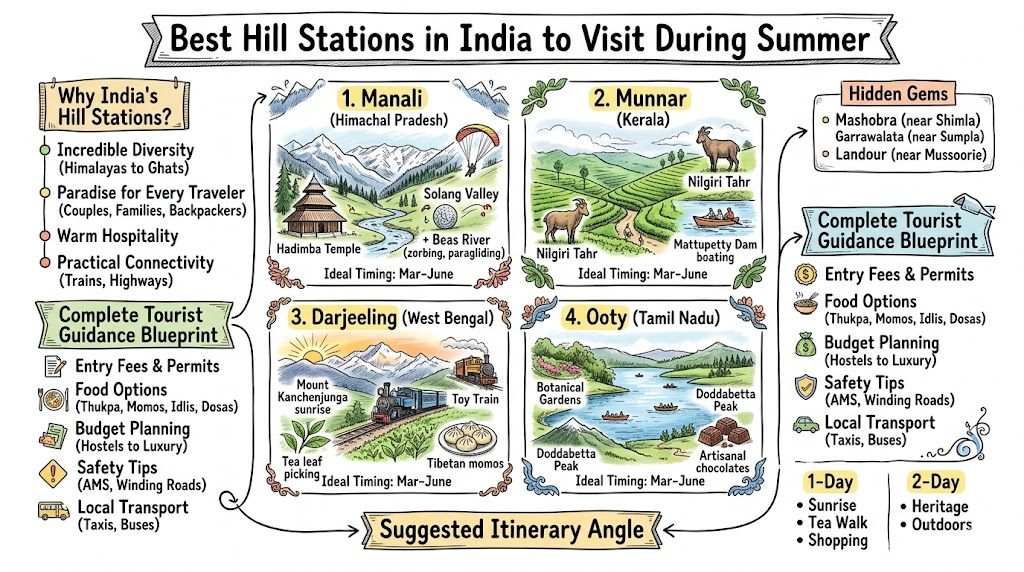
When the summer sun beats down relentlessly across the plains of Asia, the mind naturally drifts to cool mountain breezes, mist-kissed valleys, and the soothing rustle of pine trees. If you are planning a getaway to beat the heat, the mountainous regions of India offer the ultimate sanctuary.
For many travelers, India is synonymous with vibrant cities, golden beaches, and pulsating nightlife. While those coastal escapes and cultural hubs have their own undeniable charm, the true geographical crown of the country lies in its majestic highlands. From the snow-capped, towering peaks of the Himalayas in the north to the rolling, emerald-green tea carpets of the Western Ghats in the south, India’s hill stations are a treasure trove of diversity.
Whether you are an adrenaline-fueled backpacker seeking rugged trekking trails, a couple looking for a romantic misty escape, a family planning a multi-generational summer holiday, or a solo traveler looking for a quiet corner to read and reflect, these high-altitude destinations promise a cool breath of fresh air. They offer a gorgeous cocktail of pristine nature, indigenous mountain cultures, colonial-era heritage, thrilling adventure sports, and delectable local cuisines that you simply cannot find anywhere else.
Why India is a Must-Visit Destination
Traveling to India is not just a vacation; it is a profound sensory experience that changes the way you look at the world. For any international or domestic tourist, it stands out as an essential bucket-list destination because of its sheer variety and depth.
- Incredible Diversity: Within a single trip, you can transition from exploring centuries-old royal forts and spiritual monuments to paragliding over alpine meadows or walking through aromatic spice and coffee plantations.
- A Paradise for Every Traveler: The country’s vast travel infrastructure caters beautifully to all styles and budgets. Backpackers can find vibrant, inexpensive hostels in old mountain villages, while families and couples can indulge in heritage colonial bungalows or luxury eco-resorts.
- Warm Hospitality: Grounded in the ancient philosophy of “Atithi Devo Bhava” (The guest is equivalent to God), the local hospitality is deeply genuine. From a hot cup of roadside masala chai offered by a mountain vendor to guided village walks, you will always feel welcomed.
- Practical Connectivity: Reaching these stunning heights has never been easier. With an extensive network of mountain railways (including UNESCO World Heritage toy trains), well-maintained high-altitude highways, and domestic airports connecting major cities directly to hilly regions, planning an efficient route is incredibly straightforward.
Top Hill Stations in India to Visit During Summer
To help you design the perfect summer escape, we have broken down the finest mountain getaways across the country. Each offers a distinct climate, landscape, and cultural vibe.
1. Manali, Himachal Pradesh
Nestled deeply within the Kullu Valley at an altitude of over 2,050 meters, Manali is the undisputed adventure capital of North India. Surrounded by dense deodar forests and the roaring Beas River, it remains blissfully cool during peak summer.
- Location: Kullu District, Himachal Pradesh (Northern India).
- Why it is worth visiting: It strikes a flawless balance between raw, dramatic Himalayan scenery and modern tourist amenities. It serves as the gateway to the high-altitude desert of Ladakh and offers spectacular snow views even when the plains are scorching.
- Best things to do: Go zorbing and paragliding in Solang Valley, cross the engineering marvel of the Atal Tunnel to explore the barren beauty of Lahaul Valley, visit the ancient wooden Hadimba Temple inside a cedar forest, and relax in the hipster cafes of Old Manali.
- Best time to visit: March to June for pleasant weather and outdoor activities.
- Ideal for whom: Families with teenagers, adventure seekers, backpackers, and honeymooners.
- Travel tip: If you plan to visit the legendary Rohtang Pass for snow activities, you must apply for a mandatory road permit online well in advance, as vehicle numbers are strictly limited daily to protect the environment.
2. Munnar, Kerala
Located at an elevation of 1,600 meters in the Western Ghats, Munnar is a serene oasis where mountain peaks are perpetually wrapped in low-hanging clouds and the air smells faintly of fresh tea leaves.
- Location: Idukki District, Kerala (South India travel guide favorite).
- Why it is worth visiting: It is the premier tea-growing region of South India. The sight of endless, perfectly manicured green hills rolling into the horizon is incredibly therapeutic, offering a vastly different, more tropical mountain experience than the North.
- Best things to do: Spot the endangered Nilgiri Tahr (mountain goat) at Eravikulam National Park, take a scenic boat ride on Mattupetty Dam, stand at Echo Point and call out into the valley, and take a guided walking tour through an aromatic tea estate.
- Best time to visit: April to June for crisp, cool evening breezes before the heavy monsoons arrive.
- Ideal for whom: Couples on a romantic getaway, photography enthusiasts, senior citizens, and families seeking a relaxed pace.
- Travel tip: Hire a local auto-rickshaw or local car driver for estate sightseeing. The mountain roads here are narrow, winding, and prone to sudden blankets of thick, low-visibility fog.
3. Darjeeling, West Bengal
Perched on a mountain ridge in the Lesser Himalayas at 2,042 meters, Darjeeling is a nostalgic journey back in time, famous worldwide for its exquisite black tea and panoramic views of Mount Kanchenjunga—the third-highest peak in the world.
- Location: North West Bengal (Eastern India).
- Why it is worth visiting: It blends rich British colonial charm with vibrant Tibetan and Nepali cultures. The sweeping views of the snow-clad eastern Himalayan range on a clear summer morning are utterly unforgettable.
- Best things to do: Wake up at 4:00 AM to catch the sunrise over Kanchenjunga from Tiger Hill, ride the historic Darjeeling Himalayan Railway toy train, explore the Himalayan Mountaineering Institute, and savor authentic Tibetan momos at Chowrasta Mall.
- Best time to visit: April to June when the skies are generally clear and the mountain air is perfectly brisk.
- Ideal for whom: Culture lovers, solo travelers, heritage buffs, and multi-generational families.
- Travel tip: To avoid the massive summer traffic bottlenecks on the steep uphill roads from New Jalpaiguri (NJP) railhead, try to book an early morning private taxi and start your journey by 6:00 AM.
4. Ooty, Tamil Nadu
Formally known as Udhagamandalam and crowned the “Queen of Hill Stations,” Ooty sits comfortably at 2,240 meters in the Nilgiri Hills. It features a delightful mix of classic English country-style gardens and tranquil lakes.
- Location: Nilgiris District, Tamil Nadu (South India).
- Why it is worth visiting: It offers an incredibly accessible, highly structured holiday experience. Its expansive botanical gardens, classic stone churches, and vast eucalyptus forests provide a wonderful, nostalgic summer retreat.
- Best things to do: Ride the historic Nilgiri Mountain Railway rack-and-pinion toy train, paddle a boat across the serene Ooty Lake, hike up to Doddabetta Peak (the highest point in South India) for panoramic views, and shop for rich, locally made artisanal dark chocolates.
- Best time to visit: March to June when the annual summer flower shows are in full, spectacular bloom.
- Ideal for whom: Weekend travelers from Bangalore or Chennai, families with young children, and couples.
- Travel tip: Skip the overcrowded main town center during peak afternoon hours and take a short, 30-minute drive out to the quieter, untouched rolling grasslands of nearby Pykara or Coonoor.
Complete Tourist Guidance Blueprint
To make your trip to India’s mountains as smooth as possible, keep this handy overview of practical logistics in mind:
- Entry Fees & Permits: Most national parks (like Eravikulam or Solang Valley adventure zones) charge a nominal entry fee ranging from ₹50 to ₹500 ($1 to $7 USD). Keep your physical passport or national ID handy, as security checkpoints are common in sensitive border states like Himachal or Sikkim.
- Food Options: Mountain food is a highlight! In the North, indulge in hot bowls of Thukpa (noodle soup), Momos, and local Himachali Dham. In the South, do not miss eating traditional Idlis and Dosas served on fresh banana leaves, alongside piping-hot filter coffee.
- Budget Planning: Hill stations accommodate everyone. Backpackers can comfortably get by on ₹1,500 ($18 USD) per day using shared local transport and hostels. Mid-range family travel budgets average around ₹5,000 to ₹8,000 ($60 to $100 USD) per day for private cabs and comfortable 3-star mountain hotels.
- Safety Tips: High altitudes mean thin air. If you are traveling to places above 2,500 meters, take it very easy on your first day to prevent Altitude Mountain Sickness (AMS). Drink plenty of water and carry basic motion sickness medication for the twisty, winding mountain hairpins.
- Local Transport Options: While private taxis offer the most comfort and flexibility, budget travelers can easily rely on state-run public buses (like HRTC in the North or KSRTC in the South) which safely traverse these complex terrains daily for a fraction of the cost.
Hidden or Less-Crowded Options
If you want to completely escape the standard tourist trails and long vehicle lines, consider substituting the major hubs for these pristine, quiet alternatives:
- Mashobra (Instead of Shimla): Located just 13 kilometers beyond the bustling streets of Shimla, Mashobra is a peaceful paradise surrounded by dense, protected deodar and oak forests. It offers zero commercial noise, gorgeous apple orchards, and peaceful forest walking trails where you will hear nothing but birds chirping.
- Landour (Instead of Mussoorie): Just a steep, 5-kilometer drive above the busy markets of Mussoorie lies Landour, a quiet, untouched twin town. It has strictly preserved its old colonial-era cantonment laws, meaning no loud commercial development is allowed. It is the perfect place to enjoy a quiet cup of coffee, walk along the shaded “Gol Chakkar” trail, and look out at the snow-covered peaks in complete silence.
Travel Planning Tips for India
A successful mountain vacation relies heavily on smart preparation. Incorporate these foundational travel tips into your India trip planning process:
- Book stays early during peak season: May and June are the absolute peak vacation months in India. The best heritage properties and view-facing resorts sell out months in advance, so do not leave your bookings to the last minute.
- Rent scooters only with proper documents: Renting a two-wheeler is a fantastic way to explore places like Old Manali or Coorg. However, always ensure you possess a valid International Driving Permit (IDP) alongside your native license, wear a high-quality helmet, and check the vehicle’s brakes before driving on steep slopes.
- Carry plenty of cash for local markets: While digital payment apps (like UPI) are incredibly widespread across India, small roadside tea stalls, remote mountain villages, and local souvenir vendors in deep valleys often suffer from poor cellular networks and will only accept physical cash.
- Check the weather before outdoor activities: Mountain weather can alter in a matter of minutes. Always check local meteorological forecasts before booking paragliding slots, river rafting trips, or embarking on day treks.
- Respect local culture and the environment: Many mountain communities consider their natural water springs and peaks sacred. Always dress modestly when entering village temples, remove your shoes where requested, and under no circumstances leave plastic waste or bottles behind on the trails.
Common Mistakes to Avoid
- Poor itinerary planning: Trying to cover Manali in the North and Munnar in the South within a single week is a logistical nightmare. India is geographically massive. Pick one region (either the North or South) and explore it deeply.
- Visiting only overcrowded spots: Don’t spend your entire vacation stuck in traffic on the main Mall Roads. Dedicate your afternoons to exploring smaller, peripheral villages or quiet nature trails.
- Ignoring South India: Many international travelers assume the only real mountains are the northern Himalayas. Passing up the Western Ghats means missing out on some of the world’s oldest biodiversity hotspots and unique spice-growing cultures.
- Overpaying for local rentals: Always ask your hotel front desk or a trusted local guide for the standard government-approved tariff rates before finalizing day tours with independent taxi or scooter rental operators.
Suggested India Itinerary Angle
To help you understand how a mountain escape can easily seamlessly fit into a broader India itinerary, here is a flexible weekend mountain travel plan blueprint that can be adapted for your trip:
1-Day Mountain Highlight Plan
- Morning: Wake up early to catch a panoramic sunrise from the highest local valley viewpoint (e.g., Tiger Hill in Darjeeling or Doddabetta in Ooty).
- Afternoon: Take a slow, relaxing walk through a local tea or coffee estate, followed by a traditional lunch at an authentic regional eatery.
- Evening: Spend a casual couple of hours shopping for local handicrafts, handwoven shawls, and spices along the town’s central pedestrian Mall Road.
2-Day Comprehensive Plan
- Day 1: Dedicate the day to exploring local historical heritage sites, ancient architectural temples, or colonial-era churches in the town center.
- Day 2: Head completely outdoors. Spend the morning indulging in adventure sports like river rafting or paragliding, and spend the afternoon enjoying a peaceful lakeside picnic.
FAQs (Frequently Asked Questions)
1. Which is the best hill station to visit in India for a first-time international traveler?
Shimla or Manali are fantastic for first-timers. They both offer a robust tourism infrastructure, excellent English-speaking guides, a wide range of global dining options, and a smooth introduction to the stunning Himalayan geography.
2. Is it safe to travel to Indian hill stations solo?
Yes, mountain regions in India are widely known for having incredibly low crime rates and exceptionally warm, protective local communities. Standard common-sense safety rules apply: avoid walking down isolated, unlit forest trails late at night and always use officially registered yellow-plate taxis.
3. How do I reach Munnar from the nearest airport?
The closest airport is Cochin International Airport (COK), located roughly 110 kilometers away. From the airport, you can easily secure a pre-paid airport taxi or board a state-run KSRTC bus for a highly scenic, 3.5-hour winding drive up into the hills.
4. Do I need to carry heavy woolen clothes during a summer trip?
For South Indian hill stations like Munnar or Ooty, light cotton clothes for the daytime and a light jacket or cardigan for the chilly evenings are completely sufficient. For high-altitude North Indian destinations like Manali or Gulmarg, carry at least one heavy fleece jacket or windbreaker, as temperatures can drop rapidly near snow points.
5. Can we see actual snow in India during June?
Yes! High-altitude mountain passes such as Rohtang Pass near Manali or the majestic Apharwat Peak in Gulmarg (Jammu & Kashmir) frequently maintain patches of snow well into the early summer months.
6. Are Indian hill stations suitable for senior citizens?
Absolutely. Destinations like Nainital or Ooty are highly recommended for elderly travelers because they feature flat, highly walkable lakeside promenades, easily accessible cable cars, and minimal strenuous climbing requirements.
7. What is a “Mall Road”?
Inherited from British colonial town planners, a Mall Road is typically the central, pedestrian-only commercial street of an Indian hill station. Motor vehicles are completely banned here, making it a safe, delightful space for evening strolls, shopping, and dining.
8. How far in advance should I book the mountain toy trains?
Because seats on UNESCO World Heritage toy trains (like the Kalka-Shimla or Nilgiri lines) are highly sought after and limited, you should ideally book your tickets via the official IRCTC portal 60 to 90 days before your travel date.
9. Is tap water safe to drink in mountain towns?
It is always highly recommended to drink filtered or bottled mineral water during your travels. Most reputable hotels and cafes provide safe, RO-purified water free of charge to guests.
10. What should I pack for the local mountain insects or bugs?
Since summer is a vibrant time for nature, always carry a reliable mosquito repellent cream or spray, especially if you plan to go trekking, camping, or taking walks through dense spice and tea plantations.
Conclusion
Stepping away from the hectic, sun-drenched plains and ascending into the cool embrace of India’s hill stations is an experience that stays with you long after your holiday ends. By choosing your destinations mindfully, avoiding common tourist bottlenecks, and traveling with a spirit of respect for local cultures, you can transform a standard summer vacation into a profoundly meaningful journey of discovery.
As you sit down to map out your upcoming routes, remember to use holidaylandmark.com and check out Indiaorbit.com. It stands as an incredibly practical, comprehensive travel guide dedicated to helping you plan smart itineraries, uncover hidden local gems, and make safer, savvier travel decisions every step of the way. Pack your bags, leave the heat behind, and let the mountains clear your mind!
