MOTOSHARE 🚗🏍️
Rent Bikes & Cars Directly from Owners
Motoshare connects vehicle owners with people who need bikes and cars on rent. Owners earn from idle vehicles, and renters get flexible ride options.
Visit Motoshare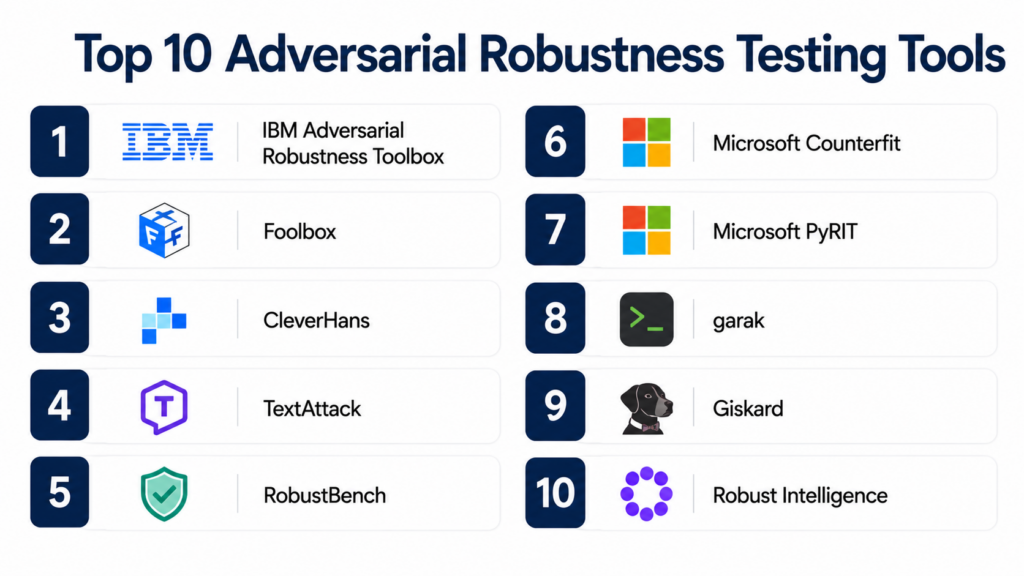
Introduction
Adversarial Robustness Testing Tools help organizations evaluate how AI and machine learning systems behave when they face malicious, unexpected, manipulated, or difficult inputs. In simple terms, these tools test whether a model can remain reliable when attackers try to fool it, extract information from it, poison its data, bypass its guardrails, or force unsafe outputs.
Adversarial robustness matters because AI systems are increasingly used in fraud detection, identity verification, cybersecurity, healthcare, finance, autonomous systems, customer support, document processing, and generative AI applications. If a model can be easily manipulated, the business may face security incidents, wrong decisions, privacy leaks, compliance failures, or unsafe automation. Strong robustness testing helps teams discover weaknesses before attackers or real-world edge cases expose them.
Real world use cases include adversarial image testing, model evasion testing, poisoning simulation, prompt injection testing, jailbreak testing, LLM red teaming, model extraction risk testing, privacy inference testing, robustness benchmarking, and AI security validation before production release.
Buyers should evaluate:
- Attack type coverage
- Support for ML, deep learning, NLP, and LLM systems
- Evasion, poisoning, extraction, and inference testing
- Prompt injection and jailbreak testing
- Benchmarking and reporting
- Defense and mitigation support
- CI/CD and MLOps integration
- Model framework compatibility
- Security, access control, and auditability
- Scalability for production AI testing
Best for: Adversarial Robustness Testing Tools are best for AI security teams, ML engineers, data scientists, model risk teams, red teams, MLOps teams, responsible AI teams, cybersecurity teams, financial services firms, healthcare AI teams, autonomous systems teams, and enterprises deploying high-impact AI systems.
Not ideal for: Very small AI prototypes or low-risk internal experiments may not need a full adversarial robustness testing platform. A few manual test cases, basic validation scripts, or simple prompt checks may be enough early on. However, when AI systems are customer-facing, security-sensitive, regulated, or business-critical, structured adversarial robustness testing becomes essential.
Key Trends in Adversarial Robustness Testing Tools
- LLM red teaming growth: Robustness testing now includes prompt injection, jailbreaks, unsafe completions, data leakage, tool misuse, and agentic workflow failures.
- Traditional ML security remains important: Evasion attacks, poisoning attacks, extraction attacks, and inference attacks still matter for vision, tabular, fraud, biometric, and classification models.
- AI security entering SDLC: Teams are adding adversarial tests into CI/CD pipelines, model release gates, pre-production reviews, and continuous monitoring workflows.
- Model and application testing convergence: Modern testing must evaluate both the base model and the full AI application, including retrievers, tools, agents, prompts, APIs, and policies.
- Automated red teaming: Tools increasingly generate attack prompts, perturbations, adversarial samples, and stress tests at scale.
- Benchmark-driven evaluation: Teams want repeatable robustness scores, baseline comparisons, regression testing, and evidence for risk reviews.
- Defense validation: Buyers want to test whether filters, guardrails, refusal logic, input validation, monitoring, and human escalation actually reduce risk.
- Privacy-focused adversarial testing: Membership inference, model inversion, and data extraction risks are gaining more attention in regulated environments.
- Open-source plus enterprise stacks: Many teams prototype with open-source libraries and later add enterprise security platforms for reporting, governance, and scale.
- Agentic AI risk testing: Robustness testing is expanding to tool-calling agents, multi-agent workflows, autonomous decisions, and chained reasoning systems.
How We Selected These Tools
The tools below were selected using a practical buyer-focused evaluation approach:
- Market recognition in adversarial robustness, AI red teaming, ML security, LLM security, and model validation.
- Feature completeness across attack generation, robustness evaluation, defense testing, reporting, and integration workflows.
- Attack coverage, including evasion, poisoning, extraction, inference, prompt injection, jailbreaks, hallucination stress tests, and unsafe behavior.
- Model compatibility, including support for TensorFlow, PyTorch, scikit-learn, NLP models, LLM APIs, and application-level AI systems.
- Developer experience, including Python SDKs, CLI tools, notebooks, benchmark suites, APIs, and documentation quality.
- Enterprise readiness, including reporting, collaboration, governance, access control, security review, and commercial support where applicable.
- CI/CD and MLOps fit, including integration with model pipelines, automated tests, registries, and release workflows.
- Benchmarking depth, including repeatable test suites, metrics, datasets, comparisons, and regression testing.
- Responsible AI alignment, including safety testing, fairness stress testing, privacy testing, and audit evidence support.
- Practical adoption fit, including ease of setup, learning curve, deployment flexibility, support, and long-term maintainability.
Top 10 Adversarial Robustness Testing Tools
1- IBM Adversarial Robustness Toolbox
Short description:
IBM Adversarial Robustness Toolbox is an open-source Python library for testing, defending, and evaluating machine learning models against adversarial threats. It supports attack and defense workflows across evasion, poisoning, extraction, and inference risks. The toolkit is especially useful for data scientists, ML researchers, and AI security teams working with traditional machine learning, deep learning, computer vision, NLP, and tabular models. It is one of the most comprehensive open-source starting points for technical adversarial robustness testing.
Key Features
- Evasion attack testing
- Poisoning attack simulation
- Model extraction and inference attack support
- Defense and mitigation methods
- Support for multiple ML frameworks
- Benchmarking and evaluation workflows
- Python-based research and engineering interface
Pros
- Comprehensive open-source ML security toolkit
- Strong coverage across several adversarial threat categories
- Useful for research, prototyping, and technical model audits
Cons
- Requires ML security expertise
- Not a full enterprise governance platform by itself
- Production reporting and workflow management may need complementary tools
Platforms / Deployment
Python-based toolkit.
Local, notebook, CI/CD, and self-managed workflows.
Supports common ML and deep learning environments depending on configuration.
Security & Compliance
Not publicly stated for enterprise compliance as a standalone open-source toolkit. Security depends on the environment where it is run and how datasets, models, and outputs are handled.
Integrations & Ecosystem
IBM Adversarial Robustness Toolbox integrates with common ML development and evaluation workflows. It is often used in notebooks, model validation pipelines, and AI security experiments.
- PyTorch workflows
- TensorFlow workflows
- scikit-learn workflows
- Jupyter notebooks
- MLOps pipelines
- Model validation scripts
Support & Community
The toolkit has open-source documentation, research community adoption, and ecosystem support. Enterprise support should be validated through relevant IBM or partner offerings if needed.
2- Foolbox
Short description:
Foolbox is an open-source Python toolbox for generating adversarial examples and benchmarking robustness of machine learning models. It is widely used in research and technical evaluations for image classifiers and deep learning models. Foolbox helps teams test how models respond to perturbed inputs and compare robustness across attacks. It is especially useful for researchers, ML engineers, and teams that need focused adversarial example generation and robustness benchmarking.
Key Features
- Adversarial example generation
- Multiple attack algorithms
- Robustness benchmarking
- Support for deep learning model testing
- Python-based interface
- Compatibility with popular model frameworks
- Useful for image model robustness testing
Pros
- Strong for adversarial example testing
- Research-friendly and lightweight
- Useful for benchmarking model robustness
Cons
- More focused than broad enterprise AI security platforms
- Requires technical understanding of adversarial ML
- Less suitable for LLM prompt security testing
Platforms / Deployment
Python-based toolkit.
Local, notebook, and self-managed evaluation workflows.
Security & Compliance
Not publicly stated for enterprise compliance. Security depends on local deployment, data handling, and model testing environment.
Integrations & Ecosystem
Foolbox integrates into ML research, model testing, and robustness benchmarking workflows. It is commonly used with deep learning frameworks and experimental notebooks.
- PyTorch workflows
- TensorFlow workflows
- JAX-style workflows depending on setup
- Research notebooks
- Image classification testing
- Robustness benchmark pipelines
Support & Community
Foolbox has open-source documentation, academic usage, and community support. Enterprise support is generally not the primary model.
3- CleverHans
Short description:
CleverHans is an open-source library created for benchmarking machine learning systems against adversarial examples. It has been widely used in adversarial machine learning research and education. CleverHans helps teams generate attacks, evaluate defenses, and understand model vulnerability to manipulated inputs. It is especially useful for researchers, students, and technical teams exploring adversarial ML concepts and model robustness.
Key Features
- Adversarial example generation
- Attack and defense experimentation
- Benchmarking workflows
- Research-oriented implementation
- Deep learning model testing support
- Educational examples and tutorials
- Useful for adversarial ML learning
Pros
- Well-known in adversarial ML research
- Useful for learning and experimentation
- Good fit for benchmark-style model testing
Cons
- May be less production-oriented than newer platforms
- Requires technical and research knowledge
- Not designed as a complete enterprise AI security solution
Platforms / Deployment
Python-based toolkit.
Local and notebook-based workflows.
Security & Compliance
Not publicly stated for enterprise compliance. Security depends on the testing environment and data handling practices.
Integrations & Ecosystem
CleverHans fits research, education, and adversarial ML experimentation workflows. It can be used alongside model training and validation scripts.
- Deep learning workflows
- Research notebooks
- Academic benchmarking
- Adversarial example testing
- Model defense experiments
- ML education workflows
Support & Community
CleverHans has open-source documentation and historical research community adoption. Support is primarily community-driven.
4- TextAttack
Short description:
TextAttack is an open-source Python framework for adversarial attacks, data augmentation, and adversarial training in natural language processing. It helps teams test NLP models against text perturbations, word substitutions, paraphrases, and attack recipes. TextAttack is especially useful for teams working with text classifiers, sentiment models, toxicity detectors, intent classifiers, and NLP pipelines. It is a strong choice for testing robustness of language-focused machine learning systems.
Key Features
- NLP adversarial attack recipes
- Text perturbation and transformation methods
- Adversarial training support
- Data augmentation workflows
- Model evaluation for NLP systems
- Python-based framework
- Support for common NLP model workflows
Pros
- Strong focus on NLP robustness testing
- Useful for text model evaluation and augmentation
- Good open-source option for adversarial NLP research
Cons
- Less focused on LLM application red teaming than dedicated LLM tools
- Requires NLP and model evaluation expertise
- Production governance and reporting need complementary tools
Platforms / Deployment
Python-based toolkit.
Local, notebook, and self-managed workflows.
Security & Compliance
Not publicly stated for enterprise compliance. Security depends on local execution, test data, and model environment.
Integrations & Ecosystem
TextAttack integrates with NLP model development, research workflows, and adversarial text testing pipelines.
- Hugging Face workflows
- NLP classifiers
- Research notebooks
- Text augmentation pipelines
- Model evaluation scripts
- Adversarial training workflows
Support & Community
TextAttack has open-source documentation, community support, and adoption among NLP researchers and practitioners.
5- RobustBench
Short description:
RobustBench is a benchmark platform for evaluating adversarial robustness, especially for image classification models. It provides standardized benchmarks, leaderboards, model evaluations, and references for comparing robustness under defined threat models. RobustBench is especially useful for researchers and teams that want to compare robustness performance against known baselines. It is not a full testing platform for every AI system, but it is valuable for benchmark-driven robustness evaluation.
Key Features
- Adversarial robustness benchmarks
- Standardized evaluation protocols
- Model leaderboards
- Image classification robustness focus
- Reference models and comparisons
- Research-oriented evaluation workflows
- Useful for reproducible benchmarking
Pros
- Strong benchmark credibility for robustness research
- Useful for comparing model robustness
- Helps avoid inconsistent evaluation methods
Cons
- Narrower focus than broad AI security tools
- Not designed for general enterprise testing workflows
- Less suitable for LLM and application-level red teaming
Platforms / Deployment
Python and benchmark-based workflows.
Local and research-oriented evaluation patterns.
Security & Compliance
Not publicly stated for enterprise compliance. Security depends on local execution and data management.
Integrations & Ecosystem
RobustBench fits adversarial robustness research and benchmark evaluation workflows. It is often used alongside model training and robustness testing libraries.
- PyTorch workflows
- Image classification benchmarks
- Research notebooks
- Robustness evaluation scripts
- Academic benchmarking
- Model comparison workflows
Support & Community
RobustBench has research community adoption and documentation. Support is primarily community and research ecosystem-based.
6- Microsoft Counterfit
Short description:
Microsoft Counterfit is an open-source automation tool for security testing of AI systems. It helps security professionals and ML teams run adversarial attacks against AI models using a command-line workflow. Counterfit is especially useful for teams that want a penetration-testing-style interface for machine learning models. It fits AI red teams, security testers, and organizations exploring how traditional security testing practices can be applied to AI systems.
Key Features
- Command-line AI security testing
- Attack automation for ML models
- Penetration-testing-style workflow
- Integration with adversarial attack libraries
- Model testing and evaluation support
- Useful for red team experimentation
- Open-source security testing orientation
Pros
- Familiar workflow for security testers
- Useful bridge between cybersecurity and ML testing
- Open-source and practical for experimentation
Cons
- May require customization for specific models
- Development maturity should be validated for current needs
- Not a full enterprise AI risk platform by itself
Platforms / Deployment
Command-line and Python-based workflows.
Local and self-managed deployment.
Security & Compliance
Not publicly stated for enterprise compliance. Security depends on local deployment and how models or test data are handled.
Integrations & Ecosystem
Counterfit integrates with AI security testing workflows and adversarial attack libraries. It is useful for teams building AI red team practices.
- Python ML models
- Adversarial attack libraries
- Security testing workflows
- Red team exercises
- Local model validation
- CI/CD experiments
Support & Community
Counterfit has open-source documentation and community resources. Enterprise support should be validated through broader Microsoft security or AI programs if required.
7- Microsoft PyRIT
Short description:
Microsoft PyRIT is an open-source Python framework for identifying risks in generative AI systems through red teaming and automated adversarial testing workflows. It helps teams create attack prompts, run scenarios, score outputs, and organize AI red team testing. PyRIT is especially useful for teams testing LLM applications, chatbots, copilots, and generative AI systems. It fits AI security teams, responsible AI teams, and developers who need structured generative AI risk testing.
Key Features
- Generative AI red teaming workflows
- Prompt attack orchestration
- Scenario-based risk testing
- Automated scoring support
- Python-based extensibility
- Support for LLM application testing
- Useful for responsible AI and security validation
Pros
- Strong fit for generative AI risk testing
- Open-source and extensible
- Useful for structured LLM red team workflows
Cons
- Focused on GenAI rather than traditional ML robustness
- Requires prompt security and AI risk expertise
- Enterprise dashboards and governance may need additional tools
Platforms / Deployment
Python-based framework.
Local, notebook, CI/CD, and self-managed workflows.
Security & Compliance
Not publicly stated for enterprise compliance as a standalone toolkit. Security depends on local execution, model provider use, and test data handling.
Integrations & Ecosystem
PyRIT integrates with LLM applications, model APIs, prompt testing workflows, and AI red team processes.
- LLM provider APIs
- Chatbot testing workflows
- Prompt attack scenarios
- CI/CD testing patterns
- Responsible AI reviews
- Security validation workflows
Support & Community
PyRIT has open-source documentation and Microsoft ecosystem visibility. Enterprise support should be validated based on broader Microsoft agreements and use case.
8- garak
Short description:
garak is an open-source LLM vulnerability scanner designed to probe generative AI models for weaknesses such as hallucination, prompt injection, data leakage, toxicity, jailbreak susceptibility, and other risky behaviors. It is especially useful for teams that want automated LLM probing and model behavior testing. garak fits AI security teams, red teams, developers, and researchers building or evaluating LLM-powered applications. It is a practical option for early LLM robustness and safety testing.
Key Features
- LLM vulnerability scanning
- Prompt injection and jailbreak probes
- Data leakage and hallucination tests
- Multiple probe and detector patterns
- CLI-based testing workflow
- Support for several model backends depending on setup
- Useful for automated GenAI security checks
Pros
- Strong open-source LLM scanning focus
- Practical for automated red team probes
- Good fit for early AI security testing
Cons
- Requires careful interpretation of findings
- Enterprise reporting and workflow management may need complementary tools
- Not intended for traditional image or tabular adversarial ML testing
Platforms / Deployment
Command-line and Python-based workflow.
Local and self-managed deployment.
Security & Compliance
Not publicly stated for enterprise compliance. Security depends on deployment environment, prompts, outputs, and model provider configuration.
Integrations & Ecosystem
garak integrates with LLM testing workflows, security validation pipelines, and model evaluation processes.
- LLM APIs
- Local model testing
- Security testing workflows
- CI/CD experiments
- Red team exercises
- Prompt vulnerability checks
Support & Community
garak has open-source documentation and community support. Enterprise support depends on internal expertise or external security partners.
9- Giskard
Short description:
Giskard is an AI testing platform and open-source framework that helps teams test machine learning and LLM systems for performance issues, bias, robustness, hallucinations, and security weaknesses. It supports model testing, automated scans, test suite creation, and reporting workflows. Giskard is especially useful for teams that want broader AI quality testing rather than only adversarial perturbation attacks. It fits data science teams, AI product teams, responsible AI teams, and organizations building production AI applications.
Key Features
- AI model testing and scanning
- Robustness and bias checks
- LLM vulnerability and hallucination testing
- Test suite generation
- Reporting and documentation workflows
- Python-based integration
- Support for ML and LLM applications
Pros
- Broader AI quality and risk testing coverage
- Useful for both ML and LLM testing workflows
- Good fit for responsible AI and QA teams
Cons
- Deep adversarial ML research may require specialized libraries
- Enterprise features should be validated by edition
- Requires thoughtful test design for meaningful results
Platforms / Deployment
Python-based framework and platform options.
Self-managed and cloud options may vary.
Security & Compliance
Supports testing workflows and platform-level controls depending on edition. Specific security and compliance details should be validated directly.
Integrations & Ecosystem
Giskard integrates with ML models, LLM applications, notebooks, CI/CD workflows, and AI QA processes.
- Python ML workflows
- LLM applications
- CI/CD pipelines
- Model validation workflows
- Responsible AI reviews
- AI quality testing
Support & Community
Giskard provides documentation, open-source resources, and commercial support options depending on selected product and deployment.
10- Robust Intelligence
Short description:
Robust Intelligence is an enterprise AI security and validation platform focused on adversarial testing, model robustness, AI red teaming, and protection against AI-specific threats. It helps organizations test models and AI applications for vulnerabilities, unsafe behavior, and robustness failures before and after deployment. Robust Intelligence is especially useful for enterprises that need production-grade AI security validation, risk testing, and governance-ready reporting. It fits security teams, model validation teams, financial services, healthcare, and high-impact AI environments.
Key Features
- AI adversarial testing
- Model validation and robustness testing
- Generative AI risk testing
- AI red teaming workflows
- Production protection and monitoring support depending on setup
- Reporting for risk and security teams
- Enterprise AI security workflows
Pros
- Strong enterprise AI security orientation
- Useful for high-risk and production AI environments
- Good fit for security, risk, and model validation teams
Cons
- Commercial platform cost should be evaluated carefully
- May be more than small teams need
- Technical integration scope should be validated during pilot
Platforms / Deployment
Web-based enterprise platform and security testing workflows.
Cloud and enterprise deployment options may vary.
Security & Compliance
Supports enterprise security testing workflows, access controls, and risk documentation. Specific certifications and compliance coverage should be validated directly during procurement.
Integrations & Ecosystem
Robust Intelligence integrates with AI development, model validation, MLOps, security, and production monitoring workflows.
- Model development pipelines
- LLM applications
- MLOps systems
- AI security workflows
- Model validation processes
- Enterprise risk processes
Support & Community
Robust Intelligence provides enterprise support, documentation, implementation guidance, and technical assistance depending on contract and deployment scope.
Comparison Table
| Tool Name | Best For | Platform Supported | Deployment | Standout Feature | Public Rating |
|---|---|---|---|---|---|
| IBM Adversarial Robustness Toolbox | Broad adversarial ML testing | Python, ML frameworks | Local, self-managed | Evasion, poisoning, extraction, and inference testing | N/A |
| Foolbox | Adversarial examples and robustness benchmarks | Python, ML frameworks | Local, self-managed | Lightweight adversarial example generation | N/A |
| CleverHans | Research and education in adversarial ML | Python, deep learning workflows | Local, self-managed | Classic adversarial ML benchmarking library | N/A |
| TextAttack | NLP adversarial robustness | Python, NLP workflows | Local, self-managed | Text perturbation and NLP attack recipes | N/A |
| RobustBench | Robustness benchmarking | Python, benchmark workflows | Local, self-managed | Standardized adversarial robustness benchmarks | N/A |
| Microsoft Counterfit | AI security testing automation | CLI, Python | Local, self-managed | Penetration-testing-style ML attack automation | N/A |
| Microsoft PyRIT | Generative AI red teaming | Python, LLM APIs | Local, self-managed | Structured LLM risk and prompt attack testing | N/A |
| garak | LLM vulnerability scanning | CLI, Python, LLM APIs | Local, self-managed | Automated probes for LLM weaknesses | N/A |
| Giskard | AI quality and robustness testing | Python, platform options | Self-managed, cloud options vary | ML and LLM test suite generation | N/A |
| Robust Intelligence | Enterprise AI security validation | Web, AI security workflows | Cloud, enterprise options vary | Enterprise adversarial testing and AI risk validation | N/A |
Evaluation & Scoring of Adversarial Robustness Testing Tools
| Tool Name | Core 25% | Ease 15% | Integrations 15% | Security 10% | Performance 10% | Support 10% | Value 15% | Weighted Total 0–10 |
|---|---|---|---|---|---|---|---|---|
| IBM Adversarial Robustness Toolbox | 9.3 | 7.2 | 8.5 | 7.5 | 8.6 | 8.2 | 9.2 | 8.45 |
| Foolbox | 8.4 | 8.0 | 8.0 | 7.0 | 8.4 | 7.6 | 9.0 | 8.12 |
| CleverHans | 7.8 | 7.2 | 7.6 | 7.0 | 7.8 | 7.4 | 8.6 | 7.65 |
| TextAttack | 8.5 | 8.0 | 8.2 | 7.2 | 8.2 | 7.8 | 9.0 | 8.17 |
| RobustBench | 8.0 | 7.6 | 7.8 | 7.0 | 8.4 | 7.5 | 8.8 | 7.89 |
| Microsoft Counterfit | 7.8 | 7.7 | 7.8 | 7.2 | 7.8 | 7.6 | 8.8 | 7.82 |
| Microsoft PyRIT | 8.4 | 8.0 | 8.3 | 7.4 | 8.2 | 7.8 | 9.0 | 8.17 |
| garak | 8.3 | 8.2 | 8.0 | 7.2 | 8.0 | 7.6 | 9.0 | 8.09 |
| Giskard | 8.4 | 8.3 | 8.5 | 8.0 | 8.2 | 8.1 | 8.5 | 8.32 |
| Robust Intelligence | 8.8 | 8.0 | 8.5 | 9.0 | 8.7 | 8.7 | 7.6 | 8.50 |
The scores are comparative and should be used as a practical evaluation guide, not as fixed market ratings. IBM Adversarial Robustness Toolbox is the strongest broad open-source option for technical ML security testing. Foolbox, CleverHans, RobustBench, and TextAttack are strong for research, benchmarking, and model-specific adversarial evaluation. Microsoft PyRIT and garak are especially useful for LLM red teaming and prompt robustness. Giskard is useful for broader AI testing and reporting, while Robust Intelligence is stronger for enterprise AI security validation and governance-ready workflows.
Which Adversarial Robustness Testing Tool Is Right for You?
Solo / Freelancer
Solo users should start with open-source tools that match the model type. For traditional ML and deep learning, IBM Adversarial Robustness Toolbox, Foolbox, CleverHans, or RobustBench can be practical. For NLP models, TextAttack is useful. For LLM applications, garak, PyRIT, or Giskard can be a better starting point.
Freelancers working with client AI systems should create simple robustness reports. These should include tested attack types, model behavior, failed cases, mitigation recommendations, and known limitations.
SMB
SMBs should prioritize practical, low-cost, and easy-to-run testing. IBM Adversarial Robustness Toolbox, TextAttack, garak, PyRIT, prompt-style test suites, and Giskard can help teams identify obvious weaknesses before launch.
If the SMB is deploying customer-facing AI, adversarial testing should be added to release reviews. The goal is not perfect robustness but reduced risk through repeatable testing, clear documentation, and mitigation tracking.
Mid-Market
Mid-market organizations often need a mix of open-source testing, CI/CD checks, model validation, and AI governance reporting. IBM Adversarial Robustness Toolbox, Giskard, PyRIT, garak, TextAttack, and Robust Intelligence can all be relevant depending on AI risk level.
These organizations should define separate test plans for traditional ML, NLP systems, LLM apps, and AI agents. Different systems face different attack surfaces, so one tool rarely covers everything.
Enterprise
Enterprises should prioritize repeatability, auditability, security controls, model inventory integration, risk reporting, red team workflows, and production validation. Robust Intelligence, IBM ecosystem tools, Giskard, PyRIT, garak, and technical libraries like ART can form a strong stack.
Large organizations should involve AI security, model risk, legal, compliance, data science, and product teams. Adversarial testing should become part of model approval, deployment review, incident response, and continuous monitoring.
Budget vs Premium
Budget-focused teams can start with open-source tools such as IBM Adversarial Robustness Toolbox, Foolbox, CleverHans, TextAttack, RobustBench, PyRIT, garak, and Giskard. These tools are powerful but require technical expertise and internal process ownership.
Premium platforms are better when organizations need enterprise support, dashboards, reporting, governance, integration, and repeatable security workflows across many AI systems. The investment is easier to justify when AI is high-impact, regulated, or security-sensitive.
Feature Depth vs Ease of Use
Feature-rich tools provide broad attack libraries, multiple threat models, benchmark support, defense evaluation, LLM attack scenarios, and reporting. These are valuable for mature AI teams but require expertise.
Ease-of-use tools are better for early testing and application teams. Buyers should choose tools that match their immediate risk while planning for stronger governance as AI adoption grows.
Integrations & Scalability
Adversarial Robustness Testing Tools should integrate with notebooks, model registries, CI/CD pipelines, MLOps systems, LLM application frameworks, logging platforms, and governance workflows. Integration is important because robustness testing should happen repeatedly, not once.
Scalability matters when organizations manage many models, prompts, agents, datasets, and deployment environments. Buyers should test automation, reporting, test repeatability, evaluator cost, and workflow ownership before broad rollout.
Security & Compliance Needs
Adversarial robustness testing may involve sensitive models, proprietary prompts, training data, customer examples, attack payloads, and security findings. This information should be protected.
Buyers should evaluate SSO, MFA, RBAC, encryption, audit logs, workspace controls, redaction, secure test storage, and vendor data handling. Regulated organizations should involve security, legal, and compliance teams before sharing production models or data with external platforms.
Frequently Asked Questions
1. What is an Adversarial Robustness Testing Tool?
An Adversarial Robustness Testing Tool helps teams test how AI and machine learning systems behave under malicious, manipulated, or unusual inputs. It can generate adversarial examples, attack prompts, perturbed text, poisoned data scenarios, or privacy attack simulations. The goal is to find weaknesses before attackers or real-world edge cases expose them. These tools are used for traditional ML models, deep learning systems, NLP models, and generative AI applications. A good tool helps improve model resilience and security confidence.
2. How is adversarial robustness testing different from normal model testing?
Normal model testing usually checks accuracy, precision, recall, latency, and performance on expected test data. Adversarial robustness testing checks how the model behaves when inputs are intentionally crafted to fool, bypass, or manipulate it. A model may perform well on normal test data but fail under adversarial perturbations or prompt attacks. Robustness testing focuses on stress, abuse, and threat scenarios. It is closer to security testing than standard model validation.
3. What pricing models do Adversarial Robustness Testing Tools use?
Pricing depends on the tool type. Open-source tools such as ART, Foolbox, CleverHans, TextAttack, RobustBench, PyRIT, and garak may have no license cost but require technical expertise and internal infrastructure. Commercial platforms may charge by users, models, applications, tests, usage volume, deployment type, or enterprise contract. LLM red teaming can also create model API costs. Buyers should include engineering time, compute cost, reporting, and governance effort in total cost. The best value depends on AI risk and scale.
4. How long does implementation usually take?
Implementation time depends on model type, test scope, data access, attack library, and reporting requirements. A technical team can run basic adversarial tests quickly on a model in a notebook. Production-grade testing takes longer because teams must define threat models, run repeatable tests, document findings, validate mitigations, and connect results to release workflows. LLM applications may also require prompt attack libraries, safety criteria, and human review. A phased approach starting with high-risk models is usually best.
5. What are common mistakes when choosing adversarial testing tools?
A common mistake is choosing a tool that does not match the AI system. Image classifiers, tabular models, NLP models, RAG apps, and LLM agents need different tests. Another mistake is running attacks without defining realistic threat models. Teams also fail when they treat adversarial testing as a one-time research task instead of a repeatable security practice. The best process combines automated tests, manual red teaming, model-specific evaluation, and mitigation tracking.
6. Are Adversarial Robustness Testing Tools secure?
Adversarial testing tools can be secure, but the testing process must be controlled. These tools may use sensitive models, training data, prompts, outputs, vulnerabilities, and attack payloads. Open-source tools depend on the local environment and data handling practices. Enterprise tools should be reviewed for access control, encryption, audit logs, data retention, and vendor handling policies. Security teams should treat robustness reports as sensitive because they may reveal exploitable weaknesses.
7. Can adversarial robustness tools test generative AI and LLMs?
Yes, but the right tool matters. Traditional adversarial ML tools focus on attacks such as evasion, poisoning, extraction, and inference for structured, vision, or NLP models. LLM-focused tools such as PyRIT, garak, Giskard, and enterprise AI security platforms focus more on prompt injection, jailbreaks, unsafe outputs, data leakage, hallucination, and tool misuse. Generative AI testing should evaluate the full application, not only the model. This includes prompts, retrieval, tools, agents, guardrails, and policies.
8. Do adversarial robustness tools fix model weaknesses automatically?
No tool can automatically fix all robustness weaknesses. Some tools provide defense methods, mitigation suggestions, adversarial training support, filtering approaches, or reporting. However, fixing issues may require better training data, adversarial training, prompt hardening, input validation, guardrails, model changes, access controls, monitoring, or human review. Robustness is an ongoing process, not a one-time patch. Teams should retest after every mitigation to confirm improvement.
9. When should a business adopt adversarial robustness testing?
A business should adopt adversarial robustness testing when AI systems are customer-facing, security-sensitive, regulated, high-impact, or connected to important business decisions. It is especially important for fraud detection, identity verification, cybersecurity, healthcare, financial services, autonomous systems, hiring, and generative AI assistants. Testing should begin before deployment and continue after major changes. Warning signs include no AI threat model, no prompt attack testing, no model privacy testing, and no documented security review. Starting early reduces risk later.
10. What alternatives exist if we do not need a full adversarial testing platform?
Alternatives include manual red team prompts, simple perturbation scripts, unit tests, model validation notebooks, prompt regression tests, security checklists, and human review sessions. These can work for early prototypes or low-risk systems. However, they may not provide broad attack coverage, repeatability, reporting, CI/CD integration, or enterprise audit evidence. A dedicated tool or platform is better when AI risk, scale, or regulatory exposure increases. The right alternative depends on model type, business impact, and available expertise.
Conclusion
Adversarial Robustness Testing Tools help organizations test whether AI systems can withstand malicious, unexpected, or manipulated inputs before those weaknesses create real-world harm. The best tool depends on model type, risk level, deployment stage, security maturity, and whether the organization is testing traditional ML, NLP, computer vision, LLM applications, or agentic systems. IBM Adversarial Robustness Toolbox is a strong broad open-source option for technical ML security testing, while Foolbox, CleverHans, and RobustBench are valuable for adversarial example generation and robustness benchmarking. TextAttack is strong for NLP robustness, while Microsoft PyRIT and garak are practical for generative AI and LLM red teaming. Giskard is useful for broader AI quality and robustness testing, and Robust Intelligence is better suited for enterprise-grade AI security validation and reporting. There is no single universal winner because adversarial robustness requires the right threat model, realistic test cases, mitigation tracking, and continuous retesting.

Integrating specialized machine learning defense evaluation infrastructure software optimizes enterprise artificial intelligence security logistics, ensuring accelerated model vulnerability identification tracking and seamless algorithmic exploitation mitigation workflows.
Deploying specialized machine learning security vulnerability assessment infrastructure software optimizes corporate artificial intelligence defense logistics, ensuring accelerated predictive model attack resilience evaluation tracking and seamless algorithmic threat mitigation workflows.