MOTOSHARE 🚗🏍️
Rent Bikes & Cars Directly from Owners
Motoshare connects vehicle owners with people who need bikes and cars on rent. Owners earn from idle vehicles, and renters get flexible ride options.
Visit Motoshare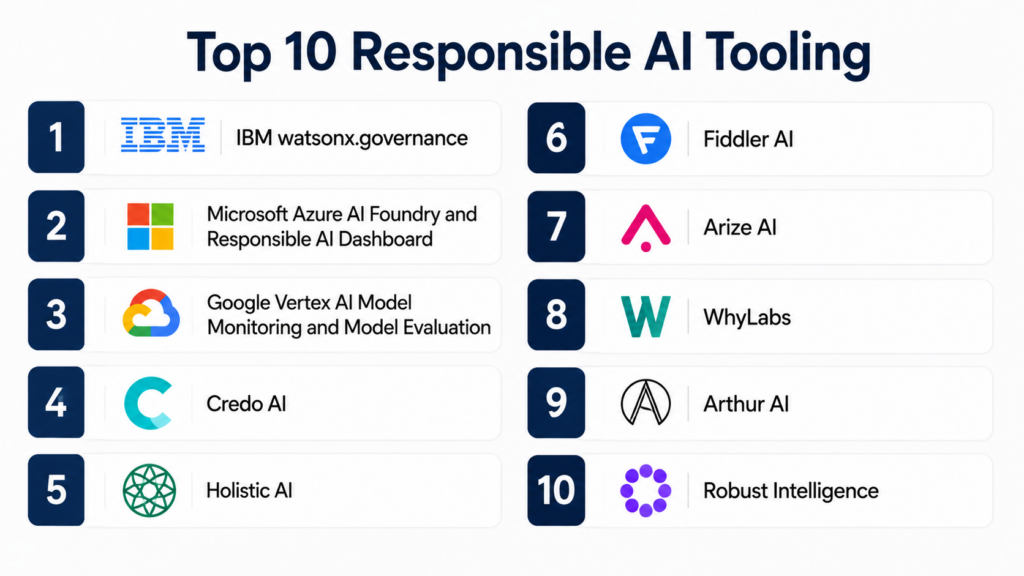
Introduction
Responsible AI Tooling helps organizations design, evaluate, monitor, govern, and improve AI systems so they are safer, fairer, more transparent, more reliable, and better aligned with business, legal, and ethical expectations. In simple terms, these tools help teams answer critical questions: Is the AI system fair? Is it explainable? Is it secure? Is it compliant? Is it drifting? Is it producing harmful or unreliable outputs?Responsible AI matters because AI is now used in customer service, hiring, lending, healthcare, software development, fraud detection, marketing, operations, and enterprise decision-making. Poorly governed AI can create bias, privacy risks, hallucinations, compliance failures, reputational damage, and unsafe automation. Strong responsible AI tooling helps teams document model purpose, test risk, monitor behavior, explain decisions, detect drift, evaluate outputs, and create audit-ready governance workflows.
Real world use cases include AI governance, model risk management, bias detection, explainability, LLM evaluation, red teaming, compliance documentation, AI inventory management, model monitoring, prompt safety testing, data drift detection, and human review workflows.
Buyers should evaluate:
- AI governance and policy management
- Model inventory and lifecycle tracking
- Bias, fairness, and explainability testing
- LLM safety and hallucination evaluation
- Risk assessment and compliance workflows
- Model monitoring and drift detection
- Human review and approval workflows
- Audit logs and documentation
- Integration with MLOps and AI platforms
- Security, privacy, and access controls
Best for: Responsible AI Tooling is best for AI governance teams, risk teams, compliance leaders, data science teams, ML engineers, MLOps teams, legal teams, product teams, security teams, AI platform teams, and enterprises deploying machine learning or generative AI systems at scale.
Not ideal for: Very small AI experiments or internal prototypes may not need a full responsible AI governance platform. A basic checklist, manual review, model card, test notebook, or simple monitoring workflow may be enough at the earliest stage. However, when AI affects customers, employees, regulated decisions, financial outcomes, safety, or brand trust, responsible AI tooling becomes much more important.
Key Trends in Responsible AI Tooling
- AI governance becoming operational: Organizations are moving from policy documents to active governance platforms that track AI systems, risks, owners, controls, and approvals.
- Generative AI risk management: LLM applications require new controls for hallucinations, prompt injection, toxicity, privacy leakage, unsafe responses, and grounding quality.
- Regulatory readiness: Enterprises need better documentation, risk classification, audit trails, and evidence workflows for emerging AI regulations and internal controls.
- AI inventory and model registry expansion: Teams are tracking not only ML models but also prompts, agents, datasets, vendors, foundation models, and AI-powered workflows.
- Automated evaluations: Responsible AI tooling increasingly includes bias tests, safety checks, robustness tests, red-team scenarios, and LLM-as-judge evaluations.
- Continuous monitoring: AI risk is no longer checked only before launch; teams monitor drift, performance, fairness, usage, prompts, outputs, and incidents in production.
- Explainability for business users: Explainability tools are becoming more accessible to risk, legal, product, and compliance stakeholders, not only data scientists.
- Human-in-the-loop governance: High-risk AI workflows increasingly require human review, approvals, escalation paths, and documented accountability.
- Third-party AI oversight: Enterprises need to govern external AI tools, APIs, foundation models, vendor AI features, and shadow AI usage.
- Responsible AI integrated with MLOps: Governance, monitoring, evaluation, and documentation are becoming part of model development, deployment, and CI/CD workflows.
How We Selected These Tools
The tools below were selected using a practical buyer-focused evaluation approach:
- Market recognition in responsible AI, AI governance, model risk management, ML monitoring, explainability, and LLM safety.
- Feature completeness across governance, evaluation, monitoring, documentation, explainability, risk assessment, and compliance support.
- Responsible AI coverage, including fairness, transparency, accountability, privacy, safety, robustness, and human oversight.
- Generative AI readiness, including LLM evaluation, prompt risk, hallucination checks, safety testing, red teaming, and AI application monitoring.
- Enterprise governance fit, including AI inventory, approval workflows, risk classification, policy mapping, and audit evidence.
- MLOps integration, including model registries, pipelines, deployment tools, observability stacks, and cloud AI platforms.
- Security and access control, including RBAC, SSO, audit logs, encryption, data handling, and workspace governance.
- Monitoring and observability, including drift, bias, performance, model health, data quality, and production behavior.
- Usability for multiple stakeholders, including data scientists, risk teams, compliance leaders, legal teams, and product owners.
- Practical adoption fit, including setup effort, documentation, support, deployment options, and long-term maintainability.
Top 10 Responsible AI Tooling
1- IBM watsonx.governance
Short description:
IBM watsonx.governance is an AI governance platform designed to help organizations manage, monitor, document, and govern AI systems across their lifecycle. It supports both traditional machine learning and generative AI governance use cases. The platform is especially useful for enterprises that need risk documentation, model factsheets, compliance workflows, monitoring, and governance across multiple AI vendors and environments. It is a strong fit for regulated industries and large organizations that need structured AI oversight.
Key Features
- AI governance and lifecycle management
- Model inventory and documentation
- Risk and compliance workflows
- Monitoring for model performance and drift
- Generative AI governance support
- Model factsheets and audit evidence
- Integration with broader IBM AI and data ecosystem
Pros
- Strong enterprise AI governance focus
- Useful for regulated and audit-heavy environments
- Supports governance across traditional ML and generative AI
Cons
- Best value depends on enterprise governance maturity
- Implementation may require cross-functional process design
- Smaller teams may find it too broad or advanced
Platforms / Deployment
Web-based enterprise platform.
Cloud and hybrid deployment options may vary.
Security & Compliance
Supports enterprise access controls, audit-friendly documentation, governance workflows, and administrative controls. Specific certifications and compliance coverage should be validated during procurement.
Integrations & Ecosystem
IBM watsonx.governance integrates with AI platforms, model lifecycle workflows, data governance systems, and enterprise risk processes. It is useful when governance must span multiple AI initiatives.
- IBM watsonx ecosystem
- Model registries
- AI development workflows
- Risk and compliance systems
- Monitoring workflows
- Enterprise governance processes
Support & Community
IBM provides enterprise support, documentation, consulting, training, partner services, and implementation assistance. Support depth depends on contract and deployment scope.
2- Microsoft Azure AI Foundry and Responsible AI Dashboard
Short description:
Microsoft Azure AI Foundry and Azure Machine Learning responsible AI capabilities help teams build, evaluate, monitor, and govern AI applications inside the Microsoft ecosystem. Microsoft’s responsible AI tooling includes fairness, interpretability, error analysis, model assessment, content safety, prompt risk management, and AI development workflows. It is especially useful for organizations already using Azure, Microsoft security, Microsoft identity, and enterprise cloud services. It fits teams building both ML models and generative AI applications on Azure.
Key Features
- Responsible AI dashboard capabilities
- Model interpretability and error analysis
- Fairness and model assessment workflows
- Azure AI content safety tools
- Prompt and generative AI evaluation support
- Integration with Azure Machine Learning
- Security and identity integration through Microsoft ecosystem
Pros
- Strong fit for Microsoft and Azure customers
- Good responsible AI and safety tooling across ML and GenAI
- Useful for teams needing cloud-native AI governance
Cons
- Best value depends on Azure adoption
- Some governance needs may require complementary enterprise tools
- Configuration can require Azure and AI platform expertise
Platforms / Deployment
Web-based Azure platform.
Cloud deployment.
Hybrid patterns may depend on Azure architecture.
Security & Compliance
Uses Microsoft identity, RBAC, encryption, audit logs, policy controls, and Azure security administration. Specific compliance coverage depends on licensing, region, and configuration.
Integrations & Ecosystem
Microsoft responsible AI tooling integrates with Azure AI, Azure Machine Learning, Microsoft security services, data platforms, and enterprise development workflows.
- Azure Machine Learning
- Azure AI Foundry
- Azure AI Content Safety
- Microsoft Entra ID
- Microsoft Defender ecosystem
- Azure monitoring and data services
Support & Community
Microsoft provides documentation, support plans, partner services, enterprise assistance, training, and a large developer community. Support depth depends on Azure support agreement.
3- Google Vertex AI Model Monitoring and Model Evaluation
Short description:
Google Vertex AI provides model monitoring, model evaluation, explainability, and ML lifecycle capabilities for teams building and deploying AI on Google Cloud. It helps teams track model performance, monitor drift, evaluate model outputs, and manage AI workflows within the broader Vertex AI environment. Google’s tooling is especially useful for teams building cloud-native AI, ML pipelines, and generative AI applications on Google Cloud. It fits organizations that need managed AI infrastructure with monitoring and evaluation capabilities.
Key Features
- Model monitoring and drift detection
- Model evaluation workflows
- Explainability support
- ML pipeline and model registry integration
- Generative AI evaluation capabilities
- Integration with Google Cloud data services
- Cloud-native AI lifecycle management
Pros
- Strong fit for Google Cloud AI teams
- Useful managed AI lifecycle and monitoring capabilities
- Good integration with data and ML services
Cons
- Best suited for Google Cloud environments
- Full governance may require complementary tools
- Enterprise policy mapping should be validated carefully
Platforms / Deployment
Web-based Google Cloud platform.
Cloud deployment.
Security & Compliance
Uses Google Cloud IAM, encryption, logging, monitoring, and cloud security controls. Specific compliance coverage depends on region, service configuration, and contract.
Integrations & Ecosystem
Vertex AI integrates with Google Cloud data, analytics, ML, storage, monitoring, and generative AI workflows.
- Vertex AI pipelines
- BigQuery
- Cloud Storage
- Model registry workflows
- Google Cloud monitoring
- Generative AI services
Support & Community
Google Cloud provides documentation, support plans, partner services, training resources, and developer community support. Support depth depends on cloud support agreement.
4- Credo AI
Short description:
Credo AI is an AI governance and responsible AI platform focused on helping organizations manage AI risk, policy, compliance, and oversight across AI systems. It supports AI use case inventory, risk assessments, policy controls, documentation, and governance workflows. Credo AI is especially useful for enterprises that need cross-functional collaboration between AI teams, legal, compliance, risk, and business stakeholders. It fits organizations building responsible AI programs and preparing for AI regulatory requirements.
Key Features
- AI governance workflows
- AI use case and system inventory
- Risk assessment and control mapping
- Policy management and documentation
- Compliance support workflows
- Cross-functional review and approvals
- Responsible AI program management
Pros
- Strong governance and policy orientation
- Useful for enterprise responsible AI program operations
- Good fit for legal, compliance, and risk collaboration
Cons
- Technical model monitoring may require integrations
- Best value depends on process adoption across teams
- Smaller AI teams may not need full governance workflow depth
Platforms / Deployment
Web-based platform.
Cloud deployment.
Enterprise options should be validated directly.
Security & Compliance
Supports governance controls, access management, documentation workflows, and audit-ready responsible AI oversight. Specific certifications and compliance documentation should be validated during procurement.
Integrations & Ecosystem
Credo AI integrates with AI governance workflows, model development processes, risk systems, documentation workflows, and enterprise compliance practices.
- Model lifecycle systems
- Risk management workflows
- Policy documentation
- AI inventory processes
- Compliance workflows
- Enterprise review processes
Support & Community
Credo AI provides documentation, customer support, implementation guidance, and enterprise assistance. Support depth depends on plan and contract.
5- Holistic AI
Short description:
Holistic AI is an AI governance, risk, and compliance platform designed to help organizations evaluate, monitor, and govern AI systems. It supports risk assessments, bias testing, documentation, regulatory readiness, and governance workflows. Holistic AI is especially useful for organizations that need structured AI risk management and responsible AI oversight across multiple AI use cases. It fits enterprises, public-sector organizations, financial institutions, and regulated businesses adopting AI at scale.
Key Features
- AI risk management workflows
- Bias and fairness assessment
- Governance documentation
- Compliance readiness support
- Model and system inventory
- Monitoring and evaluation workflows
- Cross-functional AI oversight
Pros
- Strong focus on AI risk and governance
- Useful for compliance-oriented organizations
- Good fit for responsible AI program management
Cons
- Technical integration depth should be validated
- Best value depends on governance process maturity
- May need complementary observability or MLOps tooling
Platforms / Deployment
Web-based platform.
Cloud deployment options may vary.
Enterprise deployment requirements should be validated directly.
Security & Compliance
Supports governance, risk documentation, access controls, and audit-related workflows. Specific security certifications and compliance details should be validated during procurement.
Integrations & Ecosystem
Holistic AI integrates with governance, risk, model evaluation, and compliance workflows. It is often used by teams building structured responsible AI oversight programs.
- AI inventory workflows
- Risk assessment processes
- Compliance documentation
- Model evaluation workflows
- Governance review processes
- Enterprise reporting
Support & Community
Holistic AI provides documentation, customer support, advisory resources, and enterprise assistance. Support depth depends on contract and implementation scope.
6- Fiddler AI
Short description:
Fiddler AI is an AI observability and model monitoring platform focused on explainability, performance monitoring, bias detection, drift monitoring, and responsible AI operations. It helps teams understand how models behave in production and detect issues before they create business risk. Fiddler is especially useful for enterprises deploying ML models and AI systems where explainability, fairness, and monitoring are critical. It fits data science, MLOps, risk, and compliance teams that need production model oversight.
Key Features
- Model monitoring and observability
- Explainability and feature impact analysis
- Bias and fairness monitoring
- Data drift and performance drift detection
- LLM monitoring support depending on use case
- Alerts and dashboards
- Model risk and audit support workflows
Pros
- Strong model observability and explainability focus
- Useful for production AI monitoring
- Good fit for risk-sensitive ML environments
Cons
- Governance policy workflows may need complementary tools
- Best value depends on production model volume
- Integration setup may require MLOps expertise
Platforms / Deployment
Web-based platform.
Cloud and enterprise deployment options may vary.
Security & Compliance
Supports enterprise access controls, monitoring governance, audit-friendly workflows, and administrative controls. Specific certifications and compliance coverage should be validated directly.
Integrations & Ecosystem
Fiddler integrates with ML pipelines, model serving systems, data platforms, and production monitoring workflows. It is especially useful when responsible AI requires ongoing monitoring.
- Model serving systems
- Data platforms
- MLOps workflows
- Cloud AI platforms
- Alerting systems
- Model risk workflows
Support & Community
Fiddler provides documentation, support resources, customer success assistance, and enterprise support options. Support depth depends on contract and deployment scope.
7- Arize AI
Short description:
Arize AI is an ML observability and AI evaluation platform that helps teams monitor models, detect drift, analyze performance, evaluate LLM applications, and troubleshoot production AI issues. It supports both traditional ML and generative AI observability workflows. Arize is especially useful for teams that need continuous monitoring, evaluation, tracing, and root cause analysis for production AI systems. It fits MLOps teams, AI platform teams, and organizations running many models or LLM applications.
Key Features
- ML observability and monitoring
- Drift and performance monitoring
- LLM tracing and evaluation workflows
- Root cause analysis tools
- Dataset and cohort analysis
- Alerts and dashboards
- Integration with Arize Phoenix open-source workflows
Pros
- Strong monitoring and observability capabilities
- Useful for both ML and LLM application oversight
- Good debugging and analysis workflows
Cons
- Broader governance policy management may need complementary tools
- Setup depends on telemetry and pipeline integration
- Teams need process maturity to act on monitoring signals
Platforms / Deployment
Web-based platform.
Cloud deployment options may vary.
Open-source companion workflows may support self-managed evaluation use cases.
Security & Compliance
Supports enterprise access controls, administrative governance, and monitoring data controls depending on plan. Specific compliance coverage should be validated during procurement.
Integrations & Ecosystem
Arize integrates with ML systems, LLM applications, observability workflows, model serving platforms, and data pipelines.
- Model serving platforms
- LLM application traces
- Arize Phoenix
- MLOps pipelines
- Data warehouses
- Alerting workflows
Support & Community
Arize provides documentation, customer support, open-source community resources through Phoenix, and enterprise support options. Support depth depends on contract and deployment.
8- WhyLabs
Short description:
WhyLabs is an AI observability platform focused on monitoring data quality, model health, drift, and production ML behavior. It helps teams detect data issues, model performance changes, and operational risks across ML systems. WhyLabs is especially useful for teams that want lightweight monitoring and observability across many models, datasets, or AI pipelines. It fits MLOps teams, data science teams, and platform teams that need scalable production monitoring.
Key Features
- Data and model monitoring
- Data drift and data quality detection
- Model health dashboards
- Alerts and anomaly detection
- Dataset profiling
- Production monitoring workflows
- Integration with ML pipelines
Pros
- Strong data and model observability orientation
- Useful for monitoring many models or datasets
- Good fit for production ML reliability workflows
Cons
- Responsible AI governance workflows may require complementary tools
- Explainability and bias workflows should be validated by use case
- Requires integration with production data flows
Platforms / Deployment
Web-based platform and SDK-based monitoring workflows.
Cloud and self-managed patterns may vary by offering.
Security & Compliance
Supports access controls and monitoring governance depending on deployment. Specific certifications and compliance details should be validated directly.
Integrations & Ecosystem
WhyLabs integrates with ML pipelines, data workflows, model serving systems, notebooks, and production monitoring environments.
- Python ML workflows
- Model serving systems
- Data pipelines
- MLOps platforms
- Cloud services
- Alerting workflows
Support & Community
WhyLabs provides documentation, open-source resources, customer support, and enterprise assistance depending on plan and deployment.
9- Arthur AI
Short description:
Arthur AI is an AI performance monitoring and evaluation platform focused on model monitoring, explainability, bias detection, generative AI evaluation, and AI risk oversight. It helps teams understand how AI systems behave in production and evaluate output quality. Arthur AI is especially useful for organizations that need monitoring and responsible AI controls across both predictive models and LLM applications. It fits enterprises with risk-sensitive AI deployments and AI governance initiatives.
Key Features
- AI model monitoring
- Bias and fairness analysis
- Explainability and performance tracking
- Generative AI evaluation support
- Drift monitoring
- AI system observability
- Risk and compliance support workflows
Pros
- Strong responsible AI and monitoring orientation
- Useful for both traditional ML and generative AI oversight
- Good fit for enterprise AI risk programs
Cons
- Full governance lifecycle needs should be validated
- Implementation depends on model and app integration
- Smaller teams may prefer lighter evaluation tools
Platforms / Deployment
Web-based platform.
Cloud and enterprise deployment options may vary.
Security & Compliance
Supports enterprise access and governance features depending on deployment. Specific compliance documentation should be validated directly.
Integrations & Ecosystem
Arthur AI integrates with model serving systems, LLM applications, AI evaluation workflows, and monitoring pipelines.
- ML platforms
- LLM workflows
- Model serving systems
- Monitoring pipelines
- Governance workflows
- Enterprise AI systems
Support & Community
Arthur AI provides documentation, customer support, enterprise support options, and implementation assistance depending on contract.
10- Robust Intelligence
Short description:
Robust Intelligence focuses on AI security, model validation, red teaming, and risk testing for machine learning and generative AI systems. It helps teams identify vulnerabilities, unsafe behavior, robustness failures, and model risks before and after deployment. Robust Intelligence is especially useful for organizations that need adversarial testing, AI firewall-style protection, and safety validation for AI systems. It fits security teams, AI risk teams, model validation teams, and enterprises deploying high-impact AI applications.
Key Features
- AI red teaming and robustness testing
- Model validation workflows
- Adversarial testing
- Generative AI risk detection
- AI security controls
- Vulnerability and safety evaluation
- Production protection workflows depending on setup
Pros
- Strong focus on AI security and robustness
- Useful for high-risk and adversarial AI environments
- Good fit for security and model validation teams
Cons
- Broader governance and documentation may require complementary tools
- Best value depends on AI security maturity
- Technical integration should be evaluated carefully
Platforms / Deployment
Web-based platform and security-oriented workflows.
Cloud and enterprise deployment options may vary.
Security & Compliance
Supports AI security testing, risk workflows, and enterprise controls depending on deployment. Specific compliance and certification details should be validated directly.
Integrations & Ecosystem
Robust Intelligence integrates with AI development, model validation, security, and production monitoring workflows.
- Model development pipelines
- LLM applications
- Security workflows
- Model validation processes
- MLOps systems
- AI risk management processes
Support & Community
Robust Intelligence provides enterprise support, technical assistance, documentation, and implementation guidance depending on contract and deployment scope.
Comparison Table
| Tool Name | Best For | Platform Supported | Deployment | Standout Feature | Public Rating |
|---|---|---|---|---|---|
| IBM watsonx.governance | Enterprise AI governance | Web, enterprise AI systems | Cloud, hybrid options vary | AI governance and lifecycle documentation | N/A |
| Microsoft Azure AI Foundry and Responsible AI Dashboard | Azure AI teams | Web, Azure services | Cloud | Responsible AI tools inside Microsoft ecosystem | N/A |
| Google Vertex AI Model Monitoring and Model Evaluation | Google Cloud AI teams | Web, Google Cloud AI services | Cloud | Managed model monitoring and evaluation | N/A |
| Credo AI | AI governance and policy management | Web | Cloud options vary | Responsible AI governance workflows | N/A |
| Holistic AI | AI risk and compliance programs | Web | Cloud options vary | AI risk assessment and compliance readiness | N/A |
| Fiddler AI | Explainability and model monitoring | Web, ML integrations | Cloud, enterprise options vary | Explainable AI observability | N/A |
| Arize AI | ML and LLM observability | Web, SDKs, traces | Cloud options vary | Production AI monitoring and evaluation | N/A |
| WhyLabs | Data and model health monitoring | Web, SDKs | Cloud, self-managed options vary | Data quality and drift observability | N/A |
| Arthur AI | AI monitoring and evaluation | Web, ML and LLM integrations | Cloud, enterprise options vary | Bias, explainability, and GenAI evaluation | N/A |
| Robust Intelligence | AI security and red teaming | Web, AI security workflows | Cloud, enterprise options vary | AI robustness and adversarial testing | N/A |
Evaluation & Scoring of Responsible AI Tooling
| Tool Name | Core 25% | Ease 15% | Integrations 15% | Security 10% | Performance 10% | Support 10% | Value 15% | Weighted Total 0–10 |
|---|---|---|---|---|---|---|---|---|
| IBM watsonx.governance | 9.2 | 7.8 | 8.8 | 9.0 | 8.5 | 8.8 | 7.9 | 8.60 |
| Microsoft Azure AI Foundry and Responsible AI Dashboard | 8.8 | 8.2 | 9.2 | 9.0 | 8.7 | 8.7 | 8.4 | 8.72 |
| Google Vertex AI Model Monitoring and Model Evaluation | 8.6 | 8.2 | 9.0 | 8.9 | 8.8 | 8.6 | 8.3 | 8.62 |
| Credo AI | 8.7 | 8.1 | 8.2 | 8.6 | 8.2 | 8.4 | 8.0 | 8.37 |
| Holistic AI | 8.5 | 8.0 | 8.0 | 8.5 | 8.1 | 8.3 | 8.0 | 8.25 |
| Fiddler AI | 8.7 | 8.0 | 8.5 | 8.6 | 8.6 | 8.3 | 8.1 | 8.43 |
| Arize AI | 8.7 | 8.2 | 8.7 | 8.5 | 8.8 | 8.4 | 8.2 | 8.51 |
| WhyLabs | 8.2 | 8.4 | 8.4 | 8.3 | 8.5 | 8.2 | 8.5 | 8.36 |
| Arthur AI | 8.5 | 8.0 | 8.3 | 8.5 | 8.5 | 8.2 | 8.0 | 8.31 |
| Robust Intelligence | 8.4 | 7.8 | 8.2 | 9.0 | 8.6 | 8.3 | 7.9 | 8.31 |
The scores are comparative and should be used as a practical evaluation guide, not as fixed market ratings. IBM watsonx.governance, Credo AI, and Holistic AI are strong for governance, documentation, and risk workflows. Azure AI and Vertex AI are strong for teams already building in those cloud ecosystems. Fiddler, Arize, WhyLabs, and Arthur AI are stronger for monitoring, explainability, and observability. Robust Intelligence is especially relevant where AI security, robustness, and red teaming are priorities.
Which Responsible AI Tool Is Right for You?
Solo / Freelancer
Solo users and freelancers usually do not need a full enterprise responsible AI platform. A lightweight approach with model cards, test datasets, bias checks, red-team prompts, manual review, and basic monitoring may be enough for small projects.
If the freelancer builds AI applications for clients, they should create responsible AI documentation from the start. This includes model purpose, known limitations, evaluation results, data handling notes, safety checks, and human escalation rules.
SMB
SMBs should prioritize practical responsible AI controls that are easy to adopt. Cloud-native tools from Microsoft or Google, lightweight monitoring, RAG evaluation frameworks, and simple governance checklists may be enough at the start.
If the SMB handles sensitive data or customer-facing AI, tools like Arize, WhyLabs, Fiddler, Arthur AI, or Credo AI may become more relevant. The goal should be measurable oversight without creating unnecessary bureaucracy.
Mid-Market
Mid-market companies often need AI inventory, risk classification, approval workflows, monitoring, evaluation, and documentation. Credo AI, Holistic AI, Fiddler, Arize, WhyLabs, IBM watsonx.governance, Azure AI, and Vertex AI can all be strong candidates.
These organizations should define ownership between data science, risk, compliance, security, legal, and business teams. Responsible AI works best when governance is connected to real development and deployment workflows.
Enterprise
Enterprises should prioritize governance, policy mapping, audit logs, risk controls, model lifecycle tracking, monitoring, explainability, human oversight, vendor AI review, and regulatory readiness. IBM watsonx.governance, Microsoft Azure AI, Google Vertex AI, Credo AI, Holistic AI, Fiddler, Arize, Arthur AI, and Robust Intelligence are strong enterprise candidates.
Large organizations may need more than one tool because governance, monitoring, security testing, and LLM evaluation are different layers of the responsible AI stack. The key is integration and clear accountability.
Budget vs Premium
Budget-focused teams can start with open-source evaluation tools, cloud-native dashboards, model cards, manual risk reviews, and basic monitoring. This can work for early-stage AI systems with limited business risk.
Premium platforms are better when AI is regulated, customer-facing, high-impact, or deployed across many teams. Paid platforms may provide governance workflows, enterprise security, audit evidence, policy mapping, integrations, and dedicated support.
Feature Depth vs Ease of Use
Feature-rich responsible AI platforms provide model inventory, risk workflows, fairness testing, explainability, monitoring, documentation, compliance mapping, and human approvals. These are valuable for enterprises but require process maturity.
Ease-of-use tools are better for teams starting responsible AI programs. Buyers should avoid complex platforms until they have clear AI ownership, risk categories, and evaluation standards.
Integrations & Scalability
Responsible AI tools should integrate with model registries, MLOps platforms, cloud AI tools, data pipelines, monitoring systems, ticketing tools, security platforms, and governance workflows. Without integration, responsible AI may become manual documentation instead of operational control.
Scalability matters when many teams build AI systems independently. Buyers should test AI inventory management, approval workflows, monitoring coverage, alert routing, and reporting before enterprise rollout.
Security & Compliance Needs
Responsible AI tools may store model details, prompts, evaluation data, customer examples, risk assessments, incident records, and compliance evidence. Security must be reviewed carefully.
Buyers should evaluate SSO, MFA, RBAC, encryption, audit logs, data retention, workspace isolation, redaction, policy enforcement, and vendor data handling. Regulated organizations should involve legal, compliance, security, and risk teams early.
Frequently Asked Questions
1. What is Responsible AI Tooling?
Responsible AI Tooling helps organizations build, evaluate, monitor, and govern AI systems so they are safer, fairer, more transparent, and more accountable. These tools can support model monitoring, bias testing, explainability, risk assessments, compliance documentation, safety evaluation, and human review. They help teams identify problems before and after AI systems are deployed. Responsible AI tooling is especially important when AI affects people, business decisions, or regulated workflows. It turns ethical AI principles into repeatable operational practices.
2. How is responsible AI different from AI governance?
Responsible AI is the broader principle of building and using AI in a fair, safe, transparent, accountable, and privacy-aware way. AI governance is the operating system that enforces those principles through policies, workflows, approvals, documentation, monitoring, and audits. Responsible AI defines what good AI behavior should look like. Governance defines who owns it, how it is measured, and how it is controlled. In practice, responsible AI tooling often includes both technical evaluation and governance workflows.
3. What pricing models do Responsible AI Tools use?
Pricing varies by platform type. Governance platforms may charge by users, AI systems, workflows, modules, or enterprise contracts. Monitoring tools may charge by model volume, traffic, events, traces, data volume, or deployments. Cloud-native tools may be priced through broader cloud consumption and AI platform usage. Buyers should also consider implementation, integration, review workflows, and compliance reporting costs. The best value depends on AI risk level, number of models, and governance maturity.
4. How long does implementation usually take?
Implementation depends on AI system count, risk categories, existing MLOps stack, compliance requirements, and stakeholder alignment. A small team can start with model cards, risk checklists, and basic monitoring quickly. Enterprise rollout takes longer because teams must define policies, owners, approval workflows, monitoring standards, and audit evidence. Integrations with model registries, data pipelines, and deployment systems may add time. A phased rollout starting with high-risk AI systems is usually best.
5. What are common mistakes when choosing Responsible AI Tooling?
A common mistake is buying a governance platform without defining responsible AI policies and ownership first. Another mistake is focusing only on documentation while ignoring production monitoring and real-world behavior. Some teams also evaluate fairness or explainability once before launch and never monitor again. Responsible AI requires continuous oversight because data, users, models, and risks change over time. Buyers should match tools to actual AI risks, not only market trends.
6. Are Responsible AI Tools secure?
Responsible AI Tools can be secure, but buyers must review how they store model metadata, prompts, outputs, evaluations, incidents, and risk documentation. Important controls include SSO, MFA, RBAC, encryption, audit logs, workspace isolation, data retention, and vendor data handling policies. AI evaluation datasets may include sensitive customer or business information. Security teams should review integrations with model systems, data sources, and cloud platforms. Regulated organizations should validate compliance evidence before production use.
7. Can Responsible AI Tooling support generative AI?
Yes, many Responsible AI Tools now support generative AI use cases. These tools may evaluate hallucinations, toxicity, prompt injection, grounding, privacy leakage, unsafe responses, bias, and answer quality. Some tools also track prompts, foundation models, agents, retrieved context, and LLM application traces. Generative AI requires different controls than traditional ML because outputs are open-ended and user interactions are dynamic. Teams should combine automated evaluation, human review, red teaming, and production monitoring.
8. Do Responsible AI Tools replace MLOps platforms?
No, Responsible AI Tools usually complement MLOps platforms rather than replace them. MLOps tools manage model development, deployment, versioning, pipelines, and operations. Responsible AI tools add risk controls, explainability, governance, fairness checks, compliance documentation, safety evaluation, and oversight. Some cloud platforms combine both areas, but many enterprises use dedicated responsible AI tools alongside MLOps. The best architecture connects governance directly to development and deployment workflows.
9. When should a business adopt Responsible AI Tooling?
A business should adopt Responsible AI Tooling when AI systems affect customers, employees, compliance, safety, financial decisions, healthcare, hiring, lending, security, or brand trust. Warning signs include no AI inventory, no approval process, no model monitoring, unclear ownership, and no documentation of risks. The need becomes stronger as generative AI spreads across departments. Starting early prevents governance from becoming a rushed compliance exercise later. A good first step is to inventory AI systems and classify risk levels.
10. What alternatives exist if we do not need a full Responsible AI platform?
Alternatives include model cards, manual risk assessments, spreadsheets, internal review boards, open-source evaluation libraries, cloud monitoring tools, bias testing notebooks, and simple documentation templates. These can work for early-stage or low-risk AI systems. However, they become hard to scale when many teams build AI independently. A full platform is better when organizations need consistent policy enforcement, audit logs, monitoring, and compliance evidence. The right alternative depends on AI risk, scale, and regulatory exposure.
Conclusion
Responsible AI Tooling helps organizations move from abstract AI ethics principles to practical controls, measurable evaluations, production monitoring, and audit-ready governance. The best tool depends on AI maturity, risk level, cloud ecosystem, regulatory needs, model volume, and whether the organization is focused on traditional ML, generative AI, or both. IBM watsonx.governance, Credo AI, and Holistic AI are strong choices for governance, policy, and risk workflows, while Microsoft Azure AI and Google Vertex AI are strong for cloud-native AI teams. Fiddler, Arize, WhyLabs, and Arthur AI are better suited for model monitoring, explainability, drift detection, and observability, while Robust Intelligence is especially relevant for AI security, robustness testing, and red teaming. There is no single universal winner because responsible AI requires a stack of practices, tools, and ownership.

Incorporating complete machine learning ethical governance infrastructure software optimizes corporate AI deployment logistics leading to a quicker tracking of predictive model accountability metrics and a smooth systemic risk mitigation workflow.