MOTOSHARE 🚗🏍️
Rent Bikes & Cars Directly from Owners
Motoshare connects vehicle owners with people who need bikes and cars on rent. Owners earn from idle vehicles, and renters get flexible ride options.
Visit Motoshare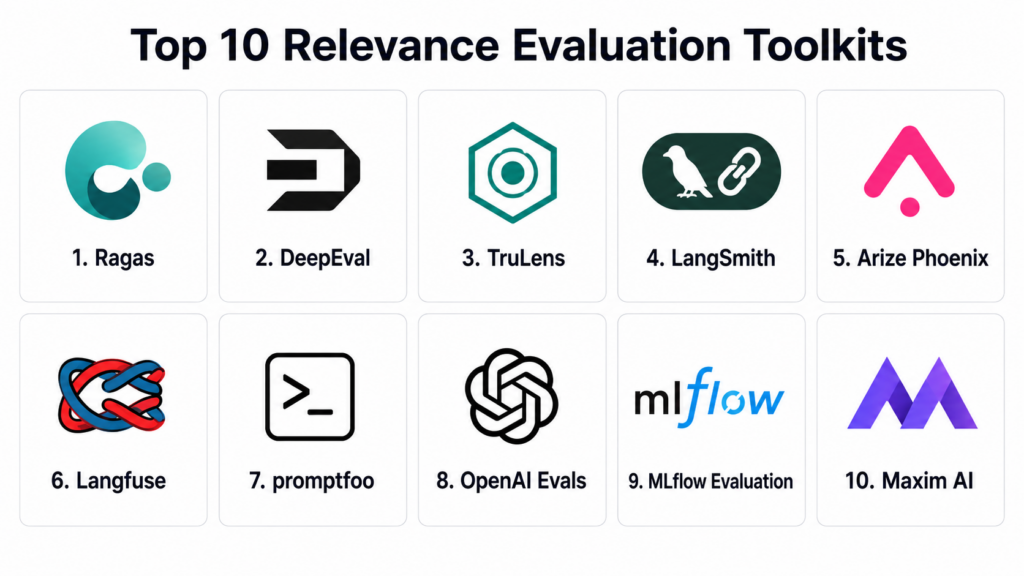
Introduction
Relevance Evaluation Toolkits help teams measure whether search systems, recommendation engines, RAG pipelines, AI assistants, chatbots, and retrieval systems are returning useful, accurate, and contextually appropriate results. In simple terms, these tools help answer one important question: did the system retrieve or generate the right thing for the user’s intent?
Relevance evaluation matters because modern AI and search experiences depend on retrieval quality. If search results are weak, recommendations are irrelevant, or RAG systems retrieve poor context, the final output becomes unreliable. Relevance Evaluation Toolkits help teams test retrieval quality, compare prompts and models, detect regressions, measure grounding, validate ranking changes, and improve user experience before issues reach production.
Real world use cases include RAG evaluation, semantic search testing, chatbot answer scoring, enterprise search quality checks, recommendation evaluation, LLM-as-judge scoring, prompt regression testing, search ranking experiments, knowledge base retrieval validation, and human feedback review workflows.
Buyers should evaluate:
- Retrieval relevance metrics
- RAG evaluation support
- LLM-as-judge capabilities
- Human feedback workflows
- Dataset and benchmark management
- Prompt and model comparison
- Tracing and observability
- CI/CD integration
- Security, access control, and audit logs
- Integration with LLM, vector search, and app frameworks
Best for: Relevance Evaluation Toolkits are best for AI engineers, search engineers, data scientists, ML engineers, MLOps teams, product teams, QA teams, knowledge management teams, LLM application developers, RAG teams, and enterprises building AI-powered retrieval or search experiences.
Not ideal for: Very small prototypes with only a few test queries may not need a full evaluation toolkit. A simple spreadsheet, manual review, or basic test script may be enough during early experimentation. However, once search, RAG, recommendations, or AI answers become customer-facing or business-critical, structured relevance evaluation becomes essential.
Key Trends in Relevance Evaluation Toolkits
- RAG-specific evaluation: Teams need metrics for context precision, context recall, faithfulness, answer relevancy, hallucination risk, and source grounding.
- LLM-as-judge adoption: Many teams use LLM judges to score nuanced qualities such as helpfulness, relevance, correctness, tone, and groundedness.
- Human feedback alignment: Evaluation workflows increasingly combine automated scoring with human labels to improve trust and calibrate judges.
- Trace-aware evaluation: Tools now evaluate not only final answers but also retrieved chunks, tool calls, intermediate reasoning steps, and workflow traces.
- CI/CD evaluation gates: Engineering teams are adding relevance tests to pull requests, prompt changes, retriever updates, and model migrations.
- Synthetic test set generation: Some toolkits help create test questions, expected answers, and adversarial examples when labeled datasets are limited.
- Production monitoring: Evaluation is moving from offline notebooks to continuous monitoring of live AI applications and search quality.
- Hybrid search testing: Teams evaluate vector search, keyword search, reranking, filters, metadata rules, and permissions together.
- Evaluation observability: Modern tools connect scores with traces, logs, prompts, retrieved context, user feedback, and model outputs.
- Agent evaluation expansion: Relevance evaluation is expanding into multi-turn agents, tool selection, goal completion, and retrieval quality across conversations.
How We Selected These Tools
The tools below were selected using a practical buyer-focused evaluation approach:
- Market recognition in RAG evaluation, LLM evaluation, search relevance testing, observability, and AI application QA.
- Feature completeness across relevance metrics, judge-based scoring, traces, datasets, experiments, monitoring, and reporting.
- RAG and retrieval fit, including support for context relevance, grounding, retrieved chunk quality, and answer faithfulness.
- Developer experience, including Python SDKs, CLI workflows, test assertions, notebooks, APIs, and CI/CD integration.
- Human evaluation support, including labeling, feedback collection, reviewer workflows, and judge calibration.
- Observability integration, including traces, spans, prompts, model calls, retrieval logs, and production monitoring.
- Security and governance, including RBAC, SSO, audit logs, workspace controls, and deployment options.
- Framework compatibility, including LangChain, LlamaIndex, OpenAI-style APIs, vector databases, and MLOps tools.
- Scalability, including ability to support many experiments, datasets, users, applications, and production evaluations.
- Practical adoption fit, including ease of setup, learning curve, documentation, open-source maturity, and enterprise support.
Top 10 Relevance Evaluation Toolkits
1- Ragas
Short description:
Ragas is an open-source evaluation framework focused on RAG and LLM application evaluation. It helps teams measure retrieval and generation quality using metrics such as faithfulness, answer relevancy, context precision, and context recall. Ragas is especially useful for teams building RAG systems that need to understand whether retrieved context is useful and whether answers are grounded. It is a strong fit for AI engineers, data scientists, and teams that want a metric-first evaluation toolkit.
Key Features
- RAG-specific evaluation metrics
- Context precision and context recall scoring
- Faithfulness and answer relevancy metrics
- Synthetic test data generation support
- Works with common LLM application workflows
- Python-based evaluation interface
- Useful for offline benchmark evaluation
Pros
- Strong fit for RAG relevance evaluation
- Open-source and developer-friendly
- Useful for separating retrieval quality from answer quality
Cons
- Not a complete production observability platform by itself
- Debugging poor scores may require additional tracing tools
- Human review workflows may need complementary platforms
Platforms / Deployment
Python-based toolkit.
Local, notebook, CI/CD, and self-managed workflow deployment.
Security & Compliance
Security depends on the environment where it is run and the LLM providers used. Enterprise compliance controls are Not publicly stated for the toolkit itself.
Integrations & Ecosystem
Ragas integrates well with common RAG development stacks and can be used with retrieval frameworks, vector stores, and experiment workflows. It is often combined with observability or tracing platforms.
- LangChain
- LlamaIndex
- Vector search pipelines
- Notebook workflows
- CI/CD pipelines
- LLM provider APIs
Support & Community
Ragas has open-source documentation, community resources, and strong adoption among RAG developers. Enterprise support availability should be validated based on current vendor or project options.
2- DeepEval
Short description:
DeepEval is an open-source LLM evaluation framework designed for testing LLM applications using assertion-style evaluations. It is often used by teams that want to evaluate RAG pipelines, chatbot responses, summarization quality, hallucination risk, contextual relevance, and custom criteria inside development and CI/CD workflows. DeepEval is especially useful for engineering teams that want evaluations to feel similar to unit tests. It supports both built-in metrics and custom evaluation logic.
Key Features
- Pytest-style LLM evaluation
- RAG and chatbot evaluation metrics
- LLM-as-judge scoring
- Custom metrics and assertions
- CI/CD-friendly test workflows
- Dataset-based evaluation support
- Regression testing for prompts and outputs
Pros
- Strong test-driven evaluation workflow
- Good fit for CI/CD and engineering teams
- Useful built-in metrics for LLM and RAG quality
Cons
- Production observability may require additional tools
- Judge-based scoring still needs careful calibration
- Larger evaluation operations may need a platform layer
Platforms / Deployment
Python-based toolkit.
Local development, CI/CD, and self-managed evaluation workflows.
Security & Compliance
Security depends on deployment environment, stored datasets, and connected LLM providers. Formal enterprise compliance details should be validated directly if using related commercial services.
Integrations & Ecosystem
DeepEval integrates with Python application stacks, LLM APIs, RAG pipelines, test runners, and development workflows.
- Pytest workflows
- LangChain
- LlamaIndex
- CI/CD pipelines
- OpenAI-style APIs
- Custom RAG systems
Support & Community
DeepEval provides documentation, open-source community resources, and related commercial support options depending on selected offering.
3- TruLens
Short description:
TruLens is an evaluation and observability toolkit for LLM applications, with strong support for RAG evaluation. It helps teams inspect application behavior, score outputs, evaluate context relevance, measure groundedness, and compare different versions of LLM workflows. TruLens is useful for developers who need to understand why a RAG answer succeeded or failed by connecting evaluation scores with traces and records. It is a strong fit for teams that want both relevance scoring and explainability during development.
Key Features
- RAG application evaluation
- Feedback functions and scoring
- Groundedness and relevance evaluation
- Trace and record inspection
- Experiment comparison
- Integration with LLM application frameworks
- Useful debugging workflows
Pros
- Good combination of evaluation and observability
- Useful for debugging RAG failures
- Flexible feedback function approach
Cons
- Advanced workflows may require setup and tuning
- Enterprise deployment needs should be validated
- May be used with other tools for full production monitoring
Platforms / Deployment
Python-based toolkit with dashboard-style workflows depending on setup.
Local, self-managed, and platform-connected deployment options may vary.
Security & Compliance
Security depends on deployment setup and connected systems. Specific enterprise compliance controls should be validated directly.
Integrations & Ecosystem
TruLens integrates with common LLM application frameworks and RAG development workflows. It is often used by teams evaluating retrieval quality and groundedness.
- LangChain
- LlamaIndex
- Vector retrieval systems
- Notebook workflows
- LLM provider APIs
- Experiment tracking workflows
Support & Community
TruLens provides documentation, community resources, and ecosystem support. Commercial or enterprise support should be validated based on current offering.
4- LangSmith
Short description:
LangSmith is an observability, evaluation, tracing, and debugging platform for LLM applications. It is especially useful for teams building applications with LangChain, but it can also support broader LLM app evaluation workflows. LangSmith helps teams create datasets, run evaluations, compare prompts and chains, inspect traces, collect feedback, and monitor production behavior. It is a strong fit for teams that want evaluation connected with LLM application debugging and lifecycle management.
Key Features
- LLM application tracing
- Dataset and evaluation management
- Prompt and chain comparison
- Human feedback workflows
- Production monitoring support
- Debugging for RAG and agent applications
- Strong LangChain ecosystem alignment
Pros
- Strong trace-based debugging experience
- Good for evaluating RAG and agent workflows
- Useful for teams already using LangChain
Cons
- Best value depends on LangChain ecosystem adoption
- Open-source-only teams may prefer self-hosted alternatives
- Pricing and data retention should be reviewed for enterprise use
Platforms / Deployment
Web-based platform.
Cloud deployment.
Deployment options may vary by plan and enterprise requirements.
Security & Compliance
Supports workspace administration and access controls. Specific enterprise security and compliance details should be validated during procurement.
Integrations & Ecosystem
LangSmith integrates closely with LangChain and broader LLM application workflows. It is useful for tracing model calls, retrieval steps, prompts, tools, and outputs.
- LangChain
- LangGraph
- RAG pipelines
- Agent workflows
- LLM provider APIs
- Production monitoring workflows
Support & Community
LangSmith benefits from the LangChain ecosystem, documentation, community adoption, and commercial support options depending on plan and contract.
5- Arize Phoenix
Short description:
Arize Phoenix is an open-source observability and evaluation platform for LLM applications, RAG systems, and AI agents. It helps teams inspect traces, evaluate retrieval quality, debug hallucinations, analyze prompts, and monitor application behavior. Phoenix is especially useful for teams that want open-source observability combined with evaluation workflows. It fits AI engineers, MLOps teams, and organizations that want to understand both offline evaluation and production behavior.
Key Features
- Open-source LLM observability
- RAG and retrieval evaluation
- Tracing and span inspection
- Dataset and experiment analysis
- Hallucination and relevance evaluation workflows
- Production monitoring support depending on setup
- Integration with OpenTelemetry-style workflows
Pros
- Strong open-source observability and evaluation option
- Useful for connecting traces with relevance scoring
- Good fit for RAG and agent debugging
Cons
- Enterprise support depends on selected deployment and vendor options
- Requires operational setup if self-hosted
- Teams may need additional tooling for CI/CD gating
Platforms / Deployment
Web-based open-source platform.
Self-hosted and cloud-connected options may vary.
Security & Compliance
Security depends on deployment configuration, access controls, and hosting environment. Specific enterprise compliance should be validated based on selected deployment.
Integrations & Ecosystem
Phoenix integrates with LLM application stacks, traces, OpenTelemetry workflows, RAG pipelines, and AI observability ecosystems.
- OpenTelemetry workflows
- LangChain
- LlamaIndex
- RAG systems
- LLM provider APIs
- AI observability pipelines
Support & Community
Phoenix has open-source documentation, community resources, and commercial ecosystem support through Arize-related offerings. Support depth depends on selected setup.
6- Langfuse
Short description:
Langfuse is an open-source LLM engineering platform for tracing, evaluation, prompt management, and observability. It helps teams monitor LLM applications, inspect traces, collect feedback, manage evaluation datasets, and compare changes across prompts or models. Langfuse is especially useful for teams that want open-source visibility into production LLM and RAG applications. It can support relevance evaluation by connecting user queries, retrieved context, generated answers, and evaluator scores.
Key Features
- Open-source LLM observability
- Tracing and session tracking
- Evaluation dataset management
- Prompt management
- User feedback collection
- RAG and agent workflow visibility
- Self-hosting and cloud options
Pros
- Strong open-source observability platform
- Good for production LLM tracing and feedback
- Useful for teams needing self-hosting flexibility
Cons
- Built-in relevance metrics may require configuration or custom evaluators
- Operational ownership needed for self-hosting
- Enterprise capabilities depend on edition and deployment
Platforms / Deployment
Web-based platform.
Cloud and self-hosted deployment options may be available.
Security & Compliance
Supports workspace controls and deployment-level security features depending on edition and setup. Specific compliance details should be validated directly.
Integrations & Ecosystem
Langfuse integrates with LLM applications, SDKs, tracing workflows, prompt systems, and evaluation pipelines.
- LangChain
- LlamaIndex
- OpenAI-style APIs
- Custom LLM apps
- RAG pipelines
- User feedback workflows
Support & Community
Langfuse has open-source community resources, documentation, and commercial support options depending on edition and plan.
7- promptfoo
Short description:
promptfoo is an open-source testing and evaluation toolkit for prompts, LLM outputs, RAG workflows, and AI application behavior. It lets teams define test cases, compare models and prompts, run assertions, use LLM-as-judge scoring, and add checks into development workflows. promptfoo is especially useful for teams that want fast CLI-based evaluation, prompt regression testing, and red-team-style checks. It is a strong fit for developers who want lightweight and practical evaluation without a heavy platform.
Key Features
- CLI-based prompt and LLM testing
- YAML-based test configuration
- Model and prompt comparison
- LLM-as-judge evaluation
- Assertions and regression checks
- CI/CD integration
- Red-team and safety testing support
Pros
- Lightweight and fast to adopt
- Strong for prompt regression testing
- Useful for CI/CD and red-team checks
Cons
- Less focused on deep RAG observability than tracing platforms
- Large-scale evaluation management may need complementary tools
- Requires careful test case design
Platforms / Deployment
CLI and configuration-based toolkit.
Local, CI/CD, and self-managed workflows.
Security & Compliance
Security depends on local execution environment, test data handling, and connected LLM providers. Formal enterprise compliance is Not publicly stated for the open-source toolkit.
Integrations & Ecosystem
promptfoo integrates with many model APIs, prompt workflows, CI/CD pipelines, and application testing setups.
- LLM provider APIs
- CI/CD pipelines
- Prompt workflows
- RAG test cases
- Red-team checks
- Developer automation
Support & Community
promptfoo has open-source documentation, community adoption, and commercial or enterprise options depending on current offering.
8- OpenAI Evals
Short description:
OpenAI Evals is an open-source framework for creating and running evaluations of model behavior, prompts, and application outputs. It is useful for teams that want a structured way to define evals, run test sets, compare behavior, and measure performance across tasks. While it is not specific only to relevance evaluation, it can be adapted for search relevance, answer quality, retrieval quality, and LLM output checks. It is best for technical teams comfortable creating custom evaluation logic.
Key Features
- Evaluation framework for model behavior
- Custom eval definition support
- Dataset-based testing
- Model and prompt comparison workflows
- Flexible scoring patterns
- Useful for benchmark-style evaluation
- Open-source evaluation structure
Pros
- Flexible for custom evaluation design
- Useful for model and prompt comparison
- Good fit for technical evaluation teams
Cons
- Requires custom setup and evaluation design
- Not a full observability or production monitoring platform
- RAG-specific metrics may need custom implementation
Platforms / Deployment
Python-based open-source framework.
Local, CI/CD, and self-managed evaluation workflows.
Security & Compliance
Security depends on local environment, test data storage, and connected model providers. Formal compliance controls are Not publicly stated for the toolkit itself.
Integrations & Ecosystem
OpenAI Evals can be adapted to model evaluation, prompt testing, retrieval evaluation, and custom benchmark workflows.
- OpenAI-style model APIs
- Custom test datasets
- Prompt experiments
- CI/CD workflows
- Notebook analysis
- Benchmark pipelines
Support & Community
OpenAI Evals has open-source documentation and community resources. Enterprise support should be validated based on broader platform or vendor agreements.
9- MLflow Evaluation
Short description:
MLflow Evaluation provides capabilities for evaluating machine learning, LLM, and agent workflows inside the broader MLflow ecosystem. It is especially useful for teams already using MLflow for experiment tracking, model registry, and ML lifecycle management. MLflow can help centralize evaluation results, compare model or prompt versions, and connect evaluation with governance workflows. It is a strong fit for MLOps teams that want relevance evaluation to live alongside broader model lifecycle management.
Key Features
- Evaluation inside MLflow workflows
- Experiment tracking integration
- Model and prompt comparison
- Custom metrics and scorers
- LLM and agent evaluation support depending on setup
- Results tracking and reproducibility
- Integration with ML lifecycle workflows
Pros
- Strong fit for teams already using MLflow
- Helps centralize evaluation and experiment tracking
- Useful for governed AI and ML workflows
Cons
- RAG-specific workflows may need external metric libraries
- Setup depends on MLflow maturity in the organization
- Less lightweight than single-purpose eval libraries
Platforms / Deployment
Web-based MLflow UI and Python SDK.
Self-hosted, managed, and platform-based deployment options may vary.
Security & Compliance
Security depends on MLflow deployment, workspace controls, authentication, artifact storage, and platform configuration. Specific compliance should be validated by deployment provider.
Integrations & Ecosystem
MLflow integrates with machine learning platforms, notebooks, CI/CD workflows, model registries, and evaluation libraries.
- Python ML workflows
- Model registry
- Experiment tracking
- Ragas and DeepEval-style metric workflows
- Databricks environments
- CI/CD pipelines
Support & Community
MLflow has strong open-source community support, documentation, and commercial support options depending on deployment provider.
10- Maxim AI
Short description:
Maxim AI is an evaluation and observability platform for AI applications, including RAG systems, agents, and prompt workflows. It helps teams run experiments, evaluate outputs, compare prompts, manage datasets, collect human feedback, and monitor production behavior. Maxim AI is especially useful for product and engineering teams that want evaluation, simulation, and monitoring in one workflow. It fits teams building customer-facing AI applications that need continuous quality improvement.
Key Features
- AI application evaluation
- Prompt and model experimentation
- RAG and agent evaluation workflows
- Human feedback and review support
- Dataset and test case management
- Observability and monitoring
- Collaboration for product and engineering teams
Pros
- Strong end-to-end evaluation and observability orientation
- Useful for product teams evaluating AI experiences
- Supports both offline and production quality workflows
Cons
- Commercial platform fit should be validated by team needs
- Open-source teams may prefer self-hosted alternatives
- Pricing and data retention should be reviewed carefully
Platforms / Deployment
Web-based platform.
Cloud deployment.
Enterprise deployment options should be validated directly.
Security & Compliance
Supports platform-level access and administration controls. Specific security certifications, compliance coverage, and data handling policies should be validated during procurement.
Integrations & Ecosystem
Maxim AI integrates with LLM application workflows, prompt systems, datasets, monitoring, and AI evaluation pipelines.
- LLM provider APIs
- RAG pipelines
- Agent workflows
- Prompt experiments
- Human review workflows
- Production monitoring
Support & Community
Maxim AI provides documentation, customer support, onboarding resources, and commercial assistance. Support depth depends on plan and enterprise agreement.
Comparison Table
| Tool Name | Best For | Platform Supported | Deployment | Standout Feature | Public Rating |
|---|---|---|---|---|---|
| Ragas | RAG relevance metrics | Python, notebooks, CI/CD | Local, self-managed | RAG metrics such as faithfulness and context precision | N/A |
| DeepEval | Test-driven LLM and RAG evaluation | Python, pytest-style workflows | Local, CI/CD, self-managed | Assertion-style LLM evaluation | N/A |
| TruLens | RAG evaluation and debugging | Python, dashboard workflows | Local, self-managed options vary | Feedback functions and groundedness evaluation | N/A |
| LangSmith | LLM tracing and evaluation | Web, SDKs | Cloud options vary | Trace-based debugging and evaluation | N/A |
| Arize Phoenix | Open-source LLM observability and evals | Web, Python, tracing | Self-hosted, cloud-connected options vary | Open-source tracing with RAG evaluation | N/A |
| Langfuse | Open-source LLM tracing and feedback | Web, SDKs | Cloud, self-hosted options vary | Production tracing and feedback workflows | N/A |
| promptfoo | Prompt regression testing | CLI, YAML, CI/CD | Local, CI/CD, self-managed | Lightweight prompt and model testing | N/A |
| OpenAI Evals | Custom model and prompt evaluations | Python | Local, CI/CD, self-managed | Flexible custom evaluation framework | N/A |
| MLflow Evaluation | Evaluation inside ML lifecycle | Web, Python SDK | Self-hosted, managed options vary | Evaluation tied to experiment tracking | N/A |
| Maxim AI | End-to-end AI app evaluation | Web platform | Cloud options vary | Evaluation, simulation, and monitoring workflow | N/A |
Evaluation & Scoring of Relevance Evaluation Toolkits
| Tool Name | Core 25% | Ease 15% | Integrations 15% | Security 10% | Performance 10% | Support 10% | Value 15% | Weighted Total 0–10 |
|---|---|---|---|---|---|---|---|---|
| Ragas | 9.0 | 8.0 | 8.4 | 7.4 | 8.2 | 7.8 | 9.0 | 8.35 |
| DeepEval | 8.8 | 8.4 | 8.3 | 7.5 | 8.2 | 7.8 | 8.8 | 8.33 |
| TruLens | 8.6 | 7.8 | 8.2 | 7.6 | 8.1 | 7.8 | 8.4 | 8.10 |
| LangSmith | 8.7 | 8.4 | 9.0 | 8.4 | 8.5 | 8.5 | 8.0 | 8.53 |
| Arize Phoenix | 8.5 | 8.0 | 8.6 | 7.8 | 8.3 | 8.0 | 8.8 | 8.31 |
| Langfuse | 8.2 | 8.3 | 8.5 | 8.0 | 8.2 | 8.0 | 8.7 | 8.28 |
| promptfoo | 8.0 | 8.8 | 8.3 | 7.2 | 8.0 | 7.6 | 9.0 | 8.18 |
| OpenAI Evals | 7.8 | 7.4 | 8.0 | 7.2 | 8.0 | 7.5 | 8.6 | 7.82 |
| MLflow Evaluation | 8.4 | 7.8 | 8.8 | 8.3 | 8.3 | 8.4 | 8.4 | 8.36 |
| Maxim AI | 8.5 | 8.5 | 8.3 | 8.2 | 8.4 | 8.2 | 8.0 | 8.34 |
The scores are comparative and should be used as a practical evaluation guide, not as fixed market ratings. Ragas is strong for RAG-specific relevance metrics, while DeepEval and promptfoo are strong for test-driven engineering workflows. LangSmith, Phoenix, and Langfuse are stronger when tracing and observability matter. TruLens is useful for RAG debugging and feedback functions, while MLflow Evaluation fits MLOps teams that want evaluation connected with experiment tracking. Maxim AI is useful for teams that want a broader evaluation and monitoring platform.
Which Relevance Evaluation Toolkit Is Right for You?
Solo / Freelancer
Solo developers should start with lightweight tools that are easy to run locally. Ragas, DeepEval, promptfoo, OpenAI Evals, or Chroma-style manual scripts can be enough for early-stage relevance testing. The priority should be building a small test set and measuring whether retrieval and answers improve after each change.
If the project is a RAG chatbot, Ragas is a strong starting point. If the project involves prompt testing across models, promptfoo may be simpler. If the developer wants unit-test-style assertions, DeepEval can be practical.
SMB
SMBs should prioritize ease of setup, clear dashboards, automated tests, and low operational overhead. Ragas, DeepEval, promptfoo, Langfuse, Phoenix, and LangSmith can all be practical depending on team skill and budget.
Small teams should avoid building a complex evaluation platform before defining core metrics. Start with 50 to 200 representative test cases, score retrieval and answer quality, and add CI checks before moving to production monitoring.
Mid-Market
Mid-market companies often need evaluation datasets, human review workflows, prompt comparisons, RAG tracing, regression testing, and production monitoring. LangSmith, Phoenix, Langfuse, Ragas, DeepEval, MLflow, and Maxim AI are strong candidates.
These teams should define whether evaluation ownership sits with AI engineering, QA, product, or MLOps. Relevance evaluation works best when automated metrics are combined with human review and production feedback.
Enterprise
Enterprises should prioritize governance, access controls, auditability, evaluation reproducibility, dataset management, production observability, human feedback, and integration with MLOps or AI platforms. LangSmith, MLflow, Phoenix, Langfuse, Maxim AI, DeepEval, and Ragas can all be relevant depending on architecture.
Large organizations should also define evaluation standards across teams. Without shared metrics, two teams may evaluate relevance differently and produce inconsistent quality benchmarks.
Budget vs Premium
Budget-focused teams can start with open-source tools such as Ragas, DeepEval, promptfoo, OpenAI Evals, Phoenix, Langfuse, and MLflow. These tools can be powerful but may require internal setup and process ownership.
Premium platforms are better when teams need managed hosting, collaboration, access controls, dashboards, human review workflows, production monitoring, and support. The right decision depends on whether engineering time or software cost is the bigger constraint.
Feature Depth vs Ease of Use
Feature-rich platforms provide tracing, datasets, experiments, human feedback, monitoring, judge workflows, dashboards, and production alerts. These are valuable for mature teams but can require process design.
Ease-of-use tools are better for early-stage teams that simply need to prevent regressions. Buyers should avoid overengineering before they have a reliable baseline dataset.
Integrations & Scalability
Relevance Evaluation Toolkits should integrate with vector databases, LLM providers, RAG frameworks, prompt tools, CI/CD systems, observability stacks, data warehouses, and human review workflows. Integration quality determines whether evaluation becomes part of the development lifecycle or stays in notebooks.
Scalability matters when many prompts, retrievers, models, applications, and teams are involved. Buyers should test dataset versioning, run history, trace volume, evaluator cost, and collaboration workflows before broad rollout.
Security & Compliance Needs
Evaluation tools may store prompts, user questions, retrieved documents, model outputs, traces, feedback, and internal knowledge base snippets. This data may be sensitive.
Buyers should evaluate SSO, MFA, RBAC, audit logs, encryption, data retention, workspace controls, redaction, PII handling, and model provider data policies. Regulated organizations should involve security, legal, and compliance teams before sending production traces into external tools.
Frequently Asked Questions
1. What is a Relevance Evaluation Toolkit?
A Relevance Evaluation Toolkit helps teams measure whether search results, retrieved context, recommendations, or AI-generated answers match user intent. It can score retrieval quality, answer relevance, grounding, faithfulness, and ranking behavior. These tools are commonly used for RAG systems, semantic search, AI assistants, and recommendation engines. They help teams compare versions and catch regressions before users are affected. A good toolkit turns subjective quality into measurable signals.
2. How is relevance evaluation different from general LLM evaluation?
General LLM evaluation may focus on tone, accuracy, safety, reasoning, formatting, or task completion. Relevance evaluation focuses specifically on whether the system retrieved or returned the most useful information for the query. In RAG systems, relevance evaluation often measures retrieved chunks, source grounding, and answer alignment with context. This makes it more retrieval-focused than generic answer scoring. Many teams use both relevance evaluation and broader LLM evaluation together.
3. What pricing models do Relevance Evaluation Toolkits use?
Pricing depends on whether the tool is open-source, managed, or enterprise-focused. Open-source tools may have no license cost but require internal setup, hosting, evaluator model costs, and maintenance. Managed platforms may charge by users, traces, evaluations, tokens, applications, datasets, or enterprise contract. LLM-as-judge evaluations can also create model usage costs. Buyers should calculate total cost based on evaluation volume, production tracing, human review needs, and storage retention.
4. How long does implementation usually take?
Implementation time depends on application complexity, test dataset quality, evaluation metrics, tracing setup, and team process. A simple offline RAG evaluation can be set up quickly with Ragas or DeepEval. Production evaluation with traces, dashboards, human review, CI/CD gates, and monitoring takes longer. The hardest part is often building a representative test set and defining what “relevant” means for the business. A phased rollout with a small benchmark is usually best.
5. What are common mistakes when choosing a relevance evaluation toolkit?
A common mistake is choosing a tool before defining evaluation goals. Some teams need RAG metrics, while others need prompt regression tests, human feedback, ranking evaluation, or production monitoring. Another mistake is relying only on LLM judges without human calibration. Teams also fail when test datasets are too small, unrealistic, or outdated. The best evaluation program combines automated metrics, human review, production feedback, and clear quality thresholds.
6. Are Relevance Evaluation Toolkits secure?
Relevance Evaluation Toolkits can be secure, but buyers must review how prompts, traces, retrieved documents, outputs, and feedback are stored. These datasets may contain customer questions, internal documents, confidential policies, or personal data. Important controls include RBAC, SSO, MFA, audit logs, encryption, redaction, data retention, and workspace isolation. Self-hosted tools may offer more control but require internal security ownership. Managed tools should be reviewed by security and compliance teams before production use.
7. Can relevance evaluation tools support RAG applications?
Yes, RAG is one of the most common use cases for relevance evaluation. Tools can measure whether retrieved context is relevant, whether important context was missed, whether the answer is grounded, and whether the final response satisfies the user query. RAG evaluation often combines context precision, context recall, answer relevancy, faithfulness, and human review. Teams should evaluate retrieval and generation separately. This helps identify whether the problem is the retriever, chunking, embedding model, prompt, or language model.
8. Do relevance evaluation tools support CI/CD workflows?
Many relevance evaluation tools can be added to CI/CD workflows. Tools such as DeepEval, promptfoo, Ragas, OpenAI Evals, and MLflow-style evaluation can run tests before prompt, model, retriever, or code changes are deployed. CI/CD evaluation helps catch regressions in answer quality, retrieval relevance, hallucination risk, and formatting behavior. However, teams should manage evaluator cost and runtime carefully. A small critical test set can run on every change, while larger evaluations can run on a schedule.
9. When should a business adopt a structured relevance evaluation process?
A business should adopt structured relevance evaluation when search, recommendations, RAG, or AI answers become important to users or operations. Warning signs include inconsistent answers, irrelevant retrieved context, hallucinations, poor search satisfaction, and no way to compare system changes. Evaluation becomes more important when multiple teams are changing prompts, embeddings, retrievers, or models. A structured process gives teams confidence before deployment. It also helps product leaders measure whether quality is improving over time.
10. What alternatives exist if we do not need a full evaluation toolkit?
Alternatives include spreadsheets, manual review sessions, simple Python scripts, search logs, click-through analysis, user feedback forms, and custom benchmark notebooks. These can work for early prototypes or small systems. However, they become difficult to manage when applications grow, teams multiply, or production quality matters. A dedicated toolkit is better when teams need repeatable tests, datasets, traces, metrics, and monitoring. The right alternative depends on risk level, scale, and evaluation maturity.
Conclusion
Relevance Evaluation Toolkits help teams build more reliable search, RAG, recommendation, chatbot, and AI agent experiences by measuring whether retrieved context and generated answers actually match user intent. The best toolkit depends on the use case, team maturity, deployment preference, security requirements, and evaluation workflow. Ragas is a strong starting point for RAG-specific metrics, while DeepEval and promptfoo are useful for engineering teams that want test-driven evaluation and CI/CD checks. TruLens, LangSmith, Arize Phoenix, and Langfuse are stronger when teams need traces, observability, and debugging around retrieval and generation behavior. OpenAI Evals and MLflow Evaluation fit teams that want custom benchmark workflows or evaluation connected to broader ML lifecycle management, while Maxim AI is useful for teams seeking an end-to-end evaluation and monitoring platform. There is no single universal winner because relevance evaluation is not just a tool choice; it is a quality discipline.

Specialized search retrieval accuracy verification infrastructure software implementation optimizes logistics of corporate information accessibility, ensures accelerated algorithmic indexing performance tracking, and seamless semantic ranking validation workflows.