MOTOSHARE 🚗🏍️
Rent Bikes & Cars Directly from Owners
Motoshare connects vehicle owners with people who need bikes and cars on rent. Owners earn from idle vehicles, and renters get flexible ride options.
Visit Motoshare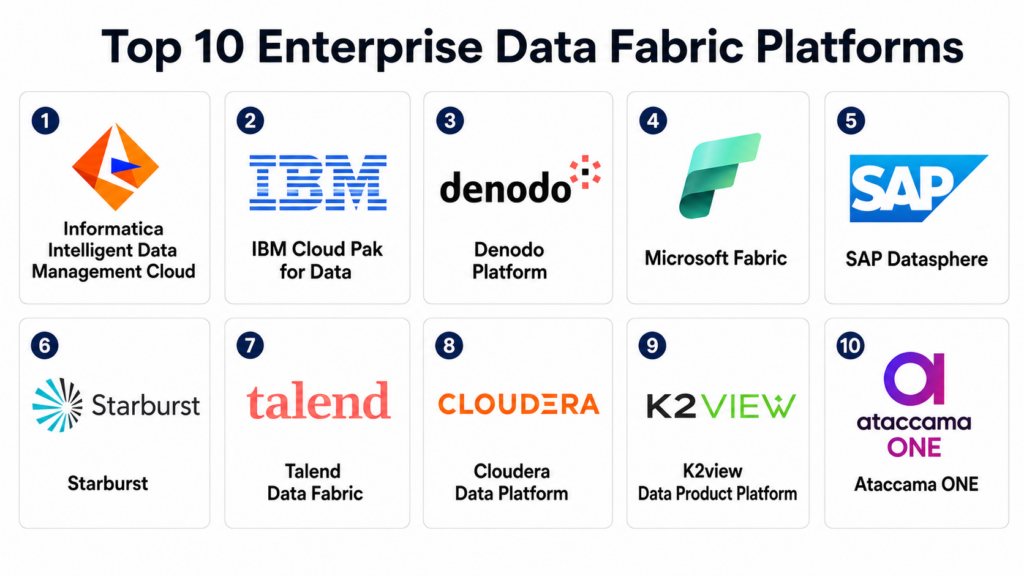
Introduction
Enterprise Data Fabric Platforms help organizations connect, integrate, govern, discover, secure, and use data across many systems without forcing every dataset into one single location. In simple terms, a data fabric creates a unified data management layer across databases, warehouses, lakes, lakehouses, SaaS apps, APIs, streaming systems, and legacy platforms.
Enterprise data fabric matters because modern businesses often have data spread across cloud, on-premise, hybrid, multi-cloud, departmental tools, operational systems, and analytics platforms. Without a connected fabric, teams struggle with duplicated data, inconsistent definitions, poor governance, slow access, and low trust in reporting. A strong enterprise data fabric helps improve data access, enable self-service analytics, support AI projects, enforce governance, and reduce data silos.
Real world use cases include customer 360, governed self-service analytics, AI-ready data access, hybrid cloud migration, data product delivery, regulatory reporting, master data alignment, data cataloging, lineage tracking, and enterprise-wide data governance.
Buyers should evaluate:
- Data integration and connectivity
- Metadata management and cataloging
- Data governance and policy enforcement
- Data quality and observability
- Data virtualization or federation
- Master data and entity resolution support
- Security, privacy, masking, and audit controls
- AI and machine learning readiness
- Hybrid and multi-cloud deployment
- Scalability across domains, teams, and business units
Best for: Enterprise Data Fabric Platforms are best for CIOs, CDOs, data architects, data engineering teams, analytics leaders, data governance teams, AI teams, compliance teams, and large organizations managing complex distributed data estates.
Not ideal for: Small organizations with one warehouse, a few dashboards, and simple data needs may not require a full enterprise data fabric platform. A cloud warehouse, BI semantic layer, basic ETL tool, and lightweight catalog may be enough when data sources are limited and governance complexity is low.
Key Trends in Enterprise Data Fabric Platforms
- AI-ready data foundations: Enterprises are building data fabrics to provide trusted, governed, and reusable data for AI, generative AI, analytics agents, and machine learning workflows.
- Metadata-driven automation: Modern data fabrics use active metadata to recommend data flows, detect quality issues, enforce policies, and improve data discovery.
- Data fabric plus data mesh: Many enterprises combine centralized governance from data fabric with domain ownership from data mesh to deliver governed data products.
- Hybrid and multi-cloud control: Data fabric platforms increasingly support data across on-premise systems, cloud warehouses, lakehouses, SaaS apps, and legacy databases.
- Logical access and virtualization: Instead of copying everything, enterprises use virtualized access, query federation, and semantic layers to reduce unnecessary movement.
- Data product marketplaces: Teams are exposing governed datasets as reusable data products with owners, descriptions, quality scores, and access workflows.
- Privacy and compliance automation: Platforms are adding policy enforcement, masking, consent controls, lineage, and audit trails to support regulated data use.
- Lakehouse and warehouse integration: Data fabric platforms are increasingly designed to work with open table formats, warehouses, object storage, and lakehouse architectures.
- Operational and analytical convergence: Enterprises want data fabric to support both analytics use cases and operational workflows such as customer service, risk, fraud, and supply chain.
- Semantic and knowledge graph layers: Data fabrics are becoming more context-aware through business glossaries, ontologies, entity relationships, and semantic modeling.
How We Selected These Tools
The tools below were selected using a practical buyer-focused evaluation approach:
- Market recognition in enterprise data fabric, data management, data integration, governance, cataloging, and logical data access.
- Feature completeness across integration, catalog, governance, quality, lineage, metadata, virtualization, and data delivery.
- Enterprise readiness, including scalability, role-based access, security controls, auditability, multi-domain use, and support options.
- Hybrid and multi-cloud capabilities, especially support for cloud, on-premise, SaaS, databases, warehouses, and lakehouses.
- Metadata and governance depth, including business glossary, lineage, data quality, stewardship, masking, policies, and access workflows.
- AI and analytics readiness, including governed access, reusable data products, semantic context, and trusted data pipelines.
- Integration ecosystem, including BI, ETL, ELT, catalogs, warehouses, AI platforms, MDM, APIs, and enterprise applications.
- Deployment flexibility, including cloud-native, self-hosted, hybrid, and managed service options.
- Operational usability, including data marketplace, dashboards, automation, workflow management, and user experience.
- Implementation practicality, including onboarding effort, data maturity requirements, consulting needs, and long-term maintainability.
Top 10 Enterprise Data Fabric Platforms
1- Informatica Intelligent Data Management Cloud
Short description:
Informatica Intelligent Data Management Cloud is an enterprise data management platform that supports data integration, governance, cataloging, quality, privacy, MDM, and data fabric use cases. It is designed for large organizations that need to connect and govern data across hybrid and multi-cloud environments. Informatica is especially useful for regulated enterprises that require strong metadata, lineage, quality, and policy controls. It is a strong fit for data fabric programs where integration and governance must work together.
Key Features
- Cloud data integration and application integration
- Data catalog and metadata management
- Data quality and profiling
- Master data management support
- Data governance and privacy workflows
- API and data marketplace capabilities
- AI-assisted metadata and automation capabilities
Pros
- Broad enterprise data management coverage
- Strong governance, catalog, quality, and integration depth
- Good fit for large and regulated organizations
Cons
- Platform scope can be complex
- Implementation may require data maturity and planning
- Cost and module selection should be reviewed carefully
Platforms / Deployment
Web-based enterprise platform.
Cloud and hybrid deployment options may vary.
Security & Compliance
Supports role-based access, audit logs, policy controls, encryption, data privacy workflows, metadata governance, and enterprise administration. Specific certifications and compliance coverage should be validated during procurement.
Integrations & Ecosystem
Informatica integrates with databases, warehouses, lakehouses, SaaS applications, cloud platforms, catalogs, BI tools, and enterprise applications. It is often used as a core data management layer for enterprise data fabric programs.
- Cloud data warehouses
- Databases and data lakes
- SaaS applications
- BI and analytics tools
- MDM and governance workflows
- APIs and enterprise applications
Support & Community
Informatica provides enterprise support, documentation, training, professional services, partner assistance, and customer success resources. Support depth depends on selected products and contract.
2- IBM Cloud Pak for Data
Short description:
IBM Cloud Pak for Data is an enterprise data and AI platform that supports data fabric architecture through data integration, governance, cataloging, data virtualization, AI lifecycle management, and analytics capabilities. It is especially useful for organizations building governed data and AI environments across hybrid cloud systems. IBM’s platform is strong for enterprises that need data governance, AI readiness, data virtualization, and metadata-driven access in one ecosystem. It fits regulated industries, large data teams, and hybrid cloud strategies.
Key Features
- Data fabric and data governance capabilities
- Data virtualization and federated access
- Data catalog and metadata management
- AI and machine learning lifecycle support
- Data quality and policy controls
- Hybrid cloud data management
- Analytics and operational data workflows
Pros
- Strong data fabric and AI governance alignment
- Useful for hybrid cloud enterprise environments
- Good fit for IBM-centered data and AI ecosystems
Cons
- Broad platform scope may require implementation planning
- Best value depends on IBM ecosystem alignment
- Smaller teams may find it too complex
Platforms / Deployment
Web-based enterprise platform.
Cloud, self-hosted, and hybrid deployment options may vary.
Security & Compliance
Supports role-based access, policy enforcement, governed data access, audit-friendly workflows, encryption, and enterprise security administration. Specific compliance details should be validated directly.
Integrations & Ecosystem
IBM Cloud Pak for Data integrates with IBM data, AI, governance, analytics, databases, cloud services, and enterprise systems.
- IBM data and AI tools
- Data catalogs
- Enterprise databases
- BI and analytics platforms
- Cloud and hybrid systems
- Governance workflows
Support & Community
IBM provides documentation, enterprise support, consulting, partner services, implementation assistance, and training resources. Support depth depends on platform scope and contract.
3- Denodo Platform
Short description:
Denodo Platform is a leading logical data fabric and data virtualization platform that helps organizations access, govern, and deliver data across distributed sources without physically moving everything. It is especially useful for enterprises that need real-time or near-real-time access across cloud, on-premise, SaaS, legacy, and analytical systems. Denodo supports logical data warehouses, data services, data marketplace delivery, and self-service analytics. It is a strong choice when virtualization and governed access are central to the data fabric strategy.
Key Features
- Logical data fabric and virtualization
- Query federation and optimization
- Broad source connectivity
- Caching and acceleration options
- Data catalog and metadata support
- Security, masking, and policy controls
- BI, API, and analytics delivery
Pros
- Strong logical data fabric capabilities
- Mature virtualization and governed access model
- Useful for hybrid and multi-source environments
Cons
- Requires data architecture and performance planning
- Not a full replacement for all physical data integration
- Advanced tuning may require specialist skills
Platforms / Deployment
Web-based platform and administration tools.
Cloud, self-hosted, and hybrid deployment options may vary.
Security & Compliance
Supports role-based access, authentication integration, masking, policy controls, audit logs, and governed data access. Specific certifications and compliance coverage should be validated directly.
Integrations & Ecosystem
Denodo integrates with databases, warehouses, lakes, SaaS systems, APIs, BI tools, catalogs, and enterprise data platforms.
- Cloud data warehouses
- Data lakes and lakehouses
- BI and analytics tools
- Data catalogs
- Enterprise databases
- SaaS applications and APIs
Support & Community
Denodo provides enterprise support, documentation, training resources, partner services, and professional assistance. Support depth depends on contract and deployment scope.
4- Microsoft Fabric
Short description:
Microsoft Fabric is an integrated analytics and data platform that combines data engineering, data integration, data warehousing, real-time analytics, data science, and business intelligence capabilities in one Microsoft ecosystem. It supports enterprise data fabric patterns by centralizing data access, lakehouse storage, semantic modeling, governance, and analytics workflows. Microsoft Fabric is especially useful for organizations already using Microsoft 365, Power BI, Azure, and Microsoft security tools. It fits teams that want a unified platform for analytics and AI-ready data.
Key Features
- Unified analytics and data platform
- OneLake data storage layer
- Data engineering and data integration tools
- Warehouse and lakehouse capabilities
- Real-time analytics support
- Power BI and semantic modeling integration
- Microsoft security and governance alignment
Pros
- Strong fit for Microsoft-centered enterprises
- Combines multiple analytics services in one platform
- Useful for BI, analytics, and AI data workflows
Cons
- Best value depends on Microsoft ecosystem adoption
- Some organizations may still need external governance or integration tools
- Platform design and cost governance require planning
Platforms / Deployment
Web-based Microsoft cloud platform.
Cloud deployment.
Security & Compliance
Supports Microsoft identity, access controls, tenant governance, audit logs, encryption, data protection, and administration through Microsoft ecosystem controls. Specific compliance coverage depends on licensing, region, and configuration.
Integrations & Ecosystem
Microsoft Fabric integrates with Power BI, Azure services, Microsoft 365, cloud data systems, data pipelines, notebooks, warehouses, lakehouses, and AI workflows.
- Power BI
- Azure data services
- Microsoft 365
- OneLake
- Data pipelines
- AI and analytics workflows
Support & Community
Microsoft provides documentation, support plans, partner services, training resources, community forums, and enterprise assistance. Support depth depends on licensing and support agreement.
5- SAP Datasphere
Short description:
SAP Datasphere is a business data fabric platform designed to connect, model, govern, and deliver business data across SAP and non-SAP environments. It is especially useful for organizations running SAP ERP, SAP S/4HANA, SAP BW, SAP HANA, and SAP Analytics Cloud. SAP Datasphere helps teams build semantic models, enable governed access, and connect business context across enterprise systems. It is a strong fit for SAP-centered enterprises that need trusted business data for analytics and planning.
Key Features
- Business data fabric capabilities
- Semantic modeling and business layer support
- SAP and non-SAP data integration
- Data federation and access
- Governance and access controls
- Integration with SAP Analytics Cloud
- Support for enterprise planning and analytics
Pros
- Strong fit for SAP-centered enterprises
- Useful semantic layer for business data
- Helps connect SAP operational data with analytics
Cons
- Best value depends on SAP ecosystem adoption
- Non-SAP complexity should be validated carefully
- May not be ideal as a neutral independent data fabric platform
Platforms / Deployment
Web-based SAP platform.
Cloud deployment with hybrid connectivity options.
Security & Compliance
Supports SAP security models, role-based access, governance, data controls, and administrative security. Specific compliance details should be validated with SAP product scope and deployment.
Integrations & Ecosystem
SAP Datasphere integrates with SAP enterprise applications, analytics platforms, databases, and selected external data sources.
- SAP S/4HANA
- SAP BW
- SAP HANA
- SAP Analytics Cloud
- Enterprise data sources
- Business planning workflows
Support & Community
SAP provides enterprise support, documentation, partner services, training resources, and consulting. Support depth depends on product and enterprise agreement.
6- Starburst
Short description:
Starburst is a distributed SQL platform based on Trino that helps enterprises query data across lakes, warehouses, databases, and cloud platforms without unnecessary data movement. It supports data fabric and data mesh patterns through federated access, data products, and high-performance SQL analytics. Starburst is especially useful for organizations building lakehouse, multi-cloud analytics, or query-driven data fabric architectures. It fits teams that want fast access to distributed data using open SQL and flexible connectors.
Key Features
- Distributed SQL query engine
- Federated access across data sources
- Lakehouse and data mesh support
- Connector ecosystem
- Query optimization and workload management
- Data product and governance workflows
- Integration with BI and analytics tools
Pros
- Strong for federated SQL and lakehouse analytics
- Useful for reducing unnecessary data movement
- Good fit for data mesh and distributed data access
Cons
- Not a full governance suite by itself
- Source system performance and architecture matter
- Requires SQL and data platform expertise
Platforms / Deployment
Web-based management and SQL query interfaces.
Cloud, self-hosted, and hybrid deployment options may vary.
Security & Compliance
Supports authentication integrations, access controls, policies, audit logs, and security administration. Specific certifications and compliance details should be validated directly.
Integrations & Ecosystem
Starburst integrates with data lakes, lakehouses, warehouses, catalogs, BI tools, and Trino-compatible data sources.
- Object storage
- Apache Iceberg and lakehouse tables
- Cloud data warehouses
- BI tools
- Data catalogs
- Trino connectors
Support & Community
Starburst provides documentation, commercial support, training, partner assistance, and benefits from the broader Trino ecosystem. Support depth depends on edition and contract.
7- Talend Data Fabric
Short description:
Talend Data Fabric provides data integration, quality, governance, preparation, and application integration capabilities for organizations building connected data environments. It is especially useful for teams that need to move, clean, transform, and govern data across cloud and on-premise systems. Talend is relevant for enterprise data fabric programs where integration, trust, and usability are key priorities. It fits data engineering teams, analytics teams, and organizations modernizing data pipelines across hybrid architectures.
Key Features
- Data integration and pipeline development
- Data quality and profiling
- Data preparation capabilities
- Cloud and hybrid connectivity
- Application and API integration
- Metadata and governance support
- Reusable data pipeline workflows
Pros
- Strong integration and data quality capabilities
- Useful for hybrid data modernization programs
- Good fit for teams needing trusted pipeline delivery
Cons
- Not focused only on logical data fabric or virtualization
- Platform direction should be reviewed during procurement
- Advanced governance may require complementary tools
Platforms / Deployment
Web-based and developer tooling options.
Cloud, self-hosted, and hybrid deployment options may vary.
Security & Compliance
Supports access controls, secure connectivity, data quality governance, and administrative security features. Specific certifications and compliance details should be validated directly.
Integrations & Ecosystem
Talend integrates with databases, SaaS applications, cloud platforms, warehouses, data lakes, APIs, and analytics systems.
- Cloud warehouses
- Databases
- SaaS applications
- APIs
- Data lakes
- BI and analytics tools
Support & Community
Talend provides documentation, training, support resources, partner services, and enterprise assistance depending on product edition and contract.
8- Cloudera Data Platform
Short description:
Cloudera Data Platform is an enterprise data platform that supports hybrid data management, lakehouse-style analytics, data engineering, streaming, machine learning, governance, and security across large-scale environments. It is especially useful for organizations with large distributed data estates, regulated workloads, and hybrid cloud strategies. Cloudera supports data fabric patterns by helping teams manage, secure, analyze, and operationalize data across multiple environments. It fits enterprises that need scalable analytics and governance across complex data infrastructure.
Key Features
- Hybrid data platform capabilities
- Data engineering and analytics
- Streaming and operational data support
- Machine learning workflows
- Governance and security controls
- Data lake and warehouse patterns
- Multi-environment data management
Pros
- Strong fit for large-scale hybrid data estates
- Useful for regulated and complex data environments
- Supports analytics, ML, and streaming workflows
Cons
- Platform scope can be broad and complex
- Best suited for mature data infrastructure teams
- Implementation may require significant planning
Platforms / Deployment
Web-based enterprise platform.
Cloud, on-premise, and hybrid deployment options may vary.
Security & Compliance
Supports enterprise security, governance, access control, auditability, data protection, and policy management depending on deployment. Specific certifications should be validated directly.
Integrations & Ecosystem
Cloudera integrates with data lakes, warehouses, streaming systems, BI tools, ML environments, and enterprise data platforms.
- Data lakes
- Streaming platforms
- BI tools
- ML workflows
- Enterprise data systems
- Cloud infrastructure
Support & Community
Cloudera provides enterprise support, documentation, professional services, partner resources, and training. Support depth depends on deployment scope and contract.
9- K2view Data Product Platform
Short description:
K2view Data Product Platform focuses on operational data fabric and data products, especially for customer 360, entity-centric data access, real-time data delivery, and governed operational use cases. It helps organizations organize distributed data around business entities such as customers, accounts, devices, or policies. K2view is especially useful for companies that need real-time, trusted data products for operations, analytics, AI, and customer-facing applications. It fits telecom, financial services, insurance, healthcare, and large customer-centric enterprises.
Key Features
- Entity-centric data fabric
- Data product delivery
- Real-time data access and integration
- Customer 360 and operational views
- Data masking and governance support
- API-based data services
- Support for distributed source systems
Pros
- Strong fit for operational data fabric use cases
- Useful for customer 360 and entity-centric data products
- Good for real-time operational data delivery
Cons
- More specialized than broad data management platforms
- Best value depends on entity-centric architecture fit
- Implementation requires data product design discipline
Platforms / Deployment
Web-based enterprise platform.
Cloud, self-hosted, and hybrid deployment options may vary.
Security & Compliance
Supports access controls, masking, governance, data privacy workflows, and audit-friendly data product delivery. Specific compliance details should be validated directly.
Integrations & Ecosystem
K2view integrates with operational systems, analytics platforms, APIs, databases, and enterprise applications. It is designed to deliver governed data products to applications and users.
- Operational databases
- APIs and microservices
- Customer data systems
- Analytics platforms
- Enterprise applications
- Data privacy workflows
Support & Community
K2view provides enterprise support, documentation, implementation assistance, and professional services. Support depth depends on contract and project scope.
10- Ataccama ONE
Short description:
Ataccama ONE is an enterprise data management platform focused on data quality, cataloging, governance, MDM, lineage, and AI-assisted data management. It supports data fabric programs by helping teams discover, understand, govern, improve, and trust data across distributed environments. Ataccama is especially useful for organizations where data quality, governance, and stewardship are central to the data fabric strategy. It fits regulated industries, data governance programs, and enterprises building trusted analytics and AI data foundations.
Key Features
- Data catalog and metadata management
- Data quality and profiling
- Master data management support
- Data governance workflows
- Lineage and stewardship support
- AI-assisted data management features
- Hybrid data environment support
Pros
- Strong data quality and governance focus
- Useful for trusted data fabric foundations
- Good fit for regulated and data stewardship-heavy organizations
Cons
- Not primarily a virtualization or query federation platform
- Best used with broader data architecture components
- Implementation requires governance ownership
Platforms / Deployment
Web-based enterprise platform.
Cloud, self-hosted, and hybrid deployment options may vary.
Security & Compliance
Supports role-based access, governance workflows, auditability, data quality controls, metadata security, and administrative policies. Specific certifications and compliance details should be validated during procurement.
Integrations & Ecosystem
Ataccama integrates with databases, warehouses, lakes, BI tools, MDM workflows, governance processes, and enterprise data environments.
- Data warehouses
- Data lakes
- BI tools
- MDM systems
- Data catalogs
- Governance workflows
Support & Community
Ataccama provides documentation, enterprise support, customer success resources, partner services, and implementation assistance. Support depth depends on contract and deployment scope.
Comparison Table
| Tool Name | Best For | Platform Supported | Deployment | Standout Feature | Public Rating |
|---|---|---|---|---|---|
| Informatica Intelligent Data Management Cloud | Enterprise data integration and governance | Web, cloud and enterprise systems | Cloud, hybrid options vary | Broad metadata-driven data management fabric | N/A |
| IBM Cloud Pak for Data | Hybrid data and AI fabric | Web, enterprise data and AI systems | Cloud, self-hosted, hybrid options vary | Governed data and AI fabric capabilities | N/A |
| Denodo Platform | Logical data fabric and virtualization | Web, SQL, APIs, BI tools | Cloud, self-hosted, hybrid options vary | Mature logical data fabric layer | N/A |
| Microsoft Fabric | Microsoft-centered analytics fabric | Web, Microsoft cloud ecosystem | Cloud | Unified analytics platform with OneLake | N/A |
| SAP Datasphere | SAP-centered business data fabric | Web, SAP and non-SAP data | Cloud with hybrid connectivity options | Semantic business data fabric for SAP landscapes | N/A |
| Starburst | Federated SQL and lakehouse data fabric | Web, SQL, Trino connectors | Cloud, self-hosted, hybrid options vary | Distributed SQL across data lakes and warehouses | N/A |
| Talend Data Fabric | Integration and data quality programs | Web, developer tools, connectors | Cloud, self-hosted, hybrid options vary | Data integration plus quality for trusted pipelines | N/A |
| Cloudera Data Platform | Large hybrid data estates | Web, enterprise data systems | Cloud, on-premise, hybrid options vary | Hybrid analytics, streaming, governance, and ML | N/A |
| K2view Data Product Platform | Operational and entity-centric data fabric | Web, APIs, enterprise systems | Cloud, self-hosted, hybrid options vary | Real-time entity-based data products | N/A |
| Ataccama ONE | Data quality and governance fabric | Web, enterprise data systems | Cloud, self-hosted, hybrid options vary | Data quality, governance, MDM, and stewardship | N/A |
Evaluation & Scoring of Enterprise Data Fabric Platforms
| Tool Name | Core 25% | Ease 15% | Integrations 15% | Security 10% | Performance 10% | Support 10% | Value 15% | Weighted Total 0–10 |
|---|---|---|---|---|---|---|---|---|
| Informatica Intelligent Data Management Cloud | 9.3 | 7.8 | 9.4 | 9.1 | 8.7 | 8.8 | 8.0 | 8.77 |
| IBM Cloud Pak for Data | 9.0 | 7.5 | 8.9 | 9.1 | 8.6 | 8.8 | 7.8 | 8.54 |
| Denodo Platform | 9.0 | 8.0 | 9.1 | 8.9 | 8.8 | 8.6 | 8.1 | 8.69 |
| Microsoft Fabric | 8.8 | 8.5 | 9.0 | 9.0 | 8.8 | 8.7 | 8.4 | 8.76 |
| SAP Datasphere | 8.4 | 8.0 | 8.6 | 8.8 | 8.4 | 8.6 | 8.0 | 8.39 |
| Starburst | 8.6 | 8.1 | 9.0 | 8.6 | 9.0 | 8.4 | 8.4 | 8.62 |
| Talend Data Fabric | 8.3 | 8.0 | 8.8 | 8.4 | 8.3 | 8.2 | 8.2 | 8.33 |
| Cloudera Data Platform | 8.7 | 7.5 | 8.6 | 8.8 | 8.8 | 8.5 | 7.9 | 8.42 |
| K2view Data Product Platform | 8.4 | 7.9 | 8.3 | 8.6 | 8.5 | 8.2 | 8.1 | 8.29 |
| Ataccama ONE | 8.5 | 8.1 | 8.4 | 8.7 | 8.2 | 8.3 | 8.2 | 8.37 |
The scores are comparative and should be used as a practical evaluation guide, not as fixed market ratings. Informatica, IBM, and Denodo are strong enterprise data fabric candidates where integration, governance, and logical access matter. Microsoft Fabric and SAP Datasphere are especially strong for organizations already standardized on those ecosystems. Starburst is strong for federated SQL and lakehouse access, while Ataccama and Talend are valuable where quality, integration, and governance are priorities. The right choice depends on architecture, ecosystem, governance maturity, data source complexity, and AI readiness goals.
Which Enterprise Data Fabric Platform Is Right for You?
Solo / Freelancer
Solo users usually do not need a full enterprise data fabric platform. A simple cloud warehouse, lightweight ETL tool, BI semantic layer, or open-source catalog may be enough for small projects.
However, consultants working with enterprise clients should understand data fabric concepts such as metadata, governance, virtualization, and data products. For prototypes, a smaller lakehouse, SQL federation, or cataloging tool may be more practical than a large enterprise platform.
SMB
SMBs should avoid overcomplicating their data stack too early. A full data fabric platform may only be necessary if the company has many systems, governance requirements, or AI initiatives that need trusted data.
For many SMBs, Microsoft Fabric, Dremio-style lakehouse tools, cloud warehouses, or focused integration platforms may be enough. The priority should be clean data pipelines, reliable reporting, and basic governance before pursuing a full data fabric strategy.
Mid-Market
Mid-market organizations often need stronger integration, governance, cataloging, data quality, and hybrid data access. Denodo, Microsoft Fabric, Starburst, Talend, Ataccama, Informatica, and SAP Datasphere can be relevant depending on the existing ecosystem.
These companies should define whether the main problem is data access, data quality, data governance, data integration, or AI readiness. A good data fabric program should start with a clear use case rather than a broad platform rollout.
Enterprise
Enterprises should prioritize metadata management, governance, lineage, policy enforcement, data quality, access controls, scalability, and integration across many domains. Informatica, IBM, Denodo, Microsoft Fabric, SAP Datasphere, Cloudera, Ataccama, and Starburst are strong candidates.
Large organizations should also define operating models around data ownership, stewardship, data product delivery, domain governance, and platform adoption. Data fabric success depends as much on process and ownership as technology.
Budget vs Premium
Budget-focused teams should start with targeted capabilities rather than buying a broad platform immediately. For example, they may begin with cataloging, integration, or federated query tools for specific business problems.
Premium data fabric platforms are better when organizations need enterprise governance, metadata automation, hybrid access, security controls, AI readiness, and large-scale support. The investment is easier to justify when data fabric reduces duplication, accelerates analytics, and improves compliance.
Feature Depth vs Ease of Use
Feature-rich platforms provide integration, cataloging, governance, MDM, quality, virtualization, policy control, lineage, and AI-readiness. These are powerful but require architecture planning and organizational maturity.
Ease-of-use platforms may help teams move faster with analytics and data access. Buyers should avoid choosing a complex platform without a clear implementation roadmap and dedicated ownership.
Integrations & Scalability
Enterprise Data Fabric Platforms should integrate with data warehouses, lakehouses, databases, SaaS applications, BI tools, catalogs, governance systems, MDM platforms, APIs, cloud services, and AI platforms. Integration depth determines whether the platform can become a true enterprise layer.
Scalability matters when data fabric expands across domains, regions, business units, data products, and analytics workloads. Buyers should test metadata performance, policy enforcement, query performance, access workflows, and user adoption before large rollout.
Security & Compliance Needs
Data fabric platforms often sit across sensitive enterprise data, including customer, financial, employee, operational, and regulated information. Security and governance must be built into the architecture.
Buyers should evaluate SSO, MFA, RBAC, data masking, row-level controls, encryption, audit logs, lineage, policy enforcement, consent controls, and data retention support. Regulated organizations should involve legal, compliance, data governance, and security teams early.
Frequently Asked Questions
1. What is an Enterprise Data Fabric Platform?
An Enterprise Data Fabric Platform is a data management layer that helps organizations connect, govern, discover, secure, and use data across many systems. It may combine integration, cataloging, metadata, quality, governance, virtualization, and data product delivery. The goal is to reduce data silos and make trusted data easier to access. Data fabric does not always mean one tool; it is often an architecture supported by multiple capabilities. A strong platform helps teams manage distributed data more consistently.
2. How is data fabric different from data virtualization?
Data virtualization is usually one capability within a data fabric. It provides logical access to distributed data without physically moving everything. Data fabric is broader and may include metadata, governance, quality, cataloging, lineage, integration, MDM, security, and automation. A data fabric may use virtualization, ETL, ELT, streaming, APIs, and data products together. In short, virtualization helps access data, while data fabric manages the broader data ecosystem.
3. What pricing models do Enterprise Data Fabric Platforms use?
Pricing models vary widely. Vendors may charge by users, data volume, connectors, modules, compute usage, managed environments, data products, or enterprise contract. Broad platforms often include separate modules for integration, cataloging, governance, quality, MDM, and virtualization. Buyers should calculate total cost of ownership, including licenses, implementation, training, consulting, infrastructure, and ongoing support. The best value depends on how much the platform reduces duplication, improves governance, and accelerates trusted data access.
4. How long does data fabric implementation usually take?
Implementation depends on data maturity, source complexity, governance readiness, and business scope. A focused pilot around one domain or use case can be delivered faster than an enterprise-wide rollout. Large programs may take longer because teams must define metadata standards, ownership models, data quality rules, access policies, and integration patterns. Data fabric should be implemented incrementally. Starting with one high-value use case helps prove value and build momentum.
5. What are common mistakes when choosing a data fabric platform?
A common mistake is treating data fabric as a single product purchase rather than an architecture and operating model. Another mistake is starting too broadly without a clear use case. Teams also fail when they ignore data ownership, metadata quality, and governance workflows. Some organizations focus only on integration but neglect trust, lineage, and policy enforcement. Buyers should define goals, stakeholders, data domains, and success metrics before selecting a platform.
6. Are Enterprise Data Fabric Platforms secure?
Enterprise Data Fabric Platforms can be secure, but security depends on configuration and governance. These platforms may connect to sensitive data across many systems, so access control is critical. Important features include SSO, MFA, RBAC, masking, row-level security, encryption, audit logs, consent controls, and policy enforcement. Security teams should review source access, data movement, virtual views, and data product permissions. Regulated organizations should also validate lineage, retention, and compliance reporting.
7. Can data fabric platforms support AI and generative AI?
Yes, data fabric platforms can support AI by providing trusted, governed, and discoverable data across enterprise systems. AI projects often fail when data is fragmented, poorly documented, or inconsistent. A data fabric can help AI teams find the right data, understand lineage, enforce policies, and access reusable data products. It can also support RAG, model training, analytics agents, and machine learning workflows. However, AI readiness still requires strong data quality, governance, and domain ownership.
8. Do data fabric platforms replace data warehouses or lakehouses?
No, data fabric platforms usually do not replace warehouses or lakehouses. Instead, they connect and govern data across warehouses, lakes, lakehouses, SaaS apps, operational systems, and APIs. A warehouse may still be best for curated analytics, while a lakehouse may support large-scale data science and open-format storage. Data fabric helps users discover, access, and govern data across these environments. Most mature architectures use data fabric alongside warehouses and lakehouses.
9. When should a business adopt an enterprise data fabric platform?
A business should consider data fabric when data is spread across many systems and teams struggle with access, trust, governance, or duplication. Warning signs include inconsistent reports, slow data onboarding, unclear ownership, poor metadata, repeated data copies, and difficulty supporting AI use cases. Data fabric is especially useful for large enterprises, regulated industries, and hybrid cloud environments. The best time to start is when a clear business use case can demonstrate measurable value. It should grow domain by domain rather than all at once.
10. What alternatives exist if we do not need a full data fabric platform?
Alternatives include data warehouses, lakehouses, ETL tools, ELT tools, data catalogs, BI semantic layers, MDM tools, data quality platforms, and API gateways. These may be enough for smaller or simpler environments. A full data fabric platform is more useful when multiple capabilities must work together across many systems and business domains. Some organizations build a data fabric using several specialized tools instead of one broad platform. The right approach depends on scale, governance needs, and data architecture maturity.
Conclusion
Enterprise Data Fabric Platforms help organizations connect fragmented data environments into a more governed, trusted, and reusable data foundation for analytics, AI, operations, and compliance. The best platform depends on existing ecosystem, data maturity, source complexity, governance requirements, and business goals. Informatica, IBM, and Denodo are strong enterprise options when integration, governance, metadata, and logical access are central priorities. Microsoft Fabric and SAP Datasphere are especially attractive for organizations already committed to those ecosystems, while Starburst is strong for federated SQL and lakehouse data access. Talend, Cloudera, K2view, and Ataccama serve important needs around integration, hybrid analytics, operational data products, quality, and governance. There is no single universal winner because data fabric is both a technology architecture and an organizational operating model.

Leveraging specialized unified distributed metadata integration architecture software optimizes corporate information management logistics, ensuring accelerated federated pipeline processing tracking and seamless cross-platform data orchestrations workflows.