MOTOSHARE 🚗🏍️
Rent Bikes & Cars Directly from Owners
Motoshare connects vehicle owners with people who need bikes and cars on rent. Owners earn from idle vehicles, and renters get flexible ride options.
Visit Motoshare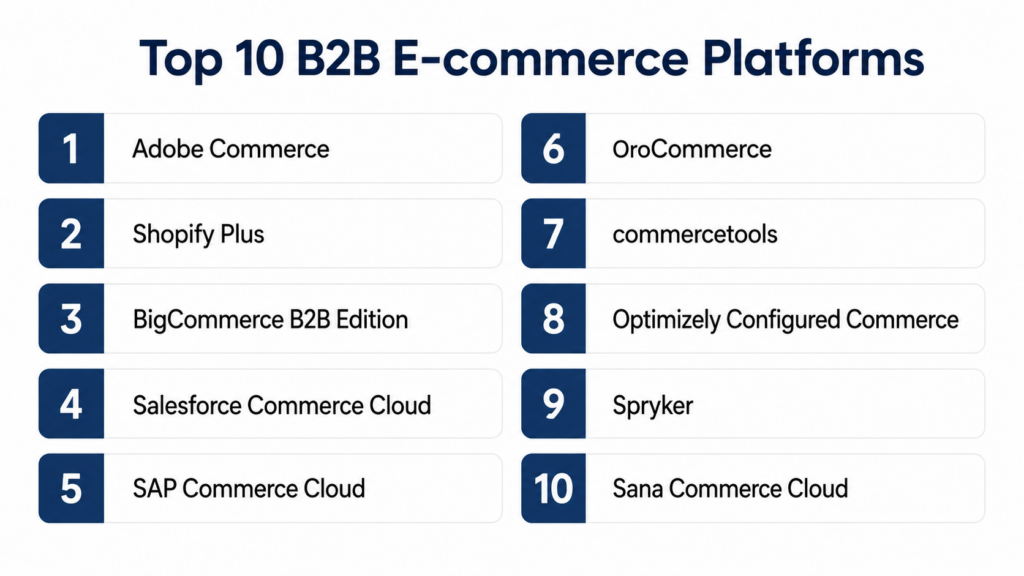
Introduction
B2B E-commerce Platforms help manufacturers, distributors, wholesalers, suppliers, and enterprise sellers sell products and services online to business customers. Unlike simple retail stores, B2B commerce usually needs account-based pricing, bulk ordering, custom catalogs, negotiated contracts, quote requests, purchase approvals, buyer roles, credit terms, tax rules, ERP integration, inventory visibility, and repeat ordering.
B2B e-commerce matters because business buyers now expect fast, self-service digital purchasing experiences similar to consumer shopping, but with enterprise-grade controls. Sales teams, distributors, procurement departments, and customers want accurate product data, real-time pricing, order tracking, and digital account management. Without a strong B2B commerce platform, companies often rely on emails, phone orders, spreadsheets, PDF catalogs, and manual ERP entry, which slows sales and increases errors.
Real World Use Cases:
- Launching a self-service online portal for distributors, dealers, and business customers
- Enabling account-specific pricing, catalogs, contracts, and payment terms
- Supporting bulk ordering, repeat ordering, reorder lists, and quick order forms
- Connecting online orders with ERP, CRM, inventory, tax, shipping, and fulfillment systems
- Managing complex product catalogs, variants, parts, SKUs, and replacement items
- Supporting quote requests, purchase approvals, sales rep-assisted ordering, and customer-specific workflows
Evaluation Criteria for Buyers:
- B2B catalog, pricing, and account management depth
- ERP, CRM, PIM, payment, tax, shipping, and fulfillment integrations
- Account-specific pricing, contract pricing, discounts, and quote workflows
- Buyer roles, permissions, approval workflows, and procurement controls
- Bulk ordering, repeat ordering, reorder lists, and quick order support
- Product information management and search quality
- Multi-site, multi-brand, multi-language, and multi-currency support
- Security controls, role permissions, audit logs, and data protection
- Ease of use for customers, sales reps, admins, and operations teams
- Implementation support, scalability, extensibility, and total cost
Best for: B2B E-commerce Platforms are best for manufacturers, distributors, wholesalers, industrial suppliers, building material companies, automotive parts sellers, medical supply companies, electrical suppliers, chemical distributors, food service suppliers, B2B marketplaces, sales operations teams, digital commerce teams, and enterprises that need a scalable online buying experience for business customers.
Not ideal for: B2B e-commerce platforms may not be necessary for very small sellers with limited products, simple pricing, and low order volume. In those cases, a basic website, retail e-commerce tool, manual invoicing system, or simple order form may be enough temporarily. However, once customer-specific pricing, ERP integration, bulk orders, product complexity, sales rep workflows, and business account controls become important, a dedicated B2B e-commerce platform becomes much more valuable.
Key Trends in B2B E-commerce Platforms
- Self-service buying is becoming standard: Business buyers increasingly want to place orders, reorder products, download invoices, check order history, and manage accounts without waiting for sales reps.
- ERP integration is still the foundation: B2B commerce success depends on accurate pricing, inventory, customer accounts, payment terms, order status, tax data, and fulfillment information from ERP systems.
- Account-based personalization is growing: B2B sellers need customer-specific catalogs, negotiated pricing, contract terms, product recommendations, and role-based buying experiences.
- Composable commerce is becoming popular: Many enterprises now prefer modular platforms that connect commerce, CMS, PIM, search, checkout, payments, and ERP through APIs.
- Headless commerce is gaining adoption: Businesses want flexible front-end experiences across web portals, mobile apps, marketplaces, dealer portals, and embedded commerce channels.
- AI-assisted product discovery is improving: Search, recommendations, product matching, spare parts discovery, and guided selling are becoming more intelligent.
- B2B marketplaces are expanding: Manufacturers and distributors are building supplier marketplaces, dealer networks, and multi-vendor buying experiences.
- Sales-assisted commerce remains important: B2B e-commerce does not replace sales teams; it often gives reps better tools for quoting, ordering, account management, and customer service.
- Payment flexibility is a key differentiator: Business buyers need invoices, credit terms, purchase orders, partial payments, bank transfers, cards, and approval-based purchasing.
- Omnichannel B2B commerce is now expected: Customers want the same account, pricing, catalog, order history, and support experience across online portals, sales reps, customer service, and marketplaces.
How We Selected These Tools
The Top 10 tools were selected using practical evaluation logic for B2B commerce buyers.
- Recognition in B2B e-commerce, digital commerce, enterprise commerce, wholesale commerce, and marketplace use cases
- Suitability for manufacturers, distributors, wholesalers, enterprise brands, mid-market sellers, and global B2B businesses
- Feature depth across account management, pricing, catalogs, bulk ordering, quotes, buyer roles, approvals, and order workflows
- Ability to support ERP integration, customer-specific pricing, inventory visibility, tax, shipping, payments, and fulfillment
- Flexibility for headless, composable, cloud, SaaS, marketplace, and enterprise deployment models
- Support for sales rep workflows, customer portals, distributor portals, dealer portals, and self-service buying
- Scalability across SKUs, customers, regions, currencies, languages, sites, brands, and order volume
- Security posture signals, access controls, role permissions, auditability, and enterprise data governance expectations
- Reporting depth for revenue, conversion, accounts, product performance, repeat orders, and customer behavior
- Vendor support, implementation ecosystem, developer resources, partner network, and long-term platform value
Top 10 B2B E-commerce Platforms
1- Adobe Commerce
Short description:
Adobe Commerce is a flexible digital commerce platform used by B2B and B2C businesses to build online stores, customer portals, and complex commerce experiences. For B2B commerce, it supports company accounts, shared catalogs, custom pricing, quotes, purchase orders, approval workflows, and account-specific buying experiences. It is especially useful for manufacturers, distributors, and wholesalers that need strong customization and integration flexibility. It is best for mid-market and enterprise teams that want a powerful, extensible commerce platform.
Key Features
- Company accounts and B2B customer management
- Shared catalogs and customer-specific pricing
- Quote requests, purchase orders, and approval workflows
- Bulk ordering, quick order, and requisition lists
- Flexible product catalog and merchandising capabilities
- ERP, PIM, CRM, payment, tax, and shipping integrations
- Headless and API-driven commerce options
Pros
- Strong customization and extension ecosystem
- Good fit for complex catalogs and B2B buying workflows
- Useful for companies needing both B2B and B2C commerce
Cons
- Implementation can require experienced developers or partners
- Maintenance effort can be higher than simpler SaaS platforms
- Best value depends on technical and integration readiness
Platforms / Deployment
Web / Cloud / Hybrid depending on configuration
Security & Compliance
Adobe environments commonly support enterprise security features depending on configuration. Buyers should verify SSO, MFA, encryption, RBAC, audit logs, data retention, and compliance documentation directly.
Integrations & Ecosystem
Adobe Commerce fits organizations that need a flexible B2B commerce platform connected with enterprise systems and digital experience tools.
- ERP and inventory systems
- PIM and product data tools
- CRM and marketing systems
- Payment, tax, and shipping providers
- Search, personalization, and analytics tools
- Headless front-end frameworks and APIs
Support & Community
Adobe Commerce has a large implementation partner ecosystem, developer community, documentation, training resources, and enterprise support options. Support quality depends on edition, implementation partner, hosting model, and internal technical capability.
2- Shopify Plus
Short description:
Shopify Plus is a SaaS commerce platform used by growing and enterprise businesses to launch scalable online storefronts quickly. For B2B commerce, it supports company profiles, customer-specific catalogs, price lists, payment terms, self-service buying, and wholesale-style account management depending on setup. It is especially useful for brands and distributors that want faster time to market with a managed SaaS platform. It is best for teams that prioritize ease of use, speed, and a strong app ecosystem.
Key Features
- B2B customer accounts and company profiles
- Customer-specific catalogs and price lists
- Payment terms and account-based buying workflows
- Self-service ordering and storefront management
- Strong checkout and storefront performance
- App ecosystem for integrations and extensions
- Integration with ERP, PIM, CRM, tax, shipping, and payment systems
Pros
- Fast deployment compared with many enterprise platforms
- Easy admin experience for commerce teams
- Strong app and agency ecosystem
Cons
- Very complex B2B workflows may require apps or custom development
- Deep enterprise ERP requirements should be validated
- Platform flexibility may be lower than fully composable options
Platforms / Deployment
Web / Cloud
Security & Compliance
Not publicly stated. Buyers should verify SSO, MFA, encryption, RBAC, audit logs, data protection, and compliance controls for their selected configuration.
Integrations & Ecosystem
Shopify Plus fits B2B sellers that need rapid commerce deployment with strong ecosystem support.
- ERP and accounting systems
- CRM and marketing platforms
- Product information systems
- Payment, tax, and shipping apps
- Marketplace and channel tools
- Analytics and reporting platforms
Support & Community
Shopify Plus provides platform support, documentation, agency partners, developer resources, and a large app ecosystem. Support quality depends on plan, implementation partner, and integration complexity.
3- BigCommerce B2B Edition
Short description:
BigCommerce B2B Edition is a SaaS commerce platform designed to support B2B selling with company accounts, account-specific pricing, quote management, bulk ordering, invoice payments, user roles, and customer-specific catalogs. It is especially useful for manufacturers, distributors, wholesalers, and brands that want SaaS flexibility with strong B2B functionality. The platform supports both traditional storefronts and headless commerce approaches. It is best for mid-market B2B sellers needing scalable commerce without heavy platform maintenance.
Key Features
- Company accounts and buyer user roles
- Customer-specific pricing and catalogs
- Quote management and sales rep-assisted buying
- Bulk ordering, quick ordering, and reorder workflows
- Invoice payments and B2B payment options
- ERP, PIM, CRM, tax, shipping, and payment integrations
- API and headless commerce support
Pros
- Strong SaaS B2B commerce capabilities
- Good fit for mid-market manufacturers and distributors
- Flexible headless and traditional storefront options
Cons
- Advanced enterprise workflows may still need customization
- Integration quality depends on ERP and partner setup
- Some specialized B2B use cases may require additional tools
Platforms / Deployment
Web / Cloud
Security & Compliance
Not publicly stated. Buyers should verify SSO, MFA, encryption, RBAC, audit logs, data retention, and compliance controls directly.
Integrations & Ecosystem
BigCommerce B2B Edition fits sellers that need strong B2B storefront capabilities with SaaS simplicity and integration flexibility.
- ERP and inventory systems
- PIM and product data tools
- CRM and marketing platforms
- Payment, tax, and shipping providers
- Headless front ends and APIs
- Analytics and business intelligence tools
Support & Community
BigCommerce provides customer support, documentation, implementation partners, developer resources, and an app ecosystem. Support quality depends on plan, partner, and integration complexity.
4- Salesforce Commerce Cloud
Short description:
Salesforce Commerce Cloud supports enterprise digital commerce across B2B and B2C channels, with strong alignment to Salesforce CRM, service, marketing, and revenue workflows. For B2B, it can support account-based buying, catalogs, pricing, ordering, self-service portals, and sales-assisted experiences. It is especially relevant for enterprises already using Salesforce for sales, service, and customer data. It is best for organizations that want commerce connected with CRM-driven customer engagement.
Key Features
- B2B account and customer management
- Catalog, pricing, and ordering workflows
- Integration with Salesforce Sales Cloud and Service Cloud
- Self-service customer portals
- Personalization and customer engagement capabilities
- API and headless commerce support depending on setup
- Reporting and analytics through Salesforce ecosystem
Pros
- Strong fit for Salesforce-centered enterprises
- Connects commerce with CRM, service, and customer engagement
- Useful for sales-assisted and self-service B2B commerce
Cons
- Implementation can require experienced Salesforce partners
- Costs may be high for smaller organizations
- Complex ERP and pricing integrations require careful planning
Platforms / Deployment
Web / Cloud
Security & Compliance
Salesforce environments commonly support identity controls, role-based access, encryption options, auditability, and enterprise security features depending on configuration. Buyers should verify commerce-specific controls directly.
Integrations & Ecosystem
Salesforce Commerce Cloud fits organizations that need B2B commerce connected with CRM, service, marketing, and revenue operations.
- Salesforce Sales Cloud and Service Cloud
- ERP and order management systems
- PIM and product data tools
- Payment, tax, and shipping systems
- Marketing and personalization tools
- Analytics and reporting dashboards
Support & Community
Salesforce provides enterprise support, implementation partners, documentation, training, and a large ecosystem. Support quality depends on implementation partner, system complexity, and Salesforce maturity.
5- SAP Commerce Cloud
Short description:
SAP Commerce Cloud is an enterprise commerce platform used by global companies to manage complex B2B and B2C commerce experiences. For B2B, it supports account-based purchasing, product catalogs, pricing, order management, self-service portals, and integration with SAP ERP and SAP S/4HANA. It is especially useful for SAP-centered manufacturers, distributors, and enterprises with complex commerce requirements. It is best for large organizations needing deep enterprise system integration and global scalability.
Key Features
- B2B customer account and organization management
- Complex product catalog and pricing support
- Self-service ordering and account portals
- Integration with SAP ERP and SAP S/4HANA
- Multi-site, multi-language, and multi-currency commerce
- Order management and customer service workflows
- API and headless commerce capabilities depending on setup
Pros
- Strong fit for SAP-centered enterprise environments
- Good for complex B2B commerce and global operations
- Useful for manufacturers and distributors with deep ERP needs
Cons
- Implementation can be complex and resource-intensive
- Best suited for larger organizations with SAP expertise
- Time to value may be longer than simpler SaaS platforms
Platforms / Deployment
Web / Cloud
Security & Compliance
SAP environments commonly support identity controls, role-based access, encryption, auditability, and enterprise security capabilities depending on configuration. Buyers should verify commerce-specific controls directly.
Integrations & Ecosystem
SAP Commerce Cloud fits enterprises that need commerce tightly connected with SAP back-office, pricing, product, and order workflows.
- SAP ERP and SAP S/4HANA
- SAP customer experience applications
- Product information management tools
- Payment, tax, and shipping systems
- Order management workflows
- Analytics and reporting platforms
Support & Community
SAP provides enterprise support, implementation partners, documentation, training, and a large ecosystem. Support quality depends on SAP architecture, partner capability, and commerce complexity.
6- OroCommerce
Short description:
OroCommerce is a B2B-first e-commerce platform designed specifically for manufacturers, distributors, wholesalers, and B2B sellers. It supports account structures, buyer roles, custom pricing, quotes, workflows, catalogs, approval rules, and complex B2B customer relationships. OroCommerce is especially useful for businesses that need B2B features as core functionality rather than add-ons. It is best for companies seeking a dedicated B2B commerce platform with strong workflow flexibility.
Key Features
- B2B account hierarchy and customer organization management
- Custom catalogs, price lists, and contract pricing
- Request for quote and negotiation workflows
- Buyer roles, permissions, and approval workflows
- Multi-website and multi-organization support
- CRM capabilities depending on configuration
- ERP, PIM, payment, tax, and shipping integrations
Pros
- Built specifically for B2B commerce workflows
- Strong fit for distributors, wholesalers, and manufacturers
- Flexible account, pricing, and quoting capabilities
Cons
- Implementation may require technical resources or partners
- Ecosystem may be smaller than larger commerce platforms
- Advanced front-end experience may require customization
Platforms / Deployment
Web / Cloud / Self-hosted / Hybrid depending on configuration
Security & Compliance
Not publicly stated. Buyers should verify SSO, MFA, encryption, RBAC, audit logs, data retention, and compliance controls directly.
Integrations & Ecosystem
OroCommerce fits organizations that need B2B commerce workflows connected with enterprise operations.
- ERP and order management systems
- PIM and product catalog tools
- CRM and sales workflows
- Payment, tax, and shipping systems
- Marketplace and supplier workflows
- Reporting and analytics tools
Support & Community
OroCommerce provides documentation, implementation partners, customer support, and developer resources. Support quality depends on hosting model, partner selection, and customization depth.
7- commercetools
Short description:
commercetools is a composable commerce platform that helps enterprises build flexible, API-first, headless commerce experiences across B2B and B2C channels. It is especially useful for organizations that want to design custom B2B buyer portals, marketplaces, self-service ordering flows, and omnichannel commerce experiences. The platform provides commerce building blocks rather than a fixed storefront. It is best for enterprises with strong technical teams and composable commerce strategies.
Key Features
- API-first and headless commerce architecture
- Flexible product, catalog, cart, pricing, and order capabilities
- Support for custom B2B commerce experiences
- Multi-channel and omnichannel commerce support
- Integration with front-end, ERP, PIM, CRM, and fulfillment systems
- Scalable cloud-native commerce infrastructure
- Composable architecture for enterprise commerce stacks
Pros
- Highly flexible for custom B2B commerce experiences
- Strong fit for composable and headless strategies
- Scales well for complex enterprise commerce architectures
Cons
- Requires strong technical and implementation capability
- Not an out-of-the-box B2B portal for non-technical teams
- Total cost depends on connected ecosystem and development work
Platforms / Deployment
Web / Cloud / API-first / Headless
Security & Compliance
Not publicly stated. Buyers should verify SSO, MFA, encryption, RBAC, audit logs, data governance, and compliance documentation directly.
Integrations & Ecosystem
commercetools fits enterprises building custom B2B commerce architectures with modular systems.
- Headless front-end frameworks
- ERP and order management systems
- PIM and search platforms
- CRM and customer data platforms
- Payment, tax, and fulfillment systems
- Analytics and personalization tools
Support & Community
commercetools provides enterprise support, documentation, implementation partners, developer resources, and composable commerce expertise. Support quality depends on technical architecture and partner capability.
8- Optimizely Configured Commerce
Short description:
Optimizely Configured Commerce is a B2B commerce platform designed for manufacturers and distributors that need strong catalog, pricing, account, and ERP-integrated buying experiences. It supports customer-specific pricing, product data, order history, reorder workflows, account management, and B2B self-service. It is especially useful for industrial, distribution, and manufacturing businesses with complex product catalogs. It is best for organizations needing B2B commerce plus digital experience capabilities.
Key Features
- B2B account and customer portal capabilities
- Customer-specific pricing and catalogs
- ERP-integrated inventory, order, and account data
- Reorder, quick order, and order history workflows
- Product search and catalog management
- Content and digital experience support depending on setup
- Analytics and personalization capabilities
Pros
- Strong fit for manufacturers and distributors
- Good ERP-connected B2B commerce workflows
- Useful for self-service ordering and account portals
Cons
- Implementation requires clean ERP and product data
- Best fit is B2B sellers with established digital commerce maturity
- Advanced marketplace use cases may need additional tools
Platforms / Deployment
Web / Cloud
Security & Compliance
Not publicly stated. Buyers should verify SSO, MFA, encryption, RBAC, audit logs, data retention, and compliance documentation directly.
Integrations & Ecosystem
Optimizely Configured Commerce fits organizations that need B2B commerce connected with product, inventory, and account systems.
- ERP and inventory systems
- PIM and product content tools
- CRM and marketing platforms
- Payment, tax, and shipping systems
- Analytics and personalization tools
- Digital experience workflows
Support & Community
Optimizely provides implementation partners, documentation, customer support, developer resources, and digital experience expertise. Support quality depends on solution scope and implementation partner.
9- Spryker
Short description:
Spryker is a composable commerce platform used for B2B, B2C, marketplace, unified commerce, and complex digital business models. For B2B sellers, it supports custom commerce experiences, marketplace models, account workflows, pricing, catalog logic, and modular architecture. It is especially useful for companies building differentiated commerce models rather than simple storefronts. It is best for enterprises that need flexibility across B2B commerce, marketplaces, and complex digital channels.
Key Features
- Composable commerce architecture
- B2B commerce and marketplace capabilities
- Account, catalog, pricing, and checkout workflows
- Modular business capabilities for custom use cases
- Multi-channel and multi-business model support
- API-driven integration with enterprise systems
- Scalable commerce infrastructure
Pros
- Strong flexibility for complex B2B and marketplace models
- Useful for enterprises building custom commerce ecosystems
- Supports modular and composable architecture
Cons
- Requires technical implementation expertise
- May be more complex than simple B2B storefront needs
- Total cost depends on architecture and implementation scope
Platforms / Deployment
Web / Cloud / API-first / Headless depending on configuration
Security & Compliance
Not publicly stated. Buyers should verify SSO, MFA, encryption, RBAC, audit logs, data governance, and compliance controls directly.
Integrations & Ecosystem
Spryker fits enterprises that need modular B2B commerce connected with complex systems and custom channels.
- ERP and order systems
- PIM and catalog tools
- Marketplace and supplier systems
- CRM and customer data systems
- Payment, tax, and logistics providers
- Analytics and experience platforms
Support & Community
Spryker provides implementation partners, documentation, customer support, and composable commerce expertise. Support quality depends on architecture complexity and partner capability.
10- Sana Commerce Cloud
Short description:
Sana Commerce Cloud is a B2B e-commerce platform designed to integrate deeply with ERP systems, especially for manufacturers, distributors, and wholesalers. It focuses on using ERP data for product information, pricing, inventory, customer accounts, order history, and order processing. This helps companies create reliable self-service portals without duplicating core business data. It is best for B2B sellers that want ERP-driven e-commerce with accurate operational data.
Key Features
- ERP-integrated B2B e-commerce storefronts
- Customer-specific pricing and catalogs
- Real-time inventory, order history, and account data depending on ERP setup
- Quick ordering, reorder, and self-service workflows
- Customer portal and account management
- Payment, tax, shipping, and fulfillment integrations
- Reporting and commerce analytics
Pros
- Strong ERP-driven commerce approach
- Useful for manufacturers, distributors, and wholesalers
- Reduces duplicate data between commerce and ERP systems
Cons
- Best value depends on ERP compatibility and data quality
- Custom front-end flexibility may be lower than headless platforms
- Complex marketplace models may require additional tools
Platforms / Deployment
Web / Cloud
Security & Compliance
Not publicly stated. Buyers should verify SSO, MFA, encryption, RBAC, audit logs, data retention, and compliance controls directly.
Integrations & Ecosystem
Sana Commerce Cloud fits organizations that want commerce tightly connected to ERP data and operational workflows.
- ERP systems
- Product and inventory data
- Customer account and order data
- Payment, tax, and shipping systems
- CRM and marketing systems
- Analytics and reporting tools
Support & Community
Sana provides implementation support, documentation, customer success resources, and ERP-focused commerce expertise. Support quality depends on ERP setup, data readiness, and commerce requirements.
Comparison Table
| Tool Name | Best For | Platform Supported | Deployment | Standout Feature | Public Rating |
|---|---|---|---|---|---|
| Adobe Commerce | Flexible B2B and B2C commerce customization | Web | Cloud / Hybrid | Extensible B2B commerce with strong customization | N/A |
| Shopify Plus | Fast SaaS commerce deployment | Web | Cloud | Easy-to-manage B2B storefront and app ecosystem | N/A |
| BigCommerce B2B Edition | Mid-market B2B SaaS commerce | Web | Cloud | Strong built-in B2B features with SaaS simplicity | N/A |
| Salesforce Commerce Cloud | Salesforce-centered enterprises | Web | Cloud | Commerce connected with Salesforce CRM and service | N/A |
| SAP Commerce Cloud | SAP-centered global enterprises | Web | Cloud | Deep SAP ERP-connected enterprise commerce | N/A |
| OroCommerce | B2B-first manufacturers and distributors | Web | Cloud / Self-hosted / Hybrid | Purpose-built B2B workflows and account structures | N/A |
| commercetools | Composable and headless enterprise commerce | Web, API | Cloud | API-first commerce for custom B2B experiences | N/A |
| Optimizely Configured Commerce | Manufacturers and distributors | Web | Cloud | ERP-connected B2B self-service commerce | N/A |
| Spryker | Complex B2B and marketplace models | Web, API | Cloud / Headless | Modular commerce for custom business models | N/A |
| Sana Commerce Cloud | ERP-driven B2B portals | Web | Cloud | Real-time ERP-integrated B2B commerce | N/A |
Evaluation & Scoring of B2B E-commerce Platforms
| Tool Name | Core 25% | Ease 15% | Integrations 15% | Security 10% | Performance 10% | Support 10% | Value 15% | Weighted Total 0–10 |
|---|---|---|---|---|---|---|---|---|
| Adobe Commerce | 9.0 | 7.5 | 9.0 | 8.4 | 8.6 | 8.5 | 7.8 | 8.5 |
| Shopify Plus | 8.2 | 9.0 | 8.5 | 8.3 | 8.8 | 8.6 | 8.4 | 8.5 |
| BigCommerce B2B Edition | 8.6 | 8.5 | 8.6 | 8.2 | 8.6 | 8.4 | 8.3 | 8.5 |
| Salesforce Commerce Cloud | 8.8 | 7.7 | 9.0 | 8.6 | 8.7 | 8.7 | 7.6 | 8.5 |
| SAP Commerce Cloud | 9.0 | 7.2 | 9.2 | 8.6 | 8.7 | 8.7 | 7.5 | 8.5 |
| OroCommerce | 8.8 | 7.8 | 8.5 | 8.1 | 8.4 | 8.2 | 8.1 | 8.4 |
| commercetools | 8.8 | 7.0 | 9.2 | 8.5 | 9.0 | 8.5 | 7.7 | 8.4 |
| Optimizely Configured Commerce | 8.5 | 8.0 | 8.5 | 8.2 | 8.5 | 8.4 | 8.0 | 8.3 |
| Spryker | 8.6 | 7.2 | 8.8 | 8.2 | 8.7 | 8.3 | 7.7 | 8.2 |
| Sana Commerce Cloud | 8.4 | 8.2 | 8.8 | 8.1 | 8.5 | 8.4 | 8.2 | 8.4 |
These scores are comparative and should be used as a practical guide, not as a universal ranking. A platform with a slightly lower score may be the best fit if it matches your ERP environment, product complexity, customer account structure, digital maturity, and budget. SaaS platforms may be faster to launch, while composable and enterprise platforms may offer deeper flexibility. B2B-first platforms can be especially valuable when account hierarchy, custom pricing, and self-service ordering are central requirements.
Which B2B E-commerce Platform Is Right for You?
Solo / Freelancer
Solo consultants, e-commerce advisors, digital transformation specialists, and implementation experts usually do not need a full B2B commerce platform for internal use. They may support clients with platform selection, ERP integration planning, catalog cleanup, buyer journey design, and implementation strategy. Adobe Commerce, Shopify Plus, BigCommerce, Salesforce Commerce Cloud, SAP Commerce Cloud, OroCommerce, and Sana knowledge can be especially useful.
For smaller clients, Shopify Plus or BigCommerce may be practical. For enterprise clients, Adobe Commerce, SAP Commerce Cloud, Salesforce Commerce Cloud, commercetools, Spryker, or OroCommerce may be more relevant.
SMB
Small and mid-sized B2B sellers should start with the biggest operational problem. If customers need simple online ordering, Shopify Plus or BigCommerce may be practical. If ERP accuracy is critical, Sana Commerce Cloud or ERP-integrated platforms may be more relevant. If B2B workflows are complex, OroCommerce can be a strong fit.
SMBs should avoid overbuilding a fully composable architecture before they have strong product data, clear pricing rules, and digital operations. A fast, reliable portal with account pricing and reorder capabilities can create immediate value.
Mid-Market
Mid-market manufacturers, distributors, and wholesalers usually need account-specific pricing, customer catalogs, ERP integration, reorder workflows, quote requests, sales rep visibility, and product search. BigCommerce B2B Edition, Adobe Commerce, OroCommerce, Optimizely Configured Commerce, Sana Commerce Cloud, and Shopify Plus can all be relevant depending on architecture and complexity.
Mid-market buyers should evaluate ERP integration carefully. B2B commerce fails quickly when prices, inventory, and order status are inaccurate.
Enterprise
Large enterprises need scalable B2B commerce across entities, regions, currencies, languages, brands, channels, customers, roles, and integration points. SAP Commerce Cloud, Salesforce Commerce Cloud, Adobe Commerce, commercetools, Spryker, Optimizely Configured Commerce, and OroCommerce are strong enterprise candidates depending on operating model.
Enterprise buyers should define product data governance, pricing architecture, customer account structures, API strategy, order management, and support workflows before implementation. B2B commerce is a business transformation project, not only a storefront launch.
Budget vs Premium
Budget-focused buyers should begin with the simplest platform that supports account pricing, product catalog, order history, payments, and ERP connection. SaaS platforms can reduce infrastructure effort and speed up launch. However, complex pricing or ERP workflows may still require customization.
Premium platforms make sense when product catalogs are complex, global selling is required, customer-specific pricing is extensive, or commerce must connect deeply with ERP, CRM, PIM, OMS, and marketplace systems. The cost should be compared with increased self-service sales, lower manual order entry, better customer retention, and faster ordering.
Feature Depth vs Ease of Use
Shopify Plus and BigCommerce are strong when ease of use and speed matter. Adobe Commerce and OroCommerce are strong when customization and B2B workflows matter. SAP Commerce Cloud and Salesforce Commerce Cloud are strong for enterprise ecosystem alignment. commercetools and Spryker are strong for composable and headless strategies. Sana Commerce Cloud and Optimizely Configured Commerce are strong for ERP-connected manufacturer and distributor experiences.
Choose feature depth when account structures, pricing, workflows, and integrations are complex. Choose ease of use when the main goal is faster launch and simpler admin management.
Integrations & Scalability
B2B E-commerce Platforms should integrate with ERP, CRM, PIM, order management, inventory, warehouse management, tax, shipping, payments, procurement systems, customer service, marketing automation, analytics, and business intelligence tools. ERP and PIM integrations are especially important because pricing, inventory, and product data must be accurate.
Scalability depends on SKU count, customer count, order volume, regions, languages, currencies, catalogs, and integration frequency. A strong platform should support growth without forcing teams back to phone orders and manual entry.
Security & Compliance Needs
B2B commerce platforms store customer account data, pricing, negotiated contracts, payment terms, tax information, order history, buyer roles, addresses, and transaction records. Buyers should evaluate SSO, MFA, encryption, RBAC, audit logs, data retention, admin permissions, and secure API access.
Organizations should define who can view contract pricing, place orders, approve purchases, manage users, edit catalogs, and export customer data. If a vendor does not clearly confirm a security or compliance control, request documentation before implementation.
Frequently Asked Questions
1. What is a B2B E-commerce Platform?
A B2B E-commerce Platform is software that allows businesses to sell products or services online to other businesses. It supports business-specific needs such as account-based pricing, bulk ordering, customer catalogs, buyer roles, quote requests, invoice payments, and ERP integration. Unlike consumer e-commerce, B2B commerce often involves negotiated pricing, repeat orders, purchase approvals, and complex product data. These platforms help sellers reduce manual order entry and give customers a self-service buying portal. The main goal is to make business purchasing faster, more accurate, and easier to manage.
2. How is B2B e-commerce different from B2C e-commerce?
B2C e-commerce usually serves individual consumers with standard prices, simple checkout, and direct payment. B2B e-commerce serves business customers that may have account-specific pricing, payment terms, buyer permissions, purchase orders, approvals, contracts, tax rules, and bulk ordering needs. B2B buyers may reorder frequently, negotiate pricing, and need invoices or credit terms. Product catalogs may also vary by customer or region. This makes B2B commerce more complex than standard retail e-commerce.
3. How much do B2B E-commerce Platforms cost?
Pricing varies based on platform type, users, transaction volume, SKU count, integrations, storefronts, custom workflows, hosting model, implementation services, and support level. SaaS platforms may have subscription pricing, while enterprise and composable platforms often require larger implementation budgets. Costs may also include ERP integration, PIM setup, design, development, data migration, tax, shipping, payments, and ongoing maintenance. Buyers should evaluate total cost of ownership. The business case should include increased online sales, lower manual order costs, better customer retention, and faster ordering.
4. How long does B2B e-commerce implementation usually take?
Implementation time depends on product data quality, ERP integration, customer pricing complexity, catalog structure, payment rules, shipping logic, user roles, and design requirements. A simple B2B storefront can launch faster than a global enterprise portal with multiple regions, currencies, catalogs, and systems. Product data cleanup and ERP integration often take the most effort. A phased rollout is usually best. Start with a specific customer segment or product category, then expand after validating order flow and user adoption.
5. What are common mistakes when choosing a B2B commerce platform?
A common mistake is choosing a platform based only on storefront design while ignoring ERP integration, pricing rules, and customer account workflows. Another mistake is underestimating product data cleanup. Some companies try to copy a B2C shopping experience without supporting business buying requirements like quotes, approvals, and reorder lists. Others overbuild a complex architecture before validating customer adoption. The best selection process tests real customers, real pricing, real orders, real integrations, and real support workflows.
6. Can B2B commerce platforms support customer-specific pricing?
Yes, many B2B commerce platforms support customer-specific pricing, contract pricing, account-based price lists, discount rules, tiered pricing, and negotiated terms. The depth varies by platform. Some systems store pricing inside the commerce platform, while others pull pricing from ERP in real time. Buyers should test complex pricing scenarios before selecting a platform. Pricing accuracy is one of the most important success factors in B2B commerce.
7. What is headless B2B commerce?
Headless B2B commerce separates the front-end customer experience from the back-end commerce engine. This allows companies to build custom web portals, mobile apps, dealer portals, marketplaces, or embedded buying experiences while using commerce APIs for catalog, cart, pricing, and order logic. Headless architecture offers flexibility but requires stronger technical skills. It is useful for enterprises with custom digital experiences. It may be unnecessary for companies that only need a standard B2B storefront.
8. What integrations are most important for B2B e-commerce?
Important integrations include ERP, CRM, PIM, inventory, order management, warehouse management, payment gateways, tax engines, shipping systems, customer service platforms, marketing automation, and analytics tools. ERP integration is often the most critical because B2B commerce depends on accurate pricing, inventory, order status, customer accounts, and payment terms. PIM integration is important for rich product data. CRM integration helps sales and service teams support digital customers. Poor integrations often lead to order errors and customer frustration.
9. How should buyers evaluate product catalog capabilities?
Buyers should evaluate whether the platform can handle large SKU counts, product variants, replacement parts, technical specifications, images, documents, compatibility data, customer-specific catalogs, and search filters. B2B catalogs often require more technical detail than retail catalogs. Search quality is especially important because business buyers need to find exact products quickly. Product data should be easy to update and govern. A strong catalog experience can significantly improve online conversion and customer satisfaction.
10. Can B2B e-commerce reduce manual sales work?
Yes, B2B e-commerce can reduce manual work by allowing customers to place repeat orders, check inventory, download invoices, view order history, request quotes, and manage account details online. Sales reps can spend less time on routine order entry and more time on strategic accounts. Customer service teams can also reduce repetitive status inquiries. However, sales teams still play an important role in complex deals and relationship management. The best B2B commerce strategy supports both self-service and sales-assisted buying.
Conclusion
B2B E-commerce Platforms help manufacturers, distributors, wholesalers, and enterprise sellers create self-service buying experiences that support account-based pricing, customer catalogs, bulk ordering, quote workflows, ERP integration, and repeat purchasing. The best platform depends on product complexity, ERP environment, technical maturity, customer expectations, implementation budget, and long-term digital commerce strategy. Adobe Commerce is strong for flexible customization, Shopify Plus is strong for fast SaaS deployment, BigCommerce B2B Edition offers strong built-in B2B capabilities, Salesforce Commerce Cloud fits Salesforce-centered enterprises, SAP Commerce Cloud fits SAP-centered global organizations, OroCommerce is purpose-built for B2B workflows, commercetools and Spryker are strong for composable commerce, Optimizely Configured Commerce is strong for manufacturers and distributors, and Sana Commerce Cloud is valuable for ERP-driven B2B portals. There is no single universal winner because an industrial distributor, wholesale brand, manufacturing company, healthcare supplier, B2B marketplace, and global enterprise all sell differently.

All-inclusive integrated wholesale digital transactional storefront infrastructure software deployment. Corporate client procurement logistics for prompt enterprise market interaction monitoring and seamless high-volume commerce orchestrations workflows.