MOTOSHARE 🚗🏍️
Rent Bikes & Cars Directly from Owners
Motoshare connects vehicle owners with people who need bikes and cars on rent. Owners earn from idle vehicles, and renters get flexible ride options.
Visit Motoshare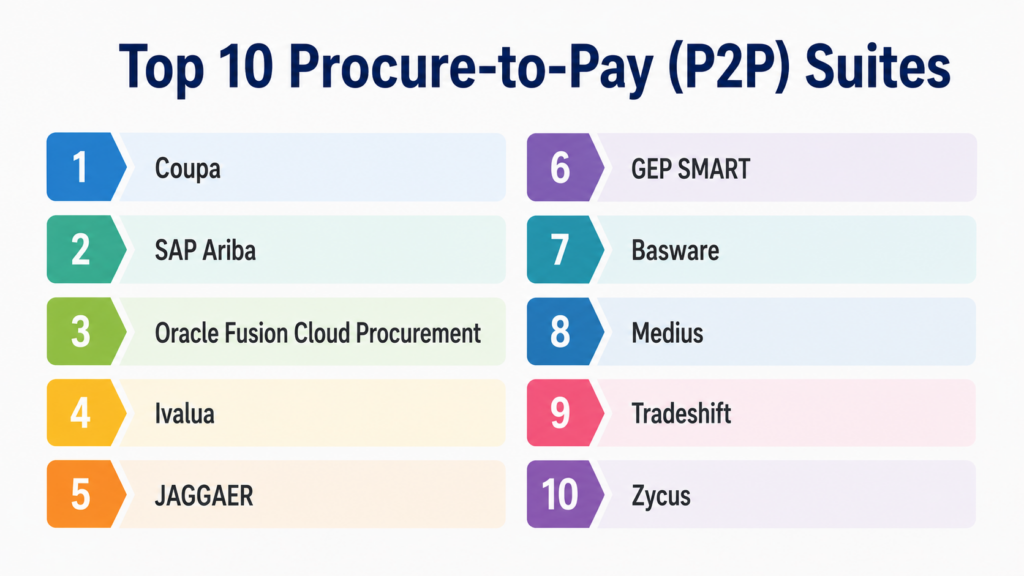
Introduction
Procure-to-Pay P2P Suites help organizations manage the complete purchasing cycle from requisition to purchase order, supplier collaboration, goods receipt, invoice processing, approvals, payment readiness, and spend visibility. In simple terms, P2P software connects procurement and accounts payable so companies can buy goods and services, control spend, process invoices, and pay suppliers with fewer manual steps.
P2P suites matter because procurement and finance teams often deal with scattered purchase requests, manual approvals, supplier emails, duplicate invoices, budget leakage, contract non-compliance, delayed payments, and poor visibility into spend. A strong P2P platform helps standardize purchasing, enforce policies, improve supplier collaboration, reduce invoice errors, and support better cash flow management.
Real World Use Cases:
- Managing purchase requisitions, purchase orders, approvals, and receipts
- Automating invoice capture, matching, exception handling, and payment workflows
- Enforcing procurement policies, budgets, contracts, and preferred supplier usage
- Improving supplier onboarding, catalogs, communication, and collaboration
- Reducing maverick spend, duplicate invoices, and manual AP workload
- Creating spend visibility for finance, procurement, category, and executive teams
Evaluation Criteria for Buyers:
- Requisition, purchase order, and approval workflow depth
- Invoice automation, matching, exception handling, and AP controls
- Supplier onboarding, supplier portal, and collaboration features
- Catalog management, punchout, contract compliance, and guided buying
- Budget control, spend visibility, analytics, and reporting
- ERP, finance, payment, tax, procurement, and supplier network integrations
- Workflow configurability, approval routing, and policy enforcement
- Security controls, role permissions, audit logs, and data governance
- Ease of use for requesters, buyers, approvers, suppliers, and AP teams
- Implementation support, scalability, supplier adoption, and total cost
Best for: Procure-to-Pay P2P Suites are best for procurement leaders, finance teams, accounts payable teams, CFO offices, sourcing teams, category managers, shared services centers, supplier management teams, enterprise operations teams, and organizations that want tighter control over purchasing, invoicing, approvals, and supplier payments.
Not ideal for: P2P suites may not be necessary for very small businesses with low purchase volume, few suppliers, and simple invoice processing needs. In those cases, basic accounting software, spreadsheets, email approvals, or lightweight expense tools may be enough temporarily. However, once purchase volume, supplier count, approval complexity, compliance needs, and invoice workload increase, a dedicated P2P suite becomes much more valuable.
Key Trends in Procure-to-Pay P2P Suites
- AI-assisted invoice automation is becoming standard: P2P platforms increasingly use AI and machine learning to extract invoice data, detect duplicates, predict coding, and route exceptions.
- Guided buying is improving user adoption: Employees want a shopping-like buying experience that helps them choose approved suppliers, catalogs, contracts, and buying channels.
- Supplier networks are becoming more important: Organizations want better supplier onboarding, communication, invoice status visibility, and collaboration without relying on email.
- Procurement and AP are becoming more connected: P2P suites are helping procurement and finance teams work from shared purchase, receipt, invoice, and payment data.
- Spend control is shifting earlier in the process: Instead of fixing problems after invoices arrive, companies want policy enforcement at requisition, approval, and purchase order creation.
- ERP integration remains critical: P2P software must connect cleanly with ERP, accounting, tax, payment, vendor master, general ledger, and budgeting systems.
- Exception management is a major efficiency driver: AP teams want fewer manual invoice holds, faster three-way matching, clearer dispute workflows, and better supplier communication.
- Global compliance needs are increasing: Multi-country organizations need tax handling, e-invoicing support, audit trails, localization, and compliant approval workflows.
- Analytics are moving beyond spend reports: Teams want dashboards for savings leakage, supplier performance, invoice cycle time, early payment opportunities, and policy compliance.
- Composable procurement stacks are growing: Some organizations use one suite for end-to-end P2P, while others connect best-of-breed sourcing, contract, AP, ERP, and payment tools.
How We Selected These Tools
The Top 10 tools were selected using practical evaluation logic for P2P buyers.
- Recognition in enterprise procurement, accounts payable automation, supplier management, and spend management
- Suitability for mid-market companies, large enterprises, global businesses, and shared services teams
- Feature depth across requisitions, purchase orders, approvals, invoices, receipts, suppliers, and payments
- Ability to support guided buying, catalogs, punchout, contracts, supplier portals, and policy controls
- Integration potential with ERP, accounting, tax, payment, sourcing, contract, and vendor master systems
- Invoice automation strength, including capture, coding, matching, exceptions, and audit trails
- Reporting depth for spend visibility, AP performance, supplier performance, and compliance
- Scalability across business units, entities, countries, currencies, suppliers, and approval structures
- Security posture signals, role permissions, auditability, and enterprise data protection expectations
- Vendor support, implementation maturity, supplier onboarding help, and long-term platform value
Top 10 Procure-to-Pay P2P Suites
1- Coupa
Short description:
Coupa is a cloud-based business spend management platform that includes strong procure-to-pay capabilities for requisitions, approvals, purchase orders, invoices, suppliers, expenses, contracts, sourcing, and spend analytics. It is especially useful for organizations that want procurement, finance, and supplier workflows connected in one spend platform. Coupa is known for guided buying, spend visibility, and broad supplier collaboration. It is best for mid-market and enterprise organizations seeking a modern, scalable P2P suite.
Key Features
- Guided buying and requisition workflows
- Purchase order management and approval routing
- Invoice capture, matching, and exception handling
- Supplier portal and supplier collaboration
- Spend analytics and budget visibility
- Catalog, punchout, and contract compliance support
- Integration with ERP, finance, sourcing, and payment systems
Pros
- Strong end-to-end spend management coverage
- User-friendly buying experience for employees
- Good fit for enterprises seeking procurement and AP alignment
Cons
- Implementation requires process design and supplier onboarding
- Costs may be high for smaller organizations
- Best value depends on strong adoption across procurement and finance
Platforms / Deployment
Web / iOS / Android / Cloud
Security & Compliance
Not publicly stated. Buyers should verify SSO, MFA, encryption, RBAC, audit logs, data retention, and compliance documentation directly.
Integrations & Ecosystem
Coupa fits organizations that need P2P connected with spend management, supplier collaboration, sourcing, contracts, and ERP workflows.
- ERP and finance systems
- Supplier portals and networks
- Sourcing and contract workflows
- Payment and virtual card workflows
- Tax and compliance systems
- Business intelligence and analytics tools
Support & Community
Coupa provides onboarding, implementation support, documentation, training, partner services, and customer success resources. Support quality depends on module scope, integration complexity, and supplier adoption strategy.
2- SAP Ariba
Short description:
SAP Ariba is an enterprise procurement and supplier collaboration platform that supports sourcing, contracts, supplier management, procurement, invoicing, and spend visibility. Its P2P capabilities help organizations manage requisitions, purchase orders, catalogs, supplier collaboration, invoice processing, and procurement compliance. It is especially relevant for enterprises using SAP ERP or SAP S/4HANA. It is best for large and global organizations that need procurement depth and supplier network scale.
Key Features
- Requisition, purchase order, and approval workflows
- Supplier network and supplier collaboration
- Catalog and punchout support
- Invoice processing and matching workflows
- Sourcing and contract integration
- Procurement policy and compliance controls
- Integration with SAP ERP and enterprise finance systems
Pros
- Strong enterprise procurement and supplier network capabilities
- Good fit for SAP-centered organizations
- Supports global procurement and supplier collaboration
Cons
- Implementation can be complex for large organizations
- User experience depends on configuration quality
- Smaller companies may find it too broad or resource-intensive
Platforms / Deployment
Web / Cloud
Security & Compliance
SAP environments commonly support identity controls, role-based access, encryption, auditability, and enterprise security capabilities depending on configuration. Buyers should verify specific controls directly.
Integrations & Ecosystem
SAP Ariba fits organizations that need procurement, supplier, invoice, contract, and ERP workflows connected at enterprise scale.
- SAP ERP and SAP S/4HANA
- Supplier network workflows
- Contract and sourcing systems
- Invoice and payment workflows
- Tax and compliance systems
- Spend analytics and reporting tools
Support & Community
SAP provides enterprise support, implementation partners, documentation, training, and a large ecosystem. Support quality depends on implementation partner quality, SAP architecture, and procurement process maturity.
3- Oracle Fusion Cloud Procurement
Short description:
Oracle Fusion Cloud Procurement supports source-to-pay and procure-to-pay workflows for enterprises using Oracle Cloud applications or broader Oracle finance environments. It helps teams manage requisitions, purchase orders, supplier collaboration, contracts, sourcing, procurement approvals, and invoice-related workflows. The platform is especially useful for organizations that want procurement connected with Oracle ERP, financials, and supply chain systems. It is best for Oracle-centered enterprises seeking integrated procurement and finance control.
Key Features
- Requisition and purchase order management
- Supplier qualification and supplier portal workflows
- Catalog, contract, and guided procurement support
- Procurement approvals and policy enforcement
- Integration with Oracle Financials and ERP workflows
- Sourcing and supplier collaboration capabilities
- Reporting and procurement analytics
Pros
- Strong fit for Oracle Cloud ERP environments
- Integrated procurement and finance data model
- Useful for enterprises seeking standardized procurement workflows
Cons
- Best value depends on Oracle ecosystem alignment
- Implementation may require experienced Oracle configuration support
- Supplier collaboration depth should be validated by use case
Platforms / Deployment
Web / Cloud
Security & Compliance
Oracle environments commonly support identity management, encryption, role-based access, auditability, and enterprise security features depending on configuration. Buyers should verify procurement-specific controls directly.
Integrations & Ecosystem
Oracle Fusion Cloud Procurement fits organizations that need P2P tightly connected with ERP, finance, supply chain, and enterprise reporting.
- Oracle Cloud ERP
- Oracle Financials
- Supplier management systems
- Contract and sourcing workflows
- Tax and payment systems
- Analytics and reporting dashboards
Support & Community
Oracle provides enterprise support, implementation partners, documentation, training, and customer resources. Support quality depends on deployment scope, integration needs, and Oracle expertise.
4- Ivalua
Short description:
Ivalua is a source-to-pay platform that supports procurement, supplier management, sourcing, contracts, procurement operations, invoicing, and spend analytics. Its P2P capabilities help organizations manage purchase requests, approvals, purchase orders, supplier catalogs, invoices, and compliance workflows. The platform is known for configurability and broad spend management coverage. It is best for organizations that need flexible procurement processes across complex business units, categories, and geographies.
Key Features
- Procure-to-pay and source-to-pay workflows
- Requisition, purchase order, and invoice management
- Supplier management and collaboration
- Catalog, contract, and procurement policy controls
- Spend analytics and reporting
- Workflow configurability and approval routing
- Integration with ERP and finance systems
Pros
- Highly configurable source-to-pay platform
- Strong supplier and procurement workflow coverage
- Good fit for complex enterprise procurement environments
Cons
- Configuration flexibility requires strong implementation planning
- May be more than small teams need
- User adoption depends on clean workflow design
Platforms / Deployment
Web / Cloud
Security & Compliance
Not publicly stated. Buyers should verify SSO, MFA, encryption, RBAC, audit logs, data retention, and compliance controls directly.
Integrations & Ecosystem
Ivalua fits organizations that need procurement, supplier, sourcing, contract, invoice, and spend workflows connected in a configurable platform.
- ERP and finance systems
- Supplier portals and data workflows
- Sourcing and contract management
- Invoice automation workflows
- Spend analytics systems
- Tax, payment, and compliance systems
Support & Community
Ivalua provides implementation support, partner services, documentation, training, and customer success resources. Support quality depends on project complexity, configuration scope, and integration needs.
5- JAGGAER
Short description:
JAGGAER is a procurement and supplier collaboration platform that supports source-to-pay and procure-to-pay workflows for enterprises, public sector organizations, education, healthcare, manufacturing, and regulated industries. It helps teams manage requisitions, catalogs, purchase orders, supplier collaboration, contracts, invoices, and spend visibility. The platform is especially useful for organizations with complex supplier networks and category-specific procurement needs. It is best for procurement teams that need supplier depth and industry-specific procurement workflows.
Key Features
- Requisition, approval, and purchase order workflows
- Supplier management and supplier collaboration
- Catalog and punchout support
- Contract and sourcing workflow integration
- Invoice processing and matching support
- Spend analytics and procurement reporting
- Industry-specific procurement workflow support
Pros
- Strong supplier and procurement network functionality
- Useful for education, healthcare, manufacturing, and public sector procurement
- Good fit for complex category and supplier environments
Cons
- Implementation can require supplier and catalog cleanup
- User experience depends on configuration
- Invoice automation depth should be validated for AP-heavy use cases
Platforms / Deployment
Web / Cloud
Security & Compliance
Not publicly stated. Buyers should verify SSO, MFA, encryption, RBAC, audit logs, data retention, and compliance controls directly.
Integrations & Ecosystem
JAGGAER fits organizations that need procurement, supplier, contract, catalog, and invoice workflows connected with enterprise systems.
- ERP and finance systems
- Supplier portals and networks
- Contract and sourcing workflows
- Catalog and punchout systems
- Invoice and AP workflows
- Analytics and reporting tools
Support & Community
JAGGAER provides implementation support, documentation, customer services, training, and procurement domain expertise. Support quality depends on industry needs, supplier network complexity, and integration scope.
6- GEP SMART
Short description:
GEP SMART is a unified procurement platform covering sourcing, supplier management, contracts, procurement, invoices, savings tracking, and spend analytics. Its P2P capabilities help organizations manage buying, supplier collaboration, purchase orders, invoice workflows, and spend compliance. The platform is especially relevant for enterprises seeking procurement transformation and category management support. It is best for organizations that want source-to-pay software combined with procurement consulting and transformation expertise.
Key Features
- Source-to-pay and procure-to-pay workflows
- Requisitions, purchase orders, and approvals
- Supplier management and collaboration
- Invoice processing and spend compliance
- Sourcing, contracts, and savings tracking
- Spend analytics and category visibility
- Integration with ERP and finance systems
Pros
- Unified procurement platform with strong consulting alignment
- Useful for enterprise procurement transformation
- Good coverage across sourcing, P2P, suppliers, and analytics
Cons
- Best value depends on transformation scope and adoption
- Implementation requires process alignment
- Smaller companies may not need full source-to-pay depth
Platforms / Deployment
Web / Cloud
Security & Compliance
Not publicly stated. Buyers should verify SSO, MFA, encryption, RBAC, audit logs, data retention, and compliance documentation directly.
Integrations & Ecosystem
GEP SMART fits organizations that need procurement workflows connected across sourcing, suppliers, contracts, purchasing, invoices, and analytics.
- ERP and finance systems
- Supplier collaboration workflows
- Sourcing and contract systems
- Invoice and AP systems
- Spend analytics tools
- Procurement performance dashboards
Support & Community
GEP provides software support, implementation services, procurement advisory, documentation, and customer success resources. Support quality depends on program scope, modules, and transformation goals.
7- Basware
Short description:
Basware is a procure-to-pay and accounts payable automation platform with strong invoice processing, e-invoicing, supplier network, purchase-to-pay, and AP workflow capabilities. It helps organizations capture invoices, automate matching, manage exceptions, collaborate with suppliers, and improve AP visibility. The platform is especially strong for organizations focused on invoice automation and AP efficiency. It is best for finance and procurement teams that want strong AP automation with P2P controls.
Key Features
- Invoice capture, automation, and matching
- E-invoicing and supplier network support
- Purchase order and procurement workflow support
- Exception handling and approval routing
- Supplier portal and invoice status visibility
- Spend and AP analytics
- ERP and finance system integrations
Pros
- Strong AP automation and e-invoicing focus
- Useful for reducing manual invoice processing
- Good fit for global organizations with high invoice volume
Cons
- Procurement depth should be validated against full source-to-pay needs
- Supplier adoption and e-invoicing setup require planning
- Best value is strongest for AP-heavy organizations
Platforms / Deployment
Web / Cloud
Security & Compliance
Not publicly stated. Buyers should verify SSO, MFA, encryption, RBAC, audit logs, data retention, e-invoicing compliance, and security controls directly.
Integrations & Ecosystem
Basware fits organizations that need invoice automation, supplier collaboration, and AP workflows connected with procurement and ERP systems.
- ERP and finance systems
- Supplier network and e-invoicing workflows
- Purchase order systems
- Tax and compliance workflows
- Payment readiness processes
- AP analytics dashboards
Support & Community
Basware provides implementation support, documentation, supplier onboarding resources, customer support, and AP automation expertise. Support quality depends on invoice volume, supplier network needs, and integration complexity.
8- Medius
Short description:
Medius is an accounts payable automation and spend management platform that supports invoice automation, procurement, supplier management, payments, and expense-related workflows depending on configuration. Its P2P capabilities help organizations manage purchasing, invoices, approvals, matching, exceptions, and supplier communication. The platform is especially useful for mid-market and enterprise finance teams looking to automate AP while improving procurement control. It is best for organizations that want strong invoice automation with practical procurement workflows.
Key Features
- AP invoice automation and capture
- Purchase order matching and exception workflows
- Requisition and procurement workflow support
- Supplier management and communication
- Approval routing and policy controls
- Analytics for AP and procurement performance
- ERP and finance system integrations
Pros
- Strong invoice automation and AP usability
- Practical fit for mid-market and enterprise finance teams
- Helps reduce manual invoice processing and approval delays
Cons
- Full procurement depth should be validated for complex enterprise sourcing
- Supplier network capabilities may vary by requirement
- Implementation still requires clean ERP and supplier data
Platforms / Deployment
Web / Cloud
Security & Compliance
Not publicly stated. Buyers should verify SSO, MFA, encryption, RBAC, audit logs, data retention, and compliance controls directly.
Integrations & Ecosystem
Medius fits organizations that need AP automation and P2P workflows connected with ERP, finance, and supplier processes.
- ERP and accounting systems
- Purchase order and receipt workflows
- Supplier communication tools
- Payment and invoice workflows
- AP reporting dashboards
- Tax and compliance systems
Support & Community
Medius provides onboarding, implementation support, documentation, training, and customer success resources. Support quality depends on ERP integration complexity, invoice volume, and AP process maturity.
9- Tradeshift
Short description:
Tradeshift is a supplier collaboration, e-invoicing, marketplace, and procure-to-pay platform that helps organizations connect with suppliers, manage purchasing, automate invoices, and improve transaction visibility. It is especially relevant for companies that want a network-oriented approach to supplier transactions and invoicing. The platform supports supplier onboarding, invoice exchange, collaboration, and digital procurement workflows. It is best for organizations focused on supplier connectivity and digital transaction automation.
Key Features
- Supplier network and collaboration workflows
- E-invoicing and invoice automation
- Procurement and purchasing workflow support
- Supplier onboarding and communication
- Marketplace and supplier commerce capabilities
- Transaction visibility and reporting
- ERP and finance system integrations
Pros
- Strong supplier network and collaboration focus
- Useful for digital supplier transaction automation
- Good fit for organizations prioritizing e-invoicing and supplier connectivity
Cons
- Full procurement suite depth should be validated
- Supplier adoption strategy is important
- Best value depends on network participation and integration design
Platforms / Deployment
Web / Cloud
Security & Compliance
Not publicly stated. Buyers should verify SSO, MFA, encryption, RBAC, audit logs, data governance, e-invoicing compliance, and security controls directly.
Integrations & Ecosystem
Tradeshift fits organizations that need supplier transactions, e-invoicing, and procurement workflows connected across a digital business network.
- ERP and finance systems
- Supplier network workflows
- E-invoicing and AP automation
- Procurement and purchasing workflows
- Marketplace and commerce tools
- Analytics and transaction reporting
Support & Community
Tradeshift provides onboarding, supplier enablement support, documentation, and customer services. Support quality depends on supplier network strategy, invoice volume, and integration scope.
10- Zycus
Short description:
Zycus is a source-to-pay suite that supports procurement, sourcing, supplier management, contracts, procurement operations, invoice automation, and spend analytics. Its P2P capabilities help organizations manage requisitions, approvals, purchase orders, invoices, suppliers, and spend compliance. The platform is especially relevant for enterprises seeking AI-assisted procurement and spend management capabilities. It is best for procurement teams that want broad source-to-pay coverage with analytics and automation.
Key Features
- Source-to-pay and procure-to-pay workflows
- Requisition, purchase order, and approval management
- Invoice automation and matching support
- Supplier information and performance management
- Contract and sourcing workflow integration
- Spend analytics and savings visibility
- AI-assisted procurement capabilities depending on configuration
Pros
- Broad source-to-pay platform coverage
- Strong spend analytics and procurement automation focus
- Useful for enterprises seeking connected procurement workflows
Cons
- Implementation requires workflow and data readiness
- User experience depends on configuration and adoption
- AP automation depth should be validated for high-volume invoice environments
Platforms / Deployment
Web / Cloud
Security & Compliance
Not publicly stated. Buyers should verify SSO, MFA, encryption, RBAC, audit logs, data retention, and compliance documentation directly.
Integrations & Ecosystem
Zycus fits organizations that need procurement, sourcing, contracts, suppliers, invoices, and analytics connected across source-to-pay workflows.
- ERP and finance systems
- Supplier management workflows
- Sourcing and contract systems
- Invoice automation processes
- Spend analytics and reporting
- Procurement performance dashboards
Support & Community
Zycus provides implementation support, documentation, training, customer success resources, and procurement domain expertise. Support quality depends on selected modules, integration needs, and process maturity.
Comparison Table
| Tool Name | Best For | Platform Supported | Deployment | Standout Feature | Public Rating |
|---|---|---|---|---|---|
| Coupa | Enterprise spend management and guided buying | Web, iOS, Android | Cloud | Unified spend platform with strong P2P controls | N/A |
| SAP Ariba | SAP-centered global procurement teams | Web | Cloud | Supplier network and enterprise procurement depth | N/A |
| Oracle Fusion Cloud Procurement | Oracle-centered procurement and finance teams | Web | Cloud | Procurement connected with Oracle ERP and finance | N/A |
| Ivalua | Configurable enterprise source-to-pay workflows | Web | Cloud | Flexible P2P and supplier workflow configuration | N/A |
| JAGGAER | Complex supplier and industry procurement workflows | Web | Cloud | Supplier depth and industry-specific procurement support | N/A |
| GEP SMART | Procurement transformation and source-to-pay teams | Web | Cloud | Unified procurement software and advisory alignment | N/A |
| Basware | AP automation and e-invoicing-heavy organizations | Web | Cloud | Invoice automation and supplier e-invoicing strength | N/A |
| Medius | Mid-market and enterprise AP automation | Web | Cloud | Practical invoice automation with P2P workflows | N/A |
| Tradeshift | Supplier network and e-invoicing workflows | Web | Cloud | Supplier collaboration and digital transaction network | N/A |
| Zycus | AI-assisted source-to-pay and spend analytics | Web | Cloud | Broad procurement automation and spend visibility | N/A |
Evaluation & Scoring of Procure-to-Pay P2P Suites
| Tool Name | Core 25% | Ease 15% | Integrations 15% | Security 10% | Performance 10% | Support 10% | Value 15% | Weighted Total 0–10 |
|---|---|---|---|---|---|---|---|---|
| Coupa | 9.2 | 8.3 | 8.8 | 8.3 | 8.8 | 8.6 | 7.8 | 8.6 |
| SAP Ariba | 9.1 | 7.5 | 9.2 | 8.5 | 8.8 | 8.7 | 7.5 | 8.5 |
| Oracle Fusion Cloud Procurement | 8.8 | 7.8 | 9.0 | 8.5 | 8.7 | 8.6 | 7.7 | 8.4 |
| Ivalua | 9.0 | 7.8 | 8.7 | 8.2 | 8.6 | 8.5 | 7.9 | 8.4 |
| JAGGAER | 8.6 | 7.8 | 8.5 | 8.2 | 8.5 | 8.4 | 7.9 | 8.3 |
| GEP SMART | 8.8 | 8.0 | 8.5 | 8.2 | 8.6 | 8.5 | 8.0 | 8.4 |
| Basware | 8.4 | 8.2 | 8.5 | 8.2 | 8.6 | 8.4 | 8.1 | 8.3 |
| Medius | 8.2 | 8.6 | 8.3 | 8.0 | 8.5 | 8.3 | 8.4 | 8.4 |
| Tradeshift | 8.1 | 8.0 | 8.4 | 8.0 | 8.3 | 8.2 | 8.1 | 8.2 |
| Zycus | 8.6 | 7.9 | 8.4 | 8.1 | 8.4 | 8.3 | 8.0 | 8.3 |
These scores are comparative and should be used as a practical guide, not as a universal ranking. A platform with a slightly lower score may be the best fit if it matches your ERP ecosystem, AP volume, supplier base, budget, approval complexity, and procurement maturity. Enterprises should prioritize integrations, governance, supplier collaboration, and scalability. Mid-market organizations may prioritize ease of use, invoice automation, supplier onboarding, and faster time to value.
Which Procure-to-Pay P2P Suite Is Right for You?
Solo / Freelancer
Solo procurement consultants, AP automation advisors, and finance transformation specialists usually do not need a full P2P suite for internal use. They may support clients with process design, software selection, supplier onboarding, invoice automation, and ERP integration. Coupa, SAP Ariba, Oracle, Ivalua, JAGGAER, GEP, Basware, Medius, Tradeshift, and Zycus knowledge can all be useful depending on client size.
For smaller clients, Medius or Basware-style AP automation may be more relevant. For large enterprise procurement transformation, Coupa, SAP Ariba, Oracle, Ivalua, GEP, JAGGAER, or Zycus may be stronger candidates.
SMB
Small and mid-sized businesses should start with the biggest pain point. If invoice processing is slow, AP automation should come first. If maverick spend is the issue, guided buying and purchase order controls may be more important. Medius, Basware, Tradeshift, and selected mid-market configurations of larger suites can be practical depending on complexity.
SMBs should avoid overbuying a full enterprise suite if they only need basic purchase approvals and invoice automation. The best system should reduce manual work without creating heavy administration.
Mid-Market
Mid-market companies usually need stronger controls across purchase requests, purchase orders, suppliers, invoices, approvals, and reporting. Coupa, Ivalua, GEP SMART, JAGGAER, Basware, Medius, Tradeshift, Oracle, and Zycus can all be relevant depending on ERP environment and business complexity.
Mid-market buyers should evaluate ERP integration, supplier onboarding effort, catalog strategy, approval workflows, invoice matching rules, and AP exception handling. Adoption by requesters and suppliers is critical.
Enterprise
Large enterprises need scalable P2P across countries, entities, suppliers, categories, currencies, tax rules, approval hierarchies, and ERP systems. Coupa, SAP Ariba, Oracle Fusion Cloud Procurement, Ivalua, JAGGAER, GEP SMART, Basware, and Zycus are strong candidates depending on technology ecosystem and procurement model.
Enterprise buyers should focus on standardization, integration, compliance, supplier enablement, reporting, and governance. A P2P implementation should be treated as procurement and finance transformation, not just software deployment.
Budget vs Premium
Budget-focused buyers should identify whether they need procurement control, AP automation, supplier collaboration, or full source-to-pay coverage. A focused AP automation tool may be more cost-effective if invoice processing is the main issue. A full suite makes sense when purchasing, supplier, invoice, and spend controls all need improvement.
Premium suites are justified when the organization manages high spend volume, complex approvals, global suppliers, multiple ERPs, and strict compliance requirements. The cost should be compared with savings from reduced maverick spend, faster invoice processing, better supplier terms, and improved visibility.
Feature Depth vs Ease of Use
SAP Ariba, Oracle, Coupa, Ivalua, GEP, JAGGAER, and Zycus provide broader source-to-pay depth. Basware and Medius are especially strong for invoice automation and AP efficiency. Tradeshift is useful where supplier connectivity and e-invoicing are priorities.
Choose feature depth when procurement complexity, supplier management, contracts, and spend governance are high. Choose ease of use when the goal is faster adoption by requesters, approvers, suppliers, and AP teams.
Integrations & Scalability
P2P suites should integrate with ERP, accounting, general ledger, vendor master, tax, payments, sourcing, contracts, supplier management, budgeting, and business intelligence tools. ERP integration is especially important because purchase orders, receipts, invoices, payments, and accounting entries must remain synchronized.
Scalability depends on transaction volume, supplier count, approval complexity, entities, regions, currencies, and invoice volume. A strong platform should support growth without forcing teams back to email approvals and spreadsheets.
Security & Compliance Needs
P2P suites store sensitive supplier data, purchase records, invoice information, banking details, tax records, approvals, contracts, and financial workflows. Buyers should evaluate SSO, MFA, encryption, RBAC, audit logs, segregation of duties, approval controls, data retention, and administrator permissions.
Organizations should also review supplier access controls, invoice approval auditability, payment data protection, and compliance with local e-invoicing or tax requirements. If a vendor does not clearly confirm a security or compliance control, request documentation before implementation.
Frequently Asked Questions
1. What is a Procure-to-Pay P2P Suite?
A Procure-to-Pay P2P Suite is software that manages the full purchasing and invoice process from requisition to purchase order, receipt, invoice, approval, and payment readiness. It connects procurement and accounts payable teams so purchasing is controlled and invoices are processed more efficiently. P2P suites help enforce budgets, contracts, supplier rules, and approval policies. They also reduce manual data entry and improve visibility into spend. The main goal is to make purchasing and AP workflows faster, cleaner, and more compliant.
2. How is P2P different from source-to-pay?
Procure-to-pay focuses on the operational buying and payment process, including requisitions, purchase orders, receipts, invoices, approvals, and payment preparation. Source-to-pay is broader and includes sourcing, supplier selection, contract management, procurement, invoicing, and supplier performance. Many platforms support both P2P and source-to-pay workflows. If your main issue is invoice processing and purchase approvals, P2P may be enough. If you also need sourcing, contracts, supplier lifecycle management, and savings tracking, source-to-pay may be more appropriate.
3. How much do P2P suites cost?
Pricing varies based on users, modules, supplier count, invoice volume, transaction volume, deployment model, integrations, support, and implementation scope. Enterprise suites often require custom pricing and professional services. Costs may also include supplier onboarding, ERP integration, catalog setup, workflow design, training, and change management. Buyers should evaluate total cost of ownership rather than only subscription fees. The business case should include reduced manual work, fewer invoice errors, better spend control, and improved supplier collaboration.
4. How long does implementation usually take?
Implementation time depends on organization size, ERP complexity, supplier count, catalog needs, approval workflows, invoice volume, and data readiness. A focused AP automation rollout can be faster than a full global P2P transformation. Large enterprises may need phased deployment by region, business unit, supplier group, or spend category. Supplier onboarding and ERP integration often take significant effort. A practical rollout usually starts with core requisition, PO, invoice, and approval workflows before expanding to advanced analytics and supplier collaboration.
5. What are common mistakes when choosing P2P software?
A common mistake is selecting software based only on feature lists without testing real purchasing and invoice workflows. Another mistake is ignoring supplier onboarding, ERP integration, and user adoption. Some organizations automate broken processes instead of simplifying them first. Others choose an AP tool when they actually need purchasing controls, or they choose a procurement suite when invoice automation is the biggest pain. The best selection process tests real requisitions, invoices, approval rules, supplier records, and ERP posting requirements.
6. Can P2P suites reduce maverick spend?
Yes, P2P suites can reduce maverick spend by guiding employees toward approved suppliers, catalogs, contracts, and buying channels. They can enforce approval rules, budget checks, purchase order requirements, and preferred supplier usage before money is committed. However, software alone is not enough. Procurement teams must maintain accurate catalogs, clear policies, and stakeholder-friendly buying experiences. The best results happen when guided buying is simple enough for employees to use consistently.
7. What is three-way matching in P2P?
Three-way matching compares the purchase order, goods receipt, and supplier invoice before approving payment. The goal is to confirm that the company ordered the item, received the item, and was invoiced correctly. If quantities, prices, taxes, or supplier details do not match, the invoice becomes an exception for review. Automated three-way matching reduces manual AP work and helps prevent overpayment. It is especially important for organizations with high invoice volume and strict financial controls.
8. What integrations are most important for P2P suites?
Important integrations include ERP, accounting, general ledger, vendor master, tax, payment systems, sourcing, contracts, supplier management, budgeting, and business intelligence tools. ERP integration is the most critical because purchase orders, invoices, receipts, and accounting entries must remain accurate. Supplier network and e-invoicing integrations can also improve automation. Payment integrations help complete the finance workflow. Strong integrations reduce duplicate entry and improve reporting accuracy.
9. How should buyers evaluate invoice automation?
Buyers should evaluate invoice capture accuracy, duplicate detection, PO matching, non-PO invoice handling, approval routing, exception workflows, supplier communication, and ERP posting. The platform should handle PDFs, e-invoices, supplier portal submissions, and different invoice layouts. It should also provide clear dashboards for pending approvals, exceptions, cycle time, and invoice status. Strong invoice automation reduces AP workload and improves payment control. Testing with real invoices is essential before selection.
10. Can P2P suites help suppliers?
Yes, P2P suites can help suppliers by giving them clearer purchase orders, invoice submission channels, invoice status visibility, dispute communication, and payment process transparency. Supplier portals reduce email follow-ups and improve collaboration. E-invoicing can reduce errors and speed up invoice processing. However, suppliers need simple onboarding and clear instructions. A complex supplier experience can reduce adoption and limit the value of the platform.
Conclusion
Procure-to-Pay P2P Suites help organizations connect procurement and finance by improving purchasing control, supplier collaboration, invoice automation, approval governance, and spend visibility. The best platform depends on company size, ERP environment, procurement maturity, invoice volume, supplier complexity, and global compliance needs. Coupa is strong for unified spend management and guided buying, SAP Ariba is strong for SAP-centered global procurement and supplier networks, Oracle Fusion Cloud Procurement is strong for Oracle-centered finance teams, Ivalua and GEP SMART are strong for configurable source-to-pay transformation, JAGGAER fits complex supplier and industry workflows, Basware and Medius are strong for AP automation and e-invoicing, Tradeshift is useful for supplier network transactions, and Zycus provides broad procurement automation and analytics. There is no single universal winner because a small finance team, mid-market manufacturer, global retailer, public sector agency, and multinational enterprise all have different P2P needs.

Leveraging integrated organizational expenditure fulfillment software optimizes enterprise procurement cycle management logistics, ensuring accelerated corporate purchase order validation tracking and seamless supplier invoice reconciliation workflows.