MOTOSHARE 🚗🏍️
Rent Bikes & Cars Directly from Owners
Motoshare connects vehicle owners with people who need bikes and cars on rent. Owners earn from idle vehicles, and renters get flexible ride options.
Visit Motoshare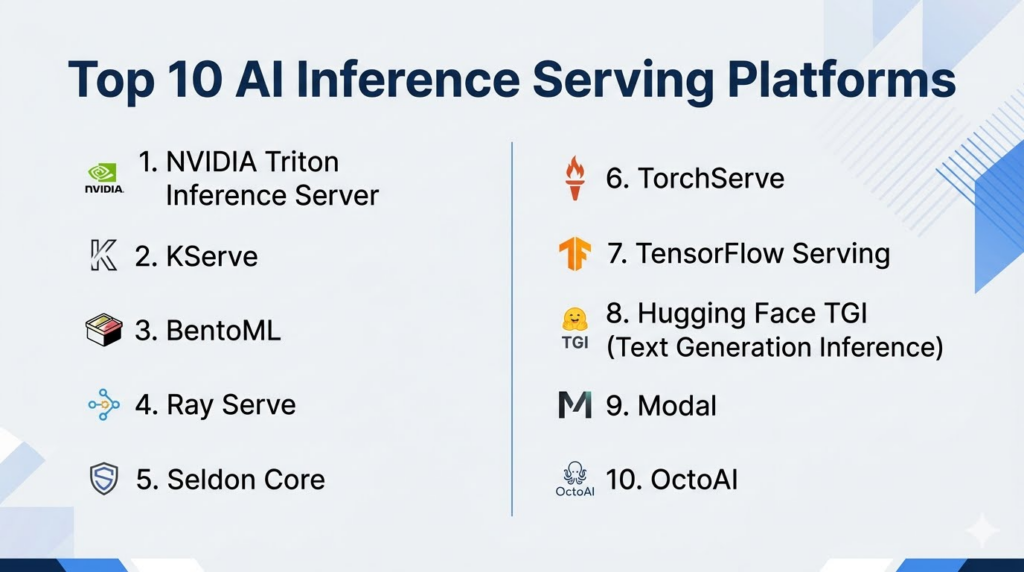
Introduction
AI Inference Serving Platforms help organizations deploy, manage, scale, and optimize machine learning and large language models in production environments. These platforms are responsible for handling real-time or batch inference requests after a model has been trained. They manage GPU utilization, autoscaling, latency optimization, routing, observability, versioning, and deployment reliability across cloud, on-premises, and hybrid environments.The category has become critical because enterprises are rapidly moving AI systems from experimentation into production. Modern AI workloads require low-latency inference, efficient GPU scheduling, multi-model serving, API management, and support for large foundation models. Organizations now expect inference platforms to support Kubernetes, serverless workflows, vector integrations, and enterprise-grade monitoring while controlling infrastructure costs.
Real-World Use Cases
- Serving LLM-powered chatbots and copilots
- Real-time recommendation systems
- Computer vision inference pipelines
- Enterprise AI API deployment
- Multi-tenant AI SaaS platforms
Evaluation Criteria for Buyers
When evaluating AI Inference Serving Platforms, buyers should consider:
- Scalability and autoscaling performance
- GPU optimization and utilization efficiency
- Latency and throughput handling
- Multi-model deployment support
- Kubernetes and cloud-native compatibility
- Observability and monitoring features
- Security and governance controls
- Framework compatibility
- Cost optimization capabilities
- API management and routing flexibility
Best for: AI engineering teams, MLOps teams, AI SaaS companies, enterprise AI platforms, cloud-native organizations, and developers deploying production-grade machine learning or generative AI systems.
Not ideal for: Small experimental projects or offline-only research workflows where lightweight local inference tools may be sufficient.
Key Trends in AI Inference Serving Platforms
- LLM serving optimization is becoming the primary focus for many vendors.
- GPU scheduling and utilization efficiency are major competitive differentiators.
- Serverless inference models are expanding rapidly.
- AI gateways and model routing layers are becoming common.
- Multi-model serving and dynamic loading are improving infrastructure efficiency.
- Quantization and low-precision inference are reducing operational costs.
- Kubernetes-native deployments remain dominant for enterprise environments.
- AI observability and inference monitoring are becoming essential.
- Edge inference and hybrid deployments are gaining traction.
- Open-source inference stacks continue competing strongly with managed cloud offerings.
How We Selected These Tools
The following AI Inference Serving Platforms were selected using practical infrastructure and enterprise evaluation criteria.
- Strong adoption in production AI environments
- Support for modern LLM and ML frameworks
- Kubernetes and cloud-native readiness
- Scalability and GPU orchestration maturity
- Performance optimization capabilities
- Security and governance features
- Ecosystem integrations and APIs
- Enterprise deployment flexibility
- Community adoption and developer ecosystem
- Long-term platform innovation
Top 10 AI Inference Serving Platforms
1- NVIDIA Triton Inference Server
Short description:
NVIDIA Triton Inference Server is one of the most widely adopted AI inference platforms for high-performance GPU serving. It supports multiple frameworks, dynamic batching, concurrent model execution, and advanced GPU optimization. Triton is heavily used in enterprise AI environments, computer vision systems, and large-scale generative AI deployments where throughput and latency are critical.
Key Features
- Multi-framework model serving
- Dynamic batching
- Concurrent model execution
- GPU optimization
- TensorRT acceleration
- Kubernetes support
- Real-time inference monitoring
Pros
- Excellent GPU performance optimization
- Strong enterprise scalability
- Broad framework compatibility
Cons
- Complex setup for beginners
- Best optimized for NVIDIA ecosystem
- Infrastructure tuning can require expertise
Platforms / Deployment
- Linux / Kubernetes / Cloud / Self-hosted / Hybrid
Security & Compliance
- RBAC support available
- Encryption support available
- Additional compliance certifications vary by deployment
Integrations & Ecosystem
Triton integrates deeply with NVIDIA AI infrastructure and cloud-native ML pipelines.
- Kubernetes
- TensorRT
- PyTorch
- TensorFlow
- ONNX Runtime
- Prometheus
Support & Community
Strong enterprise adoption with extensive documentation, GitHub activity, and NVIDIA ecosystem support.
2- KServe
Short description:
KServe is a Kubernetes-native model serving platform designed for scalable machine learning inference workloads. It simplifies deployment, autoscaling, canary rollouts, and serverless inference operations for AI teams. KServe is widely used in cloud-native MLOps environments and supports both traditional ML models and modern LLM deployments.
Key Features
- Kubernetes-native architecture
- Serverless inference
- Autoscaling support
- Canary deployment workflows
- Multi-framework serving
- Event-driven scaling
- Inference graph pipelines
Pros
- Strong Kubernetes integration
- Flexible deployment workflows
- Open-source ecosystem strength
Cons
- Requires Kubernetes expertise
- Operational complexity for smaller teams
- Infrastructure setup can be time-intensive
Platforms / Deployment
- Kubernetes / Cloud / Self-hosted / Hybrid
Security & Compliance
- RBAC support available
- Kubernetes security integration
- Additional certifications not publicly stated
Integrations & Ecosystem
KServe integrates with cloud-native ML and observability stacks.
- Kubeflow
- Istio
- Knative
- Prometheus
- Seldon Core
- MLflow
Support & Community
Large open-source community with strong adoption in Kubernetes-focused AI environments.
3- BentoML
Short description:
BentoML is a developer-focused AI serving platform designed to simplify packaging, deployment, and serving of machine learning models. It supports APIs, scalable inference services, model versioning, and containerized deployments. BentoML is popular among AI startups and developer teams seeking fast deployment workflows.
Key Features
- Model packaging workflows
- API serving support
- Containerized deployment
- Multi-framework compatibility
- Model versioning
- GPU deployment support
- CI/CD integration
Pros
- Developer-friendly experience
- Fast deployment workflows
- Strong API serving capabilities
Cons
- Smaller enterprise footprint than larger competitors
- Some advanced orchestration requires customization
- Scaling complexity depends on deployment stack
Platforms / Deployment
- Linux / macOS / Kubernetes / Cloud / Self-hosted
Security & Compliance
- Authentication support available
- Additional compliance details not publicly stated
Integrations & Ecosystem
BentoML integrates well with Python-based ML workflows and deployment pipelines.
- FastAPI
- Docker
- Kubernetes
- PyTorch
- TensorFlow
- MLflow
Support & Community
Strong developer community with active open-source momentum and modern documentation.
4- Ray Serve
Short description:
Ray Serve is a scalable inference serving framework built on top of the Ray distributed computing ecosystem. It is optimized for distributed AI workloads, multi-model serving, and large-scale generative AI applications. Ray Serve is commonly used in high-performance AI infrastructure environments requiring flexible distributed inference orchestration.
Key Features
- Distributed inference
- Multi-model serving
- Autoscaling support
- Python-native APIs
- LLM deployment workflows
- GPU scheduling
- Traffic routing
Pros
- Excellent distributed scalability
- Strong LLM serving support
- Flexible developer workflows
Cons
- Requires distributed systems knowledge
- Operational tuning may be complex
- Learning curve for smaller teams
Platforms / Deployment
- Linux / Kubernetes / Cloud / Hybrid
Security & Compliance
- Authentication and access controls supported
- Additional certifications not publicly stated
Integrations & Ecosystem
Ray Serve integrates deeply with distributed AI and data processing ecosystems.
- Ray Core
- Kubernetes
- PyTorch
- Hugging Face
- FastAPI
- Prometheus
Support & Community
Rapidly growing AI infrastructure community with strong open-source support and enterprise adoption.
5- Seldon Core
Short description:
Seldon Core is an open-source MLOps and inference serving platform designed for Kubernetes-based deployments. It supports advanced deployment patterns such as A/B testing, canary rollouts, explainability, and monitoring. Seldon Core is commonly used by enterprises building production-grade AI systems with governance requirements.
Key Features
- Kubernetes-native serving
- Canary deployments
- A/B testing workflows
- Explainability integrations
- Monitoring and metrics
- Multi-framework serving
- Model orchestration
Pros
- Strong enterprise deployment features
- Advanced rollout controls
- Mature Kubernetes integration
Cons
- Operational complexity
- Requires Kubernetes expertise
- Setup can be resource-intensive
Platforms / Deployment
- Kubernetes / Cloud / Self-hosted / Hybrid
Security & Compliance
- RBAC support available
- Enterprise governance features supported
- Compliance details vary by deployment
Integrations & Ecosystem
Seldon Core integrates with enterprise MLOps and observability environments.
- Kubernetes
- Prometheus
- Grafana
- Istio
- MLflow
- KFServing
Support & Community
Strong enterprise-oriented open-source community with commercial support options available.
6- TorchServe
Short description:
TorchServe is an inference serving framework optimized for PyTorch models. Developed with support from AWS and Meta ecosystems, it provides scalable model serving, REST APIs, monitoring, and model management workflows. TorchServe is especially useful for organizations deeply invested in PyTorch development environments.
Key Features
- PyTorch model serving
- REST and gRPC APIs
- Multi-model management
- Monitoring tools
- GPU inference support
- Batch inference
- Model snapshotting
Pros
- Strong PyTorch optimization
- Good developer experience
- Flexible deployment support
Cons
- Limited outside PyTorch ecosystem
- Smaller feature breadth than broader platforms
- Enterprise governance features are lighter
Platforms / Deployment
- Linux / Kubernetes / Cloud / Self-hosted
Security & Compliance
- Authentication support available
- Additional compliance details not publicly stated
Integrations & Ecosystem
TorchServe integrates directly with PyTorch-centered ML workflows.
- PyTorch
- AWS
- Kubernetes
- Docker
- Prometheus
- ONNX
Support & Community
Well-supported within PyTorch communities with active open-source development.
7- TensorFlow Serving
Short description:
TensorFlow Serving is Google’s production-ready serving platform for TensorFlow models. It is designed for high-performance inference, version management, and scalable deployment workflows. TensorFlow Serving remains popular in organizations already standardized around TensorFlow ecosystems.
Key Features
- TensorFlow model serving
- High-performance inference
- Version management
- gRPC and REST APIs
- Batch processing
- Model lifecycle management
- Scalable deployment workflows
Pros
- Strong TensorFlow integration
- Proven production scalability
- High-performance serving engine
Cons
- Primarily TensorFlow-focused
- Less flexible for multi-framework environments
- Configuration can be technical
Platforms / Deployment
- Linux / Kubernetes / Cloud / Self-hosted
Security & Compliance
- Authentication support available
- Additional compliance details not publicly stated
Integrations & Ecosystem
TensorFlow Serving integrates deeply with Google and TensorFlow ecosystems.
- TensorFlow
- Kubernetes
- Docker
- Google Cloud
- TensorBoard
- Prometheus
Support & Community
Large global TensorFlow community with strong enterprise and research adoption.
8- Hugging Face Text Generation Inference
Short description:
Hugging Face Text Generation Inference is a specialized serving platform optimized for large language model inference. It focuses on high-throughput transformer serving, token streaming, quantization, and GPU optimization. The platform is widely used in modern generative AI and LLM deployment environments.
Key Features
- LLM inference optimization
- Token streaming
- Quantization support
- Multi-GPU serving
- Hugging Face model integration
- Kubernetes deployment support
- OpenAI-compatible APIs
Pros
- Excellent LLM serving performance
- Strong Hugging Face ecosystem integration
- Modern generative AI optimization
Cons
- Primarily focused on transformer workloads
- Less suitable for traditional ML pipelines
- GPU requirements can be significant
Platforms / Deployment
- Linux / Kubernetes / Cloud / Self-hosted
Security & Compliance
- Authentication support available
- Additional compliance details not publicly stated
Integrations & Ecosystem
The platform integrates tightly with modern generative AI ecosystems.
- Hugging Face Hub
- Kubernetes
- NVIDIA GPUs
- Transformers
- Prometheus
- OpenAI-compatible clients
Support & Community
Very strong generative AI community with active open-source development and documentation.
9 — Baseten
Short Description: Baseten is a production AI inference platform built for teams that need cross-cloud reliability alongside deployment flexibility. Its Multi-cloud Capacity Manager abstracts 18 cloud providers behind a single deployment target, with active-active redundancy and automated failover that sustain 99.99% uptime when a region degrades or capacity shifts. The Baseten Inference Stack serves LLMs, embeddings, transcription, image and video generation, and compound AI systems on one optimized runtime. Deployment options include fully managed, self-hosted, and hybrid configurations, giving organizations control over cost, data residency, and infrastructure.
Key Features:
- Multi-cloud capacity management (18 providers)
- Active-active redundancy and automated failover
- 99.99% uptime SLA
- LLM, embedding, transcription, image, and video generation serving
- Compound AI system support
- Fully managed, self-hosted, and hybrid deployment options
- Single optimized inference runtime
Pros:
- Cross-cloud reliability with automated failover
- Broad workload coverage on one runtime
- Flexible deployment configurations for enterprise needs
Cons:
- Newer entrant compared to established open-source platforms
- Advanced multi-cloud configuration may require onboarding support
Platforms / Deployment:
Multi-cloud
Cloud
Self-hosted
Hybrid
10- OctoAI
Short description:
OctoAI is a managed AI inference platform designed for optimized generative AI serving and GPU acceleration. It focuses heavily on cost efficiency, performance optimization, and deployment simplification for enterprise AI applications. The platform is commonly evaluated for production-grade LLM deployment workflows.
Key Features
- Managed LLM serving
- GPU optimization
- Low-latency inference
- Autoscaling
- Multi-model deployment
- API serving
- Performance optimization tools
Pros
- Strong generative AI optimization
- Simplified managed infrastructure
- Good performance efficiency
Cons
- Managed platform dependency
- Customization depth may vary
- Smaller ecosystem than hyperscale vendors
Platforms / Deployment
- Cloud / Managed Platform
Security & Compliance
- Encryption support available
- Additional compliance details not publicly stated
Integrations & Ecosystem
OctoAI integrates with modern generative AI workflows and cloud APIs.
- LLM APIs
- Kubernetes
- NVIDIA GPUs
- Hugging Face
- Cloud inference pipelines
- Developer SDKs
Support & Community
Growing AI infrastructure ecosystem with increasing enterprise interest in LLM serving optimization.
Comparison Table
| Tool Name | Best For | Platforms Supported | Deployment | Standout Feature | Public Rating |
|---|---|---|---|---|---|
| NVIDIA Triton | GPU inference optimization | Linux, Kubernetes | Self-hosted / Hybrid | TensorRT acceleration | N/A |
| KServe | Kubernetes-native serving | Kubernetes | Cloud / Hybrid | Serverless inference | N/A |
| BentoML | Developer-focused deployment | Linux, macOS | Cloud / Self-hosted | Fast API serving | N/A |
| Ray Serve | Distributed AI inference | Linux, Kubernetes | Cloud / Hybrid | Distributed serving | N/A |
| Seldon Core | Enterprise MLOps workflows | Kubernetes | Cloud / Hybrid | Advanced rollout controls | N/A |
| TorchServe | PyTorch inference | Linux, Kubernetes | Cloud / Self-hosted | PyTorch optimization | N/A |
| TensorFlow Serving | TensorFlow production serving | Linux, Kubernetes | Cloud / Self-hosted | TensorFlow integration | N/A |
| Hugging Face TGI | LLM serving | Linux, Kubernetes | Cloud / Self-hosted | Transformer optimization | N/A |
| Modal | Serverless AI inference | Cloud | Serverless | Simplified GPU deployment | N/A |
| OctoAI | Managed generative AI serving | Cloud | Managed Platform | LLM cost optimization | N/A |
Evaluation & Scoring of AI Inference Serving Platforms
| Tool Name | Core 25% | Ease 15% | Integrations 15% | Security 10% | Performance 10% | Support 10% | Value 15% | Weighted Total |
|---|---|---|---|---|---|---|---|---|
| NVIDIA Triton | 10 | 7 | 9 | 8 | 10 | 9 | 8 | 8.9 |
| KServe | 9 | 7 | 9 | 8 | 9 | 8 | 8 | 8.4 |
| BentoML | 8 | 9 | 8 | 7 | 8 | 8 | 9 | 8.2 |
| Ray Serve | 9 | 7 | 9 | 7 | 9 | 8 | 8 | 8.3 |
| Seldon Core | 9 | 6 | 9 | 8 | 8 | 8 | 7 | 8.0 |
| TorchServe | 8 | 8 | 7 | 7 | 8 | 7 | 8 | 7.7 |
| TensorFlow Serving | 8 | 7 | 7 | 7 | 9 | 8 | 8 | 7.8 |
| Hugging Face TGI | 9 | 8 | 8 | 7 | 10 | 8 | 8 | 8.5 |
| Modal | 8 | 9 | 7 | 7 | 8 | 8 | 8 | 8.0 |
| OctoAI | 8 | 8 | 8 | 7 | 9 | 7 | 7 | 7.9 |
These scores are comparative and should be interpreted based on deployment goals, infrastructure maturity, and AI workload type. Organizations deploying LLM-heavy systems may prioritize Triton or Hugging Face TGI, while Kubernetes-native teams may prefer KServe or Seldon Core. Smaller developer teams may value BentoML or Modal for simplified deployment workflows. Infrastructure strategy and operational expertise should strongly influence final platform selection.
Which AI Inference Serving Platform Is Right for You?
Solo / Freelancer
Independent developers and small AI builders should prioritize ease of deployment, lower infrastructure complexity, and fast iteration cycles. BentoML and Modal are strong options because they simplify deployment workflows and reduce operational overhead. Hugging Face TGI is also attractive for developers focused specifically on LLM applications.
SMB
Small and medium-sized AI companies often need scalable inference without building large platform engineering teams. BentoML, Modal, and OctoAI provide a good balance between deployment simplicity and production readiness. Teams already using Kubernetes may also evaluate KServe for long-term scalability.
Mid-Market
Mid-market organizations running multiple AI services should prioritize autoscaling, observability, and governance. KServe, Ray Serve, and Seldon Core are strong options because they support distributed deployments, canary rollouts, and enterprise-style infrastructure orchestration.
Enterprise
Large enterprises with heavy GPU workloads and strict performance requirements often standardize around NVIDIA Triton, KServe, or Seldon Core. These platforms provide advanced optimization, infrastructure flexibility, and large-scale deployment capabilities for production AI environments.
Budget vs Premium
Open-source platforms like KServe, BentoML, Ray Serve, and Seldon Core can reduce licensing costs but require operational expertise. Managed services like Modal and OctoAI reduce infrastructure burden but may increase long-term cloud spending depending on workload scale.
Feature Depth vs Ease of Use
Triton, Seldon Core, and Ray Serve provide deep infrastructure control and optimization capabilities, while BentoML and Modal focus more on developer simplicity and rapid deployment workflows.
Integrations & Scalability
Organizations deeply invested in Kubernetes, observability stacks, and distributed AI systems should prioritize platforms with strong cloud-native integrations. Multi-model and multi-tenant deployments also require careful evaluation of autoscaling and routing capabilities.
Security & Compliance Needs
Enterprises should evaluate RBAC support, audit logging, encryption, authentication layers, network isolation, and governance tooling before deployment. Compliance requirements often depend more on deployment architecture and cloud configuration than the inference platform itself.
Frequently Asked Questions FAQs
1. What is an AI Inference Serving Platform?
An AI Inference Serving Platform is a system used to deploy and run machine learning or generative AI models in production environments. After a model is trained, the inference platform handles incoming requests, processes predictions, manages scaling, and ensures reliable API access. These platforms are critical for real-time AI applications such as chatbots, recommendation systems, and computer vision pipelines.
2. Why are AI inference platforms important for LLMs?
Large language models require specialized infrastructure because they consume large amounts of GPU memory and compute resources. AI inference platforms optimize token generation, batching, GPU utilization, and autoscaling to reduce latency and operational costs. Without optimized serving infrastructure, production LLM deployments can become extremely expensive and difficult to scale efficiently.
3. What is the difference between model training and model serving?
Model training focuses on teaching an AI model using datasets and computational learning workflows. Model serving happens after training and involves deploying the model to production so users or applications can access predictions through APIs or applications. Training is resource-intensive but periodic, while inference serving is continuous and user-facing.
4. Are Kubernetes skills required for AI inference serving?
Not always, but Kubernetes is widely used in enterprise AI deployments because it supports autoscaling, orchestration, and container management. Platforms like KServe and Seldon Core rely heavily on Kubernetes. However, managed services such as Modal and OctoAI reduce the need for deep Kubernetes expertise by abstracting much of the infrastructure complexity.
5. Which platform is best for LLM serving?
NVIDIA Triton and Hugging Face Text Generation Inference are among the strongest options for LLM-focused workloads. Triton excels in GPU optimization and enterprise scalability, while Hugging Face TGI is highly optimized for transformer-based inference and token streaming. The right choice depends on infrastructure scale, engineering expertise, and deployment goals.
6. What are the biggest challenges in AI inference serving?
Common challenges include GPU cost management, latency optimization, autoscaling, model versioning, observability, and infrastructure complexity. Organizations also struggle with balancing performance against operational expenses. Multi-model deployments and large LLM workloads can create additional scaling and resource allocation challenges.
7. Can open-source inference platforms compete with managed services?
Yes. Open-source platforms like KServe, Ray Serve, BentoML, and Seldon Core are widely used in production AI environments. They provide flexibility, infrastructure control, and reduced licensing costs. However, managed services may simplify deployment and reduce operational burden for smaller teams or organizations lacking platform engineering expertise.
8. What security features should enterprises evaluate?
Enterprises should evaluate authentication mechanisms, RBAC, encryption, audit logging, network isolation, API protection, and governance controls. Inference platforms themselves may support these features, but security posture also depends heavily on deployment architecture and cloud infrastructure configuration.
9. How does autoscaling work in inference platforms?
Autoscaling automatically increases or decreases compute resources based on incoming traffic or workload demand. This helps organizations reduce costs during low usage periods while maintaining performance during traffic spikes. GPU-aware autoscaling is particularly important for generative AI and LLM serving environments.
10. What is the biggest mistake organizations make when selecting an inference platform?
A common mistake is focusing only on raw model performance without considering operational complexity, scalability, observability, and long-term infrastructure costs. Some organizations also underestimate GPU optimization requirements and monitoring needs. The best platform should align with both technical workloads and organizational operational maturity.
Conclusion
AI Inference Serving Platforms have become foundational infrastructure for production AI systems, especially as organizations move beyond experimentation into real-world deployment of machine learning and generative AI applications. Modern platforms now focus heavily on GPU optimization, autoscaling, Kubernetes-native orchestration, observability, and efficient LLM serving workflows. NVIDIA Triton remains one of the strongest options for high-performance GPU inference, while KServe and Seldon Core excel in Kubernetes-centric enterprise environments. BentoML and Modal simplify deployment for developer-focused teams, and Hugging Face Text Generation Inference stands out for transformer and LLM optimization. Ray Serve offers distributed scalability for advanced workloads, while managed services like OctoAI reduce operational burden for fast-moving organizations. The best platform ultimately depends on infrastructure maturity, deployment scale, GPU requirements, and operational expertise.

Platform selection should also test rollback behavior during model upgrades. Shadow traffic, semantic quality checks, and per-model error budgets can catch regressions that latency and throughput dashboards miss before responses reach production users.