MOTOSHARE 🚗🏍️
Rent Bikes & Cars Directly from Owners
Motoshare connects vehicle owners with people who need bikes and cars on rent. Owners earn from idle vehicles, and renters get flexible ride options.
Visit Motoshare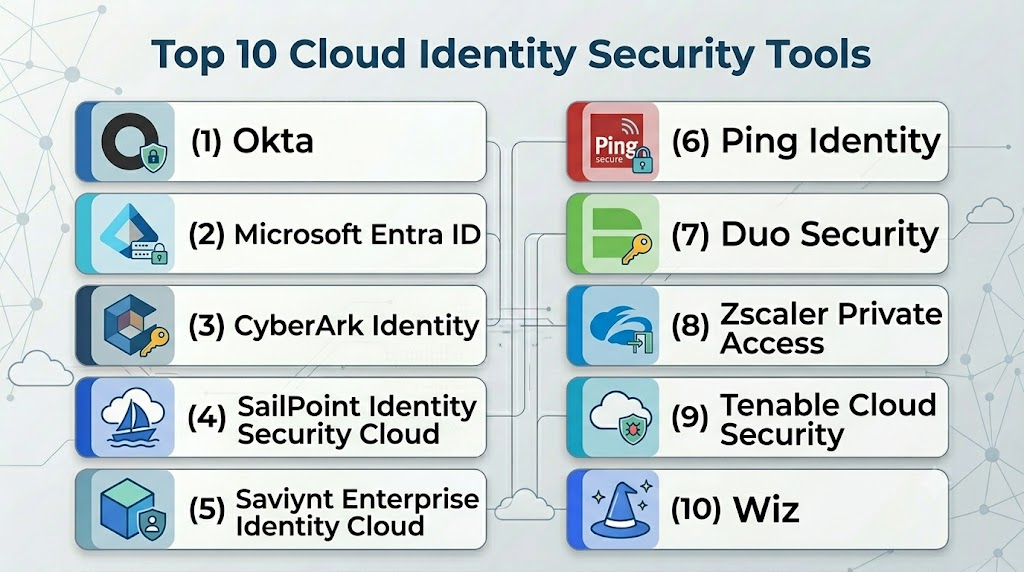
Introduction
Cloud Identity Security Tools help organizations protect user accounts, service accounts, privileged access, applications, APIs, and cloud infrastructure from identity-based attacks. In simple terms, these tools make sure the right people, devices, workloads, and machines get the right access at the right time, while reducing the risk of stolen credentials, excessive permissions, misconfigured roles, and privilege misuse.
Cloud identity security matters now because modern businesses use SaaS apps, hybrid work, cloud platforms, DevOps pipelines, machine identities, and third-party integrations every day. Attackers increasingly target identities instead of only networks, so security teams need stronger visibility, automation, access governance, MFA, risk-based authentication, identity threat detection, and continuous permission monitoring.
Real-world use cases include securing employee logins, protecting privileged cloud admins, managing SaaS access, reducing over-permissioned identities, detecting suspicious sign-in behavior, and enforcing Zero Trust access policies. Buyers should evaluate identity coverage, MFA strength, SSO support, cloud entitlement visibility, risk detection, governance workflows, API integrations, audit reporting, automation, and ease of deployment.
Best for: Cloud Identity Security Tools are best for enterprises, mid-market companies, regulated industries, SaaS-heavy businesses, DevOps teams, security teams, IT administrators, compliance teams, and organizations adopting Zero Trust security. They are especially valuable for companies using multiple cloud providers, many SaaS apps, contractors, remote employees, and privileged administrator accounts.
Not ideal for: Very small teams with only a few users and limited cloud usage may not need a full identity security platform. In such cases, built-in identity controls from a primary cloud provider, passwordless MFA, or basic SSO may be enough. These tools may also be less suitable when an organization lacks internal ownership for access reviews, identity lifecycle management, and policy enforcement.
Key Trends in Cloud Identity Security Tools
- Identity-first security is becoming a core Zero Trust requirement: Organizations are treating identity as the new security perimeter because users, devices, workloads, and SaaS applications often operate outside traditional networks.
- AI-assisted identity threat detection is growing: Many platforms now use behavior analytics, risk scoring, anomaly detection, and automated recommendations to detect unusual sign-ins, privilege escalation, and suspicious access patterns.
- Cloud Infrastructure Entitlement Management is becoming essential: Teams are focusing more on excessive permissions across AWS, Microsoft Azure, Google Cloud, Kubernetes, and SaaS platforms to reduce cloud identity risk.
- Passwordless authentication is gaining adoption: Passkeys, FIDO2, biometrics, hardware keys, and phishing-resistant MFA are becoming more important as organizations reduce reliance on passwords and SMS-based authentication.
- Machine identity security is expanding: Service accounts, API keys, secrets, certificates, tokens, and workload identities are now part of identity security programs because attackers increasingly target non-human identities.
- Identity governance and access reviews are more automated: Modern tools help automate joiner-mover-leaver workflows, access certification, role mining, approval workflows, and policy-based provisioning.
- SaaS security and identity security are converging: Identity platforms increasingly integrate with SaaS security posture management, CASB, endpoint security, SIEM, SOAR, and CNAPP tools.
- Compliance reporting is becoming more important: Regulated organizations need clear audit logs, access history, privileged access evidence, policy enforcement records, and separation-of-duties controls.
- Just-in-time access is replacing standing privileges: Enterprises are reducing permanent admin access and moving toward time-bound, approval-based, risk-aware privileged access.
- Platform consolidation is influencing buying decisions: Many organizations prefer identity security tools that work well with their existing cloud, endpoint, SIEM, and IT service management ecosystems.
How We Selected These Tools
The following tools were selected based on practical relevance for cloud identity security, market visibility, feature depth, security capabilities, and suitability across different business sizes.
- Market adoption and recognition: Tools with strong enterprise or mid-market usage were prioritized.
- Identity security coverage: Preference was given to platforms that support SSO, MFA, privileged access, identity governance, risk detection, or cloud entitlement management.
- Cloud and SaaS relevance: Tools were evaluated for their ability to secure cloud platforms, SaaS applications, remote access, and hybrid work environments.
- Integration ecosystem: Platforms with broad integrations across directories, SaaS apps, SIEM, ITSM, endpoint tools, and cloud providers were favored.
- Security posture signals: Tools with strong identity protection, policy enforcement, logging, RBAC, and audit support were prioritized.
- Ease of deployment: The list balances enterprise-grade platforms with tools that are practical for SMB and mid-market adoption.
- Automation and governance: Tools with lifecycle management, access reviews, adaptive policies, and automated remediation were considered stronger.
- Scalability: Platforms that can support growing user bases, contractors, multiple business units, and complex environments ranked higher.
- Use-case balance: The list includes IAM, IGA, PAM, CIEM, identity threat detection, and Zero Trust access capabilities.
- Practical buyer fit: The final selection reflects different scenarios rather than naming one universal winner.
Top 10 Cloud Identity Security Tools
1- Okta
Short description:
Okta is a widely used cloud identity platform for workforce identity, customer identity, single sign-on, lifecycle management, MFA, and adaptive access. It is designed for organizations that need centralized identity control across many SaaS applications, cloud platforms, and business units. Okta is especially useful for companies with remote employees, contractors, partners, and complex application portfolios. It supports strong authentication, directory integrations, access policies, and identity automation for modern IT and security teams.
Key Features
- Single sign-on for cloud and enterprise applications
- Adaptive MFA and risk-based access policies
- Lifecycle management for user provisioning and deprovisioning
- Universal directory and directory synchronization
- API access management for application security
- Customer identity and access management options
- Broad SaaS application integration catalog
Pros
- Strong fit for SaaS-heavy organizations with many cloud applications
- Mature SSO and MFA capabilities with broad ecosystem support
- Useful for both workforce and customer identity use cases
Cons
- Advanced features may require higher-tier plans
- Large deployments can need careful planning and identity architecture
- Governance and privileged access depth may require additional tools
Platforms / Deployment
Cloud / Web / iOS / Android
Deployment: Cloud
Security & Compliance
Okta supports SSO, SAML, MFA, encryption, audit logs, RBAC, adaptive access policies, and directory integrations. Compliance details may vary by product and plan. Certifications and regulatory mappings should be verified directly during procurement.
Integrations & Ecosystem
Okta has a large integration ecosystem and is commonly used as a central identity layer across SaaS, HR systems, directories, cloud infrastructure, and security platforms. It is suitable for organizations that want broad application coverage and flexible identity workflows.
- Microsoft Active Directory and LDAP integrations
- HR system integrations for lifecycle automation
- SaaS applications such as collaboration, CRM, and ITSM tools
- SIEM and security analytics integrations
- API and developer integrations
- Mobile and device trust ecosystem support
Support & Community
Okta offers documentation, implementation resources, training, support plans, and a strong partner ecosystem. Enterprise customers typically benefit from onboarding support, professional services, and identity architecture guidance. Community and marketplace resources are mature.
2- Microsoft Entra ID
Short description:
Microsoft Entra ID is Microsoft’s cloud identity and access management platform for securing users, applications, devices, and cloud resources. It is especially strong for organizations using Microsoft 365, Azure, Windows, Intune, Defender, and hybrid Active Directory environments. Entra ID supports SSO, MFA, conditional access, identity protection, privileged identity management, and governance capabilities. It is a practical choice for businesses already invested in Microsoft’s security and productivity ecosystem.
Key Features
- Single sign-on for Microsoft and third-party applications
- Conditional access policies based on user, device, risk, and location
- Multi-factor authentication and passwordless authentication options
- Privileged Identity Management for just-in-time admin access
- Identity Protection for risk-based detection and response
- Identity Governance for access reviews and entitlement management
- Hybrid identity support with Active Directory integration
Pros
- Excellent fit for Microsoft-centric organizations
- Strong conditional access and privileged access capabilities
- Works well with Microsoft security, endpoint, and productivity tools
Cons
- Best value is often realized inside the Microsoft ecosystem
- Licensing can be complex for advanced identity features
- Non-Microsoft environments may need extra integration planning
Platforms / Deployment
Cloud / Web / Windows / macOS / iOS / Android
Deployment: Cloud / Hybrid
Security & Compliance
Microsoft Entra ID supports SSO, SAML, OAuth, OpenID Connect, MFA, passwordless authentication, audit logs, RBAC, conditional access, identity protection, and privileged access workflows. Compliance coverage varies by Microsoft service, tenant configuration, and licensing.
Integrations & Ecosystem
Microsoft Entra ID integrates deeply with Microsoft 365, Azure, Defender, Intune, Windows devices, and many third-party SaaS applications. It is often used as the primary identity provider for cloud-first and hybrid enterprises.
- Microsoft 365 and Azure integrations
- Windows and Intune device signals
- SaaS application gallery
- SIEM and security operations integrations
- HR-driven lifecycle workflows
- API and application registration support
Support & Community
Microsoft provides extensive documentation, admin training, security guidance, support plans, and partner implementation services. Community support is strong due to broad enterprise adoption, but advanced deployments may require specialist expertise.
3- CyberArk Identity
Short description:
CyberArk Identity is a cloud identity security platform focused on access management, MFA, SSO, lifecycle controls, and privileged access protection. It is well suited for organizations that want stronger identity security while also addressing privileged user risk. CyberArk is widely associated with privileged access security, and its identity capabilities help extend access controls across cloud applications, endpoints, and administrative workflows. It is a strong option for regulated and security-conscious enterprises.
Key Features
- Single sign-on for enterprise and cloud applications
- Adaptive MFA and contextual access controls
- Identity lifecycle automation
- Privileged access security alignment
- Endpoint and application access controls
- Directory integrations
- Audit and reporting capabilities
Pros
- Strong fit for organizations prioritizing privileged access security
- Useful combination of identity access and privilege protection
- Good option for security-sensitive environments
Cons
- May be more advanced than smaller teams require
- Full value often comes from broader CyberArk ecosystem adoption
- Implementation may require careful privilege model planning
Platforms / Deployment
Cloud / Web / Windows / macOS / iOS / Android
Deployment: Cloud / Hybrid
Security & Compliance
CyberArk Identity supports SSO, MFA, adaptive access policies, audit logs, directory integration, RBAC-style controls, and privileged access alignment. Compliance details vary by offering and should be validated during vendor review.
Integrations & Ecosystem
CyberArk integrates with directories, SaaS applications, privileged access tools, endpoints, SIEM platforms, and enterprise security workflows. It is commonly selected where identity security and privileged access management need to work together.
- Active Directory and LDAP integrations
- SaaS application access integrations
- Privileged access management ecosystem
- SIEM and monitoring integrations
- Endpoint security alignment
- API-based extensibility
Support & Community
CyberArk offers enterprise documentation, customer support, partner services, and implementation guidance. Its community and training ecosystem are strong in privileged access security, making it suitable for organizations with mature security operations.
4- SailPoint Identity Security Cloud
Short description:
SailPoint Identity Security Cloud focuses on identity governance, access certification, lifecycle management, and visibility into who has access to what. It is especially useful for enterprises that need compliance-ready identity controls across employees, contractors, applications, and cloud resources. SailPoint helps security and compliance teams manage access requests, reviews, policy enforcement, and identity risk. It is best suited for organizations with complex access governance requirements.
Key Features
- Identity governance and administration
- Access reviews and certification workflows
- Joiner-mover-leaver lifecycle automation
- Role and entitlement management
- Policy violation detection
- SaaS and enterprise application connectors
- Identity analytics and risk insights
Pros
- Strong fit for compliance-heavy identity governance
- Helps reduce access sprawl across large organizations
- Useful for access reviews, audits, and lifecycle workflows
Cons
- Implementation can be complex in large environments
- Requires strong internal process ownership
- May be more governance-focused than real-time threat detection focused
Platforms / Deployment
Cloud / Web
Deployment: Cloud / Hybrid options may vary
Security & Compliance
SailPoint supports identity governance workflows, access controls, audit trails, approval processes, policy management, and integration with enterprise identity providers. Specific compliance certifications and regulatory mappings should be confirmed during procurement.
Integrations & Ecosystem
SailPoint integrates with directories, HR systems, cloud platforms, SaaS applications, ITSM tools, and security platforms. Its value increases when connected to authoritative identity sources and critical business applications.
- HR systems for identity lifecycle events
- Identity providers and directories
- SaaS and enterprise applications
- ITSM tools for request workflows
- Cloud infrastructure integrations
- API and connector-based extensibility
Support & Community
SailPoint provides documentation, implementation resources, customer support, training, and partner services. Because identity governance projects can be process-heavy, many enterprises use SailPoint with consulting support and phased rollouts.
5- Saviynt Enterprise Identity Cloud
Short description:
Saviynt Enterprise Identity Cloud is an identity governance and cloud security platform focused on access governance, application access, privileged access, cloud entitlements, and risk-based identity controls. It is designed for enterprises that need to govern access across cloud infrastructure, SaaS applications, ERP systems, and privileged environments. Saviynt is particularly relevant for organizations that want identity governance with strong cloud and application entitlement visibility. It can support complex compliance and risk management programs.
Key Features
- Identity governance and administration
- Cloud infrastructure entitlement management
- Access request and approval workflows
- Privileged access governance
- Application access governance
- Risk-based access insights
- Segregation-of-duties controls
Pros
- Strong coverage across governance, cloud, and privileged access
- Useful for large organizations with complex entitlement structures
- Good fit for compliance and risk-driven identity programs
Cons
- Can require careful configuration and implementation planning
- Smaller businesses may find it more advanced than needed
- Best results depend on clean identity data and strong governance processes
Platforms / Deployment
Cloud / Web
Deployment: Cloud
Security & Compliance
Saviynt supports access governance, audit trails, approval workflows, RBAC-style controls, policy enforcement, privileged access governance, and cloud entitlement visibility. Specific certifications and compliance claims should be verified for the selected service package.
Integrations & Ecosystem
Saviynt integrates with enterprise applications, cloud providers, directories, HR systems, privileged access tools, and IT service management platforms. It is often used where identity governance needs to extend deeply into business applications and cloud environments.
- HR and identity source integrations
- ERP and enterprise application connectors
- Cloud provider entitlement visibility
- ITSM workflow integrations
- Privileged access ecosystem
- API and connector framework
Support & Community
Saviynt offers enterprise support, product documentation, implementation guidance, and partner-led services. Because deployments can involve business applications and compliance workflows, onboarding is typically most successful with structured project planning.
6- Ping Identity
Short description:
Ping Identity provides enterprise identity and access management solutions for workforce, customer, and partner identity use cases. It supports SSO, MFA, adaptive authentication, identity orchestration, API security, and federation. Ping is often selected by large organizations that need flexible identity architecture, hybrid deployment options, and complex federation support. It is especially useful for enterprises with legacy systems, customer-facing digital platforms, and advanced identity integration needs.
Key Features
- Enterprise SSO and federation
- Adaptive authentication and MFA
- Identity orchestration workflows
- Customer identity and access management
- API access security capabilities
- Hybrid identity deployment support
- Standards-based integrations
Pros
- Strong for complex enterprise identity environments
- Flexible federation and hybrid deployment capabilities
- Useful for both workforce and customer identity scenarios
Cons
- May require identity architecture expertise
- Smaller teams may prefer simpler out-of-the-box platforms
- Licensing and deployment model can vary by use case
Platforms / Deployment
Cloud / Web / Hybrid
Deployment: Cloud / Self-hosted / Hybrid options vary by product
Security & Compliance
Ping Identity supports SAML, OAuth, OpenID Connect, MFA, SSO, federation, adaptive access, audit capabilities, and API security features. Compliance and certification details should be confirmed for the specific Ping product and deployment model.
Integrations & Ecosystem
Ping integrates with enterprise directories, SaaS apps, APIs, customer applications, security platforms, and legacy identity systems. Its strengths are most visible in complex, standards-based identity environments.
- Enterprise directory integrations
- SaaS and web application federation
- API gateway and application security integrations
- Customer identity workflows
- Hybrid application environments
- Developer and standards-based integrations
Support & Community
Ping Identity provides enterprise support, documentation, professional services, and partner expertise. Its community is strongest among enterprise IAM architects and organizations managing advanced identity federation needs.
7- Duo Security
Short description:
Duo Security, part of Cisco, is a cloud-based access security platform best known for MFA, device trust, secure access, and Zero Trust user verification. It helps organizations protect applications by verifying users and checking device health before granting access. Duo is especially useful for SMBs, mid-market companies, and enterprises that want fast MFA rollout with strong usability. It can complement existing identity providers rather than replacing them entirely.
Key Features
- Multi-factor authentication
- Device trust and endpoint visibility
- Secure access policies
- SSO capabilities
- Adaptive access controls
- Remote access protection
- Application access reporting
Pros
- Easy to adopt for MFA and access protection
- Strong user experience for authentication workflows
- Works well alongside existing identity providers
Cons
- Not a full identity governance platform
- Advanced identity lifecycle management may require other tools
- Larger enterprises may need additional PAM or IGA solutions
Platforms / Deployment
Cloud / Web / Windows / macOS / Linux / iOS / Android
Deployment: Cloud
Security & Compliance
Duo supports MFA, SSO, device trust, adaptive access policies, encryption, logs, and access controls. Compliance details vary by plan and Cisco security program. Buyers should validate specific compliance requirements during procurement.
Integrations & Ecosystem
Duo integrates with VPNs, SaaS apps, identity providers, remote access tools, servers, endpoints, and security platforms. It is commonly deployed as an MFA and Zero Trust access layer.
- VPN and remote access integrations
- SaaS application protection
- Microsoft and directory integrations
- Endpoint and device posture checks
- SIEM and logging integrations
- API-based integration options
Support & Community
Duo is known for straightforward documentation, deployment guides, and customer support options. Its community and implementation knowledge are strong because MFA adoption is a common security priority across many business sizes.
8- Zscaler Private Access
Short description:
Zscaler Private Access is a Zero Trust Network Access platform that helps secure private application access without exposing applications directly to the internet. While it is not a traditional identity provider, it plays a major role in cloud identity security by enforcing identity-aware access to private apps, cloud workloads, and internal resources. It is best for organizations replacing VPNs, securing remote users, and applying conditional access based on user identity and device posture. Zscaler is especially relevant for distributed enterprises.
Key Features
- Zero Trust access to private applications
- Identity-aware application access policies
- VPN replacement architecture
- User and device posture-based access controls
- Cloud-delivered access enforcement
- Segmentation for private applications
- Integration with identity providers
Pros
- Strong for secure remote and private app access
- Reduces reliance on traditional VPN architecture
- Useful for distributed and cloud-first enterprises
Cons
- Not a standalone IAM or identity governance tool
- Requires integration with identity providers
- Architecture planning is important for complex app environments
Platforms / Deployment
Cloud / Web / Windows / macOS / Linux / iOS / Android
Deployment: Cloud
Security & Compliance
Zscaler Private Access supports identity-aware access controls, policy enforcement, encryption, logging, and integrations with identity providers. Specific compliance details should be validated based on product edition and enterprise requirements.
Integrations & Ecosystem
Zscaler integrates with identity providers, endpoint tools, security analytics platforms, SIEM tools, and enterprise applications. It is often part of a broader Secure Access Service Edge or Zero Trust architecture.
- Identity provider integrations
- Endpoint and device posture integrations
- SIEM and logging integrations
- Private application connectors
- Cloud and data center application access
- Security operations ecosystem
Support & Community
Zscaler provides enterprise documentation, support plans, deployment guidance, and partner services. Implementation quality depends heavily on application discovery, policy design, and identity integration planning.
9- Tenable Cloud Security
Short description:
Tenable Cloud Security focuses on cloud security posture, identity exposure, entitlement visibility, and cloud infrastructure risk. It helps organizations discover risky permissions, misconfigured roles, excessive access, and identity-related cloud exposures. This type of tool is valuable for cloud security teams, DevSecOps teams, and enterprises managing AWS, Azure, Google Cloud, and Kubernetes environments. It is especially useful when identity permissions are too broad or difficult to monitor manually.
Key Features
- Cloud entitlement and permission visibility
- Cloud security posture management
- Risk-based prioritization
- Infrastructure-as-code and cloud configuration insights
- Multi-cloud visibility
- Identity exposure detection
- Remediation guidance
Pros
- Strong for cloud identity risk and excessive permission discovery
- Useful for DevSecOps and cloud security teams
- Helps prioritize identity and configuration risks together
Cons
- Not a complete workforce IAM or SSO platform
- May require cloud security expertise to operationalize
- Governance workflows may require integration with other tools
Platforms / Deployment
Cloud / Web
Deployment: Cloud
Security & Compliance
Tenable Cloud Security supports cloud identity risk visibility, cloud configuration assessment, audit insights, and integration with cloud provider permissions. Specific compliance frameworks and certifications should be validated by buyers based on their environment.
Integrations & Ecosystem
Tenable Cloud Security integrates with cloud providers, security workflows, DevOps tools, and risk management processes. It is most valuable when combined with SIEM, ticketing, and remediation workflows.
- AWS, Azure, and Google Cloud visibility
- Kubernetes and cloud workload insights
- DevOps and infrastructure-as-code workflows
- SIEM and security operations integrations
- Ticketing and remediation workflows
- API-based reporting and automation
Support & Community
Tenable provides documentation, product support, customer success resources, and security research-driven guidance. Support strength depends on plan level and enterprise requirements, but the broader Tenable ecosystem is well established.
10- Wiz
Short description:
Wiz is a cloud security platform that helps organizations understand risk across cloud environments, including identities, workloads, vulnerabilities, data exposure, and misconfigurations. While Wiz is broader than identity security alone, it is highly relevant for cloud identity security because it can help identify risky permissions, toxic combinations, exposed resources, and identity-related attack paths. It is well suited for cloud security teams that want fast visibility across multi-cloud environments. Wiz is commonly used in modern cloud-native security programs.
Key Features
- Cloud security posture management
- Cloud entitlement and identity risk insights
- Attack path analysis
- Vulnerability and exposure management
- Multi-cloud visibility
- Kubernetes and workload context
- Risk prioritization and remediation guidance
Pros
- Strong visibility across cloud environments
- Useful for finding identity risk in context with workloads and data
- Good fit for cloud-native security teams
Cons
- Not a traditional IAM, SSO, or IGA platform
- May need integration with identity and ticketing systems for remediation
- Advanced cloud security teams will get the most value
Platforms / Deployment
Cloud / Web
Deployment: Cloud
Security & Compliance
Wiz supports cloud security visibility, identity risk context, audit-ready reporting features, and cloud provider integrations. Specific compliance certifications and regulatory mapping should be verified directly during procurement.
Integrations & Ecosystem
Wiz integrates with cloud platforms, DevOps workflows, SIEM tools, ticketing systems, vulnerability management processes, and security operations tools. It is especially useful when cloud identity risk must be understood alongside infrastructure, workload, and data exposure.
- AWS, Azure, and Google Cloud integrations
- Kubernetes and container ecosystem visibility
- SIEM and SOAR integrations
- Ticketing and workflow tools
- DevOps and CI/CD ecosystem
- API-based security automation
Support & Community
Wiz provides documentation, customer support, onboarding resources, and enterprise customer success options. Its community strength is growing around cloud-native security, CNAPP, and cloud risk management practices.
Comparison Table
| Tool Name | Best For | Platform Supported | Deployment | Standout Feature | Public Rating |
|---|---|---|---|---|---|
| Okta | SaaS-heavy workforce and customer identity | Web, iOS, Android | Cloud | Broad SSO and MFA ecosystem | N/A |
| Microsoft Entra ID | Microsoft-centric enterprises | Web, Windows, macOS, iOS, Android | Cloud, Hybrid | Conditional access and privileged identity management | N/A |
| CyberArk Identity | Privileged identity and secure access | Web, Windows, macOS, iOS, Android | Cloud, Hybrid | Identity security aligned with privileged access | N/A |
| SailPoint Identity Security Cloud | Identity governance and access reviews | Web | Cloud, Hybrid varies | Enterprise identity governance workflows | N/A |
| Saviynt Enterprise Identity Cloud | Cloud entitlement and access governance | Web | Cloud | Governance plus cloud entitlement management | N/A |
| Ping Identity | Complex enterprise federation and CIAM | Web, Hybrid | Cloud, Self-hosted, Hybrid | Flexible identity federation and orchestration | N/A |
| Duo Security | MFA and Zero Trust access | Web, Windows, macOS, Linux, iOS, Android | Cloud | Fast MFA and device trust rollout | N/A |
| Zscaler Private Access | Identity-aware private app access | Web, Windows, macOS, Linux, iOS, Android | Cloud | VPN replacement with Zero Trust access | N/A |
| Tenable Cloud Security | Cloud entitlement and posture risk | Web | Cloud | Cloud identity risk and permissions visibility | N/A |
| Wiz | Multi-cloud identity risk in context | Web | Cloud | Attack path and cloud identity risk context | N/A |
Evaluation & Scoring of Cloud Identity Security Tools
| Tool Name | Core 25% | Ease 15% | Integrations 15% | Security 10% | Performance 10% | Support 10% | Value 15% | Weighted Total 0–10 |
|---|---|---|---|---|---|---|---|---|
| Okta | 9 | 8 | 9 | 8 | 8 | 8 | 7 | 8.25 |
| Microsoft Entra ID | 9 | 8 | 9 | 9 | 8 | 8 | 8 | 8.45 |
| CyberArk Identity | 8 | 7 | 8 | 9 | 8 | 8 | 7 | 7.85 |
| SailPoint Identity Security Cloud | 9 | 7 | 8 | 8 | 8 | 8 | 7 | 8.00 |
| Saviynt Enterprise Identity Cloud | 9 | 7 | 8 | 8 | 8 | 7 | 7 | 7.85 |
| Ping Identity | 8 | 7 | 8 | 8 | 8 | 8 | 7 | 7.70 |
| Duo Security | 7 | 9 | 8 | 8 | 8 | 8 | 8 | 7.95 |
| Zscaler Private Access | 8 | 7 | 8 | 8 | 9 | 8 | 7 | 7.85 |
| Tenable Cloud Security | 8 | 8 | 7 | 8 | 8 | 8 | 8 | 7.85 |
| Wiz | 9 | 8 | 8 | 8 | 9 | 8 | 8 | 8.35 |
These scores are comparative and should be interpreted as directional guidance rather than absolute rankings. A higher score does not automatically mean the tool is the best fit for every organization. For example, Microsoft Entra ID may be stronger for Microsoft-heavy environments, while SailPoint may be stronger for governance-led enterprises. Cloud security teams may prefer Wiz or Tenable Cloud Security, while companies seeking fast MFA adoption may prefer Duo. Buyers should validate scores against their own users, applications, compliance needs, cloud platforms, and operational maturity.
Which Cloud Identity Security Tools Tool Is Right for You?
Solo / Freelancer
Solo professionals usually do not need a full enterprise identity security platform. A lightweight identity provider, strong password manager, phishing-resistant MFA, and secure device practices may be enough. If you manage client systems, Duo Security or Microsoft Entra ID basic identity controls can be practical starting points. The priority should be MFA, account recovery protection, secure admin access, and avoiding shared credentials.
SMB
SMBs should focus on tools that are easy to deploy and reduce immediate risk. Duo Security, Okta, and Microsoft Entra ID are strong choices depending on the existing technology stack. SMBs should prioritize SSO, MFA, device trust, user lifecycle management, and basic access reporting. A complex IGA or CIEM platform may be unnecessary unless the SMB operates in a regulated industry or manages cloud infrastructure at scale.
Mid-Market
Mid-market organizations often need stronger access governance, cloud visibility, and automated provisioning. Okta, Microsoft Entra ID, CyberArk Identity, Duo Security, and Tenable Cloud Security can be useful depending on the security maturity level. Companies with growing cloud infrastructure should evaluate Wiz or Tenable Cloud Security for cloud identity risk visibility. If audit readiness and access reviews are becoming painful, SailPoint or Saviynt may be worth shortlisting.
Enterprise
Enterprises usually need a layered identity security architecture rather than one tool. Microsoft Entra ID, Okta, Ping Identity, CyberArk, SailPoint, Saviynt, Wiz, and Zscaler may all play different roles. Large organizations should prioritize identity governance, privileged access, cloud entitlement management, conditional access, lifecycle automation, and security operations integration. The best choice depends on whether the main problem is workforce identity, privileged access, governance, cloud risk, or secure application access.
Budget vs Premium
Budget-conscious teams should start with tools that solve the biggest risk first, such as MFA, SSO, and access lifecycle management. Duo Security and Microsoft Entra ID can be practical starting points for many organizations. Premium buyers should consider deeper platforms such as Okta, CyberArk, SailPoint, Saviynt, Wiz, and Zscaler depending on their needs. A premium platform is worthwhile when identity risk is tied to compliance, cloud scale, privileged access, or business-critical applications.
Feature Depth vs Ease of Use
Duo Security is strong for ease of use and fast MFA rollout. Okta and Microsoft Entra ID balance broad capabilities with manageable administration. SailPoint, Saviynt, CyberArk, and Ping Identity provide deeper enterprise controls but require more planning. Wiz and Tenable Cloud Security provide strong cloud risk visibility, but teams need cloud security maturity to act on the findings effectively.
Integrations & Scalability
If integrations are the top priority, Okta and Microsoft Entra ID are often strong shortlist candidates because of broad application and ecosystem support. Ping Identity is useful for complex federation and custom identity environments. SailPoint and Saviynt are stronger for governance workflows across many applications. Wiz and Tenable Cloud Security are better when the integration need is cloud security, DevOps, SIEM, and remediation workflow alignment.
Security & Compliance Needs
Regulated organizations should prioritize audit logs, access reviews, approval workflows, privileged access controls, policy enforcement, and compliance reporting. SailPoint and Saviynt are strong for identity governance. CyberArk is strong where privileged access is a central concern. Microsoft Entra ID and Okta are strong for access control and authentication. Wiz and Tenable Cloud Security help security teams understand cloud identity risk in context with cloud posture and attack paths.
Frequently Asked Questions
1. What are Cloud Identity Security Tools?
Cloud Identity Security Tools protect identities used across cloud applications, SaaS platforms, infrastructure, APIs, and remote work environments. They help verify users, enforce MFA, manage access permissions, detect risky behavior, and remove unnecessary privileges. These tools can include IAM, IGA, PAM, CIEM, Zero Trust access, and identity threat detection capabilities. The goal is to make sure access is secure, limited, auditable, and aligned with business roles. They are especially important because cloud environments often have many users, roles, services, and integrations.
2. How are Cloud Identity Security Tools different from traditional IAM?
Traditional IAM usually focuses on user authentication, SSO, password policies, and directory management. Cloud Identity Security Tools go further by addressing SaaS access, cloud entitlements, privileged access, adaptive authentication, risk-based controls, and identity threat detection. They also support modern environments where users work remotely and applications run across multiple clouds. Some tools focus on governance, while others focus on real-time access protection or cloud permission risk. The best approach often combines IAM with governance, MFA, and cloud entitlement visibility.
3. What pricing models are common for Cloud Identity Security Tools?
Pricing commonly depends on the number of users, identities, applications, administrators, cloud accounts, or protected resources. Some vendors use per-user subscription pricing, while others use platform tiers or module-based pricing. Advanced capabilities such as identity governance, privileged access, CIEM, analytics, and automation may cost extra. Enterprise pricing is often customized based on scale and deployment complexity. Buyers should compare total cost, including implementation, support, integrations, training, and future expansion needs.
4. How long does implementation usually take?
Implementation time depends on company size, application count, directory complexity, cloud usage, and governance requirements. A basic MFA or SSO deployment can be relatively fast when the environment is simple. Large enterprise rollouts involving lifecycle workflows, access reviews, privileged access, and cloud entitlement mapping can take much longer. The most successful projects begin with high-risk users, critical apps, and clear access policies. A phased rollout is usually better than trying to secure every identity and application at once.
5. What are the most common mistakes buyers make?
A common mistake is buying a platform before defining identity security goals and ownership. Another mistake is focusing only on login security while ignoring excessive cloud permissions, privileged accounts, contractors, and machine identities. Some teams also underestimate the importance of clean identity data, application ownership, and access review processes. Poorly designed policies can create user friction or security gaps. Buyers should begin with risk mapping, application inventory, user groups, and measurable success criteria.
6. Do Cloud Identity Security Tools support compliance requirements?
Many tools provide features that support compliance, such as audit logs, access reviews, MFA enforcement, approval workflows, policy controls, and privileged access records. However, compliance support does not automatically mean a company becomes compliant by using the tool. Buyers must verify exact certifications, regulatory mappings, data residency, and reporting capabilities during procurement. It is also important to confirm whether compliance evidence can be exported for auditors. Internal policies and operating processes remain essential.
7. Can these tools scale for large enterprises?
Yes, many Cloud Identity Security Tools are built for enterprise-scale environments with thousands or millions of identities, many applications, and multiple cloud providers. Enterprise scalability depends on directory architecture, application integrations, policy design, automation, and administrative delegation. Tools like Microsoft Entra ID, Okta, SailPoint, Saviynt, Ping Identity, CyberArk, Zscaler, Wiz, and Tenable Cloud Security can support large environments when implemented correctly. Scalability should be tested with real identity data and key application workflows before full rollout.
8. What integrations should buyers check first?
Buyers should first check integrations with their primary directory, HR system, business-critical SaaS applications, cloud providers, SIEM, ITSM, endpoint management, and privileged access tools. HR integration is important for joiner-mover-leaver automation. SIEM integration helps security teams detect and investigate identity threats. ITSM integration supports access requests and approvals. Cloud provider integrations are essential for permission visibility and entitlement management. The right integrations depend on whether the main goal is SSO, governance, PAM, CIEM, or Zero Trust access.
9. Is MFA enough for cloud identity security?
MFA is important, but it is not enough by itself. Attackers may still exploit over-permissioned accounts, session theft, misconfigured roles, legacy authentication, unmanaged devices, service accounts, and weak access governance. A strong cloud identity security program should combine MFA with SSO, conditional access, least privilege, privileged access management, access reviews, device posture checks, and threat detection. MFA should be phishing-resistant where possible. Organizations should also monitor risky behavior after login, not only during login.
10. When should a company switch identity security tools?
A company should consider switching when the current tool cannot support required applications, cloud platforms, compliance needs, automation workflows, or security policies. Switching may also be necessary when licensing becomes inefficient or the tool creates too much administrative friction. However, identity migration is sensitive and should be planned carefully. Before switching, teams should document current integrations, user groups, authentication flows, policies, and dependencies. A pilot migration with a limited set of users and applications is the safest approach.
11. What alternatives exist to full Cloud Identity Security Tools?
Alternatives include built-in identity controls from cloud providers, password managers, basic MFA products, directory services, VPN access controls, and manual access review processes. These may work for smaller teams or simple environments. However, they may not provide enough visibility, automation, governance, or cloud entitlement analysis for growing organizations. As identity risk increases, manual processes become difficult to maintain. Full identity security platforms are usually justified when organizations manage many users, apps, cloud roles, privileged accounts, and compliance requirements.
12. How should teams measure success after deployment?
Teams should measure success using practical metrics such as MFA adoption, number of apps behind SSO, reduction in standing admin privileges, access review completion rates, deprovisioning speed, risky permission reduction, and identity-related incident trends. Security teams should also track policy violations, audit readiness, orphaned accounts, and privileged access usage. User experience matters too, so login failure rates and support tickets should be monitored. The best programs combine risk reduction with smoother access workflows. Regular review helps keep policies aligned with business changes.
Conclusion
Cloud Identity Security Tools are now a core part of modern cybersecurity because identity has become one of the most targeted and complex areas of enterprise risk. The best tool depends on the organization’s environment, not on a universal ranking. Okta and Microsoft Entra ID are strong choices for broad workforce identity and access management. CyberArk is valuable when privileged access is a major risk. SailPoint and Saviynt are better suited for identity governance and compliance-heavy programs. Duo Security is practical for MFA and device trust. Zscaler Private Access helps secure private app access through Zero Trust. Tenable Cloud Security and Wiz are strong for cloud identity risk, permissions, and attack path visibility. The right decision should start with a clear understanding of users, apps, cloud platforms, privileged accounts, compliance needs, and security maturity. As a next step, shortlist three to five tools based on your main use case, run a controlled pilot with critical applications, validate integrations and security controls, then scale the chosen platform with clear ownership, access policies, and ongoing review.

Implementing comprehensive unified cloud credential entitlement protection architecture software optimizes corporate digital asset authorization logistics, ensuring accelerated enterprise resource permission tracking and seamless identity perimeter defense workflows.