MOTOSHARE 🚗🏍️
Rent Bikes & Cars Directly from Owners
Motoshare connects vehicle owners with people who need bikes and cars on rent. Owners earn from idle vehicles, and renters get flexible ride options.
Visit Motoshare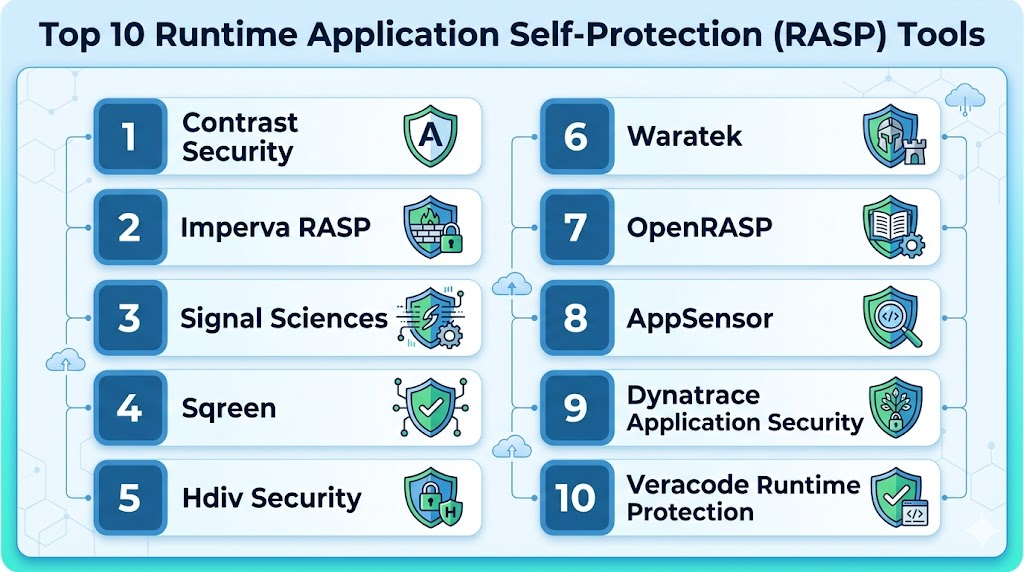
Introduction
Runtime Application Self-Protection (RASP) tools are security solutions designed to protect applications from attacks while the applications are actively running. Unlike traditional perimeter-based security tools, RASP technologies operate inside the application runtime environment, allowing them to monitor behavior, detect malicious activity, and block attacks in real time.As modern applications become increasingly cloud-native, API-driven, and distributed across containers, microservices, and hybrid cloud environments, traditional web security controls alone are no longer sufficient. RASP tools help organizations defend against SQL injection, remote code execution, cross-site scripting, insecure deserialization, API abuse, and runtime attacks directly within the application layer.
Real World Use Cases
- Protecting production web applications: Enterprises deploy RASP solutions to block real-time attacks against customer-facing applications without relying solely on external firewalls.
- Securing cloud-native APIs: Development teams use RASP to monitor API traffic, identify runtime vulnerabilities, and prevent exploitation attempts in microservices environments.
- Reducing zero-day exposure: Organizations gain runtime visibility and attack prevention capabilities even before official patches become available.
- Improving DevSecOps security posture: Security teams integrate runtime protection directly into CI/CD and application deployment workflows.
- Meeting compliance requirements: Financial, healthcare, and enterprise organizations use RASP for audit logging, runtime monitoring, and application-level threat detection.
Evaluation Criteria for Buyers
- Runtime attack detection accuracy
- Application performance impact
- Supported programming languages
- Cloud-native and container compatibility
- API security capabilities
- Integration with SIEM and DevSecOps tools
- Ease of deployment and tuning
- Compliance reporting and audit support
- Threat intelligence and analytics
- Scalability across distributed environments
Best for
RASP tools are best for enterprises, SaaS providers, fintech companies, healthcare organizations, DevSecOps teams, cloud-native application developers, and organizations running sensitive customer-facing applications.
Not ideal for
RASP platforms may not be necessary for simple static websites, low-risk internal applications, or organizations with minimal runtime security requirements. Smaller teams without application security expertise may also struggle with advanced tuning and deployment workflows.
Key Trends in Runtime Application Self-Protection (RASP)
- Cloud-native RASP adoption is increasing as organizations migrate applications to Kubernetes and containerized environments.
- AI-driven attack detection is helping identify behavioral anomalies and unknown threats more effectively.
- API runtime protection is becoming a major focus area for modern RASP platforms.
- Shift-left and runtime convergence is combining application testing with production runtime monitoring.
- eBPF-based runtime security is gaining traction in Linux and Kubernetes ecosystems.
- Zero-trust application security models are increasingly integrating runtime protection technologies.
- Observability integration is improving correlation between application telemetry and security events.
- Low-overhead instrumentation is becoming a competitive differentiator among vendors.
- Runtime protection for serverless workloads is expanding rapidly.
- Unified CNAPP integration is combining RASP with broader cloud-native application protection platforms.
How We Selected These Tools (Methodology)
- Evaluated runtime security market adoption and vendor reputation.
- Compared real-time attack prevention capabilities.
- Assessed cloud-native and Kubernetes compatibility.
- Reviewed supported languages and application frameworks.
- Evaluated SIEM, DevSecOps, and observability integrations.
- Considered runtime performance impact and deployment simplicity.
- Compared enterprise governance and compliance features.
- Reviewed threat analytics and visibility capabilities.
- Evaluated scalability for distributed applications.
- Balanced enterprise platforms with developer-friendly solutions.
Top 10 Runtime Application Self-Protection (RASP) Tools
1- Contrast Security
Short description :
Contrast Security is one of the most recognized RASP platforms, combining runtime protection, interactive application security testing, and application observability. It is widely adopted by enterprises seeking real-time application protection with developer-friendly security workflows.
Key Features
- Runtime attack blocking
- Interactive application security testing
- API security visibility
- Vulnerability correlation
- Threat intelligence
- Cloud-native deployment support
- Runtime observability
Pros
- Strong developer-focused workflows
- Excellent runtime visibility
- Mature enterprise security capabilities
Cons
- Enterprise pricing may be high
- Advanced configuration can require expertise
- Large deployments may need tuning
Platforms / Deployment
- Windows / Linux
- Cloud / Self-hosted / Hybrid
Security & Compliance
- RBAC
- Audit logging
- SSO/SAML
- MFA
- Encryption support
Integrations & Ecosystem
Contrast integrates with DevSecOps, observability, and enterprise security ecosystems to provide continuous runtime protection.
- Kubernetes
- Jenkins
- Splunk
- AWS
- Azure
- Jira
Support & Community
Contrast offers mature enterprise support, extensive documentation, and strong DevSecOps onboarding resources.
2- Imperva RASP
Short description :
Imperva RASP provides runtime protection for enterprise applications, APIs, and cloud-native services. It focuses heavily on attack prevention, application-layer visibility, and real-time threat detection.
Key Features
- Runtime attack detection
- API protection
- Threat intelligence
- Application behavior monitoring
- Real-time blocking
- Compliance reporting
- Cloud workload support
Pros
- Strong enterprise security capabilities
- Good API protection features
- Mature security analytics
Cons
- Deployment complexity can increase at scale
- Enterprise-focused pricing
- Advanced tuning may be required
Platforms / Deployment
- Windows / Linux
- Cloud / Hybrid
Security & Compliance
- RBAC
- Audit logging
- Compliance reporting
- Encryption support
Integrations & Ecosystem
Imperva integrates with enterprise security operations and cloud infrastructure platforms.
- SIEM platforms
- Kubernetes
- AWS
- Azure
- Google Cloud
Support & Community
Imperva provides enterprise-grade technical support and operational security guidance.
3- Signal Sciences
Short description :
Signal Sciences, now part of Fastly, combines application security, runtime visibility, API protection, and modern cloud-native threat detection. It is highly popular among DevSecOps and SaaS-focused organizations.
Key Features
- Runtime attack protection
- API security monitoring
- Threat intelligence
- Container security
- Real-time analytics
- Low-latency protection
- Kubernetes support
Pros
- Excellent cloud-native compatibility
- Strong API security visibility
- Lightweight deployment model
Cons
- Premium enterprise focus
- Some advanced features require tuning
- Smaller standalone RASP emphasis
Platforms / Deployment
- Linux
- Cloud / Hybrid
Security & Compliance
- Audit logging
- RBAC
- Encryption support
- API monitoring
Integrations & Ecosystem
Signal Sciences integrates with modern cloud-native and observability ecosystems.
- Kubernetes
- Fastly
- AWS
- Datadog
- Splunk
- CI/CD pipelines
Support & Community
Fastly provides enterprise support with strong documentation for modern application environments.
4- Sqreen
Short description :
Sqreen focuses on developer-friendly runtime application protection with integrated monitoring, attack detection, and automated response capabilities for web applications and APIs.
Key Features
- Runtime monitoring
- Attack detection
- Automated threat blocking
- API protection
- User behavior analytics
- Security dashboards
- Cloud-native support
Pros
- Developer-friendly deployment
- Good runtime analytics
- Strong API-focused visibility
Cons
- Smaller ecosystem maturity
- Enterprise feature depth varies
- Acquisition-related roadmap uncertainty
Platforms / Deployment
- Linux
- Cloud / Hybrid
Security & Compliance
- RBAC support
- Audit logging
- Runtime attack visibility
Integrations & Ecosystem
Sqreen supports integrations across cloud-native infrastructure and developer tooling.
- AWS
- Kubernetes
- CI/CD platforms
- SIEM systems
Support & Community
Sqreen offers practical onboarding workflows with growing runtime security documentation.
5- Hdiv Security
Short description :
Hdiv Security delivers runtime application self-protection alongside vulnerability shielding and attack prevention. It emphasizes secure coding integration and application-layer runtime defense.
Key Features
- Runtime protection
- Vulnerability shielding
- Attack prevention
- Secure coding insights
- Threat monitoring
- Real-time analytics
- API protection
Pros
- Strong vulnerability shielding
- Good developer visibility
- Useful application-layer controls
Cons
- Smaller market presence
- Fewer integrations than larger vendors
- Enterprise scalability varies
Platforms / Deployment
- Windows / Linux
- Cloud / Self-hosted
Security & Compliance
- Audit logging
- RBAC
- Runtime attack protection
Integrations & Ecosystem
Hdiv integrates with application monitoring and DevSecOps workflows.
- Jenkins
- Kubernetes
- AWS
- SIEM systems
Support & Community
Hdiv provides enterprise support and developer-focused security onboarding resources.
6- Waratek
Short description :
Waratek specializes in virtualization-based runtime application protection and secure application execution. It is commonly used in enterprise Java application environments requiring strong runtime shielding.
Key Features
- Runtime shielding
- Java application protection
- Virtualization-based security
- Attack prevention
- Runtime analytics
- Secure execution environment
- Compliance support
Pros
- Strong Java protection focus
- Low application modification requirements
- Runtime isolation capabilities
Cons
- Narrower ecosystem scope
- Primarily Java-focused
- Smaller community adoption
Platforms / Deployment
- Windows / Linux
- Self-hosted / Hybrid
Security & Compliance
- Runtime isolation
- Audit logging
- RBAC support
Integrations & Ecosystem
Waratek integrates with enterprise Java infrastructure and application environments.
- Java application servers
- Enterprise SIEM tools
- CI/CD systems
Support & Community
Waratek provides enterprise support with specialized runtime security expertise.
7- OpenRASP
Short description :
OpenRASP is an open-source runtime application protection project focused on defending web applications against common attack vectors through lightweight runtime instrumentation.
Key Features
- Open-source runtime protection
- SQL injection detection
- File inclusion protection
- Runtime monitoring
- Lightweight instrumentation
- Attack prevention
- Multi-language support
Pros
- Open-source flexibility
- Lightweight deployment
- Cost-effective runtime protection
Cons
- Smaller ecosystem maturity
- Limited enterprise governance features
- Community support varies
Platforms / Deployment
- Linux
- Self-hosted
Security & Compliance
- Runtime threat detection
- Logging support
- Policy controls vary
Integrations & Ecosystem
OpenRASP integrates into lightweight application security and monitoring workflows.
- Apache
- Nginx
- Java
- PHP
- SIEM platforms
Support & Community
OpenRASP has an active open-source community with basic operational documentation.
8- AppSensor
Short description :
AppSensor is an open-source application intrusion detection and response framework that enables applications to detect and respond to suspicious runtime behavior internally.
Key Features
- Runtime intrusion detection
- Behavioral monitoring
- Attack response workflows
- Open-source architecture
- Security event management
- Application-level detection
- Customizable response actions
Pros
- Strong customization flexibility
- Open-source model
- Developer-controlled detection logic
Cons
- Requires development expertise
- Less turnkey than enterprise platforms
- Limited enterprise automation
Platforms / Deployment
- Windows / Linux
- Self-hosted
Security & Compliance
- Logging support
- Behavioral detection
- Policy customization
Integrations & Ecosystem
AppSensor integrates with application security monitoring and custom detection workflows.
- Java environments
- SIEM systems
- Security monitoring tools
Support & Community
AppSensor benefits from OWASP-related community visibility and security developer contributions.
9- Dynatrace Application Security
Short description :
Dynatrace combines runtime application security with observability, AI-driven analytics, and cloud-native workload visibility. It provides unified monitoring and runtime threat detection for modern applications.
Key Features
- Runtime vulnerability detection
- AI-powered threat analytics
- Cloud-native observability
- Kubernetes visibility
- Runtime monitoring
- API protection
- Application dependency mapping
Pros
- Excellent observability integration
- Strong cloud-native visibility
- AI-assisted analytics
Cons
- Broad platform complexity
- Premium pricing model
- Learning curve for advanced features
Platforms / Deployment
- Windows / Linux
- Cloud / Hybrid
Security & Compliance
- RBAC
- Audit logging
- Encryption support
- Runtime threat analytics
Integrations & Ecosystem
Dynatrace integrates deeply into observability, DevOps, and cloud infrastructure ecosystems.
- Kubernetes
- AWS
- Azure
- Google Cloud
- ServiceNow
- SIEM platforms
Support & Community
Dynatrace provides enterprise support, training programs, and extensive observability documentation.
10- Veracode Runtime Protection
Short description :
Veracode extends application security into runtime environments by combining vulnerability intelligence with runtime threat monitoring and attack prevention capabilities.
Key Features
- Runtime vulnerability protection
- Threat monitoring
- Application security integration
- Cloud-native compatibility
- Risk prioritization
- Security analytics
- API protection
Pros
- Strong application security ecosystem
- Useful vulnerability correlation
- Enterprise governance support
Cons
- Broader AppSec platform complexity
- Runtime specialization varies
- Enterprise pricing considerations
Platforms / Deployment
- Windows / Linux
- Cloud / Hybrid
Security & Compliance
- RBAC
- Audit logging
- Compliance reporting
- Encryption support
Integrations & Ecosystem
Veracode integrates into enterprise DevSecOps and application security workflows.
- Jenkins
- Jira
- Kubernetes
- SIEM platforms
- Cloud platforms
Support & Community
Veracode offers enterprise-grade support with mature application security training resources.
Comparison Table (Top 10)
| Tool Name | Best For | Platform(s) Supported | Deployment | Standout Feature | Public Rating |
|---|---|---|---|---|---|
| Contrast Security | Enterprise runtime protection | Windows, Linux | Hybrid | Developer-focused runtime security | N/A |
| Imperva RASP | Enterprise application defense | Windows, Linux | Hybrid | API runtime protection | N/A |
| Signal Sciences | Cloud-native security | Linux | Hybrid | Lightweight cloud-native deployment | N/A |
| Sqreen | API runtime monitoring | Linux | Hybrid | Developer-friendly analytics | N/A |
| Hdiv Security | Vulnerability shielding | Windows, Linux | Hybrid | Runtime vulnerability protection | N/A |
| Waratek | Java runtime protection | Windows, Linux | Hybrid | Virtualization-based security | N/A |
| OpenRASP | Open-source RASP | Linux | Self-hosted | Lightweight instrumentation | N/A |
| AppSensor | Runtime intrusion detection | Windows, Linux | Self-hosted | Behavioral attack response | N/A |
| Dynatrace Application Security | Runtime observability security | Windows, Linux | Hybrid | AI-powered analytics | N/A |
| Veracode Runtime Protection | Integrated AppSec runtime security | Windows, Linux | Hybrid | Vulnerability correlation | N/A |
Evaluation & Scoring of Runtime Application Self-Protection (RASP) Tools
| Tool Name | Core (25%) | Ease (15%) | Integrations (15%) | Security (10%) | Performance (10%) | Support (10%) | Value (15%) | Weighted Total |
|---|---|---|---|---|---|---|---|---|
| Contrast Security | 10 | 8 | 9 | 10 | 9 | 9 | 8 | 9.00 |
| Imperva RASP | 9 | 7 | 8 | 10 | 9 | 9 | 7 | 8.45 |
| Signal Sciences | 9 | 8 | 9 | 9 | 9 | 8 | 8 | 8.70 |
| Sqreen | 8 | 8 | 7 | 8 | 8 | 7 | 8 | 7.85 |
| Hdiv Security | 8 | 7 | 7 | 8 | 8 | 7 | 8 | 7.70 |
| Waratek | 8 | 6 | 6 | 9 | 8 | 7 | 7 | 7.25 |
| OpenRASP | 7 | 7 | 6 | 7 | 7 | 6 | 9 | 7.10 |
| AppSensor | 7 | 6 | 6 | 7 | 7 | 6 | 8 | 6.85 |
| Dynatrace Application Security | 9 | 7 | 9 | 9 | 9 | 9 | 7 | 8.55 |
| Veracode Runtime Protection | 8 | 7 | 8 | 9 | 8 | 8 | 7 | 7.95 |
These scores are comparative and intended to help organizations evaluate relative strengths across runtime security, cloud-native support, integrations, usability, and enterprise governance. Higher-scoring platforms generally provide broader enterprise capabilities and stronger runtime analytics. However, the right choice depends heavily on application architecture, compliance needs, operational maturity, and existing security tooling.
Which Runtime Application Self-Protection (RASP) Tool Is Right for You?
Solo / Freelancer
Smaller development teams and freelancers may benefit most from lightweight or open-source options such as OpenRASP or AppSensor. These platforms provide basic runtime protection without large enterprise overhead.
SMB
Small and mid-sized businesses often prefer Signal Sciences, Sqreen, or Hdiv Security because they balance runtime protection, cloud-native support, and manageable deployment complexity.
Mid-Market
Mid-market organizations commonly adopt Contrast Security or Dynatrace Application Security for stronger observability integration, runtime visibility, and scalable DevSecOps workflows.
Enterprise
Large enterprises with strict compliance and runtime security requirements generally prioritize Contrast Security, Imperva RASP, Dynatrace, or Veracode due to enterprise governance, analytics, and broad integration ecosystems.
Budget vs Premium
Open-source platforms provide cost-effective runtime monitoring but may require additional operational expertise. Premium enterprise RASP platforms deliver stronger analytics, support, compliance visibility, and centralized governance capabilities.
Feature Depth vs Ease of Use
Contrast Security and Dynatrace provide extensive runtime insights but may require more operational tuning. Signal Sciences offers strong cloud-native usability, while OpenRASP simplifies lightweight runtime deployment.
Integrations & Scalability
Organizations with mature DevSecOps and observability pipelines should prioritize Contrast Security, Dynatrace, or Signal Sciences because of their strong ecosystem integrations and scalability.
Security & Compliance Needs
Compliance-focused industries should evaluate Imperva, Contrast Security, Veracode, and Dynatrace due to stronger runtime governance, audit reporting, and enterprise-grade security controls.
Frequently Asked Questions (FAQs)
1. What is Runtime Application Self-Protection (RASP)?
RASP is a security technology that operates inside an application runtime environment to monitor behavior, detect attacks, and block malicious activity in real time. Unlike traditional firewalls, RASP solutions understand application context directly from within the running application itself.
2. How is RASP different from a Web Application Firewall (WAF)?
A WAF protects applications externally by filtering traffic before requests reach the application. RASP operates internally within the application runtime, allowing deeper visibility into code execution, application behavior, and runtime attack patterns. Many organizations use both technologies together.
3. Does RASP impact application performance?
Modern RASP platforms are designed to minimize runtime overhead, but some performance impact is possible depending on deployment architecture and monitoring depth. Lightweight instrumentation and cloud-native optimization have significantly improved performance efficiency in modern platforms.
4. Can RASP tools protect APIs and microservices?
Yes. Many modern RASP solutions are heavily focused on API security and microservices protection. They can monitor API traffic, detect runtime anomalies, prevent exploitation attempts, and provide visibility into distributed cloud-native workloads.
5. Are RASP tools suitable for Kubernetes environments?
Yes. Most enterprise RASP platforms now support Kubernetes, containers, and cloud-native environments. Runtime visibility across Kubernetes workloads has become a major focus area due to widespread container adoption.
6. What are common challenges when implementing RASP?
Common challenges include deployment complexity, tuning false positives, balancing security with application performance, and integrating runtime telemetry into existing DevSecOps workflows. Organizations should typically begin with staged rollouts before full production deployment.
7. Can RASP tools help with compliance requirements?
Yes. RASP platforms often provide runtime monitoring, audit logging, threat visibility, and compliance reporting features that help organizations align with security and governance requirements such as PCI DSS, HIPAA, and SOC-related controls.
8. Are open-source RASP platforms reliable?
Open-source RASP tools can provide useful runtime protection capabilities, especially for smaller organizations or developer-focused environments. However, enterprise-grade platforms generally offer broader integrations, stronger analytics, centralized management, and commercial support.
9. How do organizations choose the right RASP solution?
Organizations should evaluate application architecture, supported programming languages, deployment environments, cloud-native compatibility, compliance requirements, runtime visibility needs, and existing security integrations before selecting a RASP platform.
10. Is RASP replacing traditional application security tools?
No. RASP complements existing security technologies such as WAFs, SAST, DAST, API security tools, and SIEM platforms. Most mature security programs use layered application security strategies rather than relying on a single control.
Conclusion
Runtime Application Self-Protection tools are becoming increasingly important as organizations modernize applications across cloud-native, Kubernetes, API-driven, and distributed environments. Traditional perimeter defenses alone can no longer provide sufficient visibility into runtime attacks, application abuse, and evolving threat behaviors. RASP platforms help security and DevSecOps teams detect malicious activity directly within application runtimes while improving threat visibility, compliance monitoring, and operational resilience. Contrast Security continues leading the market with developer-focused runtime protection, while Signal Sciences excels in cloud-native environments and Dynatrace combines runtime security with observability intelligence. Organizations requiring enterprise-grade governance may prefer Imperva or Veracode, while lightweight or open-source deployments may benefit from OpenRASP or AppSensor. Ultimately, the best RASP solution depends on application architecture, operational maturity, cloud strategy, and compliance priorities. Before selecting a platform, organizations should shortlist vendors, test runtime performance impact, validate integrations with existing DevSecOps pipelines, and run pilot deployments within staging or non-production environments.
