MOTOSHARE 🚗🏍️
Rent Bikes & Cars Directly from Owners
Motoshare connects vehicle owners with people who need bikes and cars on rent. Owners earn from idle vehicles, and renters get flexible ride options.
Visit Motoshare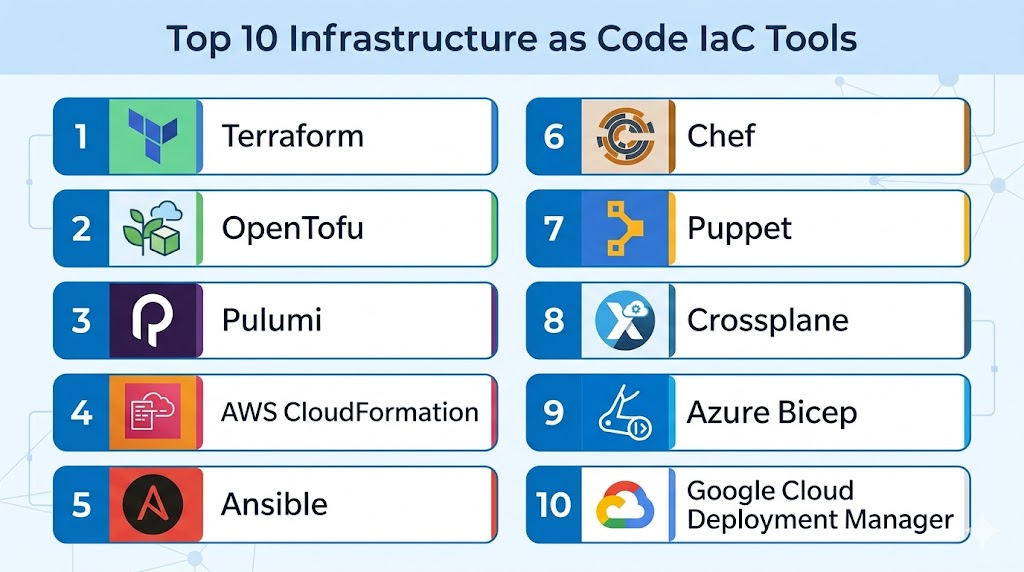
Introduction
Infrastructure as Code IaC tools help organizations provision, configure, manage, and automate infrastructure using machine-readable configuration files instead of manual processes. Rather than manually setting up servers, cloud services, networking, storage, or Kubernetes clusters, teams can define infrastructure in code and deploy it consistently across environments.IaC has become a core requirement for modern DevOps, cloud-native operations, platform engineering, and security automation. As organizations scale multi-cloud environments, container platforms, AI workloads, edge infrastructure, and compliance-heavy deployments, manual infrastructure management becomes slow, error-prone, and difficult to audit. IaC tools improve repeatability, automation, scalability, and disaster recovery while reducing configuration drift.
Real-world use cases include:
- Multi-cloud infrastructure provisioning
- Kubernetes cluster automation
- CI/CD-driven environment deployment
- Disaster recovery and infrastructure replication
- Compliance and policy enforcement automation
Evaluation criteria for buyers include:
- Multi-cloud support
- State management capabilities
- Ease of learning
- Integration ecosystem
- Security and policy enforcement
- Scalability for enterprise environments
- Community and vendor support
- GitOps compatibility
- Automation workflows
- Cost efficiency
Best for: DevOps engineers, platform teams, SREs, cloud architects, enterprises managing hybrid infrastructure, SaaS companies, regulated industries, and organizations scaling automation initiatives.
Not ideal for: Very small teams with minimal infrastructure complexity, organizations using fully managed PaaS services only, or businesses without dedicated technical operations expertise.
Key Trends in Infrastructure as Code IaC Tools
- AI-assisted infrastructure generation is becoming more common, helping teams create templates, modules, and deployment configurations faster.
- Policy-as-code integration is now expected for governance, compliance, and security validation.
- GitOps workflows are increasingly replacing manual deployment processes.
- Kubernetes-native IaC tooling adoption continues to grow rapidly.
- Multi-cloud orchestration has become a critical enterprise requirement.
- Drift detection and automated remediation are becoming standard capabilities.
- Secret management integrations are now deeply embedded into IaC ecosystems.
- Platform engineering teams are building reusable infrastructure templates for internal developer platforms.
- Security scanning and compliance validation are shifting earlier into CI/CD pipelines.
- Managed cloud-based IaC platforms are reducing operational complexity for smaller teams.
How We Selected These Tools Methodology
The tools in this list were selected using the following evaluation framework:
- Market adoption across enterprise and developer communities
- Multi-cloud and hybrid cloud compatibility
- Infrastructure automation capabilities
- Security and compliance support maturity
- Scalability for large production environments
- Ecosystem integrations and extensibility
- Documentation quality and community strength
- Support for Kubernetes and container-native workflows
- Vendor innovation and roadmap momentum
- Ease of onboarding for both SMB and enterprise users
Top 10 Infrastructure as Code IaC Tools
1- Terraform
Short description: Terraform is one of the most widely adopted Infrastructure as Code platforms for automating cloud and on-premises infrastructure. It uses declarative configuration files and supports multi-cloud deployments through a large provider ecosystem. Terraform is suitable for startups, enterprises, and platform engineering teams managing complex infrastructure at scale.
Key Features
- Declarative infrastructure provisioning
- Large provider ecosystem
- State management system
- Infrastructure dependency graphing
- Reusable modules
- Multi-cloud orchestration
- Policy integration with Sentinel
Pros
- Extremely large ecosystem and community
- Strong multi-cloud capabilities
- Highly modular and reusable
Cons
- State management can become complex
- Learning curve for beginners
- Licensing changes created some community concerns
Platforms / Deployment
- Cloud / Self-hosted / Hybrid
- Windows / macOS / Linux
Security & Compliance
- RBAC
- Audit logging
- SSO/SAML support
- Encryption support
- Policy-as-code integration
Integrations & Ecosystem
Terraform has one of the largest IaC ecosystems in the market. It integrates with major cloud providers, Kubernetes platforms, CI/CD pipelines, monitoring systems, and secrets management tools.
- AWS
- Azure
- Google Cloud
- Kubernetes
- GitHub Actions
- Jenkins
- Vault
Support & Community
Terraform has a massive open-source community, extensive documentation, enterprise support options, and strong training resources.
2- OpenTofu
Short description: OpenTofu is an open-source fork of Terraform designed to provide a fully community-driven Infrastructure as Code platform. It maintains compatibility with existing Terraform configurations while emphasizing open governance and ecosystem transparency. OpenTofu is gaining momentum among organizations seeking open-source stability.
Key Features
- Terraform-compatible syntax
- Open governance model
- Multi-cloud support
- Modular infrastructure management
- Community-driven roadmap
- State management
- Provider compatibility
Pros
- Open-source focused governance
- Familiar experience for Terraform users
- Strong compatibility ecosystem
Cons
- Smaller ecosystem compared to Terraform
- Enterprise tooling still maturing
- Long-term roadmap evolving
Platforms / Deployment
- Cloud / Self-hosted / Hybrid
- Windows / macOS / Linux
Security & Compliance
- Encryption support
- RBAC integrations
- Audit logging support
- Policy integration support
Integrations & Ecosystem
OpenTofu benefits from compatibility with existing Terraform providers and modules, making migration easier for many teams.
- AWS
- Azure
- Google Cloud
- Kubernetes
- GitLab
- Jenkins
Support & Community
The community is rapidly growing, with strong support from open-source advocates and infrastructure engineering teams.
3- Pulumi
Short description: Pulumi modernizes Infrastructure as Code by allowing developers to define infrastructure using general-purpose programming languages such as Python, TypeScript, Go, and C#. It appeals strongly to software engineering teams that prefer traditional development workflows and reusable code patterns.
Key Features
- Infrastructure using programming languages
- Multi-cloud support
- Kubernetes automation
- Reusable components
- Strong API integrations
- Policy-as-code capabilities
- GitOps support
Pros
- Developer-friendly experience
- Strong Kubernetes automation
- Excellent for reusable abstractions
Cons
- Smaller ecosystem than Terraform
- Can increase code complexity
- Pricing may rise at scale
Platforms / Deployment
- Cloud / Self-hosted / Hybrid
- Windows / macOS / Linux
Security & Compliance
- RBAC
- SSO/SAML
- Audit logging
- Encryption support
Integrations & Ecosystem
Pulumi integrates deeply into modern software engineering workflows and cloud-native environments.
- AWS
- Azure
- Google Cloud
- Kubernetes
- GitHub
- GitLab
- Datadog
Support & Community
Pulumi has strong documentation, growing community adoption, and enterprise-grade support offerings.
4- AWS CloudFormation
Short description: AWS CloudFormation is Amazon’s native Infrastructure as Code platform for provisioning AWS resources through templates. It is deeply integrated into the AWS ecosystem and is commonly used by organizations standardizing heavily on AWS infrastructure.
Key Features
- Native AWS integration
- Stack management
- Change sets
- Drift detection
- IAM integration
- Nested stacks
- Resource dependency management
Pros
- Deep AWS ecosystem integration
- Native security model alignment
- No additional orchestration layer required
Cons
- AWS-only focus
- Complex templates at scale
- Slower innovation compared to some competitors
Platforms / Deployment
- Cloud
- Web-based management
Security & Compliance
- IAM integration
- Encryption support
- Audit logs via AWS services
- RBAC through AWS IAM
Integrations & Ecosystem
CloudFormation integrates seamlessly into the broader AWS ecosystem and AWS-native DevOps workflows.
- AWS Lambda
- AWS IAM
- AWS CodePipeline
- Amazon ECS
- Amazon EKS
Support & Community
AWS provides extensive documentation, certifications, training programs, and enterprise support channels.
5- Ansible
Short description: Ansible is widely used for configuration management, automation, and infrastructure provisioning. Its agentless architecture and YAML-based playbooks make it attractive for IT operations teams and organizations prioritizing operational simplicity.
Key Features
- Agentless automation
- YAML-based playbooks
- Configuration management
- Orchestration workflows
- Infrastructure provisioning
- Large module ecosystem
- Automation workflows
Pros
- Easy to learn
- Agentless deployment model
- Strong operational automation
Cons
- Less ideal for large-scale state management
- Performance limitations at very large scale
- Complex workflows can become difficult to manage
Platforms / Deployment
- Cloud / Self-hosted / Hybrid
- Linux / Windows / macOS
Security & Compliance
- RBAC integrations
- Encryption support
- Audit logging capabilities
- Secrets management support
Integrations & Ecosystem
Ansible integrates broadly with infrastructure, networking, security, and cloud environments.
- AWS
- Azure
- VMware
- Cisco
- Kubernetes
- Jenkins
Support & Community
Ansible has one of the largest automation communities and extensive enterprise adoption.
6- Chef
Short description: Chef focuses on infrastructure automation and configuration management using code-driven workflows. It is commonly used in enterprise IT environments requiring consistent configuration enforcement across large server fleets.
Key Features
- Infrastructure automation
- Policy-based configuration
- Compliance automation
- Test-driven infrastructure
- Configuration drift management
- Scalable node management
- Cloud integrations
Pros
- Strong enterprise automation
- Good compliance tooling
- Mature operational ecosystem
Cons
- Steeper learning curve
- Ruby knowledge can help significantly
- Smaller modern cloud-native mindshare
Platforms / Deployment
- Cloud / Self-hosted / Hybrid
- Windows / Linux / macOS
Security & Compliance
- Compliance scanning
- RBAC
- Encryption support
- Audit logging
Integrations & Ecosystem
Chef supports integration across hybrid infrastructure environments and enterprise tooling.
- AWS
- Azure
- VMware
- Kubernetes
- Jenkins
- ServiceNow
Support & Community
Chef provides enterprise support and mature operational documentation for large organizations.
7- Puppet
Short description: Puppet is a long-established configuration management and infrastructure automation platform known for large-scale enterprise automation. It helps organizations standardize infrastructure configurations across distributed environments.
Key Features
- Desired state configuration
- Configuration drift management
- Reporting and compliance
- Node lifecycle management
- Automation orchestration
- Hybrid infrastructure support
- Declarative language support
Pros
- Strong enterprise capabilities
- Reliable large-scale automation
- Mature governance features
Cons
- Learning curve for Puppet DSL
- Can feel heavyweight for smaller teams
- Slower modern cloud-native adoption
Platforms / Deployment
- Cloud / Self-hosted / Hybrid
- Linux / Windows / macOS
Security & Compliance
- RBAC
- Audit logs
- Encryption support
- Compliance reporting
Integrations & Ecosystem
Puppet integrates well with enterprise IT systems and hybrid infrastructure management workflows.
- VMware
- AWS
- Azure
- Kubernetes
- ServiceNow
- Splunk
Support & Community
Puppet has a long-standing enterprise customer base and solid support ecosystem.
8- Crossplane
Short description: Crossplane extends Kubernetes into a universal control plane capable of provisioning cloud infrastructure using Kubernetes-native APIs. It is highly attractive for platform engineering and Kubernetes-centric organizations.
Key Features
- Kubernetes-native IaC
- Control plane architecture
- Cloud resource provisioning
- GitOps compatibility
- Composite resources
- Multi-cloud orchestration
- Extensible APIs
Pros
- Excellent Kubernetes integration
- Strong platform engineering fit
- Cloud-native automation model
Cons
- Requires Kubernetes expertise
- Smaller ecosystem than Terraform
- Complex initial setup
Platforms / Deployment
- Cloud / Self-hosted / Hybrid
- Kubernetes-native deployment
Security & Compliance
- Kubernetes RBAC
- Encryption support
- Policy enforcement integrations
- Audit logging support
Integrations & Ecosystem
Crossplane fits naturally into Kubernetes and GitOps ecosystems.
- Kubernetes
- Argo CD
- Flux
- AWS
- Azure
- Google Cloud
Support & Community
Crossplane has a rapidly growing cloud-native community and strong CNCF ecosystem interest.
9- Azure Bicep
Short description: Azure Bicep is Microsoft’s modern domain-specific language for deploying Azure resources declaratively. It simplifies Azure Resource Manager template development and improves readability for Azure-focused teams.
Key Features
- Simplified Azure deployments
- Declarative syntax
- Native Azure integration
- Modular templates
- Resource dependency management
- ARM compatibility
- Developer-friendly syntax
Pros
- Easier than ARM templates
- Deep Azure ecosystem integration
- Strong Microsoft support
Cons
- Azure-only focus
- Smaller cross-cloud flexibility
- Limited portability
Platforms / Deployment
- Cloud
- Windows / Linux / macOS
Security & Compliance
- Azure RBAC
- Encryption support
- Audit logging
- Azure policy integrations
Integrations & Ecosystem
Azure Bicep integrates tightly with Microsoft cloud and DevOps services.
- Azure DevOps
- GitHub Actions
- Azure Kubernetes Service
- Microsoft Defender for Cloud
Support & Community
Microsoft provides extensive documentation, tutorials, and enterprise support.
10- Google Cloud Deployment Manager
Short description: Google Cloud Deployment Manager enables automated provisioning and management of Google Cloud resources using declarative configuration files. It is primarily suitable for organizations heavily invested in Google Cloud infrastructure.
Key Features
- Native Google Cloud automation
- Declarative deployments
- Resource templates
- Deployment previews
- Infrastructure repeatability
- IAM integration
- Cloud-native provisioning
Pros
- Tight Google Cloud integration
- Simple deployment workflows
- Native Google Cloud governance alignment
Cons
- Google Cloud-only scope
- Smaller ecosystem
- Less feature-rich than broader IaC platforms
Platforms / Deployment
- Cloud
- Web-based management
Security & Compliance
- IAM integration
- Encryption support
- Audit logging via Google Cloud services
Integrations & Ecosystem
Deployment Manager integrates into Google Cloud operational environments and DevOps pipelines.
- Google Kubernetes Engine
- Cloud Build
- IAM
- Cloud Monitoring
Support & Community
Google Cloud provides enterprise support and strong documentation resources.
Comparison Table Top 10
| Tool Name | Best For | Platform(s) Supported | Deployment | Standout Feature | Public Rating |
|---|---|---|---|---|---|
| Terraform | Multi-cloud automation | Windows, Linux, macOS | Hybrid | Massive provider ecosystem | N/A |
| OpenTofu | Open-source IaC | Windows, Linux, macOS | Hybrid | Terraform compatibility | N/A |
| Pulumi | Developer-centric IaC | Windows, Linux, macOS | Hybrid | Programming language support | N/A |
| AWS CloudFormation | AWS-native deployments | Web | Cloud | Deep AWS integration | N/A |
| Ansible | Automation simplicity | Windows, Linux, macOS | Hybrid | Agentless automation | N/A |
| Chef | Enterprise automation | Windows, Linux, macOS | Hybrid | Compliance automation | N/A |
| Puppet | Large-scale config management | Windows, Linux, macOS | Hybrid | Desired state management | N/A |
| Crossplane | Kubernetes platform engineering | Kubernetes | Hybrid | Kubernetes-native control plane | N/A |
| Azure Bicep | Azure infrastructure automation | Windows, Linux, macOS | Cloud | Simplified Azure deployment | N/A |
| Google Cloud Deployment Manager | Google Cloud automation | Web | Cloud | Native GCP provisioning | N/A |
Evaluation & Scoring of Infrastructure as Code IaC Tools
| Tool Name | Core 25% | Ease 15% | Integrations 15% | Security 10% | Performance 10% | Support 10% | Value 15% | Weighted Total |
|---|---|---|---|---|---|---|---|---|
| Terraform | 9.5 | 8.0 | 9.5 | 8.5 | 9.0 | 9.5 | 8.0 | 8.9 |
| OpenTofu | 8.5 | 8.0 | 8.5 | 8.0 | 8.0 | 8.0 | 9.0 | 8.3 |
| Pulumi | 9.0 | 8.5 | 8.5 | 8.5 | 8.5 | 8.0 | 7.5 | 8.5 |
| AWS CloudFormation | 8.5 | 7.0 | 8.0 | 9.0 | 8.5 | 8.5 | 8.5 | 8.3 |
| Ansible | 8.0 | 9.0 | 8.5 | 8.0 | 7.5 | 9.0 | 9.0 | 8.4 |
| Chef | 8.0 | 6.5 | 8.0 | 8.5 | 8.5 | 8.0 | 7.5 | 7.9 |
| Puppet | 8.0 | 6.5 | 8.0 | 8.5 | 8.5 | 8.0 | 7.5 | 7.9 |
| Crossplane | 8.5 | 6.5 | 8.5 | 8.0 | 8.5 | 7.5 | 8.0 | 8.0 |
| Azure Bicep | 8.0 | 8.5 | 7.5 | 8.5 | 8.5 | 8.5 | 8.5 | 8.2 |
| Google Cloud Deployment Manager | 7.5 | 7.5 | 7.0 | 8.0 | 8.0 | 8.0 | 8.0 | 7.7 |
These scores are comparative rather than absolute. Higher scores indicate stronger alignment with enterprise-scale automation, ecosystem maturity, and operational flexibility. Organizations should prioritize criteria differently depending on their environment. For example, cloud-native teams may value integrations and scalability more heavily, while smaller teams may prioritize ease of use and pricing. A lower score does not necessarily indicate poor quality; it may simply reflect narrower specialization or platform-specific focus.
Which Infrastructure as Code IaC Tools Tool Is Right for You?
Solo / Freelancer
Freelancers and small DevOps consultants often benefit most from Terraform, Ansible, or Pulumi. Terraform offers excellent ecosystem coverage, while Ansible provides operational simplicity. Pulumi is attractive for developers comfortable with programming languages.
SMB
Small and medium-sized businesses typically prioritize ease of use, cost efficiency, and manageable automation complexity. Terraform, Ansible, and Azure Bicep are strong options depending on cloud strategy and internal expertise.
Mid-Market
Mid-market organizations often require multi-cloud automation, compliance workflows, reusable modules, and CI/CD integration. Terraform and Pulumi are particularly strong in this segment due to scalability and ecosystem maturity.
Enterprise
Large enterprises typically need governance, policy enforcement, drift detection, RBAC, auditability, and hybrid infrastructure support. Terraform, Puppet, Chef, and Crossplane are often strong enterprise candidates depending on operational models.
Budget vs Premium
Open-source tools like OpenTofu, Ansible, and Terraform Community Edition provide strong value for cost-conscious teams. Premium enterprise platforms usually justify pricing through governance, support, security, and advanced automation features.
Feature Depth vs Ease of Use
Ansible and Azure Bicep are easier for many teams to adopt initially. Terraform and Crossplane offer deeper infrastructure orchestration capabilities but require stronger operational expertise.
Integrations & Scalability
Terraform remains one of the strongest options for broad integrations and ecosystem maturity. Crossplane excels in Kubernetes-centric scalability, while Pulumi appeals to developer-centric engineering organizations.
Security & Compliance Needs
Highly regulated industries should prioritize tools supporting policy-as-code, audit logging, RBAC, encryption, and governance workflows. Terraform Enterprise, Chef, Puppet, and native cloud governance integrations are especially relevant here.
Frequently Asked Questions FAQs
1. What are Infrastructure as Code IaC tools?
Infrastructure as Code tools automate the provisioning and management of infrastructure using code-based definitions instead of manual configuration. Teams can define servers, networking, databases, storage, and cloud resources in reusable templates or configuration files. This improves consistency, scalability, and operational efficiency. IaC also reduces human error and enables repeatable deployments across development, testing, and production environments. Modern DevOps and cloud-native environments rely heavily on IaC automation for agility and reliability.
2. Why are IaC tools important for DevOps teams?
IaC tools help DevOps teams automate infrastructure provisioning and maintain consistent environments. Without IaC, manual configuration introduces configuration drift, operational delays, and increased deployment risk. IaC improves CI/CD pipelines by enabling infrastructure changes to be version-controlled and deployed automatically. It also supports disaster recovery by making environments reproducible. For organizations operating at cloud scale, IaC has become a foundational operational requirement.
3. What is the difference between Terraform and Ansible?
Terraform primarily focuses on provisioning infrastructure resources declaratively, while Ansible is commonly used for configuration management and automation workflows. Terraform manages infrastructure state and dependencies very effectively. Ansible excels at software configuration, patching, orchestration, and operational automation. Many organizations actually use both tools together. Terraform provisions infrastructure resources, while Ansible configures operating systems and applications after deployment.
4. Are Infrastructure as Code tools secure?
IaC tools can improve security significantly when implemented properly. They support repeatable infrastructure standards, policy enforcement, auditability, and automated compliance validation. However, security risks still exist if teams expose secrets, misconfigure access controls, or deploy insecure templates. Organizations should integrate secret management systems, RBAC, encryption, policy-as-code, and security scanning into IaC workflows. Security automation is becoming a critical part of modern IaC adoption.
5. Which IaC tool is best for multi-cloud environments?
Terraform remains one of the strongest choices for multi-cloud environments because of its large provider ecosystem and broad cloud compatibility. Pulumi is also highly effective for multi-cloud orchestration, especially for developer-centric organizations. OpenTofu is emerging as a strong open-source alternative. Multi-cloud organizations should evaluate provider support, governance capabilities, module reuse, and operational scalability before selecting a platform.
6. How difficult is it to learn Infrastructure as Code?
The learning curve depends on the chosen tool and the complexity of the infrastructure environment. Ansible and Azure Bicep are often easier for beginners. Terraform requires understanding declarative infrastructure concepts and state management. Crossplane requires Kubernetes expertise, making it more advanced. Teams adopting IaC should invest in structured onboarding, reusable templates, internal documentation, and operational standards to accelerate adoption.
7. Can small businesses benefit from IaC tools?
Yes, even smaller organizations can benefit significantly from IaC automation. IaC improves deployment consistency, reduces manual operational work, and supports scaling without increasing operational complexity dramatically. Small businesses using cloud infrastructure can automate environments efficiently using Terraform, Ansible, or cloud-native tools. However, extremely small environments with very limited infrastructure requirements may not justify complex enterprise-grade automation platforms.
8. What are common mistakes when implementing IaC?
Common mistakes include poor state management, insufficient access controls, hardcoding secrets, lack of version control discipline, and ignoring policy validation. Teams also sometimes create overly complex modules without standardization. Another frequent issue is failing to implement testing and security scanning within CI/CD pipelines. Organizations should establish governance standards early and adopt reusable templates to improve long-term maintainability.
9. How do IaC tools integrate with Kubernetes?
Many modern IaC tools integrate deeply with Kubernetes platforms. Terraform provisions Kubernetes infrastructure and cluster resources. Crossplane extends Kubernetes into a full infrastructure control plane. Pulumi supports Kubernetes automation using programming languages. GitOps tools such as Argo CD and Flux commonly integrate into Kubernetes-centric IaC workflows. Kubernetes adoption continues driving significant innovation within the IaC market.
10. Can organizations switch between IaC tools later?
Migration is possible, but it can become operationally complex depending on infrastructure size and architecture design. Organizations should carefully evaluate portability, ecosystem maturity, and governance requirements before large-scale adoption. Tools like OpenTofu help reduce migration friction because of Terraform compatibility. Teams should prioritize modular architecture, documentation, and reusable abstractions to reduce vendor or tooling lock-in risks over time.
Conclusion
Infrastructure as Code tools have become foundational technologies for modern cloud operations, DevOps automation, platform engineering, and enterprise infrastructure governance. As organizations continue expanding across multi-cloud environments, Kubernetes platforms, AI infrastructure, edge computing, and compliance-heavy operational models, manual infrastructure management simply cannot scale effectively. The best IaC platforms improve consistency, automation, deployment speed, security posture, disaster recovery readiness, and operational visibility across increasingly complex environments.There is no universal winner for every organization. Terraform continues to dominate multi-cloud automation, Pulumi appeals strongly to developer-centric teams, Crossplane aligns with Kubernetes-native platform engineering strategies, while cloud-native tools like AWS CloudFormation and Azure Bicep work extremely well for organizations deeply invested in specific cloud ecosystems. Smaller teams may prioritize simplicity and cost efficiency, while enterprises often require governance, compliance automation, policy enforcement, and advanced orchestration capabilities.
