MOTOSHARE 🚗🏍️
Rent Bikes & Cars Directly from Owners
Motoshare connects vehicle owners with people who need bikes and cars on rent. Owners earn from idle vehicles, and renters get flexible ride options.
Visit Motoshare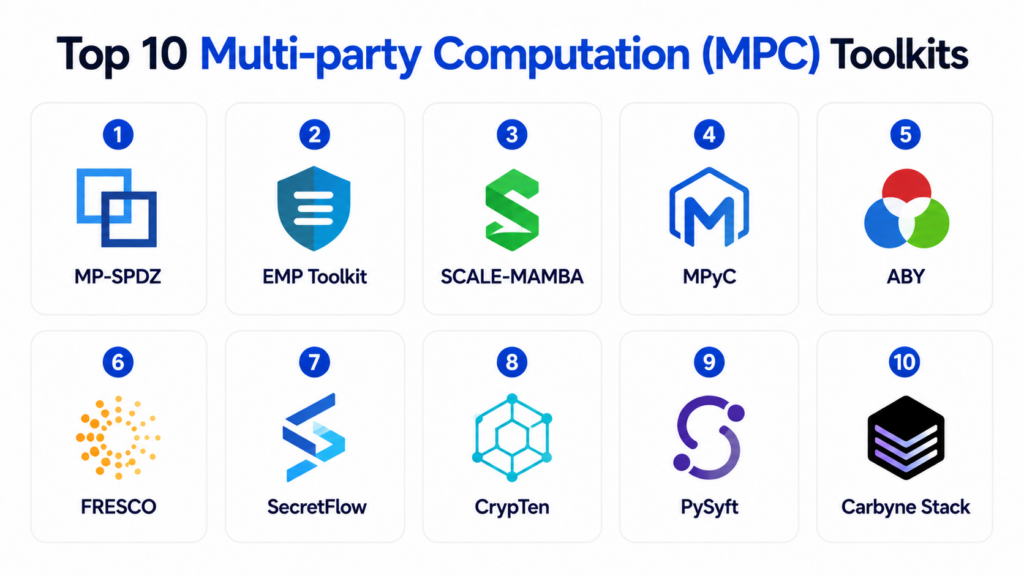
Introduction
Multi-party Computation MPC toolkits help multiple parties compute a shared result using private data without exposing the raw data to one another. In simple terms, MPC allows organizations to collaborate on sensitive calculations while each participant keeps its confidential inputs protected. This is becoming more important as enterprises, governments, banks, healthcare organizations, AI teams, and data marketplaces look for safer ways to collaborate without copying private datasets into one central location.
MPC is useful for privacy-preserving analytics, secure benchmarking, cross-bank fraud analysis, healthcare research, confidential auctions, private set intersection, secure AI collaboration, digital identity verification, and encrypted key management workflows. Buyers should evaluate protocol support, performance, developer experience, deployment model, security assumptions, scalability, documentation, integration options, governance features, and production readiness.
Best for: privacy engineers, cryptography teams, AI researchers, data collaboration teams, financial institutions, healthcare organizations, public sector teams, and enterprises that need secure computation across multiple parties. Not ideal for: teams that only need basic data masking, access control, encryption at rest, or simple anonymized reporting. MPC can be powerful, but it often requires cryptography knowledge, careful architecture, and performance testing.
Key Trends in Multi-party Computation MPC Toolkits
- Privacy-preserving data collaboration is becoming a major enterprise use case, especially where organizations need joint analytics without direct data sharing.
- MPC is increasingly used with AI and machine learning, particularly for secure model training, encrypted inference, private analytics, and collaborative feature engineering.
- Private set intersection is becoming more practical, helping companies compare customer, fraud, identity, or risk datasets without exposing full records.
- Financial services adoption is growing, especially for fraud detection, risk sharing, confidential benchmarking, secure key management, and data consortiums.
- Healthcare and life sciences teams are exploring MPC, especially for multi-institution research where patient data cannot be centralized.
- Developer-first MPC libraries are improving, making Python, C++, Java, and cloud-native workflows more accessible than older cryptography-only toolkits.
- Cloud and Kubernetes deployment patterns are becoming more common, especially for platforms that need repeatable secure computation services.
- MPC is increasingly combined with other privacy-enhancing technologies, including differential privacy, federated learning, homomorphic encryption, confidential computing, and zero-knowledge proofs.
- Performance remains a key buying factor, because MPC can be computationally expensive depending on protocol type, network latency, number of parties, and security model.
- Governance and auditability are becoming more important, especially when MPC is used for regulated data collaboration across companies or jurisdictions.
How We Selected These Tools
- Selected tools that are widely recognized in secure multi-party computation, privacy-preserving computation, or secure data collaboration.
- Balanced research-grade frameworks, developer libraries, enterprise-ready stacks, and privacy-preserving AI toolkits.
- Considered protocol depth, flexibility, documentation, ecosystem maturity, and practical implementation value.
- Prioritized toolkits that support real-world MPC patterns such as secret sharing, garbled circuits, secure aggregation, private analytics, and collaborative computation.
- Included tools useful for different audiences, including cryptography researchers, ML engineers, privacy engineers, and enterprise data teams.
- Evaluated suitability for experimentation, benchmarking, proof of concept, and production-oriented deployment.
- Considered integration potential with Python, C++, Java, Kubernetes, data pipelines, and machine learning workflows.
- Avoided public ratings because reliable rating data is not consistently available for this technical category.
- Used “Not publicly stated” where enterprise compliance certifications or commercial security controls are not clearly known.
- Scoring is comparative and practical, based on feature fit, usability, integrations, security expectations, performance, support, and value.
Top 10 Multi-party Computation MPC Toolkits
1- MP-SPDZ
Short description:
MP-SPDZ is one of the most recognized and flexible frameworks for secure multi-party computation research and benchmarking. It supports many MPC protocols and security models, making it highly useful for researchers, cryptography engineers, and advanced privacy teams. The framework is especially valuable when teams need to compare protocol choices, performance trade-offs, and honest-majority or dishonest-majority assumptions. It is powerful, but it requires strong technical expertise.
Key Features
- Supports a wide range of MPC protocols and security models.
- Useful for benchmarking secure computation approaches.
- Provides a high-level programming interface for MPC workflows.
- Supports secret sharing, garbled circuits, and related cryptographic techniques.
- Suitable for semi-honest and malicious adversary model experimentation.
- Strong fit for academic research and advanced engineering.
- Useful for comparing protocol cost, latency, and security assumptions.
Pros
- Very strong protocol depth and flexibility.
- Excellent for research, benchmarking, and advanced MPC experimentation.
- Widely recognized in the secure computation community.
Cons
- Requires cryptography and systems engineering expertise.
- Not designed as a simple business-user platform.
- Production workflows may require additional infrastructure and governance layers.
Platforms / Deployment
Linux-focused environments.
Self-hosted / Research and developer framework.
Security & Compliance
Not publicly stated as an enterprise compliance platform. Security depends on correct protocol selection, deployment architecture, participant assumptions, network configuration, and operational controls.
Integrations & Ecosystem
MP-SPDZ is usually used as a technical framework inside research, benchmarking, and custom secure computation projects. Teams often build surrounding orchestration, APIs, and data workflows around it.
- Research environments
- Secure computation benchmarking
- Custom MPC applications
- Cryptography engineering workflows
- Privacy-preserving analytics prototypes
- Integration with custom infrastructure and scripts
Support & Community
MP-SPDZ has strong recognition among MPC researchers and cryptography practitioners. Documentation and community knowledge are valuable for technical users, but enterprise-grade onboarding and support may require internal expertise or specialist consulting.
2- EMP Toolkit
Short description:
EMP Toolkit is a secure multi-party computation toolkit focused on efficient protocol implementation, especially around two-party computation and garbled circuits. It is useful for researchers and engineers building privacy-preserving computation applications that require performance-conscious cryptographic primitives. EMP is a strong fit for teams that need low-level control over secure computation design. It is not a plug-and-play enterprise analytics tool, but it is powerful for technical MPC development.
Key Features
- Efficient toolkit for secure multi-party computation.
- Strong focus on two-party computation and garbled circuit workflows.
- Useful for building custom privacy-preserving applications.
- Provides low-level cryptographic building blocks.
- Suitable for performance-sensitive secure computation experiments.
- Relevant for protocol research and implementation.
- Useful for teams needing fine-grained control over MPC behavior.
Pros
- Strong performance orientation for technical MPC workloads.
- Good fit for cryptography engineers and researchers.
- Useful for custom secure computation systems.
Cons
- Requires strong cryptographic and C++ engineering knowledge.
- Less accessible for general data science teams.
- Production readiness depends on custom implementation quality.
Platforms / Deployment
Linux / C++ development environments.
Self-hosted / Developer toolkit.
Security & Compliance
Not publicly stated as an enterprise compliance product. Security depends on correct implementation, protocol design, threat modeling, and secure deployment practices.
Integrations & Ecosystem
EMP Toolkit is best used by engineering teams that are comfortable building custom secure computation applications. It can be integrated into research prototypes, privacy-preserving computation engines, and specialized systems.
- C++ applications
- Secure two-party computation projects
- Garbled circuit workflows
- Cryptographic protocol research
- Custom privacy-preserving applications
- Academic and advanced engineering environments
Support & Community
EMP Toolkit is mainly supported through open-source documentation, academic usage, and technical community knowledge. It is best suited for teams with in-house cryptography or secure systems expertise.
3- SCALE-MAMBA
Short description:
SCALE-MAMBA is an MPC framework designed around secret-sharing-based secure computation. It is especially useful for researchers and technical teams that need to experiment with secure computation protocols and custom MPC applications. SCALE-MAMBA provides a structured environment for writing and running secure programs. It is a strong option for teams that want protocol control and academic-grade flexibility.
Key Features
- Secure computation framework based on secret sharing.
- Supports writing secure programs for MPC execution.
- Useful for research and advanced MPC experimentation.
- Designed for multi-party computation workflows.
- Provides tools for compiling and executing secure programs.
- Relevant for protocol testing and custom secure analytics.
- Suitable for technical users who need lower-level control.
Pros
- Strong fit for secret-sharing-based MPC research.
- Useful for building custom secure computation logic.
- Good educational and experimental value for advanced teams.
Cons
- Requires technical MPC expertise.
- Not designed for simple enterprise dashboarding.
- May require additional engineering for production deployment.
Platforms / Deployment
Linux-focused environments.
Self-hosted / Developer framework.
Security & Compliance
Not publicly stated as a certified enterprise security platform. Security depends on correct protocol configuration, deployment setup, participant behavior assumptions, and operational controls.
Integrations & Ecosystem
SCALE-MAMBA is typically used in research, cryptographic engineering, and secure computation experimentation. It can be integrated into custom workflows but usually requires additional engineering around APIs, data ingestion, and orchestration.
- Secure computation research
- Secret-sharing workflows
- Custom MPC programs
- Academic environments
- Privacy-preserving analytics prototypes
- Internal cryptography engineering projects
Support & Community
Support is mainly community, documentation, and research-driven. Teams should expect a technical learning curve and should validate current maintenance, compatibility, and suitability for their project.
4- MPyC
Short description:
MPyC is a Python-based framework for secure multi-party computation. It is useful for teams that want to prototype MPC workflows in a more accessible programming environment. Because it uses Python, MPyC is attractive for researchers, students, privacy engineers, and data scientists who want to experiment with secure computation concepts without starting from low-level C++ frameworks. It is best for education, prototyping, and lightweight MPC experimentation.
Key Features
- Python framework for secure multi-party computation.
- Useful for prototyping and learning MPC concepts.
- Supports secret sharing and secure computation workflows.
- Works well in Python-oriented research and data science environments.
- Easier entry point than many low-level MPC frameworks.
- Suitable for teaching, experimentation, and proof-of-concept projects.
- Can help bridge cryptography concepts with practical programming.
Pros
- Easier to approach for Python users.
- Good for learning, prototyping, and demonstrations.
- Useful for privacy engineers exploring MPC without heavy setup.
Cons
- May not be the best fit for large-scale production workloads.
- Performance may not match highly optimized low-level frameworks.
- Advanced production governance must be built separately.
Platforms / Deployment
Linux / macOS / Windows through Python environments.
Self-hosted / Developer framework.
Security & Compliance
Not publicly stated as an enterprise compliance platform. Security depends on correct protocol use, deployment design, participant setup, and surrounding access controls.
Integrations & Ecosystem
MPyC fits naturally into Python workflows and can be used in notebooks, scripts, prototypes, and educational projects. It is useful when teams want a practical introduction to MPC without complex systems setup.
- Python scripts
- Notebook environments
- Educational projects
- Privacy-preserving computation prototypes
- Research workflows
- Internal experimentation environments
Support & Community
MPyC has documentation and community relevance in research and education. It is best for technical users who want to understand and prototype MPC concepts before moving into larger-scale production frameworks.
5- ABY
Short description:
ABY is a framework for efficient mixed-protocol secure two-party computation. It is useful for technical teams that want to combine different secure computation approaches such as arithmetic sharing, Boolean sharing, and Yao-style garbled circuits. ABY is especially relevant when performance and protocol switching matter. It is a strong research and engineering toolkit for specialized privacy-preserving computation projects.
Key Features
- Framework for secure two-party computation.
- Supports mixed-protocol computation approaches.
- Combines arithmetic, Boolean, and garbled circuit methods.
- Useful for performance-aware secure computation.
- Supports protocol conversion between different sharing types.
- Relevant for advanced research and secure systems engineering.
- Suitable for building specialized privacy-preserving applications.
Pros
- Strong protocol flexibility for two-party computation.
- Useful when different computation types require different protocol choices.
- Good fit for performance-focused cryptographic engineering.
Cons
- More technical than general privacy platforms.
- Primarily focused on two-party computation.
- Requires strong understanding of secure computation design.
Platforms / Deployment
Linux-focused C++ environments.
Self-hosted / Developer framework.
Security & Compliance
Not publicly stated as an enterprise compliance solution. Security depends on implementation, protocol assumptions, network configuration, and secure operational practices.
Integrations & Ecosystem
ABY is usually used in custom secure computation projects where developers need control over protocol choices and performance trade-offs. It is better suited for advanced engineering than business-user analytics.
- C++ secure computation projects
- Two-party computation workflows
- Garbled circuit applications
- Protocol research
- Privacy-preserving analytics prototypes
- Custom secure systems
Support & Community
ABY has recognition in research and cryptography communities. Teams should expect documentation-driven adoption and may need internal cryptography expertise for serious implementation.
6- FRESCO
Short description:
FRESCO is a Java framework for secure multi-party computation. It is useful for teams that prefer Java-based development and want a structured way to build MPC applications. FRESCO provides abstractions for writing secure computations while supporting different protocol suites. It is a strong option for research teams, enterprise Java developers, and privacy engineers exploring MPC in Java-based environments.
Key Features
- Java framework for secure multi-party computation.
- Provides abstractions for secure computation development.
- Supports different protocol suites depending on use case.
- Useful for structured MPC application development.
- Fits Java-based engineering environments.
- Relevant for research, prototypes, and custom applications.
- Helps separate application logic from underlying protocol details.
Pros
- Good fit for Java teams.
- Provides useful abstractions for secure computation logic.
- Helpful for structured MPC application development.
Cons
- May require cryptography knowledge for correct usage.
- Smaller ecosystem than mainstream Python ML tools.
- Production deployment requires additional governance and infrastructure work.
Platforms / Deployment
Linux / macOS / Windows through Java environments.
Self-hosted / Developer framework.
Security & Compliance
Not publicly stated as a certified enterprise platform. Security depends on selected protocol suite, implementation details, participant setup, and secure deployment controls.
Integrations & Ecosystem
FRESCO works well where Java is already part of the engineering stack. It can support custom privacy-preserving computation applications and research workflows.
- Java applications
- Secure computation prototypes
- Enterprise Java environments
- Research workflows
- Custom privacy-preserving services
- Internal secure analytics systems
Support & Community
FRESCO has documentation and research-driven usage. Teams should validate project activity, protocol fit, and internal Java cryptography skills before using it for production systems.
7- SecretFlow
Short description:
SecretFlow is a privacy-preserving data analysis and machine learning framework that includes secure computation capabilities. It is broader than MPC alone and is useful for teams building privacy-preserving analytics, federated learning, and secure collaborative AI workflows. SecretFlow is especially relevant for organizations that need a practical environment for privacy-enhancing technologies across data science and AI. It is a strong fit for modern privacy-preserving ML use cases.
Key Features
- Privacy-preserving data analysis and machine learning framework.
- Supports secure computation and collaborative AI workflows.
- Useful for federated learning, secure analytics, and privacy-preserving ML.
- Designed for data science and AI teams.
- Supports multi-party data collaboration patterns.
- Can fit into broader privacy-enhancing technology architectures.
- Relevant for production-oriented privacy-preserving AI experimentation.
Pros
- Strong fit for AI and data science use cases.
- Broader than low-level MPC libraries.
- Useful for teams combining secure computation with federated learning.
Cons
- Broader platform scope can increase learning curve.
- Teams must validate deployment and governance needs carefully.
- May be more complex than needed for simple MPC education.
Platforms / Deployment
Linux-focused environments depending on setup.
Self-hosted / Hybrid depending on architecture.
Security & Compliance
Not publicly stated as a universal compliance platform. Security depends on deployment configuration, identity controls, secure communication, access governance, and infrastructure design.
Integrations & Ecosystem
SecretFlow is suitable for privacy-preserving AI workflows where secure computation is only one part of the architecture. It can support teams building secure analytics and machine learning collaboration.
- Python data science workflows
- Federated learning pipelines
- Secure analytics systems
- Privacy-preserving ML workflows
- Multi-party data collaboration
- Enterprise AI experimentation
Support & Community
SecretFlow has developer-oriented documentation and community resources. Teams should evaluate support expectations, deployment complexity, and ecosystem fit before using it for regulated production workloads.
8- CrypTen
Short description:
CrypTen is a privacy-preserving machine learning framework that helps researchers and engineers experiment with secure computation for ML workflows. It is especially relevant for teams exploring encrypted model inference, secure collaborative training, or privacy-preserving AI research. CrypTen is not a general-purpose enterprise analytics platform, but it is useful where MPC and machine learning intersect. It is best for technical AI teams with privacy-preserving ML goals.
Key Features
- Privacy-preserving machine learning framework.
- Supports secure computation concepts for ML workflows.
- Useful for encrypted inference and collaborative AI experiments.
- Designed for researchers and advanced ML engineers.
- Fits privacy-preserving AI development use cases.
- Can help test secure model computation patterns.
- Relevant where MPC and machine learning overlap.
Pros
- Strong fit for privacy-preserving ML experimentation.
- Useful for AI researchers and advanced developers.
- Helps bridge secure computation and model workflows.
Cons
- Not a broad business-user MPC platform.
- Requires ML and security engineering knowledge.
- Production readiness must be evaluated carefully.
Platforms / Deployment
Linux / Python environments depending on setup.
Self-hosted / Developer framework.
Security & Compliance
Not publicly stated as an enterprise compliance product. Security depends on use case, deployment architecture, protocol assumptions, and infrastructure controls.
Integrations & Ecosystem
CrypTen is useful for ML teams exploring secure computation in model workflows. It can be used in research pipelines and privacy-preserving AI prototypes.
- Python ML workflows
- Secure model inference experiments
- Privacy-preserving AI research
- PyTorch-adjacent workflows
- Collaborative ML prototypes
- Internal AI security experiments
Support & Community
CrypTen is best suited for research and technical experimentation. Teams should validate current maintenance, documentation, and suitability for their ML stack before relying on it for production.
9- PySyft
Short description:
PySyft is a privacy-preserving data science framework that supports secure collaboration, federated learning concepts, and privacy-enhancing technology workflows. It is broader than MPC alone, but it is relevant for teams exploring secure computation and controlled data access. PySyft is useful when sensitive datasets cannot be freely moved or copied. It is a strong option for advanced teams building privacy-preserving data science environments.
Key Features
- Privacy-preserving data science framework.
- Supports secure data collaboration concepts.
- Relevant for federated learning and secure computation workflows.
- Useful when data must remain controlled by owners.
- Supports advanced privacy-enhancing technology experiments.
- Suitable for research and secure AI collaboration.
- Helps reduce direct exposure of sensitive datasets.
Pros
- Strong fit for broader privacy-preserving data science.
- Useful for secure collaboration and controlled data access.
- Good option when MPC is part of a larger privacy architecture.
Cons
- Not purely an MPC toolkit.
- Broader scope can make implementation complex.
- Requires skilled technical and governance teams.
Platforms / Deployment
Linux / macOS / Windows depending on setup.
Self-hosted / Hybrid depending on architecture.
Security & Compliance
Not publicly stated as a general enterprise compliance platform. Security depends on deployment architecture, data access policies, identity controls, encryption, and governance processes.
Integrations & Ecosystem
PySyft fits into Python-based privacy-preserving data science workflows. It is useful when teams need secure collaboration, controlled computation, or privacy-preserving AI experimentation.
- Python data science workflows
- Secure data collaboration
- Federated learning experiments
- Privacy-preserving AI research
- Controlled data access environments
- Internal governance systems
Support & Community
PySyft has an open-source and research-oriented community. Documentation and examples can help advanced users, but production adoption requires planning, architecture review, and operational governance.
10- Carbyne Stack
Short description:
Carbyne Stack is a cloud-native secure computation stack designed to support MPC-based applications and services. It is especially useful for teams that want to deploy MPC in a more service-oriented or Kubernetes-style architecture. Carbyne Stack can help bridge the gap between low-level MPC engines and operational secure computation services. It is a strong fit for technical teams exploring production-style MPC infrastructure.
Key Features
- Cloud-native stack for secure multi-party computation services.
- Designed to support MPC-based application development.
- Uses service-oriented architecture for secure computation workflows.
- Useful for teams deploying MPC in modern infrastructure.
- Supports integration with MPC execution engines.
- Relevant for production-style experimentation and service deployment.
- Fits organizations exploring scalable secure computation infrastructure.
Pros
- Strong fit for cloud-native MPC deployment patterns.
- Useful for operationalizing secure computation services.
- Helps move beyond local research-only experimentation.
Cons
- Requires Kubernetes, infrastructure, and security engineering knowledge.
- May be more complex than simple MPC libraries.
- Teams must validate production maturity for their specific use case.
Platforms / Deployment
Linux / Kubernetes environments.
Self-hosted / Cloud / Hybrid depending on setup.
Security & Compliance
Not publicly stated as a universal compliance platform. Security depends on Kubernetes hardening, identity management, network controls, secret handling, encryption, logging, and participant governance.
Integrations & Ecosystem
Carbyne Stack is designed for teams that want to run MPC as part of a cloud-native service architecture. It can connect secure storage, computation services, clients, and operational workflows.
- Kubernetes environments
- MPC service orchestration
- Cloud-native secure computation
- Custom secure analytics applications
- Infrastructure automation workflows
- Enterprise privacy-enhancing technology pilots
Support & Community
Carbyne Stack has documentation and technical resources for advanced users. It is best suited for teams with cloud-native engineering skills and a clear plan for secure service deployment.
Comparison Table
| Tool Name | Best For | Platforms Supported | Deployment | Standout Feature | Public Rating |
|---|---|---|---|---|---|
| MP-SPDZ | Advanced MPC research and benchmarking | Linux-focused | Self-hosted | Broad protocol support | N/A |
| EMP Toolkit | Efficient two-party computation | Linux / C++ environments | Self-hosted | Garbled circuit and 2PC focus | N/A |
| SCALE-MAMBA | Secret-sharing-based MPC experimentation | Linux-focused | Self-hosted | Secure program execution model | N/A |
| MPyC | Python-based MPC prototyping | Linux, macOS, Windows | Self-hosted | Accessible Python MPC workflows | N/A |
| ABY | Mixed-protocol secure two-party computation | Linux / C++ environments | Self-hosted | Arithmetic, Boolean, and garbled circuit switching | N/A |
| FRESCO | Java-based MPC application development | Linux, macOS, Windows | Self-hosted | Structured Java abstractions | N/A |
| SecretFlow | Privacy-preserving AI and secure analytics | Linux-focused | Self-hosted / Hybrid | Secure computation with AI workflows | N/A |
| CrypTen | Privacy-preserving machine learning | Linux / Python environments | Self-hosted | Secure ML experimentation | N/A |
| PySyft | Secure data science collaboration | Linux, macOS, Windows | Self-hosted / Hybrid | Broader privacy-preserving data science | N/A |
| Carbyne Stack | Cloud-native MPC services | Linux / Kubernetes | Cloud / Self-hosted / Hybrid | Service-oriented MPC infrastructure | N/A |
Evaluation & Scoring of Multi-party Computation MPC Toolkits
| Tool Name | Core 25% | Ease 15% | Integrations 15% | Security 10% | Performance 10% | Support 10% | Value 15% | Weighted Total |
|---|---|---|---|---|---|---|---|---|
| MP-SPDZ | 10 | 6 | 8 | 9 | 9 | 8 | 9 | 8.50 |
| EMP Toolkit | 8 | 5 | 7 | 8 | 9 | 7 | 8 | 7.50 |
| SCALE-MAMBA | 8 | 5 | 6 | 8 | 8 | 6 | 8 | 7.15 |
| MPyC | 7 | 8 | 7 | 7 | 6 | 7 | 9 | 7.30 |
| ABY | 8 | 5 | 6 | 8 | 8 | 6 | 8 | 7.15 |
| FRESCO | 7 | 6 | 7 | 8 | 7 | 6 | 8 | 7.05 |
| SecretFlow | 8 | 7 | 8 | 8 | 7 | 7 | 8 | 7.60 |
| CrypTen | 7 | 7 | 7 | 7 | 7 | 6 | 8 | 7.00 |
| PySyft | 7 | 6 | 8 | 7 | 7 | 7 | 8 | 7.15 |
| Carbyne Stack | 8 | 6 | 8 | 8 | 8 | 7 | 8 | 7.60 |
These scores are comparative and should be interpreted as a practical buying and evaluation guide, not as fixed product ratings. A high score indicates strong overall fit across protocol depth, usability, ecosystem, security expectations, performance, support, and value. A lower score does not mean the toolkit is weak; it may simply be more specialized, more research-focused, or harder to operationalize. Teams should run proofs of concept with realistic datasets, real network conditions, participant assumptions, and target computations before making a final decision.
Which Multi-party Computation MPC Toolkit Is Right for You?
Solo / Freelancer
Solo researchers, consultants, and independent cryptography learners should start with MPyC, MP-SPDZ, or FRESCO depending on their programming background. MPyC is easier for Python users and works well for learning MPC concepts. MP-SPDZ is better for serious protocol comparison and advanced experimentation. FRESCO can be useful for Java developers who want a structured framework. Solo users should avoid over-engineering with cloud-native stacks unless the project specifically requires service deployment.
SMB
Small and mid-sized businesses should choose based on their use case and technical maturity. If the team needs simple proof-of-concept work, MPyC or SecretFlow may be easier to start with. If the team has cryptography engineering skill, MP-SPDZ or EMP Toolkit can provide deeper control. If the business is exploring privacy-preserving AI, SecretFlow, CrypTen, or PySyft may be more practical than low-level protocol libraries. SMBs should begin with a narrow use case before investing in complex multi-party infrastructure.
Mid-Market
Mid-market organizations usually need stronger deployment planning, repeatability, and integration with existing data systems. MP-SPDZ, SecretFlow, Carbyne Stack, and PySyft can be strong candidates depending on whether the focus is protocol research, secure analytics, cloud-native computation, or privacy-preserving data science. Teams should involve security, legal, data engineering, and business stakeholders early. MPC projects often fail when technical prototypes are built without governance, data contracts, participant rules, or performance expectations.
Enterprise
Enterprises should evaluate MPC toolkits based on architecture, performance, governance, security assumptions, auditability, and operational ownership. MP-SPDZ is strong for protocol depth, while Carbyne Stack is relevant for cloud-native MPC service deployment. SecretFlow and PySyft are useful where secure computation intersects with AI and data collaboration. EMP Toolkit, ABY, SCALE-MAMBA, and FRESCO may be useful for specialized engineering teams. Enterprises should validate threat models, participant trust assumptions, compliance requirements, and long-term support before production rollout.
Budget vs Premium
Most MPC toolkits are open-source or developer-first, so license costs may appear low. However, the real cost is implementation, performance optimization, infrastructure, cryptography expertise, security review, and governance. Budget-conscious teams should start with MPyC, MP-SPDZ, FRESCO, or SecretFlow for proof-of-concept work. Premium cost usually appears when building production systems, hiring specialists, hardening infrastructure, or integrating MPC into regulated workflows. The cheapest toolkit is not always the safest option if the team lacks expertise.
Feature Depth vs Ease of Use
MP-SPDZ offers the deepest protocol flexibility but has a higher learning curve. MPyC is easier for Python users but less suited to heavy production workloads. EMP Toolkit and ABY are powerful for two-party computation and performance-focused cryptography, but they require advanced knowledge. SecretFlow, PySyft, and CrypTen are easier to justify when the goal is privacy-preserving AI rather than pure MPC protocol research. Carbyne Stack is useful when operational deployment matters more than local experimentation.
Integrations & Scalability
For Python workflows, MPyC, SecretFlow, CrypTen, and PySyft are practical options. For C++ and low-level secure computation, EMP Toolkit and ABY are stronger choices. For Java-based teams, FRESCO may be a better fit. For cloud-native deployment, Carbyne Stack is worth evaluating. For broad protocol testing, MP-SPDZ is one of the strongest options. Scalability depends on computation type, network latency, number of parties, security model, and whether the workload is arithmetic-heavy, Boolean-heavy, or ML-focused.
Security & Compliance Needs
MPC is a privacy-enhancing technology, but it is not a complete compliance solution. Teams still need access controls, encryption, secure networking, authentication, audit logs, legal agreements, participant governance, incident response, and data retention policies. Security also depends on the threat model, such as semi-honest participants, malicious participants, honest majority, or dishonest majority. Regulated industries should document how data enters the MPC workflow, what outputs are revealed, who controls infrastructure, and how protocol assumptions are validated.
Frequently Asked Questions
1- What is a Multi-party Computation MPC toolkit?
A Multi-party Computation MPC toolkit is software that helps multiple parties compute a result together without exposing their private inputs to each other. For example, several banks could jointly detect fraud patterns without sharing raw customer records. The toolkit handles cryptographic protocols, secure sharing, computation steps, and output reconstruction. MPC is useful when collaboration is valuable but direct data sharing is risky or restricted. It is different from ordinary encryption because the data can be computed on while still protected. The toolkit provides the building blocks, but teams still need careful architecture and governance.
2- How is MPC different from encryption?
Traditional encryption protects data when it is stored or transmitted, but the data often needs to be decrypted before computation. MPC allows computation across private inputs without revealing those inputs to the other parties. This makes it useful for joint analytics, private benchmarking, secure auctions, private set intersection, and privacy-preserving AI. Encryption protects data from outsiders, while MPC also protects participants from learning too much about each other’s data. In practice, MPC may still use encryption-like techniques as part of its protocols. The key difference is that MPC enables collaborative computation under privacy constraints.
3- How much do MPC toolkits cost?
Many MPC toolkits are open-source, so software license cost may be low or zero. However, implementation cost can be significant because MPC requires specialized knowledge, infrastructure, performance testing, and secure deployment. Teams may need cryptography engineers, privacy architects, cloud engineers, and legal support. Production MPC also needs monitoring, participant onboarding, governance, and incident planning. For small experiments, costs can be manageable. For enterprise collaboration across multiple organizations, the total cost can be much higher than the toolkit itself.
4- How long does MPC implementation take?
Implementation time depends on the complexity of the computation, number of parties, security model, network environment, and production requirements. A technical proof of concept may be built relatively quickly by an experienced team. A production deployment may take much longer because it requires participant agreements, infrastructure setup, protocol validation, performance benchmarking, and security review. Teams must also define what data is used, what outputs are revealed, and how results are governed. The best approach is to start with one narrow computation. After that, teams can expand to larger workflows.
5- What are common mistakes when adopting MPC?
A common mistake is assuming MPC automatically solves all privacy and compliance issues. MPC protects inputs during computation, but outputs may still reveal sensitive patterns if not designed carefully. Another mistake is choosing a toolkit before defining the threat model and computation requirements. Teams also underestimate performance overhead, network latency, and participant coordination. Some projects fail because they start with a complex use case instead of a smaller pilot. Successful adoption requires clear goals, realistic benchmarks, legal review, and security architecture planning.
6- Is MPC secure enough for regulated industries?
MPC can be useful in regulated industries, but it must be implemented correctly. Healthcare, finance, insurance, telecom, and public sector teams should validate protocol assumptions, deployment controls, participant governance, and output risk. MPC does not replace compliance policies, legal agreements, consent management, or audit requirements. It should be combined with encryption, access control, logging, identity management, and security monitoring. Regulated organizations should also document how computations are approved and reviewed. MPC can reduce data-sharing risk, but it is only one part of a broader privacy and security strategy.
7- Can MPC scale to large datasets?
MPC can scale for some workloads, but performance depends heavily on the computation type, protocol, network, number of parties, and security model. Simple aggregations may be practical, while complex machine learning or large Boolean circuits can be expensive. Network latency can significantly affect performance because many MPC protocols require communication between participants. Teams should benchmark with realistic data, not only toy examples. They should also compare protocol choices before production use. In many cases, MPC works best when the computation is carefully designed and minimized.
8- What integrations should buyers look for?
Buyers should look for integrations with programming languages, data pipelines, cloud environments, orchestration tools, and machine learning workflows. Python support is helpful for data science teams, while C++ or Java may fit systems engineering environments. Cloud-native teams may need Kubernetes, APIs, secure storage, monitoring, and identity integrations. AI teams may need compatibility with ML frameworks or privacy-preserving model workflows. Integration requirements should be defined before choosing a toolkit. The best MPC toolkit is usually the one that fits the existing engineering environment and security model.
9- When should a company choose MPC instead of federated learning?
MPC is better when the goal is secure joint computation over private inputs, such as private set intersection, secure aggregation, confidential benchmarking, or encrypted business logic. Federated learning is better when the main goal is training machine learning models across distributed data sources. The two technologies can also be combined. For example, federated learning may use secure aggregation, which can rely on MPC-style techniques. If the project is analytics-heavy, MPC may be more suitable. If the project is model-training-heavy, federated learning may be the better starting point.
10- What are alternatives to MPC?
Alternatives include federated learning, homomorphic encryption, differential privacy, confidential computing, secure enclaves, data clean rooms, tokenization, anonymization, and synthetic data. Each solves a different problem. Homomorphic encryption allows computation on encrypted data but may have different performance trade-offs. Differential privacy protects statistical outputs from revealing too much about individuals. Confidential computing protects data inside trusted hardware environments. Data clean rooms provide governed collaboration spaces. In many real-world privacy architectures, MPC is combined with one or more of these approaches.
Conclusion
Multi-party Computation MPC toolkits are powerful privacy-enhancing technologies for organizations that need to collaborate on sensitive data without exposing raw inputs. MP-SPDZ is one of the strongest choices for advanced protocol research and benchmarking, EMP Toolkit and ABY are valuable for efficient two-party computation, SCALE-MAMBA and FRESCO support structured secure computation development, MPyC is a practical Python-friendly starting point, and SecretFlow, CrypTen, and PySyft are useful where MPC overlaps with privacy-preserving AI and data science. Carbyne Stack is especially relevant for teams exploring cloud-native MPC services. The best toolkit depends on your use case, technical maturity, security assumptions, programming stack, performance needs, and governance model. Start by shortlisting two or three tools, define a narrow computation, run a realistic pilot, benchmark performance, validate security assumptions, and review integration and compliance requirements before scaling MPC into production.
