MOTOSHARE 🚗🏍️
Rent Bikes & Cars Directly from Owners
Motoshare connects vehicle owners with people who need bikes and cars on rent. Owners earn from idle vehicles, and renters get flexible ride options.
Visit Motoshare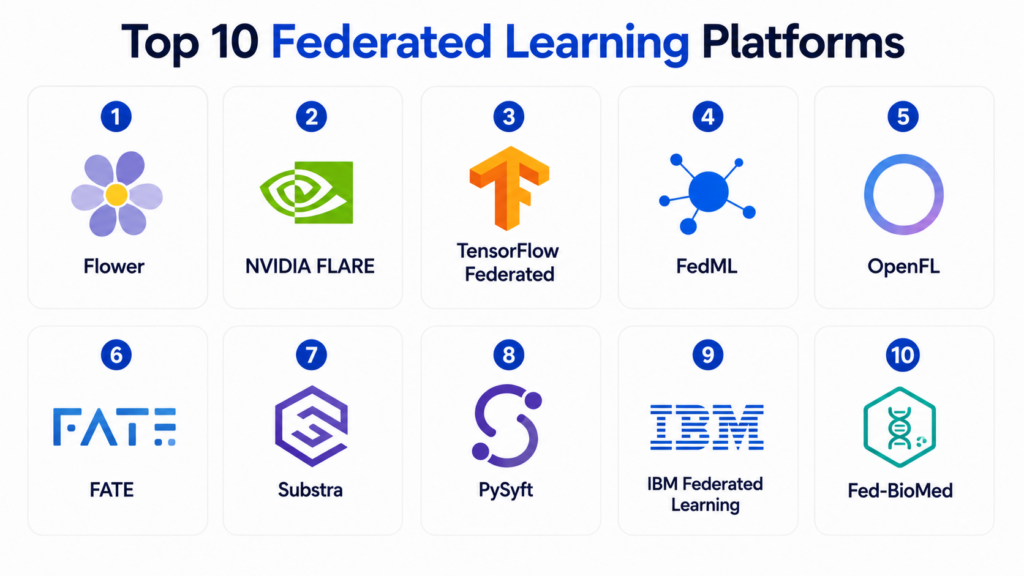
Introduction
Federated learning platforms help organizations train machine learning models across distributed datasets without moving all raw data into one central location. In simple terms, each participant keeps its data locally, trains or updates a model in its own environment, and shares only model updates or controlled outputs with a central coordinator or federation workflow. This approach matters now because enterprises want to build stronger AI models while reducing privacy, regulatory, data residency, and collaboration risks.
Real-world use cases include multi-hospital AI model training, bank fraud detection across branches or partners, telecom network optimization, edge AI for devices, cross-company research collaboration, and privacy-preserving customer analytics. Buyers should evaluate model framework support, privacy mechanisms, orchestration, secure aggregation, deployment flexibility, governance, monitoring, scalability, documentation, and integration with existing ML pipelines.
Best for: AI teams, data science leaders, healthcare researchers, financial institutions, telecom companies, public sector teams, and enterprises that need collaborative model training without centralizing sensitive data. Not ideal for: teams with small non-sensitive datasets, simple analytics needs, no distributed data problem, or limited ML engineering maturity where standard centralized training may be easier and more cost-effective.
Key Trends in Federated Learning Platforms
- Enterprise AI collaboration is driving adoption, especially in healthcare, finance, telecom, mobility, and public-sector research.
- Cross-silo federated learning is becoming more practical, where hospitals, banks, labs, or business units collaborate without centralizing data.
- Edge and device-based training is gaining attention, especially for IoT, mobile, automotive, and distributed sensor environments.
- Privacy-enhancing technologies are being combined, including federated learning, differential privacy, secure aggregation, confidential computing, encryption, and access governance.
- Framework interoperability matters more, because teams want support for PyTorch, TensorFlow, scikit-learn, XGBoost, Hugging Face, and custom model workflows.
- Governance and auditability are becoming critical, especially when multiple organizations participate in the same federation.
- Simulation-to-production workflows are improving, allowing teams to test federation logic locally before deploying across real participants.
- Healthcare-specific federated learning is growing, with platforms focusing on medical imaging, clinical research, and regulated collaboration.
- MLOps integration is now expected, including experiment tracking, pipeline orchestration, model validation, monitoring, and reproducibility.
- Security expectations are rising, with buyers looking for identity controls, participant authentication, secure communication, model update validation, and policy enforcement.
How We Selected These Tools
- Prioritized platforms and frameworks widely recognized in federated learning, privacy-preserving AI, and distributed machine learning.
- Balanced open-source developer frameworks with enterprise-oriented and domain-focused platforms.
- Considered support for real-world federation scenarios such as cross-silo, cross-device, healthcare, finance, and edge AI.
- Evaluated framework compatibility with common ML stacks such as PyTorch, TensorFlow, scikit-learn, and related ecosystems.
- Considered orchestration maturity, workflow flexibility, privacy features, scalability, and governance readiness.
- Reviewed suitability for experimentation, research, proof of concept, and production deployment.
- Favored platforms with clear documentation, active communities, or recognizable institutional adoption.
- Avoided public ratings because reliable rating data is not consistently available for this technical category.
- Used “Not publicly stated” where security certifications, compliance posture, or enterprise controls are not clearly known.
- Scoring is comparative and practical, based on feature fit, usability, ecosystem depth, security expectations, and value.
Top 10 Federated Learning Platforms
1- Flower
Short description:
Flower is an open-source federated learning framework built for flexible, framework-agnostic AI development. It is popular among researchers, startups, and enterprise AI teams that want to federate existing machine learning workflows. Flower supports multiple ML libraries, making it attractive for teams that do not want to be locked into one model framework. It is especially useful for experimentation, simulation, and building custom federated learning systems.
Key Features
- Framework-agnostic approach for federated learning workflows.
- Supports common machine learning ecosystems such as PyTorch, TensorFlow, and related tools.
- Useful for both research experiments and practical implementation.
- Flexible architecture for cross-device and cross-silo federated learning.
- Strong developer experience for Python-based ML teams.
- Supports simulation before real-world federation deployment.
- Active open-source ecosystem and practical examples.
Pros
- Flexible and developer-friendly for modern ML teams.
- Strong fit for experimentation and custom federated workflows.
- Good option when teams use multiple ML frameworks.
Cons
- Production governance may require additional engineering.
- Security and compliance controls depend on deployment design.
- Non-technical teams may face a learning curve.
Platforms / Deployment
Linux / macOS / Windows through Python environments.
Cloud / Self-hosted / Hybrid depending on implementation.
Security & Compliance
Not publicly stated as a complete enterprise compliance platform. Security depends on deployment architecture, communication design, identity controls, and surrounding infrastructure.
Integrations & Ecosystem
Flower fits well into Python-based machine learning environments and can be adapted to different model training workflows. It is useful for teams that already work with modern ML libraries and want to federate training logic without changing the entire stack.
- PyTorch workflows
- TensorFlow workflows
- Hugging Face model workflows
- scikit-learn-style experimentation
- Python ML pipelines
- Custom MLOps integrations
Support & Community
Flower has a strong developer community and useful documentation for federated learning experimentation. Enterprise support expectations should be validated separately based on deployment needs, production scale, and governance requirements.
2- NVIDIA FLARE
Short description:
NVIDIA FLARE is an open-source federated learning platform designed for real-world collaborative AI workflows. It is especially relevant for healthcare, medical imaging, research networks, and enterprise AI teams that need structured federation orchestration. NVIDIA FLARE focuses on reusable workflow components, security-aware architecture, and production-oriented collaboration. It is a strong choice for organizations that need federated learning beyond simple experiments.
Key Features
- Federated learning SDK for collaborative AI development.
- Supports cross-silo federated learning across organizations or departments.
- Useful for medical imaging, research, and enterprise AI workflows.
- Provides reusable building blocks for federated workflows.
- Supports integration with common AI and ML ecosystems.
- Designed for experimentation as well as real-world deployment patterns.
- Enables workflow customization for advanced federation scenarios.
Pros
- Strong fit for enterprise and research federations.
- Useful for healthcare and imaging-heavy AI collaboration.
- Production-oriented architecture compared with simpler frameworks.
Cons
- Requires skilled ML and infrastructure teams.
- May be more complex than needed for small experiments.
- Deployment planning can be heavier than lightweight frameworks.
Platforms / Deployment
Linux-focused development environments.
Self-hosted / Hybrid / Cloud depending on architecture.
Security & Compliance
Security posture depends on deployment design. Enterprise-grade controls such as identity, encryption, auditing, and participant governance should be validated during implementation. Specific certifications are not publicly stated here.
Integrations & Ecosystem
NVIDIA FLARE can be integrated with existing AI research and ML engineering workflows. It is often useful where teams need to federate model training across institutions or secure environments.
- PyTorch workflows
- TensorFlow workflows
- MONAI-related healthcare imaging workflows
- Hugging Face-related model workflows
- Research AI pipelines
- Enterprise MLOps environments
Support & Community
NVIDIA FLARE benefits from NVIDIA’s technical ecosystem and developer resources. Teams should still plan formal onboarding, architecture review, and security validation before using it for sensitive multi-party AI training.
3- TensorFlow Federated
Short description:
TensorFlow Federated is an open-source framework for machine learning and computation on decentralized data. It is best suited for teams already using TensorFlow or researchers studying federated learning algorithms. The framework helps users simulate and experiment with federated training and evaluation workflows. It is especially useful for academic, research, and TensorFlow-native machine learning environments.
Key Features
- Open-source federated learning framework for decentralized data.
- Strong alignment with TensorFlow-based model development.
- Supports federated training and evaluation experiments.
- Useful for research and algorithm exploration.
- Provides abstractions for federated computations.
- Enables simulation of federated learning scenarios.
- Good fit for teams focused on TensorFlow ecosystems.
Pros
- Strong choice for TensorFlow users and researchers.
- Useful for learning and testing federated algorithms.
- Good conceptual foundation for decentralized ML experimentation.
Cons
- Less framework-agnostic than some alternatives.
- Production deployment may require significant engineering.
- Not ideal for teams that primarily use PyTorch or mixed ML stacks.
Platforms / Deployment
Linux / macOS / Windows through TensorFlow-supported environments.
Self-hosted / Developer framework.
Security & Compliance
Not publicly stated as a complete enterprise security or compliance platform. Security depends on how the framework is deployed, how data is accessed, and how federation workflows are governed.
Integrations & Ecosystem
TensorFlow Federated fits naturally into TensorFlow-based experimentation and model workflows. It is useful for research teams that want to evaluate federated algorithms and prototype decentralized training.
- TensorFlow model workflows
- Python notebook environments
- Research pipelines
- Federated algorithm simulation
- ML training experiments
- Academic and lab environments
Support & Community
TensorFlow Federated benefits from the broader TensorFlow ecosystem and technical documentation. It is most suitable for users with strong ML knowledge and comfort with experimental federated learning concepts.
4- FedML
Short description:
FedML is a federated learning and distributed AI platform focused on research, development, and practical deployment across cloud, edge, and device environments. It is useful for teams building decentralized AI systems across different infrastructure layers. FedML supports multiple federated learning scenarios and is especially relevant for teams exploring scalable, production-aware AI federation. It can serve both academic researchers and engineering teams working on applied distributed AI.
Key Features
- Federated learning and distributed AI platform.
- Supports cloud, edge, and device-oriented workflows.
- Useful for cross-silo and cross-device federation scenarios.
- Supports experimentation and practical deployment patterns.
- Designed for distributed AI research and engineering.
- Can support model training across heterogeneous environments.
- Provides flexibility for advanced federated learning architectures.
Pros
- Strong fit for distributed AI and edge learning use cases.
- Useful for research-to-deployment workflows.
- Broad platform scope across cloud and device environments.
Cons
- Broader scope can increase learning curve.
- Teams must validate production readiness for specific workloads.
- Governance and compliance controls need careful implementation.
Platforms / Deployment
Linux / macOS / Windows depending on environment.
Cloud / Self-hosted / Hybrid / Edge depending on implementation.
Security & Compliance
Not publicly stated for general enterprise certifications. Security depends on deployment architecture, participant controls, communication security, and infrastructure governance.
Integrations & Ecosystem
FedML is suitable for teams that need distributed training and federated learning across varied environments. It can integrate into broader AI development workflows where models are trained across cloud, edge, and device nodes.
- Cloud AI workflows
- Edge AI environments
- Mobile and device learning scenarios
- Python ML workflows
- Distributed training pipelines
- Research and enterprise AI experiments
Support & Community
FedML has a developer and research-oriented ecosystem. Support and onboarding expectations should be validated for enterprise usage, especially when deploying across multiple sites or device networks.
5- OpenFL
Short description:
OpenFL is an open-source federated learning framework originally designed with strong relevance for research and healthcare collaboration. It is useful for organizations that need to train models across multiple institutions while keeping data local. OpenFL is especially suitable for cross-silo federated learning where hospitals, research labs, or business units participate in shared model development. It is a practical choice for teams that want structured federation with strong technical flexibility.
Key Features
- Open-source federated learning framework.
- Designed for cross-silo collaboration.
- Useful for healthcare, research, and institutional AI workflows.
- Supports model training while keeping data at local sites.
- Provides federation orchestration concepts for multi-party training.
- Suitable for privacy-preserving collaborative ML experiments.
- Can support advanced research and production-oriented deployments.
Pros
- Strong fit for healthcare and institutional collaboration.
- Useful for multi-site model training.
- Open-source framework supports customization.
Cons
- Requires technical skill to operate and customize.
- Enterprise governance must be designed around the framework.
- May be more complex than needed for simple ML experiments.
Platforms / Deployment
Linux-focused environments.
Self-hosted / Hybrid depending on architecture.
Security & Compliance
Not publicly stated as a complete compliance platform. Security should be validated through deployment controls, identity management, network design, encryption, and participant governance.
Integrations & Ecosystem
OpenFL is useful for federated learning workflows where multiple organizations or sites participate in model training. It can be integrated into research and healthcare AI pipelines with appropriate engineering support.
- Healthcare AI workflows
- Research institution collaborations
- Python ML environments
- Multi-site model training
- Cross-silo federation
- Enterprise AI experimentation
Support & Community
OpenFL has open-source community support and technical documentation. Teams should plan architecture review, site onboarding, and operational ownership before moving from experimentation to production.
6- FATE
Short description:
FATE is an open-source federated learning framework designed for industrial and enterprise-style federated AI scenarios. It is especially relevant for financial services, risk modeling, and cross-organization data collaboration. FATE supports multiple federated learning patterns and is often considered when teams need more structured federation workflows. It is suitable for technically mature organizations that want a broader federated learning system rather than a lightweight library.
Key Features
- Open-source framework for federated learning.
- Supports enterprise-style federation scenarios.
- Useful for finance, risk, and collaborative AI use cases.
- Supports multiple federated learning approaches.
- Provides workflow and orchestration capabilities.
- Designed for privacy-preserving machine learning collaboration.
- Relevant for cross-organization AI model development.
Pros
- Strong fit for structured enterprise federated learning.
- Useful for finance and risk-oriented collaboration.
- Broader platform capabilities than simple FL libraries.
Cons
- Can be complex to learn and operate.
- May require dedicated infrastructure and engineering support.
- Not ideal for lightweight experimentation.
Platforms / Deployment
Linux-focused environments.
Self-hosted / Hybrid depending on architecture.
Security & Compliance
Not publicly stated for general enterprise certifications in this context. Teams should validate encryption, access control, authentication, auditability, and governance controls before deployment.
Integrations & Ecosystem
FATE is best suited for organizations building federated learning workflows across departments, partners, or institutions. It may require deeper integration planning than lightweight developer frameworks.
- Enterprise ML workflows
- Finance and risk analytics
- Cross-organization data collaboration
- Python-based ML environments
- Federated modeling pipelines
- Internal AI governance workflows
Support & Community
FATE has an established open-source ecosystem and technical documentation. Organizations should evaluate internal skills, architecture needs, and deployment complexity before selecting it for production.
7- Substra
Short description:
Substra is a federated learning and privacy-preserving machine learning platform designed for collaborative AI across distributed data owners. It is especially relevant for regulated and research-heavy environments where data cannot be freely centralized. Substra supports controlled collaboration between participants while preserving data locality. It is a practical option for teams that need governance-aware federated learning workflows.
Key Features
- Federated learning platform for collaborative AI.
- Designed for distributed data ownership scenarios.
- Useful for regulated research and privacy-preserving collaboration.
- Supports structured workflows across participants.
- Helps keep data local while enabling shared model development.
- Relevant for healthcare, life sciences, and research collaboration.
- Supports controlled experimentation and federation governance concepts.
Pros
- Good fit for privacy-preserving research collaboration.
- Useful where data ownership and control are important.
- Strong relevance for regulated AI workflows.
Cons
- May require specialized deployment and onboarding.
- Less suitable for simple single-team ML projects.
- Teams must validate ecosystem maturity for their specific use case.
Platforms / Deployment
Linux / Web-based components depending on deployment.
Self-hosted / Hybrid depending on architecture.
Security & Compliance
Not publicly stated as a universal compliance solution. Security depends on implementation, participant management, identity controls, infrastructure, and governance processes.
Integrations & Ecosystem
Substra is useful where multiple parties collaborate on model development while retaining control over local data. It can support research and regulated-sector AI workflows that need structured collaboration.
- Healthcare AI collaboration
- Life sciences research
- Multi-party model training
- Privacy-preserving data science
- Research consortium workflows
- Internal governance processes
Support & Community
Support and community strength may vary by deployment model and use case. Teams should evaluate documentation, onboarding requirements, and available professional support before adoption.
8- PySyft
Short description:
PySyft is a privacy-preserving data science framework associated with federated learning, secure data access, and collaborative AI. It is broader than federated learning alone and is useful when teams need controlled data science across sensitive datasets. PySyft is often considered for research, secure collaboration, and privacy-enhancing technology experiments. It is best for advanced teams comfortable with privacy architecture and distributed ML concepts.
Key Features
- Privacy-preserving data science framework.
- Supports federated learning and controlled data access concepts.
- Useful for secure collaboration across sensitive datasets.
- Relevant for research and privacy-enhancing technology projects.
- Can complement secure computation and governance workflows.
- Suitable for advanced AI and data science teams.
- Helps reduce the need to centralize sensitive data.
Pros
- Strong fit for broader privacy-preserving AI research.
- Useful when data cannot easily move between parties.
- Flexible for advanced privacy architecture exploration.
Cons
- Broader scope can make adoption complex.
- Not only a federated learning platform.
- Requires skilled technical and privacy engineering teams.
Platforms / Deployment
Linux / macOS / Windows depending on setup.
Self-hosted / Hybrid depending on architecture.
Security & Compliance
Not publicly stated as a general enterprise compliance platform. Security depends on deployment design, access governance, identity controls, encryption, and operational processes.
Integrations & Ecosystem
PySyft fits into Python-based privacy-preserving data science workflows. It is most useful when federated learning is part of a broader secure data collaboration strategy.
- Python data science workflows
- Federated learning experiments
- Secure data access projects
- Privacy-preserving AI research
- Multi-party collaboration workflows
- Internal data governance systems
Support & Community
PySyft has an open-source and research-oriented community. Documentation and examples are helpful for technical teams, but production adoption requires careful architecture and governance planning.
9- IBM Federated Learning
Short description:
IBM Federated Learning is designed for privacy-preserving machine learning across distributed data sources. It is relevant for enterprises that want to train models while data remains in local environments. The platform is especially useful for teams that need structured federated learning with enterprise-oriented workflows. It is a good fit for organizations that already operate complex AI, data governance, and security programs.
Key Features
- Federated learning capabilities for distributed machine learning.
- Designed to train models across data locations without centralizing raw data.
- Useful for enterprise AI and regulated industry scenarios.
- Supports collaborative model development across participants.
- Can align with broader AI governance and enterprise ML workflows.
- Suitable for privacy-aware machine learning initiatives.
- Relevant for organizations with mature infrastructure and governance needs.
Pros
- Enterprise-oriented federated learning approach.
- Useful for regulated industries and distributed data environments.
- Good fit where AI governance and privacy are strategic priorities.
Cons
- May be more complex than open-source experimentation frameworks.
- Deployment details and product packaging should be validated directly.
- Pricing and support models may vary.
Platforms / Deployment
Cloud / Hybrid / Self-hosted depending on IBM environment and implementation.
Platform details may vary.
Security & Compliance
Not publicly stated in this context for specific certifications. Enterprise buyers should validate SSO, encryption, RBAC, audit logs, compliance mappings, and deployment controls directly.
Integrations & Ecosystem
IBM Federated Learning can fit into enterprise AI and data science environments where governance, security, and distributed data access matter. Integration planning should focus on existing ML pipelines, data platforms, and identity systems.
- Enterprise AI workflows
- Distributed data environments
- Governance-aware ML operations
- Regulated industry use cases
- Cloud and hybrid infrastructure
- Existing IBM ecosystem components where applicable
Support & Community
Support may depend on IBM product packaging, customer agreement, and implementation model. Enterprise teams should validate onboarding, professional services, support tiers, and roadmap fit before selection.
10- Fed-BioMed
Short description:
Fed-BioMed is an open-source federated learning framework focused on biomedical and healthcare research. It is designed for situations where sensitive medical or research data should remain local while models are trained collaboratively. Fed-BioMed is especially useful for hospitals, clinical research groups, and biomedical AI teams. It is a strong fit when federated learning must support healthcare-specific research needs.
Key Features
- Open-source federated learning framework for biomedical research.
- Designed for healthcare and clinical data collaboration.
- Supports model training while keeping data local.
- Useful for hospitals, labs, and research networks.
- Focuses on sensitive data and collaborative AI scenarios.
- Helps teams build privacy-aware biomedical ML workflows.
- Suitable for research-oriented federated learning projects.
Pros
- Strong healthcare and biomedical research fit.
- Useful for multi-site clinical AI collaboration.
- Open-source approach supports transparency and experimentation.
Cons
- More domain-specific than general federated learning frameworks.
- May not be ideal for non-healthcare business use cases.
- Production deployment requires healthcare-grade governance and security review.
Platforms / Deployment
Linux-focused environments depending on setup.
Self-hosted / Hybrid depending on architecture.
Security & Compliance
Not publicly stated as a universal healthcare compliance solution. Healthcare teams should validate privacy, consent, access control, auditability, encryption, and regulatory requirements before deployment.
Integrations & Ecosystem
Fed-BioMed is best suited for biomedical AI projects where hospitals or research sites collaborate without centralizing sensitive datasets. It can support research workflows that need local data control.
- Healthcare AI research
- Clinical model training
- Biomedical data science
- Multi-site hospital collaboration
- Python ML workflows
- Research consortium environments
Support & Community
Fed-BioMed has a research and healthcare-oriented community. Teams should evaluate documentation, current maintenance, deployment complexity, and clinical governance requirements before adoption.
Comparison Table
| Tool Name | Best For | Platform Supported | Deployment | Standout Feature | Public Rating |
|---|---|---|---|---|---|
| Flower | Flexible federated learning development | Linux, macOS, Windows | Cloud / Self-hosted / Hybrid | Framework-agnostic ML federation | N/A |
| NVIDIA FLARE | Enterprise and healthcare AI collaboration | Linux-focused environments | Self-hosted / Hybrid / Cloud | Production-oriented federation workflows | N/A |
| TensorFlow Federated | TensorFlow research and experiments | Linux, macOS, Windows | Self-hosted | Federated computation for TensorFlow workflows | N/A |
| FedML | Cloud, edge, and device federated AI | Linux, macOS, Windows | Cloud / Self-hosted / Hybrid / Edge | Distributed AI across varied environments | N/A |
| OpenFL | Cross-silo institutional collaboration | Linux-focused environments | Self-hosted / Hybrid | Multi-site model training workflows | N/A |
| FATE | Enterprise federated learning workflows | Linux-focused environments | Self-hosted / Hybrid | Structured federation for industrial use cases | N/A |
| Substra | Regulated research collaboration | Linux / Web-based components | Self-hosted / Hybrid | Governance-aware collaborative AI | N/A |
| PySyft | Privacy-preserving data science | Linux, macOS, Windows | Self-hosted / Hybrid | Broader secure data collaboration | N/A |
| IBM Federated Learning | Enterprise distributed ML | Varies / N/A | Cloud / Hybrid / Self-hosted | Enterprise-oriented federated learning | N/A |
| Fed-BioMed | Biomedical and healthcare research | Linux-focused environments | Self-hosted / Hybrid | Healthcare-focused federated learning | N/A |
Evaluation & Scoring of Federated Learning Platforms
| Tool Name | Core 25% | Ease 15% | Integrations 15% | Security 10% | Performance 10% | Support 10% | Value 15% | Weighted Total |
|---|---|---|---|---|---|---|---|---|
| Flower | 9 | 8 | 9 | 7 | 8 | 8 | 9 | 8.35 |
| NVIDIA FLARE | 9 | 7 | 8 | 8 | 9 | 8 | 8 | 8.25 |
| TensorFlow Federated | 8 | 7 | 7 | 7 | 8 | 8 | 8 | 7.60 |
| FedML | 8 | 7 | 8 | 7 | 8 | 7 | 8 | 7.65 |
| OpenFL | 8 | 7 | 7 | 8 | 8 | 7 | 8 | 7.65 |
| FATE | 9 | 6 | 8 | 8 | 8 | 7 | 8 | 7.85 |
| Substra | 8 | 6 | 7 | 8 | 7 | 7 | 7 | 7.25 |
| PySyft | 7 | 6 | 8 | 7 | 7 | 7 | 8 | 7.15 |
| IBM Federated Learning | 8 | 7 | 8 | 8 | 8 | 8 | 7 | 7.75 |
| Fed-BioMed | 7 | 7 | 7 | 8 | 7 | 7 | 8 | 7.25 |
The scores are comparative and should be used as a starting point, not a final buying decision. A higher score means the platform is broadly strong across feature depth, usability, integrations, security expectations, performance, support, and value. A lower score may still be excellent for a specific niche, such as healthcare research or privacy-preserving experimentation. Teams should run a pilot with realistic data, real participant environments, and actual model workflows before selecting a platform.
Which Federated Learning Platform Is Right for You?
Solo / Freelancer
Solo practitioners, researchers, and independent ML engineers should start with Flower, TensorFlow Federated, PySyft, or FedML depending on their technical goal. Flower is a strong general-purpose starting point because it supports multiple ML frameworks and is practical for experimentation. TensorFlow Federated is better if the project is TensorFlow-specific. PySyft is useful when the project involves privacy-preserving data science beyond federated learning alone. FedML can be useful for distributed AI and edge-focused experimentation.
SMB
Small and mid-sized businesses should prioritize simplicity, documentation, and compatibility with existing ML tools. Flower is often a practical starting point because it is flexible and developer-friendly. FedML may be useful if edge or distributed AI is part of the roadmap. TensorFlow Federated can work well for TensorFlow teams, while OpenFL may be suitable for healthcare or research-focused SMBs. SMBs should avoid overly complex deployments until they have proven that federated learning is necessary.
Mid-Market
Mid-market organizations usually need stronger orchestration, repeatability, and governance. NVIDIA FLARE, OpenFL, FATE, Flower, and FedML are strong candidates depending on industry and infrastructure. Healthcare and research organizations may prefer NVIDIA FLARE, OpenFL, Substra, or Fed-BioMed. Financial services teams may evaluate FATE or IBM Federated Learning. Mid-market teams should involve security, legal, data governance, and MLOps stakeholders early to avoid deployment surprises.
Enterprise
Enterprises should evaluate federated learning platforms based on security architecture, participant governance, auditability, scalability, and integration with existing AI platforms. NVIDIA FLARE, FATE, IBM Federated Learning, Flower, and OpenFL are strong candidates for enterprise evaluation. Substra and Fed-BioMed may be relevant for healthcare, life sciences, and research consortiums. Enterprise buyers should not select only based on model accuracy; they must validate identity controls, data residency, network architecture, governance, monitoring, and support.
Budget vs Premium
Open-source platforms can reduce license costs, but federated learning is rarely free to implement. The main costs are engineering, infrastructure, security review, participant onboarding, workflow design, and model monitoring. Budget-conscious teams should start with Flower, TensorFlow Federated, FedML, OpenFL, or PySyft for experimentation. Premium or enterprise-oriented approaches may be worth it when legal risk, regulated data, multi-party contracts, and operational support are major concerns.
Feature Depth vs Ease of Use
Flower offers a strong balance of flexibility and ease of use. TensorFlow Federated is strong for TensorFlow research but may be less flexible for mixed stacks. NVIDIA FLARE and FATE offer deeper federation capabilities but may require more engineering effort. PySyft is powerful for broader privacy-preserving workflows but can be complex. Fed-BioMed is easier to justify in healthcare-specific research environments than in general business ML use cases.
Integrations & Scalability
Teams should select a platform that matches their ML stack and infrastructure. PyTorch-heavy teams may prefer Flower, NVIDIA FLARE, FedML, or OpenFL depending on the workflow. TensorFlow-heavy teams should evaluate TensorFlow Federated and Flower. Healthcare teams should evaluate NVIDIA FLARE, OpenFL, Substra, and Fed-BioMed. Edge and device-focused teams should look closely at FedML and Flower. Scalability should be tested with real participant counts, network conditions, and model sizes.
Security & Compliance Needs
Federated learning reduces the need to centralize raw data, but it does not automatically guarantee privacy or compliance. Teams still need encryption, access control, participant authentication, audit logs, model update validation, secure aggregation where appropriate, and legal review. Healthcare, finance, telecom, and public sector teams should document data flows, model update flows, consent assumptions, and risk controls. If compliance evidence is required, buyers should validate vendor or project documentation directly before production deployment.
Frequently Asked Questions
1- What is a federated learning platform?
A federated learning platform helps train machine learning models across distributed data sources without requiring all raw data to be moved into one central system. Each participant trains locally and shares model updates, parameters, or controlled outputs. The central system then combines those updates into a shared model. This makes federated learning useful when data is sensitive, regulated, geographically distributed, or owned by different organizations. It is not a replacement for all privacy controls, but it can reduce centralization risk. The platform provides orchestration, communication, training coordination, and workflow management.
2- How is federated learning different from normal machine learning?
In normal machine learning, data is usually collected into a central environment before model training. In federated learning, data stays closer to where it is generated or stored. The model moves to the data, or model updates are exchanged between participants. This is useful when data cannot be shared due to privacy, regulation, commercial sensitivity, or technical constraints. Federated learning can improve collaboration, but it also adds complexity. Teams must manage communication, participant reliability, security, model aggregation, and performance trade-offs.
3- How much do federated learning platforms cost?
Many federated learning frameworks are open-source, so license cost may be low or zero. However, the true cost includes engineering, cloud or on-prem infrastructure, participant onboarding, security review, model validation, monitoring, and ongoing operations. Enterprise deployments may also require commercial support, professional services, legal agreements, and governance workflows. A small proof of concept can be relatively affordable. A production federation across hospitals, banks, or edge devices can become significantly more expensive. Buyers should estimate total implementation cost, not only software cost.
4- How long does implementation usually take?
Implementation time depends on the number of participants, model complexity, infrastructure maturity, and security requirements. A simple simulation or proof of concept may be completed quickly by a skilled ML engineer. A real-world production deployment can take much longer because teams must configure networking, identity, data access, model workflows, monitoring, and governance. Multi-organization collaboration also requires legal, compliance, and operational alignment. The best approach is to start with a controlled pilot. After the pilot, teams can expand to more participants and more complex models.
5- What are the biggest mistakes when adopting federated learning?
A common mistake is assuming federated learning automatically solves privacy and compliance problems. It reduces raw data movement, but model updates can still create privacy and security risks if not handled carefully. Another mistake is starting with too many participants before validating the workflow. Teams also underestimate network reliability, model drift, data heterogeneity, and participant governance. Some projects fail because business stakeholders expect centralized model performance without understanding federated constraints. Successful adoption requires clear use cases, realistic pilots, security review, and MLOps discipline.
6- Is federated learning secure?
Federated learning can improve privacy by keeping raw data local, but security depends on implementation. Teams still need secure communication, authentication, authorization, encryption, participant validation, logging, and model update controls. Some use cases may also require secure aggregation, differential privacy, confidential computing, or trusted execution environments. Federated learning can be vulnerable to poisoning, inference, or malicious participant risks if not governed properly. Security teams should review the full workflow before production. A federated learning platform is one part of a broader secure AI architecture.
7- Can federated learning scale to many participants?
Yes, but scalability depends on the platform, architecture, network conditions, model size, participant reliability, and training frequency. Cross-silo federation with a few hospitals or business units is different from cross-device federation with many mobile or edge devices. Some platforms are better for research-scale collaboration, while others are better for large distributed environments. Teams should test communication overhead, aggregation performance, fault tolerance, and monitoring. Scalability also includes operational scalability, such as onboarding participants and managing governance. A staged rollout is safer than a large first deployment.
8- What integrations should buyers look for?
Buyers should look for integrations with their existing ML frameworks, data platforms, identity systems, MLOps tools, and infrastructure. Common needs include PyTorch, TensorFlow, scikit-learn, Hugging Face, notebooks, experiment tracking, pipeline orchestration, container platforms, and cloud environments. Healthcare teams may also need integration with imaging or clinical data workflows. Enterprise teams should evaluate logging, monitoring, CI/CD, access control, and audit systems. The best platform is one that fits existing workflows without forcing a complete rebuild. Integration testing should be part of every pilot.
9- Can federated learning replace data sharing agreements?
No, federated learning does not remove the need for legal and governance agreements. It can reduce raw data movement, but participants still collaborate on model training and may exchange updates or outputs. Legal teams must define responsibilities, permitted use, data handling expectations, model ownership, liability, and security obligations. In regulated industries, consent and compliance requirements may still apply. Federated learning can make collaboration safer, but it does not eliminate governance. Teams should treat legal agreements and technical safeguards as complementary controls.
10- What are alternatives to federated learning?
Alternatives include centralized model training, secure data clean rooms, synthetic data, differential privacy, confidential computing, secure multi-party computation, trusted research environments, and traditional anonymized data sharing. The right alternative depends on the reason data cannot be centralized. If the issue is regulatory risk, secure governance may be enough. If the issue is data residency, federated learning or clean rooms may help. If the issue is testing data availability, synthetic data may be more practical. Many organizations combine federated learning with other privacy-enhancing technologies.
Conclusion
Federated learning platforms are becoming important for organizations that want to build AI models across distributed, sensitive, or regulated datasets without centralizing all raw data. Flower is a strong flexible starting point for developer teams, NVIDIA FLARE is well suited for structured enterprise and healthcare collaboration, TensorFlow Federated is useful for TensorFlow research, FedML supports distributed AI across cloud and edge, OpenFL and FATE fit cross-silo institutional use cases, Substra and Fed-BioMed are strong for regulated and biomedical collaboration, PySyft supports broader privacy-preserving data science, and IBM Federated Learning is relevant for enterprise-oriented distributed ML programs. The best platform depends on your ML stack, data sensitivity, participant model, security needs, governance maturity, and deployment environment. A practical next step is to shortlist two or three platforms, run a pilot with representative participants and real model workflows, validate privacy and security controls, compare model performance, and then scale only after governance, integrations, and operational responsibilities are clearly defined.
