MOTOSHARE 🚗🏍️
Rent Bikes & Cars Directly from Owners
Motoshare connects vehicle owners with people who need bikes and cars on rent. Owners earn from idle vehicles, and renters get flexible ride options.
Visit Motoshare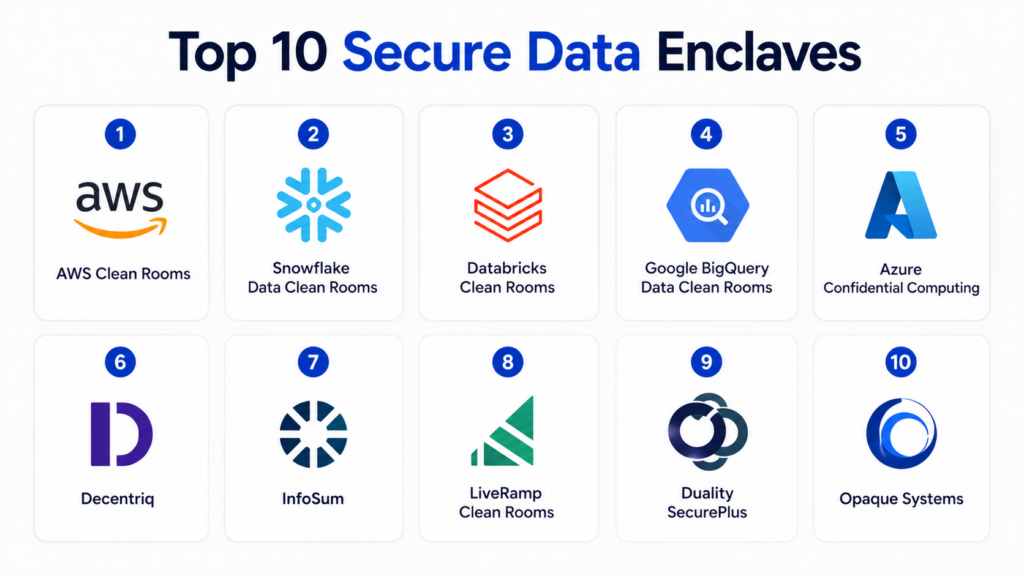
Introduction
Secure Data Enclaves are controlled environments where organizations can analyze, share, process, or collaborate on sensitive data without exposing the raw underlying information. These environments are commonly used for privacy-preserving analytics, regulated research, confidential computing, data clean rooms, AI model evaluation, secure multi-party collaboration, and governed access to high-value datasets.
As organizations use more cloud analytics, AI systems, cross-company data partnerships, and regulated datasets, secure data enclaves have become important for protecting sensitive information while still enabling useful insights. Instead of copying raw data across teams or partners, secure enclaves provide controlled access, policy enforcement, audit trails, and privacy safeguards.
Real World Use Cases:
- Secure healthcare and clinical research analytics
- Privacy-preserving financial data collaboration
- Data clean rooms for marketing and advertising
- Secure AI model training and evaluation
- Confidential analytics across multiple organizations
Evaluation Criteria for Buyers:
- Data isolation and access controls
- Privacy-preserving computation methods
- Encryption and key management
- Audit logging and compliance reporting
- Cloud and warehouse integrations
- AI and analytics workflow support
- Multi-party collaboration capabilities
- Governance and policy enforcement
- Scalability and performance
- Ease of onboarding and administration
Best for: Enterprises, healthcare organizations, financial institutions, research teams, government agencies, advertisers, data providers, AI teams, and regulated organizations that need controlled data collaboration without exposing raw sensitive data.
Not ideal for: Small teams with non-sensitive data, organizations needing only basic file sharing, or teams that do not require advanced privacy, governance, or collaboration controls.
Key Trends in Secure Data Enclaves
- Data clean rooms are becoming common for privacy-safe collaboration between brands, platforms, and data partners.
- Confidential computing is gaining adoption for protecting sensitive workloads during processing.
- AI teams are using secure enclaves to evaluate models on protected datasets without exposing raw data.
- Privacy-enhancing technologies are increasingly combined with cloud analytics platforms.
- Enterprises are moving from manual data-sharing agreements to governed collaborative environments.
- Healthcare and financial services are prioritizing secure research and analytics enclaves.
- Cloud-native enclave platforms are expanding integration with warehouses, lakehouses, and identity systems.
- Auditability and policy enforcement are becoming key buying criteria for regulated industries.
- Multi-party computation and clean room analytics are becoming more practical for enterprise workflows.
- Secure enclaves are increasingly connected with AI governance, data governance, and compliance programs.
How We Selected These Tools
The tools in this list were evaluated using practical enterprise and privacy-focused criteria:
- Recognition in secure data collaboration, clean rooms, or confidential computing
- Strength of access control and data isolation
- Support for privacy-preserving analytics
- Cloud, warehouse, and data platform integrations
- Governance, auditability, and compliance features
- Fit for regulated industries and enterprise collaboration
- Support for multi-party workflows
- Developer and data science usability
- Scalability for large datasets and workloads
- Balance across enterprise platforms, cloud-native tools, and privacy-first vendors
Top 10 Secure Data Enclaves
#1 — AWS Clean Rooms
Short description: AWS Clean Rooms enables organizations to collaborate on datasets without sharing or exposing raw data directly. It is useful for enterprises, advertisers, data providers, and partners that need privacy-safe analytics across AWS environments. The platform supports controlled collaboration, analysis rules, and governed data workflows. It is a strong choice for AWS-first organizations building secure data collaboration programs.
Key Features
- Privacy-preserving data collaboration
- Configurable analysis rules
- Multi-party clean room workflows
- AWS-native identity and access controls
- Query controls and collaboration governance
- Integration with AWS data services
- Audit-friendly collaboration setup
Pros
- Strong fit for AWS environments
- Good controlled collaboration workflows
- Scales well for cloud-native data teams
Cons
- Best suited for AWS-centric organizations
- Requires cloud and data governance expertise
- Not ideal for non-AWS-first teams
Platforms / Deployment
- Cloud
Security & Compliance
- IAM-based access controls
- Encryption
- Audit logging through AWS ecosystem
- RBAC through AWS permissions
- Compliance support varies by deployment
Integrations & Ecosystem
AWS Clean Rooms integrates closely with AWS analytics, storage, identity, and security services. It works best when data already lives in or near AWS environments.
- Amazon S3
- AWS Glue
- AWS Lake Formation
- AWS Identity and Access Management
- Amazon CloudWatch
- AWS data collaboration workflows
Support & Community
AWS provides documentation, cloud support plans, partner assistance, and a large technical ecosystem. Implementation success depends on cloud architecture and governance maturity.
#2 — Snowflake Data Clean Rooms
Short description: Snowflake Data Clean Rooms helps organizations collaborate on data securely within the Snowflake ecosystem. It is designed for privacy-safe analytics, partner collaboration, marketing measurement, and governed data sharing. Snowflake’s clean room approach benefits organizations already using Snowflake as a central data platform. It enables insights without requiring raw data movement between collaborators.
Key Features
- Secure data collaboration
- Governed data sharing
- Privacy-safe analytics
- Snowflake-native workflows
- Role-based access controls
- Query and policy controls
- Enterprise data marketplace alignment
Pros
- Strong fit for Snowflake customers
- Good governed sharing workflows
- Useful for analytics-heavy teams
Cons
- Best value inside Snowflake ecosystem
- Requires data governance planning
- May not fit organizations using different warehouses
Platforms / Deployment
- Cloud
Security & Compliance
- RBAC
- Encryption
- Audit logs
- SSO/SAML support
- Compliance support varies by deployment and edition
Integrations & Ecosystem
Snowflake Data Clean Rooms integrates with Snowflake’s broader data cloud and partner ecosystem. It is especially useful for organizations already using Snowflake for analytics and data sharing.
- Snowflake Data Cloud
- Data sharing workflows
- Marketplace ecosystem
- Identity provider integrations
- BI and analytics tools
- Partner collaboration workflows
Support & Community
Snowflake provides enterprise documentation, support plans, partner services, and a large data engineering community.
#3 — Databricks Clean Rooms
Short description: Databricks Clean Rooms enables secure collaboration on data and AI workloads across organizations without directly exposing raw data. It is especially useful for teams working with lakehouse architectures, analytics, and machine learning workflows. Databricks provides a strong foundation for governed collaboration between data providers and data consumers. It is well suited for enterprises building privacy-aware AI and analytics programs.
Key Features
- Secure data collaboration
- Lakehouse-native clean room workflows
- AI and ML workload support
- Governed data sharing
- Unity Catalog integration
- Access policy enforcement
- Collaborative analytics workflows
Pros
- Strong AI and analytics alignment
- Good fit for lakehouse environments
- Useful for advanced data science teams
Cons
- Best suited for Databricks users
- Requires technical implementation expertise
- May be complex for smaller teams
Platforms / Deployment
- Cloud
Security & Compliance
- RBAC
- Audit logs
- Encryption
- SSO/SAML support
- Unity Catalog governance
- Compliance support varies by deployment
Integrations & Ecosystem
Databricks Clean Rooms integrates with the Databricks Lakehouse platform and enterprise data workflows. It is especially useful for organizations combining analytics, AI, and governed collaboration.
- Unity Catalog
- Delta Sharing
- ML workflows
- Cloud storage platforms
- BI integrations
- Data engineering pipelines
Support & Community
Databricks provides enterprise support, documentation, training resources, and a strong data engineering and AI community.
#4 — Google BigQuery Data Clean Rooms
Short description: Google BigQuery Data Clean Rooms supports privacy-safe analytics and governed data collaboration inside the Google Cloud ecosystem. It is useful for organizations using BigQuery for analytics, advertising measurement, customer insights, and cross-partner data analysis. The platform allows teams to collaborate without directly exposing sensitive raw datasets. It is well suited for cloud-native analytics environments.
Key Features
- Governed analytics collaboration
- BigQuery-native clean room workflows
- Privacy-safe query controls
- Identity and access management
- Data sharing support
- Analytics Hub integration
- Cloud-native scalability
Pros
- Strong fit for BigQuery users
- Scalable analytics performance
- Good cloud-native governance controls
Cons
- Best suited for Google Cloud environments
- Requires BigQuery expertise
- Limited value outside Google Cloud ecosystems
Platforms / Deployment
- Cloud
Security & Compliance
- IAM-based access controls
- Encryption
- Audit logging
- Policy controls
- Compliance support varies by deployment
Integrations & Ecosystem
Google BigQuery Data Clean Rooms integrates with Google Cloud analytics, storage, identity, and AI services.
- BigQuery
- Analytics Hub
- Google Cloud IAM
- Cloud Storage
- Looker workflows
- Vertex AI ecosystem
Support & Community
Google provides enterprise cloud support, documentation, training resources, and a large analytics-focused community.
#5 — Azure Confidential Computing
Short description: Azure Confidential Computing helps organizations protect sensitive workloads while data is being processed in trusted execution environments. It is useful for regulated analytics, AI workloads, secure collaboration, and confidential application processing. Instead of focusing only on data sharing, Azure Confidential Computing protects data in use. It is a strong choice for Microsoft-centric enterprises that require secure workload isolation.
Key Features
- Trusted execution environments
- Protection for data in use
- Confidential virtual machines
- Confidential containers
- Secure AI workload support
- Enterprise identity integration
- Cloud-native governance controls
Pros
- Strong confidential computing capabilities
- Good Microsoft ecosystem integration
- Useful for regulated workloads
Cons
- Requires technical architecture expertise
- Not a traditional data clean room platform
- Best suited for Azure environments
Platforms / Deployment
- Cloud / Hybrid
Security & Compliance
- Encryption
- RBAC
- Audit logging
- Microsoft Entra ID integration
- SSO/SAML through Microsoft identity ecosystem
- Compliance support varies by workload
Integrations & Ecosystem
Azure Confidential Computing integrates with Microsoft cloud, identity, security, and data services. It is useful for teams that need secure processing environments rather than only collaborative data analytics.
- Azure Virtual Machines
- Azure Kubernetes Service
- Microsoft Entra ID
- Azure Key Vault
- Azure Machine Learning
- Microsoft security ecosystem
Support & Community
Microsoft provides enterprise support, documentation, partner services, and extensive cloud architecture guidance.
#6 — Decentriq
Short description: Decentriq provides secure data collaboration and data clean room capabilities using privacy-enhancing technologies. It is designed for organizations that need to collaborate on sensitive data without exposing raw records. Decentriq is often used in healthcare, advertising, media, and regulated data collaboration scenarios. The platform focuses on privacy-preserving computation and governed analytics.
Key Features
- Secure data clean rooms
- Privacy-preserving analytics
- Multi-party collaboration
- Confidential computing support
- Governed data access
- Query controls
- Collaboration auditability
Pros
- Strong privacy-first architecture
- Good multi-party collaboration support
- Useful for regulated and partner-driven workflows
Cons
- Smaller ecosystem than hyperscale cloud platforms
- Requires collaboration workflow planning
- May need technical onboarding support
Platforms / Deployment
- Cloud
Security & Compliance
- Encryption
- Access controls
- Audit logs
- Confidential computing capabilities
- Additional certifications not publicly stated
Integrations & Ecosystem
Decentriq integrates with enterprise data collaboration and analytics workflows. It is commonly used where multiple parties need shared insights without raw data exchange.
- Cloud storage workflows
- Data clean room collaboration
- Analytics integrations
- Partner data workflows
- Privacy-enhancing technology ecosystem
Support & Community
Decentriq provides vendor onboarding, documentation, and implementation support. Community visibility is strongest in privacy-preserving collaboration markets.
#7 — InfoSum
Short description: InfoSum provides a decentralized data collaboration platform that allows organizations to connect and analyze data without directly sharing raw records. It is widely used in media, advertising, retail, and data partnership workflows. InfoSum emphasizes privacy-safe data collaboration and identity-protected matching. It is useful for organizations that need audience insights, campaign measurement, and partner analytics.
Key Features
- Decentralized data collaboration
- Privacy-safe data matching
- Data clean room workflows
- Audience analysis
- Partner collaboration controls
- Data governance features
- Secure query and analysis workflows
Pros
- Strong fit for media and advertising use cases
- Privacy-focused collaboration model
- Useful for partner data ecosystems
Cons
- Less suited for general enterprise analytics
- Best fit for marketing and media workflows
- May require partner ecosystem alignment
Platforms / Deployment
- Cloud
Security & Compliance
- Access controls
- Encryption
- Audit support
- Compliance details vary
- Additional certifications not publicly stated
Integrations & Ecosystem
InfoSum integrates with data providers, media platforms, advertisers, and analytics workflows. It is especially relevant for privacy-safe audience collaboration.
- Advertising ecosystem integrations
- Data partner workflows
- Analytics workflows
- Customer data platform compatibility
- Cloud data collaboration
Support & Community
InfoSum provides customer support, onboarding, and data collaboration guidance. Its ecosystem is strongest in advertising, media, and data partnership markets.
#8 — LiveRamp Clean Rooms
Short description: LiveRamp Clean Rooms helps brands, publishers, retailers, and platforms collaborate on customer and audience data in privacy-focused environments. The platform is widely used for advertising measurement, customer insights, and data collaboration. It focuses on identity, connectivity, and secure data collaboration across marketing ecosystems. It is best suited for organizations with mature customer data and media partnership strategies.
Key Features
- Privacy-safe data collaboration
- Audience measurement workflows
- Identity resolution support
- Partner data collaboration
- Marketing analytics use cases
- Clean room activation workflows
- Governance and permission controls
Pros
- Strong marketing and advertising ecosystem
- Useful for audience collaboration
- Good partner data connectivity
Cons
- Best suited for marketing data use cases
- Less focused on general enterprise enclaves
- May require mature customer data operations
Platforms / Deployment
- Cloud
Security & Compliance
- Access controls
- Encryption
- Audit support
- Compliance capabilities vary by deployment
- Additional certifications not publicly stated
Integrations & Ecosystem
LiveRamp Clean Rooms integrates with marketing, media, identity, and analytics ecosystems. It is especially useful for customer data collaboration and activation workflows.
- Marketing platform integrations
- Media platform workflows
- Data partner ecosystem
- Customer data platform compatibility
- Analytics integrations
Support & Community
LiveRamp provides enterprise onboarding, customer success support, and partner ecosystem guidance.
#9 — Duality SecurePlus
Short description: Duality SecurePlus enables privacy-preserving data collaboration and analytics using advanced privacy-enhancing technologies. It is designed for organizations that need to collaborate on sensitive data without exposing underlying records. Duality is often relevant for healthcare, finance, government, and research use cases. Its approach supports secure computation across distributed data environments.
Key Features
- Privacy-preserving analytics
- Secure data collaboration
- Advanced cryptographic techniques
- Multi-party workflows
- Sensitive data protection
- Governed analytics
- Secure research collaboration
Pros
- Strong privacy-enhancing technology focus
- Good fit for regulated collaboration
- Useful for sensitive analytics use cases
Cons
- Advanced workflows may require expertise
- Smaller ecosystem visibility
- Implementation can be specialized
Platforms / Deployment
- Cloud / Hybrid
Security & Compliance
- Encryption
- Access controls
- Audit support
- Advanced privacy-enhancing technology support
- Additional certifications not publicly stated
Integrations & Ecosystem
Duality SecurePlus integrates with sensitive analytics and collaboration workflows where privacy preservation is a core requirement.
- Healthcare data workflows
- Financial analytics collaboration
- Research environments
- Cloud data platforms
- Custom enterprise integrations
Support & Community
Duality provides enterprise support, technical guidance, and implementation assistance for complex privacy-preserving analytics programs.
#10 — Opaque Systems
Short description: Opaque Systems provides confidential computing and secure analytics capabilities for sensitive data workloads. The platform enables organizations to process and analyze encrypted or protected data in secure environments. It is useful for regulated analytics, AI workflows, and multi-party collaboration scenarios. Opaque is especially relevant for teams that need strong privacy guarantees during computation.
Key Features
- Confidential computing workflows
- Secure analytics processing
- Privacy-preserving collaboration
- Protected data processing
- AI workload support
- Data isolation controls
- Enterprise deployment support
Pros
- Strong confidential computing focus
- Useful for sensitive analytics and AI
- Good fit for regulated workloads
Cons
- Requires technical expertise
- More specialized than general clean rooms
- Smaller ecosystem than hyperscale platforms
Platforms / Deployment
- Cloud / Hybrid
Security & Compliance
- Encryption
- Access controls
- Audit support
- Confidential computing support
- Additional certifications not publicly stated
Integrations & Ecosystem
Opaque Systems integrates with secure analytics, AI, and enterprise data workflows. It is often used where organizations need strong data protection during processing.
- Cloud infrastructure integrations
- Analytics workflow support
- AI pipeline compatibility
- Secure data collaboration workflows
- Enterprise data platform integrations
Support & Community
Opaque Systems provides technical support, onboarding, and implementation guidance. Its ecosystem is strongest among confidential computing and privacy-preserving analytics teams.
Comparison Table
| Tool Name | Best For | Platform(s) Supported | Deployment | Standout Feature | Public Rating |
|---|---|---|---|---|---|
| AWS Clean Rooms | AWS-native data collaboration | Web / Cloud | Cloud | Governed multi-party analytics | N/A |
| Snowflake Data Clean Rooms | Snowflake data collaboration | Web / Cloud | Cloud | Warehouse-native clean rooms | N/A |
| Databricks Clean Rooms | Lakehouse and AI collaboration | Web / Cloud | Cloud | AI and analytics clean rooms | N/A |
| Google BigQuery Data Clean Rooms | BigQuery analytics collaboration | Web / Cloud | Cloud | BigQuery-native privacy analytics | N/A |
| Azure Confidential Computing | Secure workload processing | Web / Cloud | Cloud / Hybrid | Protection for data in use | N/A |
| Decentriq | Privacy-first collaboration | Web / Cloud | Cloud | Confidential clean rooms | N/A |
| InfoSum | Media and advertising collaboration | Web / Cloud | Cloud | Decentralized data matching | N/A |
| LiveRamp Clean Rooms | Marketing data collaboration | Web / Cloud | Cloud | Identity-based clean room workflows | N/A |
| Duality SecurePlus | Regulated data collaboration | Web / Cloud | Cloud / Hybrid | Privacy-enhancing analytics | N/A |
| Opaque Systems | Confidential analytics | Web / Cloud | Cloud / Hybrid | Confidential computing analytics | N/A |
Evaluation & Scoring of Secure Data Enclaves
| Tool Name | Core 25% | Ease 15% | Integrations 15% | Security 10% | Performance 10% | Support 10% | Value 15% | Weighted Total |
|---|---|---|---|---|---|---|---|---|
| AWS Clean Rooms | 9.1 | 8.2 | 9.1 | 9.0 | 9.0 | 8.8 | 8.0 | 8.7 |
| Snowflake Data Clean Rooms | 9.0 | 8.4 | 9.2 | 9.0 | 9.1 | 8.7 | 8.0 | 8.7 |
| Databricks Clean Rooms | 9.0 | 8.0 | 9.0 | 8.9 | 9.0 | 8.7 | 7.9 | 8.6 |
| Google BigQuery Data Clean Rooms | 8.8 | 8.3 | 9.0 | 8.9 | 9.1 | 8.6 | 8.1 | 8.6 |
| Azure Confidential Computing | 8.8 | 7.7 | 8.8 | 9.4 | 8.8 | 8.8 | 7.8 | 8.6 |
| Decentriq | 8.7 | 8.0 | 8.2 | 9.2 | 8.4 | 8.2 | 8.0 | 8.4 |
| InfoSum | 8.5 | 8.2 | 8.4 | 8.8 | 8.3 | 8.2 | 8.0 | 8.3 |
| LiveRamp Clean Rooms | 8.6 | 8.1 | 8.7 | 8.7 | 8.4 | 8.5 | 7.8 | 8.4 |
| Duality SecurePlus | 8.6 | 7.6 | 8.0 | 9.3 | 8.2 | 8.1 | 7.8 | 8.2 |
| Opaque Systems | 8.5 | 7.6 | 8.1 | 9.2 | 8.4 | 8.0 | 7.9 | 8.2 |
These scores are comparative and should be used as a practical buying guide rather than a universal ranking. Cloud-native clean rooms typically score higher in integrations and ease of use when an organization already uses the same cloud or warehouse ecosystem. Privacy-first and confidential computing platforms may score higher in security depth, but they can require more technical implementation planning. The right choice depends on data sensitivity, collaboration model, cloud stack, compliance obligations, and analytics requirements.
Which Secure Data Enclave Tool Is Right for You?
Solo / Freelancer
Solo users and small consultants usually do not need a full secure data enclave unless they are handling regulated client datasets. For lightweight collaboration, controlled cloud storage and basic access policies may be enough. If advanced privacy-preserving analytics is required, choosing a cloud-native option aligned with the existing cloud environment is usually the simplest path.
SMB
SMBs should prioritize ease of setup, cloud-native integration, and clear governance controls. AWS Clean Rooms, Google BigQuery Data Clean Rooms, and Snowflake Data Clean Rooms can be practical if the organization already uses those platforms. Marketing-focused SMBs may consider LiveRamp or InfoSum if partner data collaboration is a major requirement.
Mid-Market
Mid-market organizations often need governed collaboration across departments, partners, and analytics teams. Snowflake Data Clean Rooms, Databricks Clean Rooms, AWS Clean Rooms, and Decentriq are strong options depending on data architecture. Teams should prioritize role-based access, audit logs, policy controls, and integration with existing analytics workflows.
Enterprise
Large enterprises should evaluate secure enclaves based on scale, governance, compliance, and cross-party collaboration requirements. AWS Clean Rooms, Snowflake Data Clean Rooms, Databricks Clean Rooms, Azure Confidential Computing, Google BigQuery Data Clean Rooms, and Duality SecurePlus are strong candidates. Regulated enterprises may need confidential computing or privacy-enhancing technologies in addition to standard clean room workflows.
Budget vs Premium
Cloud-native clean rooms can be cost-effective when data already lives in the same platform, but costs can increase with scale and query volume. Specialized privacy-preserving platforms may require higher investment but provide stronger collaboration and privacy guarantees. Buyers should compare licensing, compute costs, implementation effort, and operational governance workload.
Feature Depth vs Ease of Use
Hyperscale cloud and warehouse-native clean rooms are often easier for existing customers to adopt. Specialized platforms may offer deeper privacy controls but require more technical planning. Organizations should decide whether they need simple governed analytics, confidential computing, decentralized collaboration, or advanced privacy-enhancing computation.
Integrations & Scalability
Integration strategy is critical. Data teams should choose enclaves that connect naturally with their warehouses, lakehouses, identity providers, BI tools, AI platforms, and governance systems. Scalable secure enclaves should support automation, access policies, audit logs, and partner onboarding workflows without creating excessive manual overhead.
Security & Compliance Needs
Regulated industries should prioritize encryption, access controls, auditability, data residency, workload isolation, and compliance reporting. Healthcare, finance, government, and research organizations may require stronger privacy-preserving computation than standard data collaboration tools provide. Security and legal teams should validate how raw data is protected before production adoption.
Frequently Asked Questions FAQs
1. What is a Secure Data Enclave?
A Secure Data Enclave is a protected environment where sensitive data can be analyzed, processed, or shared under strict controls. It allows authorized users or partners to generate insights without directly exposing raw data. Secure enclaves often include encryption, access control, policy enforcement, audit logging, and data isolation. Some enclaves use confidential computing or privacy-enhancing technologies to protect data during processing. They are commonly used in regulated industries, research, advertising, and enterprise analytics. The goal is to enable useful collaboration while reducing privacy and security risk.
2. How is a Secure Data Enclave different from a data clean room?
A data clean room is a type of secure collaboration environment focused on privacy-safe data analysis between two or more parties. A secure data enclave is a broader concept that can include data clean rooms, confidential computing environments, research enclaves, and isolated analytics workspaces. Clean rooms are often used for marketing, advertising, and partner analytics. Secure enclaves are also used for healthcare research, financial analysis, AI workloads, and government data processing. The terms can overlap depending on the vendor. Buyers should evaluate the actual security controls rather than relying only on terminology.
3. Why are Secure Data Enclaves important?
Secure Data Enclaves are important because organizations need to collaborate on sensitive data without increasing privacy, compliance, or breach risk. Traditional data sharing often requires copying raw datasets between teams or partners, which creates exposure. Enclaves reduce this risk by controlling who can access data, what queries can be run, and what results can leave the environment. They also provide audit trails and governance controls. This is especially important for regulated industries and cross-company collaboration. Secure enclaves help organizations unlock insights while maintaining stronger data protection.
4. What industries use Secure Data Enclaves most?
Healthcare, finance, government, advertising, retail, insurance, research, and technology companies are common users of secure data enclaves. Healthcare organizations use them for clinical research and patient data analysis. Financial institutions use them for fraud detection, risk modeling, and partner collaboration. Advertisers and publishers use clean rooms for audience insights and campaign measurement. Government and research organizations use enclaves for controlled access to sensitive datasets. Any organization handling regulated or high-value data can benefit from enclave-based workflows.
5. Do Secure Data Enclaves support AI workloads?
Yes, many secure enclave platforms are increasingly used for AI workloads. AI teams can use secure enclaves to train, evaluate, or analyze models against sensitive datasets without exposing raw data. Confidential computing environments are especially useful when data must remain protected during processing. Data clean rooms can also support AI-powered analytics and partner collaboration. However, AI support varies significantly by platform. Buyers should validate whether the enclave supports model evaluation, feature engineering, data pipelines, and AI governance requirements.
6. Are Secure Data Enclaves expensive?
Costs vary depending on platform type, data volume, compute usage, number of collaborators, security requirements, and implementation complexity. Cloud-native clean rooms may be easier to start with if the organization already uses the same ecosystem. Specialized privacy-enhancing platforms may cost more but provide stronger controls for high-risk use cases. Buyers should consider not only licensing but also setup, compute, governance, partner onboarding, and operational support. Pilot testing helps estimate real-world cost. The value is strongest when secure collaboration replaces risky manual data sharing.
7. What are common mistakes when implementing Secure Data Enclaves?
A common mistake is focusing only on technology while ignoring governance design. Secure enclaves require clear policies around data access, query permissions, output review, retention, and partner responsibilities. Another mistake is assuming all clean rooms provide the same privacy guarantees. Some platforms provide governed analytics, while others offer stronger confidential computing or cryptographic protections. Organizations may also underestimate partner onboarding complexity. Successful implementation requires security, legal, compliance, data, and business teams to work together.
8. How do Secure Data Enclaves protect sensitive data?
Secure Data Enclaves protect sensitive data using controls such as encryption, role-based access, query restrictions, audit logs, data isolation, output controls, and policy enforcement. Some platforms also use confidential computing to protect data while it is being processed. Others use privacy-enhancing technologies to enable collaboration without exposing raw records. The level of protection depends on the architecture and vendor. Organizations should validate how data is stored, processed, queried, and exported. Strong controls are especially important for regulated and multi-party use cases.
9. Can multiple organizations collaborate inside a Secure Data Enclave?
Yes, multi-party collaboration is one of the most important use cases for secure data enclaves. Organizations can contribute datasets, define permissions, run approved analysis, and share aggregated results without directly exchanging raw data. This is common in advertising, healthcare research, financial risk analysis, and data partnerships. Multi-party workflows require strong identity management, access controls, legal agreements, and audit trails. Buyers should evaluate how easily partners can be onboarded and governed. Output controls are also important to prevent accidental data leakage.
10. How should organizations choose the right Secure Data Enclave?
Organizations should start by defining the collaboration model, sensitivity of data, compliance requirements, cloud environment, and analytics needs. If data already lives in AWS, Snowflake, Databricks, or BigQuery, native clean room options may be practical. If stronger protection for data in use is required, confidential computing platforms may be more appropriate. Marketing teams may prioritize audience collaboration features, while healthcare or finance teams may prioritize privacy-enhancing technologies and auditability. The best approach is to shortlist tools, run a pilot with real workflows, validate security controls, and confirm partner usability before scaling.
Conclusion
Secure Data Enclaves are becoming essential for organizations that need to collaborate on sensitive data without exposing raw information or weakening governance controls. As enterprises expand cloud analytics, AI initiatives, partner ecosystems, research programs, and regulated data workflows, traditional data sharing methods are often too risky and difficult to audit. The best enclave platform depends on the organization’s data architecture, privacy requirements, cloud ecosystem, partner collaboration model, and compliance obligations. AWS Clean Rooms, Snowflake Data Clean Rooms, Databricks Clean Rooms, Google BigQuery Data Clean Rooms, Azure Confidential Computing, Decentriq, InfoSum, LiveRamp Clean Rooms, Duality SecurePlus, and Opaque Systems each serve different needs across clean rooms, confidential computing, privacy-enhancing analytics, and secure collaboration. Buyers should avoid choosing based only on platform popularity and instead validate isolation controls, auditability, integration depth, partner onboarding, and output governance. The practical next step is to shortlist tools aligned with the current data stack, run a controlled pilot with real collaboration scenarios, review security and compliance requirements, and scale only after validating usability, privacy protection, and operational fit.
