MOTOSHARE 🚗🏍️
Rent Bikes & Cars Directly from Owners
Motoshare connects vehicle owners with people who need bikes and cars on rent. Owners earn from idle vehicles, and renters get flexible ride options.
Visit Motoshare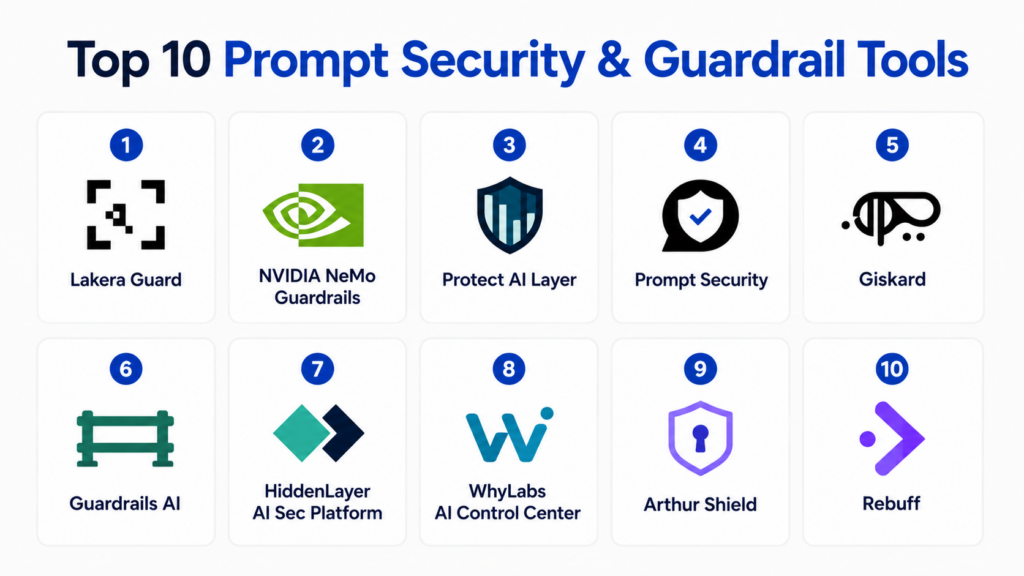
Introduction
Prompt Security & Guardrail Tools help organizations secure, monitor, and control interactions between users and AI systems. These platforms are designed to prevent prompt injection attacks, jailbreaks, harmful outputs, data leakage, unsafe AI behavior, and unauthorized model interactions. They act as protective layers around large language models, AI agents, copilots, and generative AI applications.As enterprises increasingly integrate AI into customer support, internal productivity systems, software engineering, healthcare, finance, and enterprise search, prompt security has become a critical operational requirement. AI models can be manipulated through malicious prompts, hidden instructions, and adversarial interactions that traditional cybersecurity tools are not designed to detect. Prompt Security & Guardrail Tools help organizations implement runtime AI protections while maintaining usability and operational scalability.
Real World Use Cases:
- Preventing prompt injection attacks
- Blocking jailbreak attempts
- Securing AI copilots and assistants
- Preventing sensitive data leakage
- Enforcing safe AI response policies
Evaluation Criteria for Buyers:
- Prompt injection detection accuracy
- Runtime AI monitoring capabilities
- Policy enforcement flexibility
- AI model compatibility
- AI agent protection support
- API and SDK integrations
- Governance and reporting features
- Scalability and deployment flexibility
- Ease of implementation
- Compliance and audit visibility
Best for: Enterprises deploying generative AI systems, AI platform teams, security engineers, AI governance teams, regulated industries, and organizations building customer-facing AI applications.
Not ideal for: Small teams using public AI tools casually, organizations without production AI systems, or teams only requiring lightweight content moderation instead of runtime AI security.
Key Trends in Prompt Security & Guardrail Tools
- Prompt injection defense is becoming a mandatory AI security capability.
- Runtime AI protection is gaining importance alongside pre-deployment testing.
- AI agent security is emerging as a major feature category.
- Organizations increasingly demand real-time policy enforcement.
- Multimodal AI guardrails are expanding beyond text-only protection.
- AI governance and security workflows are converging into unified platforms.
- Open-source guardrail frameworks continue growing in popularity.
- AI observability and monitoring integrations are becoming standard features.
- Cloud-native deployment models dominate enterprise adoption.
- AI security vendors are integrating with broader DevSecOps ecosystems.
How We Selected These Tools
The tools in this list were evaluated based on practical enterprise and operational criteria:
- Market visibility and industry adoption
- Prompt injection and jailbreak defense capabilities
- Runtime monitoring and policy enforcement
- AI model and platform compatibility
- API ecosystem and developer integrations
- Security and governance functionality
- Scalability for enterprise deployments
- Ease of implementation and usability
- Vendor ecosystem maturity
- Fit across SMB, mid-market, and enterprise environments
Top 10 Prompt Security & Guardrail Tools
#1 — Lakera Guard
Short description: Lakera Guard provides runtime AI security and prompt protection for generative AI systems, copilots, and AI agents. The platform helps organizations detect prompt injections, jailbreaks, unsafe prompts, and malicious AI interactions in real time. It is widely used by enterprises deploying customer-facing AI applications. Lakera emphasizes operational scalability and enterprise AI security workflows.
Key Features
- Prompt injection detection
- AI jailbreak prevention
- Runtime AI monitoring
- Real-time policy enforcement
- AI risk scoring
- AI application firewall functionality
- API-first deployment support
Pros
- Strong runtime AI protection
- Enterprise-focused security workflows
- Good API integration support
Cons
- Premium enterprise pricing
- Advanced workflows require security expertise
- Less useful for experimental AI usage
Platforms / Deployment
- Cloud / Hybrid
Security & Compliance
- RBAC
- Audit logs
- Encryption
- SSO/SAML
- GDPR support
- Additional certifications not publicly stated
Integrations & Ecosystem
Lakera integrates with enterprise AI systems, cloud environments, and AI development workflows.
- OpenAI integrations
- Anthropic compatibility
- Azure AI integrations
- API ecosystem support
- Security workflow integrations
- Cloud-native deployment support
Support & Community
Enterprise onboarding, implementation guidance, and strong technical documentation with growing AI security visibility.
#2 — NVIDIA NeMo Guardrails
Short description: NVIDIA NeMo Guardrails is an open-source framework designed to help developers implement safety and security controls for conversational AI systems. It enables organizations to define policies that govern AI behavior, responses, and interactions. The framework is particularly useful for AI developers building secure LLM applications and AI assistants. NeMo Guardrails emphasizes customization and developer flexibility.
Key Features
- Conversational AI guardrails
- Policy-based AI controls
- Open-source framework
- AI behavior management
- Prompt flow orchestration
- Customizable safety policies
- Multi-model support
Pros
- Flexible and customizable
- Strong developer ecosystem
- Open-source accessibility
Cons
- Requires technical expertise
- Limited enterprise UI workflows
- Advanced deployment complexity
Platforms / Deployment
- Windows / macOS / Linux
- Self-hosted
Security & Compliance
- Not publicly stated
Integrations & Ecosystem
NeMo Guardrails integrates with AI frameworks and enterprise AI development pipelines.
- LangChain integrations
- NVIDIA ecosystem compatibility
- API support
- Python ecosystem integration
- LLM framework compatibility
Support & Community
Strong open-source developer community with extensive technical documentation.
#3 — Protect AI Layer
Short description: Protect AI Layer helps organizations secure AI applications through runtime monitoring, prompt security, and AI governance capabilities. The platform focuses on detecting malicious prompts, enforcing AI safety policies, and protecting AI infrastructure. Enterprises commonly use it to operationalize secure AI deployment workflows. Protect AI also emphasizes AI supply-chain and operational security.
Key Features
- Prompt security controls
- AI runtime monitoring
- AI governance workflows
- Threat detection
- Policy enforcement
- AI risk analytics
- AI application visibility
Pros
- Broad AI security capabilities
- Good enterprise governance support
- Strong operational visibility
Cons
- Complex deployment for smaller teams
- Enterprise-focused pricing
- Advanced configuration requirements
Platforms / Deployment
- Cloud / Hybrid
Security & Compliance
- RBAC
- Encryption
- Audit logs
- SSO/SAML
- Compliance certifications vary
Integrations & Ecosystem
Protect AI integrates with enterprise AI pipelines, cloud platforms, and security operations ecosystems.
- Kubernetes integrations
- Cloud AI platform support
- API ecosystem
- Security workflow integrations
- MLOps compatibility
Support & Community
Enterprise support model with implementation guidance and onboarding services.
#4 — Prompt Security
Short description: Prompt Security specializes in securing generative AI interactions and preventing prompt injection attacks across enterprise AI applications. The platform helps organizations monitor AI conversations, enforce governance policies, and prevent unsafe AI behavior. It is especially focused on runtime AI defense and operational visibility. Prompt Security supports modern AI assistants, copilots, and agentic workflows.
Key Features
- Prompt injection prevention
- AI usage monitoring
- Runtime AI defense
- AI governance dashboards
- Real-time policy enforcement
- AI risk analytics
- AI conversation visibility
Pros
- Strong specialization in prompt security
- Good operational monitoring capabilities
- Enterprise-ready governance workflows
Cons
- Newer vendor ecosystem
- Premium enterprise positioning
- Public deployment details limited
Platforms / Deployment
- Cloud
Security & Compliance
- RBAC
- Encryption
- Audit logging
- SSO/SAML
- Additional certifications not publicly stated
Integrations & Ecosystem
Prompt Security integrates with enterprise AI applications and AI workflow environments.
- OpenAI integrations
- Anthropic support
- API integrations
- Cloud platform compatibility
- Security workflow support
Support & Community
Growing enterprise ecosystem with expanding AI security visibility.
#5 — Giskard
Short description: Giskard provides AI testing, evaluation, and guardrail capabilities for machine learning and generative AI systems. The platform helps organizations detect hallucinations, unsafe outputs, prompt vulnerabilities, and AI behavior risks before production deployment. Giskard combines open-source flexibility with enterprise testing workflows. It is useful for both AI engineering and governance teams.
Key Features
- AI testing automation
- Prompt vulnerability evaluation
- Hallucination detection
- AI guardrail workflows
- Continuous AI validation
- Monitoring dashboards
- Test suite management
Pros
- Strong evaluation capabilities
- Balanced developer and enterprise usability
- Flexible deployment support
Cons
- Advanced scaling may require customization
- Some governance features evolving
- Complex workflows for beginners
Platforms / Deployment
- Cloud / Self-hosted
Security & Compliance
- RBAC
- Encryption
- Audit support
- Additional certifications not publicly stated
Integrations & Ecosystem
Giskard integrates with AI development workflows and evaluation pipelines.
- Hugging Face support
- Python ecosystem
- CI/CD integrations
- API integrations
- AI workflow compatibility
Support & Community
Strong open-source ecosystem combined with commercial support options.
#6 — Guardrails AI
Short description: Guardrails AI is an open-source framework that helps developers validate, structure, and secure AI outputs using programmable rules and policies. The platform allows organizations to define runtime constraints and validation logic for generative AI systems. It is especially useful for developers building production AI applications. Guardrails AI emphasizes flexibility and output reliability.
Key Features
- AI output validation
- Programmable AI policies
- Runtime guardrails
- Open-source architecture
- Structured response enforcement
- Custom validators
- LLM compatibility support
Pros
- Developer-friendly framework
- Strong customization flexibility
- Open-source accessibility
Cons
- Requires technical implementation
- Limited enterprise governance workflows
- Operational scaling complexity
Platforms / Deployment
- Windows / macOS / Linux
- Self-hosted
Security & Compliance
- Not publicly stated
Integrations & Ecosystem
Guardrails AI integrates with developer ecosystems and modern AI application workflows.
- LangChain compatibility
- Python ecosystem
- API integrations
- AI framework support
- LLM workflow integrations
Support & Community
Active open-source community with growing developer adoption.
#7 — HiddenLayer AISec Platform
Short description: HiddenLayer AISec Platform helps organizations secure AI models and generative AI systems through runtime monitoring, threat detection, and AI guardrail enforcement. The platform focuses on enterprise AI protection and operational security workflows. HiddenLayer is commonly used by organizations deploying mission-critical AI systems. It combines AI observability with AI security operations.
Key Features
- AI threat detection
- Runtime AI protection
- AI observability
- Prompt risk monitoring
- Governance workflows
- Security analytics
- AI behavior visibility
Pros
- Strong enterprise AI protection
- Good runtime monitoring capabilities
- Operational AI security focus
Cons
- Enterprise deployment complexity
- Premium pricing structure
- Requires mature AI programs
Platforms / Deployment
- Cloud / Hybrid
Security & Compliance
- RBAC
- MFA
- Encryption
- Audit logging
- Compliance support varies
Integrations & Ecosystem
HiddenLayer integrates with enterprise security operations and AI infrastructure.
- AWS integrations
- Azure integrations
- Security analytics support
- API integrations
- Monitoring ecosystem compatibility
Support & Community
Enterprise-focused onboarding and operational support with growing market adoption.
#8 — WhyLabs AI Control Center
Short description: WhyLabs AI Control Center helps organizations monitor AI systems, detect anomalous AI behavior, and enforce AI governance controls. The platform focuses heavily on AI observability, runtime analytics, and operational monitoring. It is commonly used by teams operating production machine learning and generative AI systems. WhyLabs emphasizes operational AI reliability and visibility.
Key Features
- AI observability
- Runtime monitoring
- Prompt analytics
- AI anomaly detection
- Governance controls
- Operational dashboards
- AI behavior tracking
Pros
- Strong AI monitoring capabilities
- Useful operational analytics
- Good observability workflows
Cons
- More observability-focused than security-native
- Advanced governance features evolving
- Enterprise deployment planning required
Platforms / Deployment
- Cloud
Security & Compliance
- RBAC
- Encryption
- Audit support
- SSO/SAML
- Compliance details vary
Integrations & Ecosystem
WhyLabs integrates with modern AI development and observability environments.
- ML platform integrations
- API ecosystem
- Cloud platform support
- Monitoring workflow integrations
- AI analytics compatibility
Support & Community
Growing enterprise ecosystem with strong documentation and onboarding resources.
#9 — Arthur Shield
Short description: Arthur Shield provides runtime AI monitoring and generative AI guardrail capabilities for enterprise AI systems. The platform helps organizations detect unsafe outputs, monitor AI behavior, and enforce governance controls. Arthur emphasizes AI observability, reliability, and operational risk management. It is commonly used in enterprise AI operations environments.
Key Features
- Runtime AI monitoring
- AI behavior analysis
- Prompt risk detection
- Governance workflows
- AI observability dashboards
- Policy enforcement
- Risk analytics
Pros
- Strong operational monitoring
- Good enterprise AI analytics
- Useful governance visibility
Cons
- Enterprise-oriented complexity
- Advanced features may require customization
- Smaller vendor ecosystem
Platforms / Deployment
- Cloud / Hybrid
Security & Compliance
- RBAC
- Encryption
- Audit logs
- SSO/SAML
- Compliance support varies
Integrations & Ecosystem
Arthur integrates with AI observability, governance, and operational analytics environments.
- Cloud AI integrations
- API ecosystem
- Monitoring platform support
- AI workflow integrations
- Analytics compatibility
Support & Community
Enterprise-focused support with growing AI operations visibility.
#10 — Rebuff
Short description: Rebuff is an open-source prompt injection detection framework designed to help developers secure LLM applications against adversarial prompt attacks. The framework focuses on runtime prompt analysis and attack detection. It is useful for developers building secure AI applications and experimentation environments. Rebuff emphasizes lightweight implementation and extensibility.
Key Features
- Prompt injection detection
- Runtime prompt analysis
- Open-source framework
- Lightweight deployment
- Customizable workflows
- AI application protection
- Extensible architecture
Pros
- Lightweight and flexible
- Open-source accessibility
- Good developer-focused workflows
Cons
- Limited enterprise governance features
- Smaller ecosystem maturity
- Technical implementation required
Platforms / Deployment
- Windows / macOS / Linux
- Self-hosted
Security & Compliance
- Not publicly stated
Integrations & Ecosystem
Rebuff integrates with developer AI stacks and AI application workflows.
- Python ecosystem
- API integrations
- LLM compatibility
- AI workflow support
- Open-source ecosystem integration
Support & Community
Growing open-source community with active developer adoption.
Comparison Table
| Tool Name | Best For | Platform(s) Supported | Deployment | Standout Feature | Public Rating |
|---|---|---|---|---|---|
| Lakera Guard | Enterprise runtime AI security | Web / Cloud | Cloud / Hybrid | Prompt injection defense | N/A |
| NVIDIA NeMo Guardrails | Developer AI guardrails | Windows / macOS / Linux | Self-hosted | Policy-driven AI behavior control | N/A |
| Protect AI Layer | Enterprise AI governance | Web / Cloud | Cloud / Hybrid | Runtime AI security | N/A |
| Prompt Security | AI prompt protection | Web / Cloud | Cloud | Prompt injection prevention | N/A |
| Giskard | AI evaluation workflows | Web / Linux / macOS | Cloud / Self-hosted | AI testing automation | N/A |
| Guardrails AI | Open-source AI validation | Windows / macOS / Linux | Self-hosted | Programmable AI policies | N/A |
| HiddenLayer AISec Platform | Enterprise AI protection | Web / Cloud | Cloud / Hybrid | AI runtime protection | N/A |
| WhyLabs AI Control Center | AI observability | Web / Cloud | Cloud | Runtime AI analytics | N/A |
| Arthur Shield | AI governance monitoring | Web / Cloud | Cloud / Hybrid | AI observability workflows | N/A |
| Rebuff | Prompt injection detection | Windows / macOS / Linux | Self-hosted | Lightweight prompt security | N/A |
Evaluation & Scoring of Prompt Security & Guardrail Tools
| Tool Name | Core 25% | Ease 15% | Integrations 15% | Security 10% | Performance 10% | Support 10% | Value 15% | Weighted Total |
|---|---|---|---|---|---|---|---|---|
| Lakera Guard | 9.4 | 8.6 | 9.0 | 9.3 | 9.0 | 8.7 | 7.8 | 8.9 |
| NVIDIA NeMo Guardrails | 8.7 | 7.1 | 8.4 | 7.5 | 8.5 | 7.8 | 9.1 | 8.1 |
| Protect AI Layer | 9.0 | 8.0 | 8.8 | 9.1 | 8.8 | 8.5 | 7.5 | 8.6 |
| Prompt Security | 8.9 | 8.2 | 8.5 | 9.0 | 8.7 | 8.2 | 7.7 | 8.5 |
| Giskard | 8.8 | 8.3 | 8.5 | 8.2 | 8.5 | 8.1 | 8.4 | 8.5 |
| Guardrails AI | 8.4 | 7.5 | 8.2 | 7.8 | 8.3 | 7.7 | 9.0 | 8.0 |
| HiddenLayer AISec Platform | 8.9 | 7.9 | 8.6 | 9.1 | 8.8 | 8.4 | 7.4 | 8.5 |
| WhyLabs AI Control Center | 8.5 | 8.1 | 8.3 | 8.2 | 8.6 | 8.0 | 8.3 | 8.3 |
| Arthur Shield | 8.6 | 8.0 | 8.4 | 8.5 | 8.5 | 8.0 | 8.1 | 8.3 |
| Rebuff | 8.1 | 7.4 | 7.9 | 7.5 | 8.0 | 7.5 | 9.1 | 7.9 |
These scores are comparative rather than absolute. Enterprise-focused platforms generally score higher in governance, runtime protection, and compliance capabilities, while open-source frameworks often provide better flexibility and value for technical teams. Organizations should prioritize the categories most relevant to their deployment scale, AI maturity, operational complexity, and regulatory requirements. Running pilot deployments with shortlisted tools is usually the most effective way to validate real-world operational fit.
Which Prompt Security & Guardrail Tool Is Right for You?
Solo / Freelancer
Independent developers and researchers often benefit most from open-source tools such as Guardrails AI, NVIDIA NeMo Guardrails, and Rebuff. These frameworks provide flexibility and customization without enterprise licensing costs.
SMB
SMBs usually require balanced runtime AI protection with manageable operational complexity. Giskard and WhyLabs AI Control Center provide good monitoring and guardrail capabilities without extensive deployment overhead.
Mid-Market
Mid-market organizations often need scalable runtime AI security with governance visibility. Lakera Guard, Prompt Security, and Protect AI Layer are strong choices for organizations deploying customer-facing AI systems and internal copilots.
Enterprise
Large enterprises with significant AI exposure should evaluate Lakera Guard, HiddenLayer AISec Platform, Protect AI Layer, and Arthur Shield. These platforms provide stronger runtime monitoring, governance workflows, and operational security capabilities.
Budget vs Premium
Open-source frameworks provide strong flexibility and lower operational costs but require technical expertise and internal management. Enterprise platforms deliver operational monitoring, governance dashboards, and support services at higher pricing levels.
Feature Depth vs Ease of Use
Enterprise-grade AI guardrail platforms usually provide deeper runtime monitoring and governance controls but may require more operational effort. Developer-focused frameworks prioritize flexibility and customization.
Integrations & Scalability
Organizations operating cloud-native AI infrastructure should prioritize tools with strong API ecosystems, observability integrations, and AI workflow compatibility. Strong integrations significantly improve operational scalability.
Security & Compliance Needs
Healthcare, finance, government, and compliance-heavy organizations should prioritize platforms with audit logging, RBAC, runtime monitoring, and governance reporting capabilities.
Frequently Asked Questions FAQs
1. What are Prompt Security & Guardrail Tools?
Prompt Security & Guardrail Tools help organizations secure AI systems against unsafe prompts, prompt injections, jailbreaks, and malicious interactions. These platforms monitor AI conversations and enforce runtime safety policies. They help prevent AI systems from exposing sensitive information or generating harmful responses. Modern enterprises increasingly deploy these tools alongside generative AI systems and AI agents. AI guardrails are becoming a core operational requirement for production AI environments. They help organizations balance AI usability with security and governance needs.
2. Why are prompt injections dangerous?
Prompt injection attacks manipulate AI systems by embedding hidden or malicious instructions within prompts or external content sources. These attacks can bypass safety controls, expose confidential information, or alter AI behavior unexpectedly. Prompt injections are especially dangerous for AI agents connected to external systems and APIs. Traditional cybersecurity tools are often unable to detect these attacks effectively. Prompt Security Tools provide specialized runtime defenses against these threats. Organizations deploying production AI systems should treat prompt injection as a major operational risk.
3. What is the difference between AI guardrails and AI moderation?
AI moderation typically focuses on filtering harmful outputs or inappropriate content. AI guardrails go further by enforcing runtime policies, validating AI behavior, monitoring prompts, and preventing unsafe system interactions. Guardrails can also control AI workflows, tool access, and agent behavior. Modern enterprise AI deployments often require both moderation and guardrail capabilities together. Runtime governance is becoming increasingly important for autonomous AI systems. Organizations should evaluate whether they need simple filtering or broader operational AI controls.
4. Are open-source guardrail frameworks effective?
Yes, open-source frameworks such as NVIDIA NeMo Guardrails, Guardrails AI, and Rebuff can be highly effective for technical teams. These frameworks provide flexibility and customization for securing AI workflows. However, they often require engineering expertise and operational management. Commercial platforms usually provide more polished governance workflows, dashboards, and enterprise support. Organizations should evaluate internal technical capabilities before relying entirely on open-source tooling. Many enterprises combine open-source frameworks with commercial monitoring platforms.
5. Can these tools secure AI agents?
Yes, many modern Prompt Security & Guardrail Tools support AI agent protection. AI agents introduce additional risks because they can access APIs, external tools, business workflows, and sensitive systems autonomously. Prompt security platforms help enforce runtime restrictions and prevent unsafe actions. Agent-focused runtime protection is becoming one of the fastest-growing AI security categories. Organizations deploying autonomous AI workflows should prioritize agent security capabilities. Runtime governance becomes increasingly critical as AI agents gain broader operational access.
6. How do these tools integrate with AI development pipelines?
Most modern platforms support APIs, SDKs, CI/CD workflows, and MLOps integrations. This allows organizations to automate guardrail validation during development and deployment processes. Integration support is important for operational scalability and continuous AI governance. Enterprise platforms often integrate with AI observability and security ecosystems. Organizations should validate compatibility with existing AI infrastructure before selecting a platform. Strong integrations significantly reduce operational friction.
7. What are common mistakes organizations make with AI guardrails?
One common mistake is relying solely on output moderation without implementing runtime prompt protection. Another issue is treating AI security as a one-time deployment task rather than a continuous operational process. Some organizations underestimate the risks introduced by AI agents and tool integrations. Others fail to involve security, compliance, and AI engineering teams collaboratively. Effective AI guardrails require continuous monitoring and policy enforcement. Operational visibility is essential for long-term AI governance.
8. Are Prompt Security platforms expensive?
Pricing varies significantly depending on deployment scale, AI traffic volume, governance requirements, and enterprise support needs. Open-source frameworks are generally free but require internal operational expertise. Commercial platforms typically use subscription-based pricing tied to API usage, users, or deployment scale. Organizations should evaluate total operational cost instead of focusing only on licensing expenses. Enterprise-grade governance and runtime monitoring platforms often involve higher implementation complexity. Smaller organizations should carefully evaluate operational requirements before investing heavily.
9. Which industries benefit most from Prompt Security Tools?
Industries deploying customer-facing or operational AI systems benefit the most from prompt security platforms. Healthcare, finance, legal services, cybersecurity, government, and enterprise technology organizations are among the strongest adopters. AI copilots, customer support bots, enterprise search systems, and autonomous AI workflows are common deployment areas. Regulated industries especially require runtime governance and auditability. The level of protection required depends heavily on operational risk exposure. AI security is becoming increasingly important across nearly every enterprise sector.
10. How should organizations choose the right Prompt Security platform?
Organizations should evaluate deployment maturity, operational scale, AI architecture complexity, and regulatory requirements before selecting a platform. Teams deploying AI agents may require deeper runtime governance and monitoring capabilities. Developer-focused organizations may prioritize flexibility and API integrations. Enterprises in regulated industries often require governance dashboards and audit capabilities. Integration support is also critical for scalability. Running pilot deployments with shortlisted platforms is usually the best evaluation strategy.
Conclusion
Prompt Security & Guardrail Tools are becoming foundational components of modern enterprise AI security strategies. As organizations increasingly deploy generative AI systems, AI copilots, autonomous agents, and customer-facing AI applications, runtime AI protection and governance capabilities are becoming essential operational requirements. Modern enterprises must defend against prompt injections, jailbreaks, unsafe outputs, sensitive data exposure, and malicious AI interactions while maintaining scalability and usability. Some organizations may prioritize lightweight open-source guardrail frameworks for developer flexibility, while others require enterprise-grade runtime monitoring, governance dashboards, and operational AI security workflows. The best platform depends on deployment maturity, regulatory exposure, operational scale, integration requirements, and internal security expertise. Organizations should shortlist a few suitable platforms, run controlled pilot deployments, validate compatibility with existing AI infrastructure, and assess how effectively each solution supports long-term AI governance, runtime security, and operational resilience objectives.
