MOTOSHARE 🚗🏍️
Rent Bikes & Cars Directly from Owners
Motoshare connects vehicle owners with people who need bikes and cars on rent. Owners earn from idle vehicles, and renters get flexible ride options.
Visit Motoshare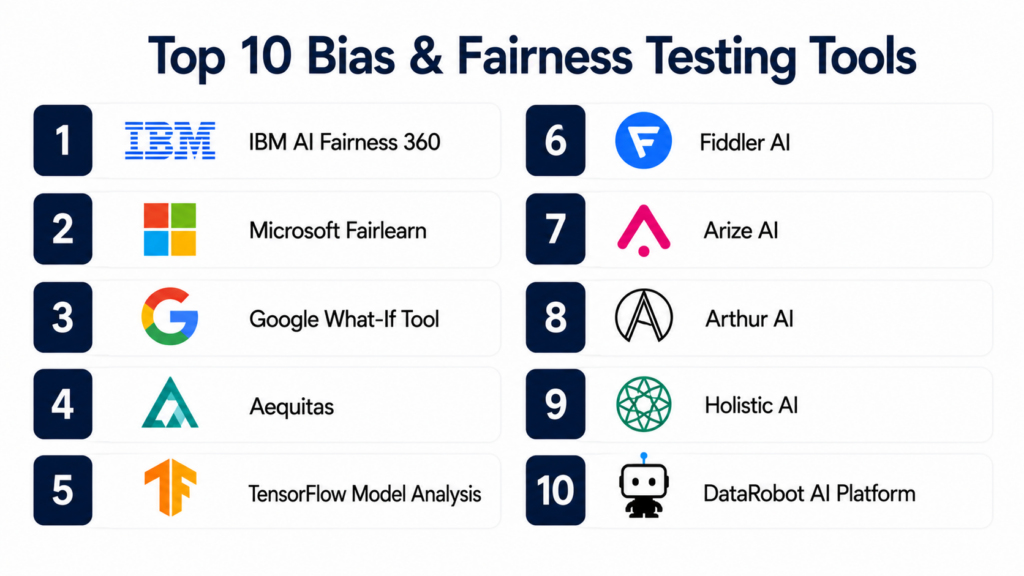
Introduction
Bias & Fairness Testing Tools help organizations detect, measure, explain, monitor, and reduce unfair outcomes in AI and machine learning systems. In simple terms, these tools help teams understand whether a model behaves differently across groups such as gender, age, geography, language, income level, disability status, or other protected and business-relevant segments.
Bias and fairness testing matters because AI systems are increasingly used in hiring, lending, insurance, healthcare, education, fraud detection, customer support, marketing, public services, and enterprise automation. If models are trained on biased data or evaluated only on aggregate accuracy, they may perform worse for specific groups or create unfair outcomes. A strong fairness testing tool helps teams compare group-level performance, identify harmful disparities, document risks, evaluate mitigation strategies, and build more trustworthy AI systems.
Real world use cases include credit risk fairness testing, hiring model audits, healthcare model subgroup analysis, fraud detection bias checks, LLM safety evaluation, recommendation fairness, model governance reviews, regulatory readiness, explainability reporting, and production fairness monitoring.
Buyers should evaluate:
- Fairness metrics coverage
- Bias detection and subgroup analysis
- Model mitigation support
- Explainability and root cause analysis
- Dataset bias analysis
- Production monitoring
- Governance and audit reporting
- LLM and generative AI evaluation support
- Integration with ML pipelines
- Security, access control, and documentation
Best for: Bias & Fairness Testing Tools are best for data science teams, ML engineers, responsible AI teams, model risk teams, compliance leaders, AI governance teams, HR technology teams, financial services firms, healthcare AI teams, public sector organizations, and enterprises deploying high-impact AI systems.
Not ideal for: Very small AI experiments or low-risk internal prototypes may not need a full fairness testing platform. A basic notebook, checklist, or manual subgroup analysis may be enough at an early stage. However, when AI influences people, access, opportunities, pricing, recommendations, risk scoring, or regulated decisions, structured bias and fairness testing becomes essential.
Key Trends in Bias & Fairness Testing Tools
- Fairness moving into AI governance: Bias testing is becoming part of formal AI risk management, approval workflows, documentation, and audit evidence.
- Subgroup performance analysis: Teams are moving beyond overall accuracy to measure false positives, false negatives, calibration, and error rates across different groups.
- LLM fairness and safety evaluation: Bias testing now includes generative AI outputs, stereotypes, toxicity, refusal behavior, representational harm, and demographic sensitivity.
- Pre-deployment and post-deployment testing: Fairness is evaluated before launch and monitored continuously after deployment because model behavior can change over time.
- Explainability-driven fairness: Teams want to understand why disparities occur, not only detect that they exist.
- Data-centric fairness workflows: Bias testing increasingly starts with training data, labeling quality, representation, missingness, and historical imbalance.
- Regulatory documentation: Organizations need model cards, fairness reports, risk assessments, human review records, and decision logs.
- Intersectional fairness: Testing is expanding beyond single protected attributes to combinations of attributes where harms may be hidden.
- Fairness mitigation tooling: Buyers want tools that not only identify bias but also support reweighting, threshold adjustment, preprocessing, post-processing, and policy decisions.
- MLOps integration: Fairness checks are being added to model pipelines, CI/CD gates, model registries, monitoring dashboards, and production alerts.
How We Selected These Tools
The tools below were selected using a practical buyer-focused evaluation approach:
- Market recognition in bias testing, fairness assessment, responsible AI, model governance, explainability, and AI monitoring.
- Feature completeness across fairness metrics, subgroup analysis, bias mitigation, monitoring, reporting, and documentation.
- Open-source and enterprise balance, including research-grade libraries and production governance platforms.
- Technical depth, including support for classification, regression, ranking, LLM outputs, and different fairness definitions.
- Explainability and root cause analysis, especially where teams need to understand drivers of unfair outcomes.
- Governance readiness, including audit trails, reports, policy workflows, and model risk documentation.
- Production monitoring support, including fairness drift, performance changes, and subgroup-level monitoring.
- Integration ecosystem, including Python, notebooks, MLOps tools, cloud AI platforms, model registries, and monitoring stacks.
- Usability for different stakeholders, including data scientists, governance teams, business users, legal teams, and compliance reviewers.
- Practical adoption fit, including learning curve, documentation, support, deployment model, and long-term maintainability.
Top 10 Bias & Fairness Testing Tools
1- IBM AI Fairness 360
Short description:
IBM AI Fairness 360 is an open-source toolkit for detecting and mitigating bias in datasets and machine learning models. It provides fairness metrics, bias mitigation algorithms, tutorials, and workflows for responsible AI development. The toolkit is especially useful for data scientists and researchers who need a deep technical library for fairness assessment. It supports fairness testing across different stages of the AI lifecycle, from dataset review to model evaluation and mitigation.
Key Features
- Fairness metrics for datasets and models
- Bias mitigation algorithms
- Python and R package availability
- Preprocessing, in-processing, and post-processing methods
- Tutorials and example notebooks
- Extensible research-oriented framework
- Useful for technical fairness experimentation
Pros
- Strong open-source fairness toolkit
- Good coverage of bias metrics and mitigation methods
- Useful for research, prototyping, and technical audits
Cons
- Requires fairness and ML expertise
- Not a full enterprise governance platform by itself
- Production monitoring requires complementary tools
Platforms / Deployment
Python and R toolkit.
Local, notebook, CI/CD, and self-managed deployment workflows.
Security & Compliance
Not publicly stated for enterprise compliance. Security depends on the environment where the toolkit is run and how datasets are handled.
Integrations & Ecosystem
IBM AI Fairness 360 can be used in data science notebooks, ML pipelines, model evaluation workflows, and responsible AI research.
- Python ML workflows
- R workflows
- Jupyter notebooks
- Scikit-learn-style workflows
- Model evaluation pipelines
- Responsible AI documentation
Support & Community
AI Fairness 360 has open-source documentation, research community adoption, tutorials, and IBM ecosystem visibility. Enterprise support should be validated through relevant IBM offerings if needed.
2- Microsoft Fairlearn
Short description:
Microsoft Fairlearn is an open-source Python toolkit designed to help teams assess and improve fairness in AI systems. It supports fairness metrics, visual dashboards, and mitigation algorithms for group fairness analysis. Fairlearn is especially useful for data scientists who need a practical fairness toolkit that integrates well with Python ML workflows. It helps teams compare model performance across groups and explore trade-offs between fairness and performance.
Key Features
- Group fairness assessment
- Fairness metrics and visualizations
- Mitigation algorithms
- Dashboard-style analysis support
- Python-based workflow
- Integration with machine learning pipelines
- Useful documentation and examples
Pros
- Practical and approachable open-source toolkit
- Strong fit for Python-based model development
- Helps visualize fairness and performance trade-offs
Cons
- Requires careful fairness metric selection
- Not a complete governance or monitoring platform
- Mainly focused on structured ML workflows
Platforms / Deployment
Python toolkit.
Local, notebook, CI/CD, and self-managed workflows.
Security & Compliance
Not publicly stated for enterprise compliance. Security depends on deployment environment, dataset handling, and broader ML platform controls.
Integrations & Ecosystem
Fairlearn integrates with Python data science workflows, model development pipelines, and responsible AI experimentation.
- Scikit-learn workflows
- Jupyter notebooks
- Azure ML workflows
- Python ML pipelines
- Model evaluation scripts
- Responsible AI dashboards
Support & Community
Fairlearn has open-source documentation, community support, tutorials, and Microsoft ecosystem visibility. Enterprise support depends on the broader Microsoft AI environment used.
3- Google What-If Tool
Short description:
Google What-If Tool is an interactive visual tool for exploring model behavior, comparing examples, testing counterfactuals, and evaluating performance across data slices. It is useful for fairness analysis because teams can inspect how predictions change across groups and scenarios. The tool is especially helpful for education, prototyping, and model debugging. It fits teams that need an interactive way to understand model behavior without relying only on code-based metrics.
Key Features
- Interactive model inspection
- Counterfactual analysis
- Fairness and subgroup slicing
- Visual exploration of predictions
- TensorBoard integration patterns
- Support for model comparison workflows
- Useful for debugging and education
Pros
- Strong visual and interactive experience
- Useful for non-code-heavy model exploration
- Good for understanding prediction behavior and scenarios
Cons
- Not a full production monitoring platform
- May not cover all enterprise fairness governance needs
- Best suited for exploratory analysis and demonstrations
Platforms / Deployment
Web-based interactive tooling through notebook and TensorBoard-style workflows.
Self-managed analysis environment.
Security & Compliance
Not publicly stated for enterprise compliance. Security depends on the environment where the tool is run and how model data is handled.
Integrations & Ecosystem
Google What-If Tool integrates with ML development, TensorBoard-style workflows, and interactive model analysis processes.
- TensorFlow workflows
- Notebook environments
- Model debugging workflows
- Fairness slicing
- Counterfactual analysis
- Educational AI fairness workflows
Support & Community
Support is primarily through documentation, open-source resources, tutorials, and broader TensorFlow ecosystem materials.
4- Aequitas
Short description:
Aequitas is an open-source bias and fairness audit toolkit designed to help teams evaluate algorithmic decision systems across population groups. It focuses on fairness auditing and provides metrics that help identify disparities in model outcomes. Aequitas is especially useful for public policy, social impact, research, government, and decision-support systems where group fairness must be reviewed carefully. It helps users compare model performance and bias metrics across demographic subgroups.
Key Features
- Bias and fairness audit workflows
- Group-level fairness metrics
- Disparity analysis
- Audit reporting support
- Open-source toolkit
- Useful for policy and decision systems
- Supports subgroup comparison
Pros
- Strong fairness audit orientation
- Useful for policy, public-sector, and social impact use cases
- Open-source and accessible for technical teams
Cons
- Less focused on modern LLM evaluation
- Production monitoring requires complementary tools
- Users must understand fairness metric trade-offs
Platforms / Deployment
Python-based and self-managed workflows.
Local, notebook, and audit analysis deployment patterns.
Security & Compliance
Not publicly stated for enterprise compliance. Security depends on dataset handling and deployment environment.
Integrations & Ecosystem
Aequitas integrates into model audit workflows, notebooks, fairness reports, and responsible AI review processes.
- Python analytics workflows
- Notebook-based audits
- Policy analysis
- Model evaluation reports
- Fairness review workflows
- Research projects
Support & Community
Aequitas has open-source documentation and research community adoption. Support is primarily community-driven unless implemented by internal or consulting teams.
5- TensorFlow Model Analysis
Short description:
TensorFlow Model Analysis is a model evaluation library that helps teams evaluate machine learning models across data slices, metrics, and production-relevant segments. It is not only a fairness tool, but it is useful for bias and fairness testing because teams can analyze model performance across groups and subgroups. TensorFlow Model Analysis is especially useful for teams using TensorFlow Extended pipelines. It supports scalable evaluation and slice-based performance analysis.
Key Features
- Model evaluation across data slices
- Metric computation and visualization
- Integration with TensorFlow Extended
- Support for large-scale model evaluation
- Slice-based subgroup analysis
- Model comparison workflows
- Pipeline-friendly evaluation
Pros
- Strong fit for TensorFlow and TFX users
- Useful for scalable subgroup performance evaluation
- Good for production-style ML evaluation pipelines
Cons
- Not a dedicated fairness mitigation toolkit
- Best suited for TensorFlow ecosystem teams
- Requires technical setup and pipeline knowledge
Platforms / Deployment
Python-based evaluation tooling.
Self-managed and pipeline-based deployment patterns.
Security & Compliance
Not publicly stated for enterprise compliance. Security depends on ML pipeline environment, storage, and access controls.
Integrations & Ecosystem
TensorFlow Model Analysis integrates with TensorFlow, TFX, model evaluation workflows, and ML pipelines.
- TensorFlow
- TensorFlow Extended
- Model evaluation pipelines
- Notebook workflows
- Data validation workflows
- Production ML systems
Support & Community
Support comes through TensorFlow documentation, community resources, and ecosystem adoption. Enterprise support depends on cloud or platform provider relationships.
6- Fiddler AI
Short description:
Fiddler AI is an AI observability and model monitoring platform with capabilities for explainability, performance monitoring, drift detection, and fairness analysis. It helps teams monitor deployed AI systems and identify issues that may affect business outcomes or subgroup performance. Fiddler is especially useful for enterprises that need production model oversight, bias monitoring, and explainable AI dashboards. It fits regulated industries and organizations deploying high-impact models.
Key Features
- Model monitoring and observability
- Bias and fairness monitoring
- Explainability and feature impact analysis
- Data and performance drift detection
- Alerts and dashboards
- Production model oversight
- Model risk and audit support workflows
Pros
- Strong production monitoring orientation
- Useful for explainability and root cause analysis
- Good fit for enterprises with deployed models
Cons
- Open-source fairness experimentation may require separate tools
- Implementation depends on model and data integration
- Governance workflows may need complementary systems
Platforms / Deployment
Web-based platform.
Cloud and enterprise deployment options may vary.
Security & Compliance
Supports enterprise access controls, monitoring governance, administrative controls, and audit-friendly workflows. Specific compliance coverage should be validated directly.
Integrations & Ecosystem
Fiddler integrates with ML pipelines, model serving systems, data platforms, and enterprise monitoring workflows.
- Model serving platforms
- Cloud AI platforms
- MLOps workflows
- Data warehouses
- Alerting systems
- Model risk workflows
Support & Community
Fiddler provides documentation, customer support, onboarding resources, and enterprise assistance. Support depth depends on contract and deployment scope.
7- Arize AI
Short description:
Arize AI is an ML observability platform that helps teams monitor model performance, drift, data quality, and production AI behavior. It can support fairness testing by enabling cohort-level analysis and monitoring how model behavior changes across different groups over time. Arize is especially useful for MLOps teams that want production visibility into model health and subgroup performance. It fits organizations running multiple models where continuous monitoring is required.
Key Features
- ML model monitoring
- Drift and performance tracking
- Cohort and slice analysis
- Data quality monitoring
- Alerts and dashboards
- LLM and AI observability support
- Root cause analysis workflows
Pros
- Strong production observability capabilities
- Useful for subgroup and cohort monitoring
- Good fit for MLOps teams managing many models
Cons
- Dedicated fairness metric design may require setup
- Governance documentation may require complementary tools
- Production data integration is required for best value
Platforms / Deployment
Web-based platform.
Cloud deployment options may vary.
Security & Compliance
Supports enterprise access controls and administrative governance depending on plan. Specific compliance details should be validated during procurement.
Integrations & Ecosystem
Arize integrates with model serving systems, ML pipelines, data platforms, and observability workflows.
- Model serving systems
- MLOps pipelines
- Data warehouses
- LLM application traces
- Alerting workflows
- Production monitoring systems
Support & Community
Arize provides documentation, customer support, open-source ecosystem resources through related tooling, and enterprise support options.
8- Arthur AI
Short description:
Arthur AI is an AI performance monitoring and evaluation platform that supports model monitoring, explainability, bias detection, drift tracking, and generative AI evaluation. It helps teams understand how models behave in production and whether outcomes vary across important groups. Arthur AI is especially useful for enterprises that need responsible AI monitoring, risk oversight, and fairness visibility. It fits financial services, insurance, healthcare, and other risk-sensitive industries.
Key Features
- Bias and fairness analysis
- Model monitoring and drift detection
- Explainability and performance tracking
- Generative AI evaluation support
- Alerts and dashboards
- Production AI oversight
- Risk and governance support workflows
Pros
- Strong focus on responsible AI monitoring
- Useful for production fairness and explainability
- Good fit for enterprise risk-sensitive models
Cons
- Requires model integration and monitoring setup
- Research-style fairness mitigation may require complementary libraries
- Pricing and deployment fit should be validated directly
Platforms / Deployment
Web-based platform.
Cloud and enterprise deployment options may vary.
Security & Compliance
Supports enterprise access and governance features depending on deployment. Specific compliance documentation should be validated during vendor review.
Integrations & Ecosystem
Arthur AI integrates with ML systems, model serving workflows, monitoring pipelines, and responsible AI review processes.
- ML platforms
- Model serving systems
- LLM workflows
- Monitoring pipelines
- Governance workflows
- Enterprise AI systems
Support & Community
Arthur AI provides documentation, customer support, enterprise assistance, and implementation guidance depending on contract.
9- Holistic AI
Short description:
Holistic AI is an AI governance, risk, and compliance platform that includes fairness and bias assessment as part of broader responsible AI oversight. It helps organizations evaluate AI systems, document risks, manage compliance workflows, and monitor responsible AI controls. Holistic AI is especially useful for enterprises that need fairness testing connected with governance and regulatory readiness. It fits organizations where bias testing must become part of formal AI risk management.
Key Features
- AI risk and governance workflows
- Bias and fairness assessment
- Compliance documentation
- AI system inventory
- Risk classification and review
- Monitoring and evaluation workflows
- Cross-functional governance support
Pros
- Strong governance and compliance orientation
- Useful when fairness testing must be audit-ready
- Good fit for regulated organizations
Cons
- Technical experimentation may require complementary open-source tools
- Integration depth should be validated by use case
- Best value depends on governance process adoption
Platforms / Deployment
Web-based platform.
Cloud deployment options may vary.
Security & Compliance
Supports governance workflows, access controls, risk documentation, and audit-related processes. Specific certifications and compliance details should be validated directly.
Integrations & Ecosystem
Holistic AI integrates with responsible AI governance, model review, compliance, and risk management workflows.
- AI inventory workflows
- Risk assessment processes
- Compliance documentation
- Model review workflows
- Governance approvals
- Enterprise reporting
Support & Community
Holistic AI provides documentation, advisory resources, customer support, and enterprise assistance. Support depth depends on contract and project scope.
10- DataRobot AI Platform
Short description:
DataRobot AI Platform includes model development, deployment, monitoring, governance, and responsible AI capabilities, including explainability and model performance analysis. It is especially useful for enterprises already using DataRobot for automated machine learning and model operations. DataRobot can support bias and fairness workflows through model evaluation, governance documentation, monitoring, and explainability features. It fits teams that want fairness testing as part of a broader enterprise AI platform.
Key Features
- Automated machine learning workflows
- Model monitoring and governance
- Explainability and model insights
- Performance tracking and validation
- Responsible AI documentation support
- Deployment and lifecycle management
- Enterprise AI governance capabilities
Pros
- Strong fit for DataRobot-centered AI teams
- Combines model development, deployment, and governance
- Useful for enterprises needing end-to-end AI lifecycle controls
Cons
- Best value depends on DataRobot platform adoption
- Specialized fairness research may require complementary tools
- Pricing and platform scope should be evaluated carefully
Platforms / Deployment
Web-based enterprise AI platform.
Cloud, self-hosted, and hybrid deployment options may vary.
Security & Compliance
Supports enterprise controls such as access management, governance workflows, auditability, and administrative security depending on deployment. Specific compliance coverage should be validated directly.
Integrations & Ecosystem
DataRobot integrates with enterprise data systems, model development workflows, deployment environments, and governance processes.
- Data warehouses
- ML pipelines
- Model deployment workflows
- Monitoring systems
- Governance processes
- Enterprise AI operations
Support & Community
DataRobot provides documentation, enterprise support, training, onboarding resources, and customer success assistance. Support depth depends on contract and platform scope.
Comparison Table
| Tool Name | Best For | Platform Supported | Deployment | Standout Feature | Public Rating |
|---|---|---|---|---|---|
| IBM AI Fairness 360 | Technical fairness metrics and mitigation | Python, R | Local, self-managed | Open-source fairness metrics and mitigation toolkit | N/A |
| Microsoft Fairlearn | Python-based fairness assessment | Python, notebooks | Local, self-managed | Fairness metrics and mitigation with visualization | N/A |
| Google What-If Tool | Interactive fairness exploration | Web, notebooks, TensorBoard-style workflows | Self-managed | Counterfactual and visual model analysis | N/A |
| Aequitas | Bias and fairness audits | Python, notebooks | Local, self-managed | Group-level fairness audit toolkit | N/A |
| TensorFlow Model Analysis | Slice-based model evaluation | Python, TensorFlow workflows | Self-managed, pipeline-based | Scalable subgroup evaluation for TensorFlow models | N/A |
| Fiddler AI | Production fairness monitoring | Web, ML integrations | Cloud, enterprise options vary | Explainability and bias monitoring in production | N/A |
| Arize AI | ML observability and cohort analysis | Web, SDKs | Cloud options vary | Production cohort-level model monitoring | N/A |
| Arthur AI | Responsible AI monitoring | Web, ML and LLM integrations | Cloud, enterprise options vary | Bias, explainability, and model monitoring | N/A |
| Holistic AI | Governance and compliance fairness workflows | Web | Cloud options vary | Bias testing connected with AI risk management | N/A |
| DataRobot AI Platform | End-to-end enterprise AI governance | Web, enterprise AI platform | Cloud, self-hosted, hybrid options vary | Responsible AI inside AI lifecycle platform | N/A |
Evaluation & Scoring of Bias & Fairness Testing Tools
| Tool Name | Core 25% | Ease 15% | Integrations 15% | Security 10% | Performance 10% | Support 10% | Value 15% | Weighted Total 0–10 |
|---|---|---|---|---|---|---|---|---|
| IBM AI Fairness 360 | 9.1 | 7.4 | 8.2 | 7.2 | 8.3 | 8.0 | 9.2 | 8.29 |
| Microsoft Fairlearn | 8.8 | 8.2 | 8.4 | 7.2 | 8.2 | 8.0 | 9.2 | 8.34 |
| Google What-If Tool | 8.0 | 8.5 | 7.8 | 7.0 | 7.8 | 7.6 | 8.8 | 7.98 |
| Aequitas | 8.2 | 8.0 | 7.6 | 7.0 | 7.8 | 7.4 | 8.8 | 7.92 |
| TensorFlow Model Analysis | 8.2 | 7.6 | 8.4 | 7.5 | 8.5 | 8.0 | 8.6 | 8.12 |
| Fiddler AI | 8.7 | 8.0 | 8.5 | 8.6 | 8.6 | 8.3 | 8.0 | 8.43 |
| Arize AI | 8.3 | 8.3 | 8.7 | 8.5 | 8.8 | 8.4 | 8.2 | 8.45 |
| Arthur AI | 8.5 | 8.0 | 8.3 | 8.5 | 8.5 | 8.2 | 8.0 | 8.31 |
| Holistic AI | 8.4 | 8.0 | 8.0 | 8.5 | 8.0 | 8.3 | 8.0 | 8.22 |
| DataRobot AI Platform | 8.5 | 8.4 | 8.8 | 8.8 | 8.6 | 8.7 | 7.9 | 8.53 |
The scores are comparative and should be used as a practical evaluation guide, not as fixed market ratings. IBM AI Fairness 360, Fairlearn, Aequitas, What-If Tool, and TensorFlow Model Analysis are strong technical and open-source options for model development and audit workflows. Fiddler, Arize, Arthur AI, Holistic AI, and DataRobot are stronger for production monitoring, enterprise governance, or responsible AI operations. The right choice depends on whether the team needs research-grade metrics, pre-launch testing, production monitoring, compliance workflows, or full AI lifecycle governance.
Which Bias & Fairness Testing Tool Is Right for You?
Solo / Freelancer
Solo users should usually start with open-source tools such as Fairlearn, IBM AI Fairness 360, Aequitas, or Google What-If Tool. These tools are practical for learning fairness metrics, testing small datasets, and creating early model audit reports.
Freelancers working with client AI systems should also create simple fairness documentation. This should include sensitive attributes reviewed, metrics used, subgroup results, limitations, and recommended mitigation steps.
SMB
SMBs should prioritize easy setup, understandable metrics, and simple reporting. Fairlearn, AIF360, Aequitas, What-If Tool, and TensorFlow Model Analysis can be enough for early fairness reviews.
If the SMB is deploying customer-facing or high-impact AI, production monitoring tools like Arize, Fiddler, Arthur AI, or DataRobot may become more relevant. The goal should be repeatable testing without overwhelming the team.
Mid-Market
Mid-market organizations often need fairness testing before launch plus monitoring after deployment. A practical stack may include Fairlearn or AIF360 for development-time testing and Arize, Fiddler, Arthur AI, Holistic AI, or DataRobot for production oversight.
These organizations should define fairness metrics by use case. A hiring model, fraud model, healthcare model, and recommendation engine may require different fairness definitions and review thresholds.
Enterprise
Enterprises should prioritize governance, auditability, production monitoring, explainability, risk assessment, and cross-functional review. Fiddler, Arize, Arthur AI, Holistic AI, DataRobot, IBM ecosystem tools, and open-source fairness libraries can all be part of the stack.
Large organizations should create fairness standards across business units. This includes approved metrics, protected attribute handling, documentation templates, escalation paths, and human review requirements.
Budget vs Premium
Budget-focused teams can start with open-source tools such as AIF360, Fairlearn, Aequitas, What-If Tool, and TensorFlow Model Analysis. These tools are powerful but require technical understanding and internal process ownership.
Premium platforms are better when fairness testing must connect with dashboards, production monitoring, enterprise access controls, audit logs, compliance reports, and support. The right decision depends on model risk, team capacity, and regulatory exposure.
Feature Depth vs Ease of Use
Feature-rich tools provide multiple fairness metrics, mitigation algorithms, root cause analysis, monitoring, explainability, alerts, and governance workflows. These are valuable for high-impact AI systems but require careful setup.
Ease-of-use tools help teams start fairness testing quickly. Buyers should avoid selecting a complex governance platform before defining fairness goals and model risk categories.
Integrations & Scalability
Bias & Fairness Testing Tools should integrate with notebooks, ML pipelines, model registries, MLOps platforms, cloud AI services, data warehouses, monitoring tools, and governance workflows. Integration is important because fairness testing should not be a one-time manual step.
Scalability matters when teams manage many models across business units. Buyers should test how tools handle multiple models, datasets, cohorts, metrics, alerts, and documentation workflows.
Security & Compliance Needs
Fairness testing often requires sensitive demographic or protected attribute data. This data must be handled carefully because it can create privacy, legal, and compliance risks.
Buyers should evaluate SSO, MFA, RBAC, encryption, audit logs, data retention, access controls, sensitive attribute handling, and reporting permissions. Legal, compliance, privacy, and security teams should be involved early in high-impact use cases.
Frequently Asked Questions
1. What is a Bias & Fairness Testing Tool?
A Bias & Fairness Testing Tool helps teams measure whether AI or machine learning systems behave differently across groups. It can compare predictions, errors, acceptance rates, false positives, false negatives, and other outcomes by demographic or business-relevant segments. These tools help identify unfair or harmful disparities before and after deployment. They are commonly used in hiring, lending, healthcare, insurance, fraud detection, and recommendation systems. A good tool helps teams move from assumptions to measurable fairness evidence.
2. How is bias testing different from model accuracy testing?
Model accuracy testing measures how well a model performs overall, while bias testing examines whether performance or outcomes differ unfairly across groups. A model can have high overall accuracy but still perform poorly for a smaller subgroup. Bias testing looks at disparities in error rates, predictions, calibration, and outcomes. This is important because aggregate performance can hide harmful differences. Fairness testing adds a group-level and impact-focused perspective to model evaluation.
3. What pricing models do Bias & Fairness Testing Tools use?
Pricing depends on the tool type. Open-source tools such as AIF360, Fairlearn, Aequitas, and What-If Tool may have no license cost but require internal expertise and setup. Enterprise platforms may charge by users, models, monitoring volume, data volume, modules, or contract size. Production observability tools may also price based on events, predictions, or monitored models. Buyers should include implementation, training, governance, and monitoring costs in the total cost. The best value depends on AI risk and scale.
4. How long does implementation usually take?
Implementation depends on model complexity, data availability, sensitive attribute handling, metric selection, and governance requirements. A data scientist can run a basic fairness audit quickly if the dataset is clean and group labels are available. Enterprise implementation takes longer because teams must define policies, review legal constraints, integrate monitoring, and document decisions. Production monitoring also requires ongoing data pipelines. A phased approach starting with one high-impact model is usually best.
5. What are common mistakes when choosing a fairness testing tool?
A common mistake is choosing a tool before deciding which fairness definition matters for the use case. Different fairness metrics can conflict with each other, so teams need business, legal, and ethical context. Another mistake is testing fairness only once before launch and never monitoring it again. Teams also fail when they ignore data quality, label bias, and historical bias in training data. The best process combines metrics, domain review, documentation, and monitoring.
6. Are Bias & Fairness Testing Tools secure?
Bias & Fairness Testing Tools can be secure, but the biggest concern is often the data used for fairness analysis. Sensitive attributes such as gender, race, age, disability, geography, or income may require strict handling. Important controls include RBAC, encryption, audit logs, data minimization, masking, retention policies, and approved access workflows. Open-source tools depend on the environment where they run. Enterprise platforms should be reviewed by security, privacy, legal, and compliance teams before production use.
7. Can fairness tools support generative AI and LLM testing?
Some fairness tools are designed for structured ML models, while others are expanding toward generative AI and LLM evaluation. LLM fairness testing may include stereotype checks, toxicity analysis, demographic sensitivity, refusal consistency, sentiment differences, and representation quality. Traditional metrics like false positive rate parity may not always apply directly to open-ended text generation. Teams may need custom test sets, human review, and LLM-as-judge workflows. For generative AI, fairness testing should be combined with safety, privacy, and relevance evaluation.
8. Do fairness testing tools remove bias automatically?
No tool can automatically remove all bias. Some tools provide mitigation algorithms such as reweighting, threshold adjustment, adversarial debiasing, or post-processing methods. However, fairness is a socio-technical issue involving data, model design, business policy, legal context, and human impact. Mitigation can also create trade-offs with accuracy or other fairness metrics. Teams must evaluate whether a mitigation strategy is appropriate for the use case. Human review and governance are essential.
9. When should a business adopt bias and fairness testing?
A business should adopt bias and fairness testing when AI influences people, decisions, access, pricing, ranking, eligibility, risk, or recommendations. It is especially important in hiring, lending, healthcare, education, insurance, law enforcement, public services, and financial decisions. Testing should begin before deployment and continue after launch. The need increases when models use personal data or affect protected groups. A good starting point is to inventory models and prioritize high-impact systems first.
10. What alternatives exist if we do not need a full fairness platform?
Alternatives include manual subgroup analysis, spreadsheets, SQL reports, notebooks, model cards, fairness checklists, and open-source libraries. These can work for small teams or early-stage projects. However, they may not provide audit trails, monitoring, governance workflows, or production alerts. A full platform is better when many models, users, regulations, or business-critical decisions are involved. The right alternative depends on risk level, model scale, and internal expertise.
Conclusion
Bias & Fairness Testing Tools help organizations evaluate whether AI systems are working equitably across different groups, not just whether they perform well on average. The best tool depends on the model type, risk level, deployment stage, technical skill, governance needs, and whether the organization needs open-source experimentation, production monitoring, or audit-ready oversight. IBM AI Fairness 360, Microsoft Fairlearn, Google What-If Tool, Aequitas, and TensorFlow Model Analysis are strong options for technical fairness testing and model development workflows. Fiddler AI, Arize AI, Arthur AI, Holistic AI, and DataRobot are stronger choices when fairness testing must connect with production monitoring, explainability, governance, and enterprise risk management. There is no single universal winner because fairness depends on context, data, stakeholders, and impact. The best next step is to shortlist three to five tools, select a high-impact model, define fairness metrics with business and compliance teams, test subgroup outcomes, document findings, evaluate mitigation options, and then monitor fairness continuously after deployment.

Deploying specialized algorithmic equitable outcome evaluation infrastructure software optimizes enterprise artificial intelligence governance logistics, ensuring accelerated predictive model demographic disparity identification tracking and seamless regulatory compliance workflows.
Implementing specialized machine learning algorithmic equity verification infrastructure software optimizes corporate artificial intelligence governance logistics, ensuring accelerated predictive model ethical compliance tracking and seamless demographic disparity mitigation workflow.