MOTOSHARE 🚗🏍️
Rent Bikes & Cars Directly from Owners
Motoshare connects vehicle owners with people who need bikes and cars on rent. Owners earn from idle vehicles, and renters get flexible ride options.
Visit Motoshare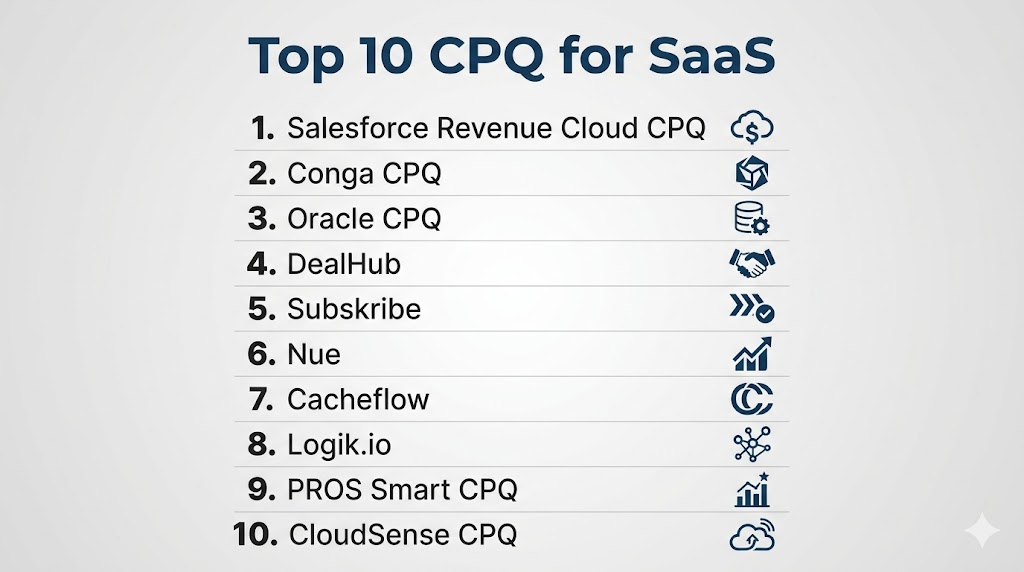
Introduction
CPQ for SaaS tools help software companies configure subscription packages, calculate pricing, apply discounts, generate quotes, manage approvals, and convert quotes into contracts, orders, or billing records. CPQ stands for Configure, Price, Quote. In simple terms, SaaS CPQ helps revenue teams sell the right product plan, add-ons, usage tiers, seats, bundles, services, renewals, and expansions with accurate pricing and cleaner approvals.
SaaS CPQ matters because software pricing is no longer simple. Many SaaS businesses now sell subscriptions, usage-based pricing, hybrid pricing, enterprise agreements, multi-year contracts, ramp deals, co-terms, discounts, trials, professional services, support packages, and renewals. Without CPQ, sales teams often rely on spreadsheets, manual pricing checks, finance approvals, and disconnected quote templates. This slows down deals, creates billing errors, weakens margin control, and causes friction between sales, finance, legal, and customer success.
Real World Use Cases:
- Creating subscription quotes for seats, plans, add-ons, and services
- Managing usage-based, tiered, ramped, and hybrid SaaS pricing
- Handling renewals, expansions, amendments, and co-terming
- Automating quote approvals based on discounts, deal size, or terms
- Generating proposals, order forms, and quote documents
- Connecting CRM quotes with billing, revenue, contracts, and finance systems
Evaluation Criteria for Buyers:
- Subscription, usage-based, and hybrid pricing support
- Product catalog, bundles, add-ons, and packaging flexibility
- Discounting, margin, approval, and deal governance controls
- Renewal, expansion, amendment, ramp, and co-terming workflows
- CRM, billing, ERP, CLM, revenue recognition, and payment integrations
- Quote document, order form, and proposal generation
- Support for sales, finance, legal, RevOps, and customer success teams
- Security controls, role permissions, audit logs, and approval governance
- Ease of use for account executives, sales managers, RevOps, and finance
- Implementation support, scalability, configurability, and total cost
Best for: CPQ for SaaS tools are best for SaaS companies, subscription businesses, cloud software vendors, B2B software sales teams, RevOps teams, finance teams, sales operations, customer success teams, billing teams, legal teams, and enterprise software companies managing complex subscription pricing and quote-to-cash workflows.
Not ideal for: CPQ may not be necessary for very small SaaS businesses with one simple plan, fixed online checkout pricing, no negotiated contracts, and low quote volume. In those cases, a CRM quote template, billing checkout, or simple proposal tool may be enough. However, once pricing complexity, enterprise deals, multi-year contracts, renewals, and approval workflows grow, dedicated SaaS CPQ becomes much more valuable.
Key Trends in CPQ for SaaS
- Usage-based pricing is reshaping SaaS CPQ: SaaS companies increasingly need CPQ tools that can quote usage tiers, committed spend, credits, overages, minimums, and consumption-based pricing.
- Quote-to-cash integration is now essential: CPQ must connect with CRM, billing, revenue recognition, contract management, ERP, and payment systems so deal terms flow cleanly downstream.
- Renewals and expansions are becoming core workflows: SaaS CPQ is no longer only for new sales. Teams need amendments, upgrades, downgrades, co-terming, ramp deals, and expansion quotes.
- Deal governance is becoming stricter: Finance and RevOps teams want discount approvals, margin checks, non-standard term controls, and audit trails before quotes are sent.
- Self-service and sales-led motions are converging: SaaS companies increasingly support both product-led growth and enterprise sales, requiring flexible CPQ and billing alignment.
- AI-assisted quoting is emerging: Some platforms are adding AI to suggest packages, flag risky terms, summarize deal changes, and help sales teams build better quotes faster.
- Pricing experimentation is increasing: SaaS businesses need flexibility to test packaging, add-ons, bundles, usage metrics, price books, regional pricing, and customer segments.
- RevOps ownership is growing: CPQ is often managed by RevOps because it sits between sales process, pricing policy, CRM data, billing rules, and reporting.
- Contract and billing accuracy is a major priority: Misalignment between quotes, contracts, invoices, and revenue schedules can create customer disputes and finance cleanup.
- Multi-entity and global SaaS selling is more complex: SaaS companies need support for currencies, tax, local terms, regional price books, legal entities, and multi-language documents.
How We Selected These Tools
The Top 10 tools were selected using practical evaluation logic for SaaS CPQ buyers.
- Recognition in SaaS CPQ, subscription management, quote-to-cash, revenue operations, and B2B software sales
- Suitability for SaaS companies selling subscriptions, usage-based products, add-ons, services, and enterprise agreements
- Feature depth across product configuration, pricing rules, discounting, approvals, renewals, amendments, and quote generation
- Ability to support CRM-driven sales, finance controls, billing handoff, contract workflows, and revenue operations
- Integration potential with CRM, billing, ERP, CLM, revenue recognition, payments, and analytics platforms
- Support for ramp pricing, co-terming, usage commitments, multi-year deals, bundles, and hybrid pricing
- Reporting depth for quote cycle time, discounting, approvals, win rates, ARR, expansion, and pricing performance
- Scalability across sales teams, business units, geographies, currencies, product catalogs, and pricing models
- Security posture signals, role permissions, auditability, and enterprise data protection expectations
- Vendor support, implementation maturity, partner ecosystem, and long-term platform value
Top 10 CPQ for SaaS
1- Salesforce Revenue Cloud CPQ
Short description:
Salesforce Revenue Cloud CPQ helps SaaS sales teams configure subscription products, apply pricing rules, generate quotes, automate approvals, and connect quoting with Salesforce CRM opportunities. It is especially useful for SaaS companies already using Salesforce Sales Cloud as their main revenue platform. The tool supports product bundles, discount rules, quote templates, renewal workflows, and approval governance. It is best for mid-market and enterprise SaaS companies that want CPQ deeply connected with CRM and revenue operations.
Key Features
- Subscription product configuration and quote creation
- Pricing, discounting, approval, and quote governance
- Product bundles, add-ons, services, and recurring charges
- Renewal, amendment, and expansion workflow support depending on setup
- Quote templates and proposal generation
- Integration with Salesforce CRM and Revenue Cloud ecosystem
- Reporting for pipeline, quote status, approvals, and revenue workflows
Pros
- Strong fit for Salesforce-centered SaaS sales teams
- Good CRM-to-quote workflow alignment
- Useful for approval governance, renewals, and revenue visibility
Cons
- Implementation can be complex for advanced SaaS pricing
- Billing and revenue recognition workflows may require additional systems
- Best value depends on Salesforce ecosystem maturity
Platforms / Deployment
Web / iOS / Android / Cloud
Security & Compliance
Salesforce environments commonly support identity controls, role-based access, encryption options, auditability, and enterprise security features depending on configuration. Buyers should verify CPQ-specific controls directly.
Integrations & Ecosystem
Salesforce Revenue Cloud CPQ fits SaaS companies that need quoting connected with CRM, revenue operations, billing, contracts, and finance workflows.
- Salesforce Sales Cloud
- Billing and subscription management systems
- Contract lifecycle management tools
- ERP and finance systems
- E-signature workflows
- Business intelligence dashboards
Support & Community
Salesforce provides documentation, implementation partners, training resources, customer support, and a large ecosystem. Support quality depends on configuration complexity, partner expertise, and internal Salesforce administration capability.
2- Conga CPQ
Short description:
Conga CPQ helps SaaS and B2B companies configure products, manage pricing, generate quotes, automate approvals, and produce quote documents. It is often used in Salesforce-centered environments and works well when quoting needs to connect with document generation, contracts, and revenue workflows. SaaS teams can use it for bundles, subscription packages, discounts, approvals, and proposal workflows. It is best for organizations that need CPQ connected with contract and document automation.
Key Features
- Product configuration and guided selling
- Subscription pricing and quote workflows
- Discounting, approval routing, and deal governance
- Proposal, quote, and order form generation
- Contract and document workflow alignment
- CRM integration depending on environment
- Reporting for quotes, approvals, and sales performance
Pros
- Strong quote and document automation capabilities
- Useful for sales teams needing flexible CPQ workflows
- Good fit for Salesforce-based revenue operations
Cons
- Advanced usage-based pricing should be validated
- Implementation complexity increases with pricing rules
- Best value depends on CRM and document workflow alignment
Platforms / Deployment
Web / Cloud
Security & Compliance
Not publicly stated. Buyers should verify SSO, MFA, encryption, RBAC, audit logs, data retention, and compliance controls directly.
Integrations & Ecosystem
Conga CPQ fits SaaS businesses that need quoting connected with CRM, contracts, e-signature, document generation, and downstream finance systems.
- CRM systems
- Contract lifecycle management tools
- E-signature workflows
- Billing and ERP systems
- Document generation workflows
- Reporting and analytics tools
Support & Community
Conga provides implementation support, documentation, customer success resources, partner services, and training. Support quality depends on configuration complexity, contract workflows, and integrated systems.
3- Oracle CPQ
Short description:
Oracle CPQ helps SaaS and enterprise technology companies configure offerings, price deals, create quotes, manage approvals, and connect sales workflows with Oracle CRM, ERP, and finance systems. It is especially relevant for larger SaaS companies with complex product catalogs, enterprise contracts, global pricing, and multi-region sales processes. Oracle CPQ supports guided selling, pricing logic, quote generation, and workflow automation. It is best for Oracle-centered SaaS enterprises needing scalable CPQ.
Key Features
- Guided selling and product configuration
- Subscription, service, and bundle quote support depending on setup
- Pricing, discounting, and approval workflows
- Quote and proposal generation
- Integration with Oracle CRM, ERP, finance, and commerce systems
- Multi-region, multi-currency, and enterprise quoting support
- Reporting for quote performance and sales operations
Pros
- Strong fit for Oracle-centered enterprises
- Scales well for complex product catalogs and global pricing
- Useful for connecting CPQ with ERP and finance workflows
Cons
- Best value depends on Oracle ecosystem alignment
- Implementation can be complex for large SaaS catalogs
- Usage-based pricing and billing handoff should be tested carefully
Platforms / Deployment
Web / Cloud
Security & Compliance
Oracle environments commonly support identity management, encryption, role-based access, auditability, and enterprise security features depending on configuration. Buyers should verify CPQ-specific controls directly.
Integrations & Ecosystem
Oracle CPQ fits SaaS companies that need quoting connected with enterprise sales, finance, commerce, and ERP workflows.
- Oracle CRM and ERP systems
- Finance and revenue systems
- Product and pricing systems
- Partner portals
- Proposal and document tools
- Analytics and reporting dashboards
Support & Community
Oracle provides enterprise support, implementation partners, documentation, training, and customer resources. Support quality depends on deployment scope, integration needs, and Oracle expertise.
4- DealHub
Short description:
DealHub is a revenue platform that supports CPQ, quote generation, deal rooms, contract workflows, subscription management, and sales engagement for B2B and SaaS companies. It is especially useful for SaaS teams that want a modern quoting experience with guided selling, buyer collaboration, and approval workflows. DealHub helps sales teams build quotes, route approvals, generate documents, and collaborate with buyers in a digital deal room. It is best for SaaS companies looking for a more agile CPQ and deal execution experience.
Key Features
- SaaS-focused CPQ and guided selling
- Quote and proposal generation
- Deal room and buyer collaboration support
- Approval workflows and discount governance
- Subscription and renewal workflow support depending on setup
- CRM and revenue system integrations
- Reporting for deal progress and quote activity
Pros
- Modern user experience for SaaS sales teams
- Useful for buyer collaboration and deal room workflows
- Faster adoption for teams seeking a lighter CPQ experience
Cons
- Very complex enterprise pricing should be validated
- Billing and revenue recognition workflows may require integrations
- Best value depends on sales process fit
Platforms / Deployment
Web / Cloud
Security & Compliance
Not publicly stated. Buyers should verify SSO, MFA, encryption, RBAC, audit logs, data retention, and compliance controls directly.
Integrations & Ecosystem
DealHub fits SaaS companies that need CPQ connected with CRM, sales engagement, contracts, and quote-to-cash workflows.
- CRM systems
- Billing and subscription platforms
- E-signature workflows
- Contract and order form workflows
- Sales engagement tools
- Revenue analytics systems
Support & Community
DealHub provides onboarding, implementation support, documentation, training, and customer success resources. Support quality depends on pricing complexity, CRM integration, and sales workflow design.
5- Subskribe
Short description:
Subskribe is a quote-to-revenue platform built for SaaS businesses, with capabilities for quoting, subscription billing, revenue recognition, order management, and finance workflows. It is especially useful for SaaS companies with complex deals, ramps, amendments, renewals, usage models, and revenue operations challenges. The platform helps connect CPQ with downstream billing and revenue processes. It is best for SaaS companies that want CPQ tightly aligned with billing and revenue recognition.
Key Features
- SaaS CPQ and quote-to-revenue workflows
- Subscription, usage, ramp, renewal, and amendment support
- Order management and billing alignment
- Revenue recognition workflow support
- Approval and deal governance
- CRM and finance system integrations
- Reporting across quote, order, billing, and revenue workflows
Pros
- Strong SaaS quote-to-revenue focus
- Useful for complex subscription, ramp, and amendment deals
- Helps reduce disconnects between sales, billing, and revenue teams
Cons
- Best fit is SaaS and subscription businesses, not general CPQ
- Implementation requires finance and RevOps alignment
- Buyers should validate fit with existing billing and ERP architecture
Platforms / Deployment
Web / Cloud
Security & Compliance
Not publicly stated. Buyers should verify SSO, MFA, encryption, RBAC, audit logs, data retention, and compliance documentation directly.
Integrations & Ecosystem
Subskribe fits SaaS businesses that need CPQ, billing, revenue, and order data connected in one revenue workflow.
- CRM systems
- ERP and finance systems
- Billing and revenue workflows
- Payment and invoicing systems
- Contract and approval workflows
- Revenue analytics dashboards
Support & Community
Subskribe provides implementation support, onboarding, customer success resources, and SaaS revenue operations expertise. Support quality depends on deal complexity, finance processes, and integration scope.
6- Nue
Short description:
Nue is a revenue lifecycle platform designed for modern SaaS and subscription businesses. It supports quoting, pricing, subscriptions, renewals, usage, billing handoff, and revenue workflows. It is especially relevant for SaaS companies that need flexibility across sales-led, product-led, and hybrid revenue motions. Nue helps revenue teams manage pricing changes, quotes, orders, subscription lifecycle events, and revenue operations. It is best for SaaS companies seeking flexible CPQ and subscription revenue infrastructure.
Key Features
- SaaS CPQ and subscription lifecycle support
- Usage-based, recurring, and hybrid pricing workflows
- Quote, order, renewal, and expansion support
- Product catalog and pricing management
- CRM and billing system alignment
- Deal approval and governance workflows
- Revenue operations reporting and lifecycle visibility
Pros
- Strong fit for modern SaaS pricing models
- Useful for hybrid product-led and sales-led revenue motions
- Helps align quoting with subscription lifecycle workflows
Cons
- Buyers should validate enterprise-scale global requirements
- Implementation requires strong RevOps and finance process design
- Best fit is SaaS and subscription-led companies
Platforms / Deployment
Web / Cloud
Security & Compliance
Not publicly stated. Buyers should verify SSO, MFA, encryption, RBAC, audit logs, data retention, and compliance controls directly.
Integrations & Ecosystem
Nue fits SaaS companies that need quote, order, subscription, and revenue workflows connected across sales and finance systems.
- CRM platforms
- Billing systems
- ERP and finance systems
- Revenue recognition workflows
- Product catalog systems
- Analytics and reporting tools
Support & Community
Nue provides onboarding, implementation support, customer success resources, and SaaS revenue operations guidance. Support quality depends on pricing model complexity and integration needs.
7- Cacheflow
Short description:
Cacheflow is a SaaS-focused CPQ and deal-closing platform that helps revenue teams create quotes, manage approvals, generate order forms, support payments, and improve buyer checkout experiences. It is especially useful for SaaS companies that want a faster quoting and close process with a modern buyer-facing experience. The platform focuses on making quote delivery, approval, acceptance, and payment smoother. It is best for SaaS teams seeking fast CPQ adoption and buyer-friendly quote workflows.
Key Features
- SaaS quote creation and approval workflows
- Order form and proposal generation
- Buyer-facing checkout and acceptance experience
- Subscription and payment workflow support depending on setup
- CRM integration
- Deal desk and approval visibility
- Reporting on quote status and buyer activity
Pros
- Modern and fast quote-to-close experience
- Useful for SaaS companies wanting buyer-friendly quoting
- Can reduce friction in approvals and order acceptance
Cons
- Advanced enterprise pricing and global workflows should be validated
- Billing and revenue recognition may require integrations
- Best fit depends on SaaS sales motion and deal complexity
Platforms / Deployment
Web / Cloud
Security & Compliance
Not publicly stated. Buyers should verify SSO, MFA, encryption, RBAC, audit logs, payment data controls, and compliance documentation directly.
Integrations & Ecosystem
Cacheflow fits SaaS teams that need CPQ connected with CRM, deal desk, order forms, and buyer checkout workflows.
- CRM systems
- Payment workflows
- Billing systems depending on setup
- E-signature and order form workflows
- Sales operations tools
- Revenue analytics dashboards
Support & Community
Cacheflow provides onboarding, implementation support, documentation, and customer success resources. Support quality depends on deal workflow complexity and CRM integration needs.
8- Logik.io
Short description:
Logik.io is an advanced product configuration and CPQ platform that helps businesses manage complex product rules, guided selling, pricing logic, and quote workflows. While it is often relevant for complex B2B selling broadly, SaaS companies with complex packaging, bundles, add-ons, and configuration logic can use it to improve quote accuracy and sales guidance. It is especially useful when standard CPQ logic becomes too rigid. It is best for SaaS and technology companies with complex product configuration and guided selling needs.
Key Features
- Advanced product configuration engine
- Guided selling and rules-based recommendations
- Complex bundle, add-on, and compatibility logic
- Pricing and quote workflow support
- CRM and commerce integrations
- Scalable product catalog management
- Reporting and quote process visibility
Pros
- Strong configuration logic and guided selling depth
- Useful for complex SaaS packaging and product rules
- Flexible for B2B technology companies with complex offers
Cons
- Billing and subscription lifecycle workflows may require separate systems
- Implementation requires strong product and pricing data readiness
- Best value depends on configuration complexity
Platforms / Deployment
Web / Cloud
Security & Compliance
Not publicly stated. Buyers should verify SSO, MFA, encryption, RBAC, audit logs, data retention, and compliance controls directly.
Integrations & Ecosystem
Logik.io fits SaaS and B2B companies that need advanced product configuration connected with CRM, commerce, pricing, and quote workflows.
- CRM systems
- Commerce platforms
- Pricing systems
- Product catalog systems
- Billing systems depending on setup
- Reporting and analytics tools
Support & Community
Logik.io provides implementation support, documentation, customer success resources, and configuration expertise. Support quality depends on product catalog complexity and integration scope.
9- PROS Smart CPQ
Short description:
PROS Smart CPQ helps B2B companies configure offers, optimize pricing, generate quotes, and improve revenue performance. For SaaS companies, it is especially relevant when pricing complexity, discount governance, margin control, and dynamic pricing are important. The platform combines CPQ with pricing intelligence and sales optimization capabilities. It is best for SaaS and technology companies that need stronger pricing science and quote governance.
Key Features
- Product configuration and guided selling
- Price optimization and dynamic pricing support
- Quote generation and approval workflows
- Discount and margin governance
- Integration with CRM, ERP, and commerce systems
- Omnichannel selling support depending on setup
- Analytics for pricing, quoting, and revenue performance
Pros
- Strong pricing intelligence and optimization focus
- Useful for discount governance and revenue performance
- Good fit for complex B2B pricing environments
Cons
- SaaS-specific subscription lifecycle support should be validated
- Implementation may require pricing transformation work
- Best value depends on pricing data maturity
Platforms / Deployment
Web / Cloud
Security & Compliance
Not publicly stated. Buyers should verify SSO, MFA, encryption, RBAC, audit logs, data retention, and security documentation directly.
Integrations & Ecosystem
PROS Smart CPQ fits SaaS companies that need CPQ connected with pricing, CRM, ERP, commerce, and revenue optimization workflows.
- CRM systems
- ERP and finance systems
- Pricing systems
- Digital commerce platforms
- Quote approval workflows
- Revenue analytics dashboards
Support & Community
PROS provides implementation support, pricing expertise, documentation, training, and customer success resources. Support quality depends on pricing complexity, data readiness, and deployment scope.
10- CloudSense CPQ
Short description:
CloudSense CPQ supports complex quoting, order capture, product catalog management, and sales workflows, especially for communications, media, technology, and subscription-based businesses. It helps teams manage bundles, product rules, pricing, guided selling, and order handoff. For SaaS companies with complex product structures or enterprise subscription sales, it can support quote accuracy and operational control. It is best for technology companies needing CPQ and order management capabilities for complex offers.
Key Features
- CPQ and guided selling workflows
- Product catalog and bundle management
- Pricing, discounting, and quote generation
- Order capture and handoff support
- Subscription-style product configuration depending on setup
- CRM and enterprise system integrations
- Reporting for sales and order workflows
Pros
- Useful for complex technology and subscription offerings
- Supports CPQ plus order capture workflows
- Good fit where product catalog complexity is high
Cons
- SaaS billing and revenue recognition fit should be validated
- Implementation requires product catalog and order process clarity
- May be more specialized than simple SaaS companies need
Platforms / Deployment
Web / Cloud
Security & Compliance
Not publicly stated. Buyers should verify SSO, MFA, encryption, RBAC, audit logs, data retention, and compliance documentation directly.
Integrations & Ecosystem
CloudSense CPQ fits SaaS and technology companies that need CPQ connected with CRM, catalog, order capture, and downstream fulfillment systems.
- CRM systems
- Product catalog systems
- Order management workflows
- Billing and finance systems depending on setup
- Partner or sales portals
- Reporting and analytics tools
Support & Community
CloudSense provides implementation support, documentation, customer success resources, and partner services. Support quality depends on catalog complexity, integration architecture, and order workflow needs.
Comparison Table
| Tool Name | Best For | Platform Supported | Deployment | Standout Feature | Public Rating |
|---|---|---|---|---|---|
| Salesforce Revenue Cloud CPQ | Salesforce-centered SaaS sales teams | Web, iOS, Android | Cloud | CRM-connected subscription quoting and approvals | N/A |
| Conga CPQ | Quote and document automation | Web | Cloud | CPQ connected with proposal and contract workflows | N/A |
| Oracle CPQ | Oracle-centered enterprise SaaS companies | Web | Cloud | Enterprise CPQ connected with Oracle ecosystem | N/A |
| DealHub | Modern SaaS quoting and deal rooms | Web | Cloud | CPQ with buyer collaboration and deal execution | N/A |
| Subskribe | SaaS quote-to-revenue workflows | Web | Cloud | CPQ connected with billing and revenue recognition | N/A |
| Nue | Modern SaaS subscription lifecycle | Web | Cloud | Flexible CPQ for usage and hybrid SaaS pricing | N/A |
| Cacheflow | Fast SaaS quote-to-close workflows | Web | Cloud | Buyer-friendly quoting and checkout experience | N/A |
| Logik.io | Complex SaaS product configuration | Web | Cloud | Advanced configuration logic and guided selling | N/A |
| PROS Smart CPQ | Pricing optimization and discount governance | Web | Cloud | CPQ with strong pricing intelligence | N/A |
| CloudSense CPQ | Complex technology and subscription offers | Web | Cloud | CPQ plus product catalog and order capture workflows | N/A |
Evaluation & Scoring of CPQ for SaaS
| Tool Name | Core 25% | Ease 15% | Integrations 15% | Security 10% | Performance 10% | Support 10% | Value 15% | Weighted Total 0–10 |
|---|---|---|---|---|---|---|---|---|
| Salesforce Revenue Cloud CPQ | 8.8 | 7.8 | 9.2 | 8.6 | 8.6 | 8.7 | 7.6 | 8.5 |
| Conga CPQ | 8.4 | 8.0 | 8.6 | 8.2 | 8.4 | 8.4 | 7.9 | 8.3 |
| Oracle CPQ | 8.6 | 7.5 | 9.0 | 8.5 | 8.7 | 8.6 | 7.6 | 8.4 |
| DealHub | 8.5 | 8.6 | 8.4 | 8.1 | 8.5 | 8.4 | 8.2 | 8.4 |
| Subskribe | 9.0 | 8.0 | 8.6 | 8.2 | 8.6 | 8.4 | 8.0 | 8.5 |
| Nue | 8.8 | 8.2 | 8.5 | 8.1 | 8.5 | 8.3 | 8.0 | 8.4 |
| Cacheflow | 8.0 | 8.8 | 8.2 | 8.0 | 8.3 | 8.2 | 8.3 | 8.3 |
| Logik.io | 8.6 | 8.0 | 8.5 | 8.1 | 8.5 | 8.3 | 7.9 | 8.4 |
| PROS Smart CPQ | 8.4 | 7.8 | 8.5 | 8.2 | 8.6 | 8.4 | 7.8 | 8.3 |
| CloudSense CPQ | 8.3 | 7.8 | 8.4 | 8.1 | 8.4 | 8.2 | 7.8 | 8.2 |
These scores are comparative and should be used as a practical guide, not as a universal ranking. A tool with a slightly lower score may be the best fit if it matches your CRM, pricing model, billing architecture, sales motion, and RevOps maturity. SaaS-specific quote-to-revenue tools are stronger for subscriptions, renewals, ramps, usage, and billing handoff, while enterprise CPQ tools are stronger for complex approvals, global scale, and CRM-centered sales processes. Buyers should test tools with real deals, renewals, amendments, discount rules, and billing scenarios before selection.
Which CPQ for SaaS Tool Is Right for You?
Solo / Freelancer
Solo RevOps consultants, SaaS pricing advisors, CPQ implementation specialists, and sales operations consultants usually do not need CPQ software for their own internal use. They may support clients with quote process design, pricing packaging, tool selection, implementation planning, and CRM-to-billing alignment. Salesforce CPQ, Conga, Oracle CPQ, DealHub, Subskribe, Nue, and Cacheflow knowledge can be especially useful for SaaS clients.
For early-stage SaaS clients, lightweight tools such as DealHub or Cacheflow may be practical. For enterprise SaaS clients, Salesforce Revenue Cloud CPQ, Oracle CPQ, Conga CPQ, Subskribe, or Nue may be more relevant depending on architecture.
SMB
Small SaaS companies should start with the main quoting pain point. If the business sells simple subscriptions, a CRM quote tool or billing checkout may be enough. If sales teams need approvals, order forms, discount controls, and clean handoff to billing, a SaaS-focused CPQ tool becomes useful.
SMBs should avoid overbuilding CPQ before pricing strategy is stable. A phased setup covering core plans, add-ons, discounts, approval rules, and order forms often works better than trying to model every possible exception at once.
Mid-Market
Mid-market SaaS companies usually need stronger quote governance, renewal workflows, expansion quoting, ramp deals, usage commitments, CRM integration, and billing alignment. DealHub, Subskribe, Nue, Cacheflow, Salesforce CPQ, Conga CPQ, and Logik.io can all be relevant depending on deal complexity.
Mid-market buyers should evaluate how well the tool handles amendments, co-terming, approvals, sales-assisted checkout, and downstream billing. CPQ success depends on clean connection between sales, finance, legal, and customer success.
Enterprise
Enterprise SaaS companies need scalable CPQ across product lines, regions, currencies, legal entities, customer segments, partner channels, discount policies, and quote approval structures. Salesforce Revenue Cloud CPQ, Oracle CPQ, Conga CPQ, Subskribe, Nue, PROS Smart CPQ, Logik.io, and CloudSense CPQ can all be relevant depending on architecture.
Enterprise buyers should define product catalog governance, quote approval rules, billing handoff, contract templates, revenue recognition dependencies, and renewal processes before implementation. CPQ should become a governed revenue system, not only a sales quote tool.
Budget vs Premium
Budget-focused buyers should begin with the workflows that create the most friction: discount approvals, quote templates, order forms, renewal quotes, or billing handoff. A lightweight CPQ tool may be enough if pricing is simple and deal volume is moderate.
Premium platforms make sense when SaaS pricing is complex, enterprise deals are frequent, renewals are large, approval governance is strict, or billing errors create finance cleanup. The cost should be compared with faster quote cycles, fewer errors, better discount control, and improved quote-to-cash accuracy.
Feature Depth vs Ease of Use
Salesforce Revenue Cloud CPQ, Oracle CPQ, and Conga CPQ provide broad enterprise CPQ capabilities. Subskribe and Nue are strong for SaaS quote-to-revenue and subscription lifecycle workflows. DealHub and Cacheflow are strong for modern sales experience and faster quote-to-close workflows. Logik.io is strong for complex configuration logic. PROS is strong for pricing optimization. CloudSense is useful for complex technology subscription and order capture needs.
Choose feature depth when pricing, approvals, and integrations are complex. Choose ease of use when adoption by sales and faster quote turnaround are the top priorities.
Integrations & Scalability
SaaS CPQ tools should integrate with CRM, billing, ERP, revenue recognition, CLM, e-signature, payment systems, customer success platforms, product catalogs, tax systems, and business intelligence tools. Integration is critical because quote terms must flow accurately into contracts, invoices, revenue schedules, and customer records.
Scalability depends on product catalog size, pricing complexity, sales team size, region count, quote volume, currencies, entities, renewal volume, and billing models. A strong CPQ platform should scale without forcing RevOps teams back to spreadsheets.
Security & Compliance Needs
CPQ tools store sensitive customer data, pricing rules, discount approvals, contract terms, order forms, revenue data, and internal deal strategy. Buyers should evaluate SSO, MFA, encryption, RBAC, audit logs, approval controls, data retention, and administrator permissions.
SaaS companies should define who can edit product catalog items, approve discounts, change terms, view customer pricing, generate order forms, and export quote data. If a vendor does not clearly confirm a security or compliance control, request documentation before implementation.
Frequently Asked Questions
1. What is CPQ for SaaS?
CPQ for SaaS is software that helps SaaS companies configure subscription products, calculate pricing, create quotes, and generate order forms or proposals. It supports plans, add-ons, seats, usage tiers, discounts, renewals, expansions, and approvals. SaaS CPQ helps sales teams quote accurately while giving finance and RevOps better control over pricing and terms. It reduces spreadsheet dependency and manual quote errors. The main goal is to make quote-to-cash faster and more accurate.
2. How is SaaS CPQ different from traditional CPQ?
Traditional CPQ often focuses on physical products, product bundles, or one-time sales. SaaS CPQ must handle recurring subscriptions, usage-based pricing, ramp deals, renewals, amendments, co-terming, discounts, service packages, and billing handoff. SaaS deals often change over the customer lifecycle, so CPQ must support expansion and renewal workflows. It also needs strong integration with billing and revenue systems. This makes SaaS CPQ more subscription-focused than traditional product CPQ.
3. How much does CPQ for SaaS cost?
Pricing varies based on users, quote volume, product complexity, modules, integrations, support, and implementation services. Enterprise CPQ platforms often require custom pricing and professional services. Costs may also include CRM integration, billing integration, product catalog setup, approval workflow design, quote template creation, and training. Buyers should evaluate total cost of ownership, not only software subscription fees. The business case should include faster quote cycles, fewer billing errors, better discount governance, and improved revenue operations.
4. How long does SaaS CPQ implementation usually take?
Implementation time depends on product catalog complexity, pricing models, CRM setup, billing systems, approval rules, order form templates, and data quality. A simple CPQ rollout for standard subscription plans can be faster than a global enterprise rollout with usage pricing, ramps, renewals, amendments, and multiple billing entities. A phased rollout is usually best. Start with core new-business quotes, then add renewals, expansions, usage pricing, partner workflows, and advanced approvals. RevOps and finance alignment is critical.
5. What are common mistakes when choosing SaaS CPQ?
A common mistake is choosing CPQ before finalizing pricing and packaging rules. Another mistake is focusing only on sales usability while ignoring billing, revenue recognition, and contract handoff. Some companies over-customize CPQ and make it difficult to maintain. Others underestimate renewal, amendment, and co-terming workflows. The best selection process tests real new business deals, renewal deals, expansion deals, discounts, ramp pricing, and billing handoff scenarios.
6. Can SaaS CPQ support usage-based pricing?
Yes, many modern SaaS CPQ tools can support usage-based pricing, but depth varies by platform. Common use cases include usage tiers, committed usage, minimum spend, overages, credits, drawdowns, and hybrid subscription-plus-usage models. Buyers should test real pricing examples before selection. Usage pricing also needs strong billing integration because quotes must translate into accurate invoices. If usage pricing is central to your business, validate CPQ and billing together.
7. What is co-terming in SaaS CPQ?
Co-terming means aligning the end dates of multiple subscriptions, add-ons, or expansion products so they renew together. For example, a customer may buy a new add-on halfway through an annual contract, and the quote must price it only for the remaining contract term. SaaS CPQ can automate co-term calculations, prorations, and renewal alignment. This reduces manual math and finance review. Co-terming is especially important for expansion and customer success workflows.
8. What integrations are most important for SaaS CPQ?
Important integrations include CRM, billing, ERP, revenue recognition, CLM, e-signature, tax, payment systems, product catalog, customer success tools, and business intelligence platforms. CRM integration helps sales teams quote from opportunities. Billing integration ensures quotes become accurate invoices. CLM and e-signature integration help turn quotes into signed contracts. Revenue recognition integration supports finance accuracy. Strong integrations reduce manual re-entry and quote-to-cash errors.
9. How should buyers evaluate approval workflows?
Buyers should test whether the CPQ tool can route approvals based on discount level, deal size, payment terms, contract length, non-standard clauses, margin impact, ramp structure, or pricing exceptions. Approval workflows should be easy for sales teams to understand and fast for managers to complete. The platform should also keep audit trails of who approved what and when. Good approvals protect pricing without slowing every deal. Overly complex approval rules can hurt adoption.
10. Can SaaS CPQ help with renewals and expansions?
Yes, SaaS CPQ can help create renewal quotes, expansion quotes, amendments, upgrades, downgrades, and co-termed add-ons. This is important because SaaS revenue growth often comes from existing customers. CPQ can help customer success and sales teams generate accurate quotes based on current subscriptions and desired changes. It can also reduce errors in contract dates, pricing, and billing terms. Buyers should test renewal and expansion scenarios carefully.
Conclusion
CPQ for SaaS tools help software companies quote faster, reduce pricing errors, control discounts, support renewals, manage usage or subscription pricing, and connect sales with billing and revenue workflows. The best platform depends on CRM ecosystem, pricing model, sales motion, deal complexity, billing architecture, and RevOps maturity. Salesforce Revenue Cloud CPQ, Conga CPQ, and Oracle CPQ are strong for enterprise CPQ and CRM-centered workflows. DealHub and Cacheflow are strong for modern SaaS quoting and buyer experience. Subskribe and Nue are strong for SaaS quote-to-revenue and subscription lifecycle management. Logik.io is useful for complex product configuration, PROS Smart CPQ is strong for pricing optimization, and CloudSense CPQ fits complex technology subscription offerings. There is no single universal winner because an early-stage SaaS startup, product-led growth company, enterprise SaaS vendor, usage-based platform, and global software business all quote differently.

Adopting comprehensive recurring subscription pricing infrastructure software optimizes enterprise software sales fulfillment logistics, ensuring accelerated commercial quote generation and seamless digital contract entitlement workflows.