MOTOSHARE 🚗🏍️
Rent Bikes & Cars Directly from Owners
Motoshare connects vehicle owners with people who need bikes and cars on rent. Owners earn from idle vehicles, and renters get flexible ride options.
Visit Motoshare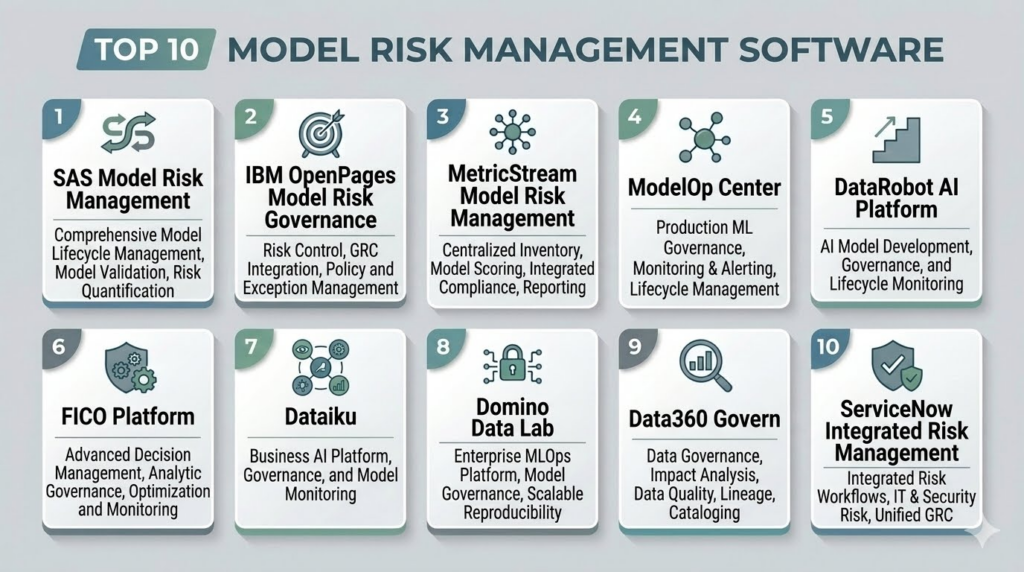
Introduction
Model Risk Management Software helps banks, insurers, fintech companies, asset managers, lenders, and regulated enterprises manage risks created by statistical models, machine learning models, AI systems, credit scoring models, pricing models, fraud models, forecasting models, and decision engines. In simple terms, these tools help organizations inventory models, validate assumptions, track approvals, monitor performance, document changes, manage governance, and prove that models are being used responsibly.
Model risk management matters because organizations now rely heavily on models for credit decisions, underwriting, fraud detection, capital planning, pricing, stress testing, trading, customer targeting, risk scoring, and AI automation. If a model is poorly designed, biased, outdated, undocumented, or used outside its intended purpose, it can create financial loss, regulatory findings, unfair outcomes, operational failures, and reputational damage.
Real World Use Cases:
- Maintaining a centralized inventory of financial, statistical, ML, and AI models
- Managing model validation, approval, review, and retirement workflows
- Monitoring model performance, drift, bias, stability, and data quality
- Documenting assumptions, limitations, owners, use cases, and dependencies
- Supporting regulatory examinations, internal audits, and board reporting
- Governing credit risk, market risk, fraud, pricing, underwriting, and AI models
Evaluation Criteria for Buyers:
- Model inventory and lifecycle management depth
- Validation workflow, review, approval, and evidence management
- Model monitoring, drift detection, performance tracking, and alerts
- Governance support for AI, ML, statistical, and financial models
- Documentation, audit trails, version control, and change management
- Integration with data science, MLOps, GRC, audit, and risk systems
- Reporting for regulators, model risk committees, audit teams, and executives
- Role-based access, SSO, encryption, audit logs, and data governance
- Configurability for risk ratings, model tiers, policies, and review cycles
- Implementation support, usability, scalability, and total cost
Best for: Model Risk Management Software is best for banks, credit unions, insurers, fintech firms, asset managers, investment firms, mortgage lenders, payment companies, risk teams, model validation teams, data science teams, compliance teams, internal audit, AI governance teams, and enterprises managing large portfolios of financial, analytical, ML, or AI models.
Not ideal for: These tools may not be necessary for very small companies with only a few low-impact models and no formal regulatory or audit pressure. In those cases, a controlled spreadsheet, documentation repository, MLOps platform, or GRC workflow may be enough temporarily. However, once model count, regulatory exposure, AI usage, validation workload, or business impact increases, dedicated model risk management software becomes much more valuable.
Key Trends in Model Risk Management Software
- AI governance is becoming part of model risk management: Organizations are expanding model risk programs to include machine learning, generative AI, decision automation, and third-party AI models.
- Model inventories are becoming more detailed: Teams need to track owners, business purpose, data sources, model tier, validation status, limitations, assumptions, dependencies, and production usage.
- Continuous monitoring is replacing annual-only review: High-impact models increasingly require ongoing performance tracking, drift monitoring, stability checks, and early warning alerts.
- Explainability is a major requirement: Risk teams need clear documentation of model logic, variables, training data, assumptions, performance, limitations, and decision impact.
- Integration with MLOps platforms is growing: Model risk teams want governance workflows connected with model development, deployment, monitoring, feature stores, and experiment tracking.
- Regulatory reporting is becoming more evidence-driven: Organizations need audit trails, validation evidence, sign-offs, issue history, remediation plans, and review documentation.
- Third-party and vendor models need stronger controls: Many organizations use external models, vendor scores, AI APIs, and embedded analytics that still require governance.
- Bias and fairness testing are gaining importance: Model risk programs increasingly include fairness checks, explainability reviews, and impact analysis for customer-facing models.
- Model risk is becoming enterprise-wide: Model governance is no longer limited to banks. Insurers, fintechs, healthcare companies, retailers, and AI-heavy enterprises are building model risk practices.
- Workflow automation is reducing review bottlenecks: Automated review cycles, approval routing, issue tracking, and document templates help model risk teams manage growing workloads.
How We Selected These Tools
The Top 10 tools were selected using practical evaluation logic for model risk management buyers.
- Recognition in model risk management, AI governance, GRC, MLOps, model monitoring, and enterprise risk workflows
- Suitability for banks, insurers, fintechs, asset managers, lenders, regulated enterprises, and AI-driven organizations
- Feature depth across model inventory, validation, approvals, documentation, monitoring, and audit trails
- Ability to support financial models, statistical models, machine learning models, AI models, and third-party models
- Integration potential with MLOps, data science platforms, GRC tools, data warehouses, BI systems, and audit workflows
- Support for model lifecycle governance from development through retirement
- Reporting and evidence management for regulators, internal audit, risk committees, and executives
- Configurability for model tiers, risk ratings, review frequency, policies, and approval workflows
- Security posture signals, role permissions, auditability, and enterprise data governance expectations
- Vendor support, implementation maturity, documentation, and long-term platform value
Top 10 Model Risk Management Software
1- SAS Model Risk Management
Short description:
SAS Model Risk Management is an enterprise platform designed to help organizations manage model inventories, validation workflows, documentation, governance, reporting, and model lifecycle controls. It is especially relevant for banks, insurers, and financial institutions with large portfolios of analytical and regulatory models. The platform supports structured model governance, review cycles, issue tracking, and evidence management. It is best for mature model risk teams that need enterprise-grade control and analytics alignment.
Key Features
- Centralized model inventory and lifecycle management
- Model validation workflow and review tracking
- Documentation, evidence, and approval management
- Model risk rating and tiering support
- Issue, remediation, and exception tracking
- Reporting for model risk committees and regulators
- Integration with SAS analytics and enterprise risk workflows
Pros
- Strong fit for regulated financial institutions
- Deep model governance and analytics heritage
- Useful for large model portfolios and formal validation programs
Cons
- Implementation can be complex for smaller teams
- Best value depends on mature model governance processes
- May require SAS ecosystem familiarity
Platforms / Deployment
Web / Cloud / Hybrid depending on configuration
Security & Compliance
Not publicly stated. Buyers should verify SSO, MFA, encryption, RBAC, audit logs, validation evidence controls, data retention, and compliance documentation directly.
Integrations & Ecosystem
SAS Model Risk Management fits organizations that need model governance connected with analytics, risk reporting, validation evidence, and enterprise risk processes.
- SAS analytics and model development environments
- Risk and compliance systems
- Data warehouses and reporting tools
- Model documentation repositories
- Validation and approval workflows
- Audit and regulatory reporting processes
Support & Community
SAS provides enterprise support, implementation services, documentation, training, and analytics expertise. Support quality depends on deployment complexity, model portfolio size, and internal SAS maturity.
2- IBM OpenPages Model Risk Governance
Short description:
IBM OpenPages Model Risk Governance helps organizations manage model inventory, model validation, risk assessments, approvals, issues, policies, and governance workflows within a broader GRC platform. It is useful for financial services firms and regulated enterprises that want model risk connected with operational risk, compliance, audit, and controls. The platform supports model lifecycle oversight and audit-ready documentation. It is best for enterprises that need model risk management inside a broader integrated risk framework.
Key Features
- Model inventory and lifecycle governance
- Model validation and approval workflows
- Risk assessment and control management
- Issue, remediation, and exception tracking
- Policy and regulatory mapping support
- Audit trail and evidence management
- Integration with broader GRC workflows
Pros
- Strong fit for integrated risk and compliance programs
- Useful for connecting model risk with audit and operational risk
- Flexible governance workflows for regulated enterprises
Cons
- Configuration may require GRC expertise
- Model monitoring depth may need integration with analytics systems
- Smaller teams may find it more platform than needed
Platforms / Deployment
Web / Cloud / Hybrid depending on configuration
Security & Compliance
Not publicly stated. Buyers should verify SSO, MFA, encryption, RBAC, audit logs, data governance, and compliance controls directly.
Integrations & Ecosystem
IBM OpenPages Model Risk Governance fits organizations that need model risk workflows connected with enterprise GRC, audit, controls, and compliance processes.
- IBM OpenPages GRC modules
- Audit and compliance workflows
- Model documentation systems
- Analytics and data science environments
- Risk reporting dashboards
- Issue and remediation workflows
Support & Community
IBM provides enterprise support, implementation services, documentation, and risk management expertise. Support quality depends on configuration scope, integration complexity, and internal platform maturity.
3- MetricStream Model Risk Management
Short description:
MetricStream Model Risk Management supports model inventory, validation, governance, issue tracking, compliance, and enterprise risk workflows. It is part of a broader GRC ecosystem, making it useful for organizations that want model risk connected with compliance, audit, operational risk, and control management. The platform helps teams standardize model review processes, assign ownership, track remediation, and report model risk posture. It is best for regulated enterprises seeking model governance within integrated risk management.
Key Features
- Model inventory and risk classification
- Validation workflow and review cycle management
- Model documentation and evidence tracking
- Issue, action, and remediation management
- Integration with audit, compliance, and control workflows
- Dashboards and model risk reporting
- Configurable policies, workflows, and approvals
Pros
- Strong GRC alignment for regulated environments
- Useful for standardizing model validation workflows
- Supports model risk reporting and governance visibility
Cons
- Model monitoring may require integration with external analytics tools
- Implementation can be resource-intensive
- Best fit depends on broader MetricStream ecosystem use
Platforms / Deployment
Web / Cloud / Hybrid depending on configuration
Security & Compliance
Not publicly stated. Buyers should verify SSO, MFA, encryption, RBAC, audit logs, data retention, and compliance documentation directly.
Integrations & Ecosystem
MetricStream Model Risk Management works well where model risk must connect with enterprise risk, compliance, audit, controls, and issue management.
- GRC and compliance workflows
- Internal audit systems
- Data science and analytics platforms
- Model documentation repositories
- Issue and remediation tracking
- Executive reporting dashboards
Support & Community
MetricStream provides enterprise implementation support, documentation, training, and customer success resources. Support quality depends on module scope, workflow complexity, and risk program maturity.
4- ModelOp Center
Short description:
ModelOp Center is a model governance and model operations platform focused on managing AI, machine learning, and advanced analytics models across the enterprise. It helps teams inventory models, govern lifecycle activities, monitor performance, manage approvals, and enforce policies across model development and production. The platform is especially useful for organizations that need governance over many AI and ML models across different development tools. It is best for enterprises building AI governance and operational model oversight programs.
Key Features
- Enterprise model inventory and lifecycle governance
- AI and ML model monitoring workflows
- Policy enforcement and approval management
- Model performance, drift, and operational status visibility
- Integration with MLOps and data science tools
- Documentation and evidence management
- Reporting for AI governance and model risk teams
Pros
- Strong fit for AI and ML model governance
- Useful across heterogeneous model development environments
- Helps connect model operations with governance requirements
Cons
- Financial model validation depth should be validated
- Best value depends on model deployment complexity
- Requires alignment between data science and risk teams
Platforms / Deployment
Web / Cloud / Hybrid depending on configuration
Security & Compliance
Not publicly stated. Buyers should verify SSO, MFA, encryption, RBAC, audit logs, model governance controls, and data protection documentation.
Integrations & Ecosystem
ModelOp Center fits organizations that need to govern AI and ML models across multiple tools, teams, and deployment environments.
- MLOps platforms
- Data science notebooks and development tools
- Model monitoring systems
- Data warehouses and feature stores
- Governance and approval workflows
- Executive and compliance reporting tools
Support & Community
ModelOp provides implementation guidance, documentation, customer support, and AI governance expertise. Support quality depends on model complexity, integrations, and enterprise AI maturity.
5- DataRobot AI Platform
Short description:
DataRobot AI Platform supports machine learning development, deployment, monitoring, governance, and model operations. While it is broader than model risk management alone, it includes governance and monitoring capabilities that can support model risk programs for AI and ML models. It helps teams track models, monitor performance, manage deployments, and support explainability. It is best for organizations that want AI model development and governance in a connected platform.
Key Features
- AI and machine learning model development
- Model deployment and monitoring
- Performance tracking and drift monitoring
- Explainability and model documentation support
- Model registry and lifecycle visibility
- Governance workflows for AI models
- Integration with data science and enterprise systems
Pros
- Strong AI and ML lifecycle capabilities
- Useful for model monitoring and explainability
- Good fit for organizations building AI models at scale
Cons
- Not a traditional financial model risk system by itself
- Formal validation workflows may need additional governance layers
- Best fit depends on DataRobot model development usage
Platforms / Deployment
Web / Cloud / Hybrid depending on configuration
Security & Compliance
Not publicly stated. Buyers should verify SSO, MFA, encryption, RBAC, audit logs, data governance, model monitoring controls, and compliance documentation.
Integrations & Ecosystem
DataRobot fits organizations that need model development, deployment, monitoring, and AI governance workflows connected.
- Data warehouses and data platforms
- MLOps and deployment environments
- Business intelligence tools
- Model monitoring dashboards
- AI governance workflows
- Enterprise application systems
Support & Community
DataRobot provides customer support, documentation, onboarding, training, and AI implementation resources. Support quality depends on deployment scope, model volume, and internal data science maturity.
6- FICO Platform
Short description:
FICO Platform supports decision management, predictive analytics, model development, optimization, and operational decisioning for financial services and other industries. For model risk management, it is relevant because many organizations use FICO models and decision strategies for credit, fraud, collections, pricing, and customer decisions. The platform can support model governance through decision strategy visibility, performance tracking, and analytics workflow control. It is best for lenders, insurers, and financial institutions using decision models in high-impact business processes.
Key Features
- Decision management and predictive analytics workflows
- Model development and strategy management
- Credit, fraud, collections, and risk decisioning support
- Performance monitoring depending on configuration
- Rules, scores, and decision strategy governance
- Reporting and operational analytics
- Integration with financial services workflows
Pros
- Strong financial services decisioning heritage
- Useful for credit, fraud, and risk model workflows
- Good fit where models are embedded in operational decision strategies
Cons
- Not a standalone enterprise model risk inventory by default
- Formal validation workflows may require additional tools
- Best fit depends on FICO ecosystem and use case
Platforms / Deployment
Web / Cloud / Hybrid depending on configuration
Security & Compliance
Not publicly stated. Buyers should verify SSO, MFA, encryption, RBAC, audit logs, model governance controls, and compliance documentation directly.
Integrations & Ecosystem
FICO Platform fits organizations where model risk is tied closely to decision strategies, scoring models, and operational risk decisions.
- Credit decisioning systems
- Fraud and collections workflows
- Data platforms and analytics tools
- Rules engines and scorecards
- Reporting and performance dashboards
- Enterprise financial services applications
Support & Community
FICO provides enterprise support, implementation services, analytics expertise, and financial services domain knowledge. Support quality depends on deployment scope and decisioning complexity.
7- Dataiku
Short description:
Dataiku is an enterprise AI and data science platform used for analytics, machine learning, data preparation, deployment, and model monitoring. While it is not a pure model risk management system, it can support model governance through project documentation, model registry, monitoring, approvals, and collaboration workflows. It is especially useful for organizations that want to govern models closer to where data science work happens. It is best for enterprises needing collaborative AI governance across technical and business teams.
Key Features
- Collaborative data science and machine learning workflows
- Model development, deployment, and monitoring
- Model registry and project documentation support
- Governance and approval workflows depending on configuration
- Explainability and performance monitoring capabilities
- Integration with data platforms and enterprise tools
- Collaboration between data scientists, analysts, and business users
Pros
- Strong collaborative AI and analytics platform
- Useful for governance near model development workflows
- Good fit for organizations with many data science teams
Cons
- Not a traditional model risk validation platform by itself
- Formal regulatory model governance may require additional tooling
- Best value depends on data science adoption
Platforms / Deployment
Web / Cloud / Self-hosted / Hybrid depending on configuration
Security & Compliance
Not publicly stated. Buyers should verify SSO, MFA, encryption, RBAC, audit logs, data governance, model governance controls, and compliance documentation.
Integrations & Ecosystem
Dataiku fits organizations that need AI development, collaboration, governance, and model monitoring connected with enterprise data systems.
- Data warehouses and lakehouses
- MLOps and deployment environments
- BI and analytics tools
- Data governance systems
- Model monitoring workflows
- Enterprise application integrations
Support & Community
Dataiku provides documentation, training, customer support, partner services, and a strong data science user ecosystem. Support quality depends on deployment model and enterprise adoption.
8- Domino Data Lab
Short description:
Domino Data Lab is an enterprise AI and data science platform that supports model development, reproducibility, deployment, monitoring, governance, and collaboration. It is relevant for model risk management when organizations need traceability over code, data, experiments, model versions, and production deployments. The platform is especially useful for regulated enterprises that need stronger controls around data science work. It is best for data science-heavy organizations that need reproducible model development and operational governance.
Key Features
- Enterprise data science workbench
- Model development, deployment, and monitoring
- Experiment tracking and reproducibility support
- Model versioning and governance workflows
- Collaboration across data science teams
- Auditability of code, data, and model artifacts
- Integration with data platforms and MLOps tools
Pros
- Strong reproducibility and data science governance
- Useful for regulated AI and ML model development
- Supports technical traceability for model artifacts
Cons
- Not a standalone model risk inventory for all model types
- Business validation workflows may need integration with GRC tools
- Best fit depends on technical data science maturity
Platforms / Deployment
Web / Cloud / Self-hosted / Hybrid depending on configuration
Security & Compliance
Not publicly stated. Buyers should verify SSO, MFA, encryption, RBAC, audit logs, model artifact controls, and compliance documentation directly.
Integrations & Ecosystem
Domino fits organizations that need controlled data science environments and traceability across model development, experimentation, and deployment.
- Data platforms and warehouses
- MLOps workflows
- Code repositories and notebooks
- Model monitoring systems
- Governance and compliance workflows
- Enterprise reporting and documentation tools
Support & Community
Domino Data Lab provides enterprise support, onboarding, documentation, and data science platform expertise. Support quality depends on deployment complexity and user base size.
9- Data360 Govern
Short description:
Data360 Govern is a data governance platform that helps organizations manage data lineage, data catalogs, metadata, business glossaries, policies, and governance workflows. For model risk management, it is relevant because models depend heavily on trusted data, lineage, definitions, and controls. It can support model governance by improving visibility into model inputs, data ownership, and data quality dependencies. It is best for organizations that need stronger data governance as part of model risk and AI governance programs.
Key Features
- Data catalog and metadata management
- Data lineage and business glossary support
- Data ownership and stewardship workflows
- Policy and governance documentation
- Data quality and control visibility depending on configuration
- Support for model input and data dependency tracking
- Reporting for governance and compliance teams
Pros
- Strong fit for data governance around model inputs
- Useful for improving lineage and data ownership visibility
- Supports broader AI and model governance foundations
Cons
- Not a dedicated model validation platform
- Model monitoring and approval workflows may require other tools
- Best used as part of a broader governance ecosystem
Platforms / Deployment
Web / Cloud / Hybrid depending on configuration
Security & Compliance
Not publicly stated. Buyers should verify SSO, MFA, encryption, RBAC, audit logs, metadata governance controls, and compliance documentation.
Integrations & Ecosystem
Data360 Govern fits organizations that need data governance, lineage, and metadata control to support model risk and AI governance.
- Data catalogs and metadata systems
- Data warehouses and lakehouses
- Governance and policy workflows
- Model documentation processes
- Data quality tools
- Compliance and reporting dashboards
Support & Community
Support is typically focused on data governance implementation, metadata strategy, documentation, and platform configuration. Buyers should validate onboarding, integration support, and governance expertise.
10- ServiceNow Integrated Risk Management
Short description:
ServiceNow Integrated Risk Management can support model risk management when organizations configure model risk workflows inside a broader risk, compliance, control, issue, and remediation platform. It is not a dedicated model risk tool by default, but it is relevant for enterprises already using ServiceNow for GRC, IT workflows, operational risk, and compliance. It can help teams manage model risk policies, approvals, issues, evidence, and remediation actions. It is best for organizations that want model risk governance connected with enterprise workflow automation.
Key Features
- Risk, control, issue, and remediation workflows
- Configurable model risk register and approval processes
- Policy and compliance mapping support
- Task assignment and workflow automation
- Dashboards and executive reporting
- Integration with IT, security, audit, and operational workflows
- Evidence and audit trail management
Pros
- Strong workflow automation and enterprise platform capabilities
- Useful for organizations already using ServiceNow
- Helps connect model risk issues with remediation workflows
Cons
- Requires configuration for model risk-specific workflows
- Not a dedicated model monitoring or validation platform
- Best value depends on ServiceNow maturity and implementation quality
Platforms / Deployment
Web / Cloud
Security & Compliance
ServiceNow environments commonly support identity controls, role-based access, encryption, auditability, and enterprise security features depending on configuration. Buyers should verify specific model risk workflow controls directly.
Integrations & Ecosystem
ServiceNow IRM fits organizations that need model risk governance connected to broader enterprise risk, compliance, audit, and issue management workflows.
- IT and security workflows
- Audit and compliance processes
- Risk and control management
- Issue remediation workflows
- Model governance records
- Enterprise reporting and dashboards
Support & Community
ServiceNow provides enterprise support, implementation partners, documentation, training, and a large platform ecosystem. Support quality depends on configuration complexity, partner expertise, and internal platform maturity.
Comparison Table
| Tool Name | Best For | Platform Supported | Deployment | Standout Feature | Public Rating |
|---|---|---|---|---|---|
| SAS Model Risk Management | Regulated financial model governance | Web | Cloud / Hybrid | Enterprise model inventory and validation governance | N/A |
| IBM OpenPages Model Risk Governance | Model risk inside broader GRC | Web | Cloud / Hybrid | Model governance connected with risk and compliance | N/A |
| MetricStream Model Risk Management | Integrated GRC and model risk workflows | Web | Cloud / Hybrid | Model risk connected with audit, controls, and compliance | N/A |
| ModelOp Center | AI and ML model governance | Web | Cloud / Hybrid | Model operations governance across AI environments | N/A |
| DataRobot AI Platform | AI model development and monitoring | Web | Cloud / Hybrid | AI lifecycle governance and monitoring | N/A |
| FICO Platform | Credit, fraud, and decision model governance | Web | Cloud / Hybrid | Decisioning and score model operational control | N/A |
| Dataiku | Collaborative AI and data science governance | Web | Cloud / Self-hosted / Hybrid | Governance near data science workflows | N/A |
| Domino Data Lab | Reproducible model development governance | Web | Cloud / Self-hosted / Hybrid | Experiment tracking and technical model traceability | N/A |
| Data360 Govern | Data governance for model inputs | Web | Cloud / Hybrid | Data lineage and metadata governance | N/A |
| ServiceNow Integrated Risk Management | Configurable enterprise model risk workflows | Web | Cloud | Model risk issues connected with enterprise remediation | N/A |
Evaluation & Scoring of Model Risk Management Software
| Tool Name | Core 25% | Ease 15% | Integrations 15% | Security 10% | Performance 10% | Support 10% | Value 15% | Weighted Total 0–10 |
|---|---|---|---|---|---|---|---|---|
| SAS Model Risk Management | 9.3 | 7.4 | 8.8 | 8.5 | 8.8 | 8.8 | 7.5 | 8.5 |
| IBM OpenPages Model Risk Governance | 8.8 | 7.5 | 8.8 | 8.5 | 8.5 | 8.6 | 7.6 | 8.3 |
| MetricStream Model Risk Management | 8.7 | 7.6 | 8.6 | 8.3 | 8.4 | 8.5 | 7.7 | 8.2 |
| ModelOp Center | 8.8 | 7.8 | 8.8 | 8.2 | 8.6 | 8.4 | 7.8 | 8.4 |
| DataRobot AI Platform | 8.4 | 8.2 | 8.5 | 8.2 | 8.6 | 8.5 | 8.0 | 8.3 |
| FICO Platform | 8.4 | 7.7 | 8.5 | 8.2 | 8.6 | 8.5 | 7.8 | 8.2 |
| Dataiku | 8.2 | 8.5 | 8.6 | 8.2 | 8.5 | 8.5 | 8.2 | 8.4 |
| Domino Data Lab | 8.3 | 8.0 | 8.5 | 8.2 | 8.5 | 8.4 | 8.0 | 8.3 |
| Data360 Govern | 7.8 | 8.0 | 8.3 | 8.2 | 8.2 | 8.2 | 8.0 | 8.0 |
| ServiceNow Integrated Risk Management | 8.0 | 7.6 | 9.0 | 8.7 | 8.5 | 8.6 | 7.6 | 8.3 |
These scores are comparative and should be used as a practical guide, not as a universal ranking. A tool with a slightly lower score may be the best fit if it matches your model type, regulatory exposure, AI maturity, data science environment, and enterprise risk architecture. Traditional model risk tools are stronger for regulated validation workflows, while AI and MLOps platforms are stronger for technical model monitoring and deployment governance. Many organizations use more than one tool to cover inventory, validation, monitoring, documentation, and data governance.
Which Model Risk Management Software Is Right for You?
Solo / Freelancer
Solo consultants, model validators, AI governance advisors, and financial risk specialists usually do not need a full enterprise model risk platform for internal use. They may use client-owned systems or lightweight documentation workflows. For advisory work, SAS, IBM OpenPages, MetricStream, ModelOp, DataRobot, Dataiku, and Domino knowledge can be valuable depending on client maturity.
If the client is a regulated bank, traditional model risk governance tools may be more relevant. If the client is building AI models at scale, ModelOp, DataRobot, Dataiku, or Domino may be more practical.
SMB
Small fintechs, lenders, insurers, and AI-driven companies should start with a clear model inventory, ownership, documentation, validation workflow, and monitoring plan. They may not need a heavy enterprise GRC suite at first. DataRobot, Dataiku, Domino, ModelOp, or a configurable risk platform can be practical depending on whether the company prioritizes AI development or governance workflow.
SMBs should avoid overcomplicating the process. A basic but disciplined model risk framework is better than a complex system that no one updates.
Mid-Market
Mid-market financial institutions and AI-heavy enterprises usually need structured model inventories, validation cycles, issue tracking, monitoring, documentation, and committee reporting. SAS, IBM OpenPages, MetricStream, ModelOp Center, DataRobot, Dataiku, Domino, and ServiceNow IRM can all be relevant depending on architecture.
Mid-market buyers should decide whether their biggest gap is governance workflow, technical monitoring, data lineage, or regulatory evidence. The right tool depends on where the model lifecycle is currently weakest.
Enterprise
Large banks, insurers, asset managers, and regulated enterprises need scalable model governance across business units, model types, data science teams, validators, auditors, and regulators. SAS, IBM OpenPages, MetricStream, ModelOp Center, FICO, DataRobot, Dataiku, Domino, Data360 Govern, and ServiceNow can all play roles.
Enterprises should build a model risk architecture, not just buy a single tool. Inventory, validation, monitoring, data lineage, issue remediation, and audit reporting may require connected systems.
Budget vs Premium
Budget-focused buyers should begin with the minimum effective model risk controls: inventory, documentation, ownership, model tiering, validation evidence, issue tracking, and review cycles. If the organization has few models, a lightweight governance workflow may be enough initially.
Premium platforms make sense when model count is high, models affect financial decisions, regulatory scrutiny is significant, or AI models are deployed at scale. The cost should be compared with reduced audit findings, faster validation, stronger governance, and fewer model-related failures.
Feature Depth vs Ease of Use
SAS, IBM OpenPages, and MetricStream offer deeper regulated governance workflows. ModelOp Center is strong for AI and ML governance across environments. DataRobot, Dataiku, and Domino are stronger near model development and deployment. FICO is valuable for decision models in credit, fraud, and financial services. Data360 Govern supports data lineage and metadata governance. ServiceNow is useful when model risk needs enterprise workflow automation.
Choose feature depth when regulation and validation complexity are high. Choose ease of use when the main challenge is adoption by data science teams and business model owners.
Integrations & Scalability
Model Risk Management Software should integrate with MLOps platforms, data science workbenches, model registries, data warehouses, feature stores, BI tools, GRC systems, audit systems, issue management, and documentation repositories. Integration is critical because model risk evidence often lives across multiple systems.
Scalability depends on model count, model complexity, review frequency, business units, validators, data sources, and monitoring requirements. A strong system should support growth without forcing teams back to manual spreadsheets.
Security & Compliance Needs
Model risk platforms store sensitive information about model logic, financial assumptions, data sources, performance results, validation findings, limitations, issues, and business decisions. Buyers should evaluate SSO, MFA, encryption, RBAC, audit logs, data retention, backup, and administrator controls.
Organizations should also define who can view model documentation, validation reports, performance results, and regulatory evidence. If a vendor does not clearly confirm a security or compliance control, request evidence before implementation.
Frequently Asked Questions
1. What is Model Risk Management Software?
Model Risk Management Software helps organizations manage the risks created by statistical models, machine learning models, AI systems, scorecards, pricing models, forecasting models, and decision engines. It usually supports model inventories, validation workflows, documentation, approvals, issue tracking, monitoring, and reporting. The goal is to ensure models are accurate, appropriate, explainable, and controlled throughout their lifecycle. These tools are especially important in financial services and regulated industries. They help organizations reduce model failures, audit findings, and governance gaps.
2. How is model risk management different from MLOps?
MLOps focuses on building, deploying, monitoring, and operating machine learning models in production. Model risk management focuses on governance, validation, documentation, approvals, policy compliance, risk rating, and independent review. MLOps is usually owned by data science and engineering teams, while model risk is often owned by risk, validation, compliance, or governance teams. The two areas overlap heavily for AI and ML models. Mature organizations connect MLOps platforms with model risk workflows.
3. How much does Model Risk Management Software cost?
Pricing varies based on users, modules, model count, deployment model, integrations, support, implementation services, and enterprise requirements. Traditional enterprise model risk tools may involve custom pricing and implementation projects. AI platform governance tools may be priced based on usage, deployment, or platform scope. Buyers should calculate total cost of ownership, including configuration, data migration, training, integration, and ongoing administration. The business case should include faster validation, better audit readiness, reduced manual work, and lower model risk exposure.
4. How long does implementation usually take?
Implementation time depends on model inventory size, workflow complexity, integrations, documentation quality, and governance maturity. A basic inventory and review workflow can be implemented faster than a full enterprise program with monitoring, validation evidence, issue tracking, and MLOps integration. Large financial institutions often need significant time to clean model records, define taxonomy, map policies, and train users. A phased rollout works best. Start with model inventory and validation workflow, then add monitoring, reporting, and advanced automation.
5. What are common mistakes when choosing model risk software?
A common mistake is selecting a tool before defining the model risk framework. Another mistake is ignoring adoption by model owners, validators, auditors, and data scientists. Some teams buy a governance platform that does not connect to technical model monitoring. Others use only an MLOps tool and miss formal validation and regulatory evidence needs. The best selection process tests real model records, validation reports, approval workflows, issue tracking, monitoring outputs, and audit reporting examples.
6. Do AI and machine learning models need model risk management?
Yes, AI and machine learning models often need model risk management, especially when they affect customers, finances, compliance, security, safety, or business-critical decisions. ML models can drift, learn from biased data, behave differently in production, or become difficult to explain. Model risk management helps define ownership, validation, monitoring, documentation, approval, and review processes. The level of control should match the model’s business impact. High-impact AI models need stronger governance than low-risk analytical models.
7. What should be included in a model inventory?
A model inventory should include model name, owner, business purpose, model type, data sources, development date, validation status, approval status, risk rating, model tier, production status, limitations, dependencies, assumptions, monitoring metrics, version history, and review schedule. It should also track whether the model is internal, vendor-provided, statistical, ML-based, AI-based, or rules-based. A strong inventory is the foundation of model governance. Without it, organizations cannot reliably manage model risk.
8. What integrations are most important?
Important integrations include MLOps platforms, data science tools, model registries, data warehouses, feature stores, monitoring tools, GRC platforms, audit systems, issue management systems, documentation repositories, and business intelligence dashboards. MLOps integration helps connect technical performance data with governance workflows. GRC integration helps connect model issues with risk and control management. Data lineage integration helps explain where model inputs come from. Strong integrations reduce manual evidence collection and improve governance reliability.
9. How should organizations evaluate model monitoring?
Organizations should evaluate whether the software can track performance, drift, stability, data quality, bias, fairness, explainability, usage, and exceptions. Monitoring should be aligned to the model’s purpose and risk tier. A credit model may need stability, default performance, and fairness monitoring, while a fraud model may need precision, recall, alert quality, and drift monitoring. Alerts should be actionable and linked to review workflows. Monitoring without ownership and escalation is not enough.
10. Can model risk tools help with regulatory audits?
Yes, model risk tools can help with regulatory audits by centralizing inventory records, validation reports, approvals, issues, remediation evidence, review history, monitoring results, and documentation. They provide audit trails showing who approved what and when. They also help teams respond faster to examiner questions. However, software alone does not guarantee audit success. Organizations still need strong policies, independent validation, clear documentation, trained model owners, and consistent governance practices.
Conclusion
Model Risk Management Software helps organizations govern models responsibly across development, validation, deployment, monitoring, review, and retirement. The best platform depends on model type, regulatory exposure, AI maturity, data science environment, and enterprise risk architecture. SAS Model Risk Management, IBM OpenPages, and MetricStream are strong for regulated governance and validation workflows; ModelOp Center is strong for AI and ML model governance; DataRobot, Dataiku, and Domino help govern models closer to development and deployment; FICO supports high-impact decision models in financial services; Data360 Govern strengthens data lineage and governance for model inputs; and ServiceNow IRM can support configurable model risk workflows inside broader enterprise risk processes. There is no single universal winner because a bank managing credit scorecards, an insurer governing pricing models, a fintech deploying ML decision engines, and an enterprise adopting generative AI all have different requirements.

Utilizing specialized quantitative analytics governance infrastructure software optimizes corporate algorithmic model lifecycle validation logistics, ensuring accelerated statistical vulnerability identification and seamless regulatory compliance workflows.