MOTOSHARE 🚗🏍️
Rent Bikes & Cars Directly from Owners
Motoshare connects vehicle owners with people who need bikes and cars on rent. Owners earn from idle vehicles, and renters get flexible ride options.
Visit Motoshare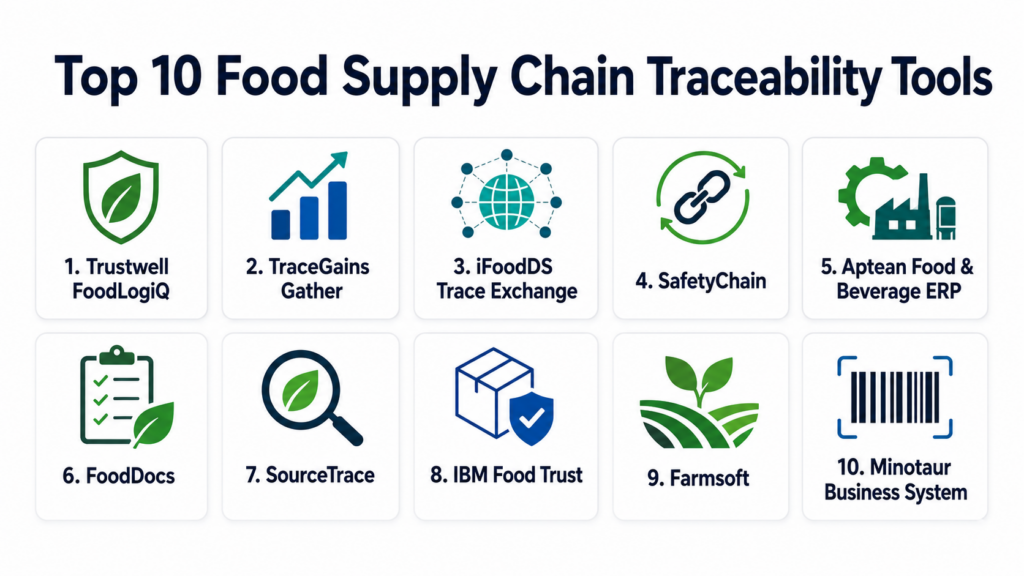
Introduction
Food Supply Chain Traceability Tools help food companies track ingredients, batches, lots, suppliers, processing events, shipments, storage locations, and customer destinations across the food supply chain. In simple terms, these tools help answer: where did this food come from, who handled it, which batch was affected, where did it go, and how quickly can we respond if there is a food safety issue? For food brands, retailers, restaurants, distributors, processors, and growers, traceability is now essential for recall readiness, supplier transparency, compliance, quality assurance, and customer trust.
Food traceability tools usually capture key product movement and transformation records such as receiving, cooling, transformation, shipping, lot creation, packaging, and distribution. Many modern platforms also support Critical Tracking Events and Key Data Elements, which are important for structured food traceability programs and faster response during food safety investigations.
Real World Use Cases
- Recall readiness: Quickly trace affected ingredients, lots, suppliers, facilities, shipments, and customers.
- Supplier traceability: Track grower, farm, ingredient, processor, distributor, and supplier data.
- Batch and lot tracking: Connect raw ingredients with finished food products and shipment destinations.
- Food safety investigations: Identify root causes faster during contamination, allergen, quality, or outbreak events.
- Compliance support: Maintain structured traceability records for internal audits, customer audits, and regulatory readiness.
- Farm-to-fork visibility: Track food movement from farms and suppliers through processing, warehousing, distribution, and retail.
Evaluation Criteria for Buyers
- Traceability depth: Lot, batch, ingredient, case, pallet, shipment, farm, supplier, and finished product tracking.
- Food industry fit: Support for processors, manufacturers, growers, distributors, retailers, restaurants, and foodservice.
- Recall speed: Ability to trace backward and forward quickly during food safety incidents.
- Supplier collaboration: Supplier onboarding, documentation, declarations, certificates, audits, and data sharing.
- Data capture methods: Barcode, QR code, RFID, mobile apps, supplier portals, APIs, EDI, and file uploads.
- Compliance support: Critical Tracking Events, Key Data Elements, audit trails, document retention, and reporting.
- Integration readiness: ERP, WMS, TMS, QMS, LIMS, procurement, labeling, supplier management, and food safety systems.
- Ease of use: Simple dashboards, searchable product history, exception queues, and operational workflows.
- Security controls: RBAC, SSO, encryption, audit logs, partner access, and secure supplier data exchange.
- Scalability: Ability to support multiple suppliers, facilities, product categories, countries, and transaction volumes.
Best for: Food manufacturers, processors, distributors, retailers, restaurants, foodservice companies, grocery chains, produce companies, seafood suppliers, ingredient companies, packaged food brands, and quality teams that need stronger visibility across food origin, transformation, movement, and recall workflows.
Not ideal for: Very small food businesses with simple local supply chains, companies with low-risk products and minimal distribution complexity, or teams that only need basic inventory tracking rather than full food traceability.
Key Trends in Food Supply Chain Traceability Tools
- Structured traceability data: Food companies are moving from paper records and spreadsheets to structured traceability data using event-based records.
- Critical Tracking Events and Key Data Elements: Food traceability systems increasingly support standardized event and data capture to make recall response faster and more reliable.
- Supplier data networks: Platforms are becoming more collaborative, allowing suppliers, manufacturers, distributors, retailers, and foodservice companies to share traceability data.
- Recall simulation: Companies are testing how quickly they can trace backward to source and forward to customers before an actual incident happens.
- Farm-to-fork visibility: Buyers want traceability from grower or ingredient origin through production, storage, shipping, distribution, and retail.
- Mobile data capture: Field teams, growers, warehouse users, and quality teams increasingly use mobile apps, QR codes, and scanning workflows.
- Food safety and quality convergence: Traceability is being connected with supplier management, audits, certificates, quality events, complaints, and corrective actions.
- Interoperability pressure: Food companies need traceability tools that exchange data across ERP, WMS, supplier portals, industry networks, and customer systems.
- Risk-based supplier visibility: Traceability platforms are being used to identify supplier gaps, missing records, high-risk ingredients, and incomplete chain-of-custody data.
- Consumer transparency: Some brands are using traceability data to support claims around sourcing, sustainability, authenticity, and product origin.
How We Selected These Tools
- We prioritized tools recognized for food traceability, supplier visibility, recall readiness, food safety compliance, and supply chain transparency.
- We included platforms focused on food manufacturing, ingredient supply chains, grocery retail, foodservice, agriculture, seafood, and farm-to-fork visibility.
- We evaluated ability to support lot tracking, batch tracking, supplier records, product genealogy, chain of custody, and trace-forward or trace-back workflows.
- We considered integration potential with ERP, WMS, TMS, QMS, LIMS, supplier portals, labeling tools, and food safety systems.
- We looked for tools that support collaborative data exchange between suppliers, processors, distributors, retailers, and foodservice partners.
- We considered recall management, supplier onboarding, documentation, audit support, and quality workflow capabilities.
- We avoided guessing public ratings, certifications, or pricing where details are not clearly known.
- We considered usability for food safety teams, quality teams, procurement, supply chain, plant operations, and supplier managers.
- We included both specialized food traceability tools and broader food ERP or supply chain platforms with traceability capabilities.
- The scoring is comparative and should be validated through demos, sample recall exercises, supplier data testing, and integration pilots.
Top 10 Food Supply Chain Traceability Tools
1- Trustwell FoodLogiQ
Short description:
Trustwell FoodLogiQ is a food traceability and supply chain management platform designed for food brands, retailers, restaurants, suppliers, distributors, and foodservice companies. It helps organizations capture traceability data, manage supplier relationships, prepare for recalls, and improve food safety visibility. FoodLogiQ Traceability supports the capture and organization of Critical Tracking Events and Key Data Elements, helping companies trace forward and backward across the supply chain. The platform is especially strong for businesses that need supplier collaboration, recall readiness, and structured food traceability workflows. Trustwell FoodLogiQ is best for food companies that want a dedicated traceability platform built around food safety and supply chain transparency.
Key Features
- Food traceability and supply chain visibility
- Critical Tracking Event and Key Data Element data capture
- Supplier management and documentation support
- Recall readiness and trace-forward or trace-back workflows
- Batch and lot-level traceability
- Food safety and quality data support
- Collaboration across suppliers, brands, retailers, and foodservice partners
Pros
- Strong food-industry focus with practical traceability workflows.
- Useful for recall readiness, supplier transparency, and compliance preparation.
- Good fit for companies that need structured food supply chain data.
Cons
- Supplier participation and data quality are critical for success.
- May require process redesign for companies using paper-based traceability.
- Smaller food businesses may not need the full platform depth.
Platforms / Deployment
Web
Cloud
Security & Compliance
Not publicly stated for every deployment context.
Buyers should validate SSO, RBAC, encryption, audit logs, supplier access controls, data retention, and compliance reporting needs directly.
Integrations & Ecosystem
FoodLogiQ is designed to connect food companies with suppliers and trading partners while supporting food safety and quality workflows.
- Supplier portals
- ERP systems
- WMS systems
- Food safety and quality systems
- Recall management workflows
- Reporting and compliance tools
Support & Community
Trustwell provides vendor-led support, onboarding, documentation, training, and food safety expertise. Support is especially important for supplier onboarding, traceability data mapping, recall simulation, and operational adoption.
2- TraceGains Gather
Short description:
TraceGains Gather is a networked supplier and ingredient platform for food, beverage, and dietary supplement companies. It helps companies manage supplier data, ingredient information, risk signals, compliance documentation, and supply chain collaboration. TraceGains is especially useful for brands and manufacturers that need to connect supplier transparency with traceability readiness, ingredient risk, and regulatory awareness. The platform monitors many food and consumer goods data sources and supports supply chain risk and compliance workflows across many countries. TraceGains Gather is best for companies that need supplier intelligence, ingredient visibility, and traceability readiness across a broad food supply network.
Key Features
- Supplier and ingredient network management
- Food and ingredient risk monitoring
- Supplier documentation and compliance workflows
- Traceability readiness and supplier visibility
- Regulatory and market-entry insights
- Ingredient data collaboration
- Supplier marketplace and networked data exchange
Pros
- Strong supplier network and ingredient data orientation.
- Useful for food, beverage, and supplement brands managing many suppliers.
- Good fit where traceability depends on supplier readiness and documentation.
Cons
- More supplier-network focused than factory-floor batch genealogy.
- Buyers may need additional ERP or MES traceability for plant-level records.
- Supplier engagement and data completeness are essential.
Platforms / Deployment
Web
Cloud
Security & Compliance
Not publicly stated for every deployment context.
Buyers should validate RBAC, SSO, encryption, audit logs, supplier access controls, and document retention requirements.
Integrations & Ecosystem
TraceGains Gather connects supplier data, ingredient records, regulatory intelligence, and food risk information across a networked food supply ecosystem.
- Supplier systems
- ERP and procurement tools
- Product and ingredient data systems
- Compliance documentation workflows
- Risk monitoring sources
- Reporting and analytics tools
Support & Community
TraceGains provides onboarding, customer support, supplier network assistance, documentation, and industry-specific guidance. Support is valuable for supplier engagement, document management, and traceability readiness programs.
3- iFoodDS Trace Exchange
Short description:
iFoodDS Trace Exchange is a food traceability platform focused on helping food supply chain participants capture, manage, and share traceability data. It is especially relevant for growers, shippers, packers, processors, distributors, retailers, and foodservice companies that need structured product movement records. The platform is designed around traceability data sharing and food supply chain collaboration, making it useful where multiple parties must exchange product history. iFoodDS is also recognized in food safety, quality, and traceability programs. It is best for food businesses that need practical traceability workflows across complex produce, fresh food, and multi-party supply chains.
Key Features
- Food supply chain traceability data management
- Trace-forward and trace-back workflows
- Supplier and trading partner data exchange
- Critical tracking event support
- Product movement and lot tracking
- Recall and investigation support
- Food safety and quality workflow alignment
Pros
- Strong fit for fresh food, produce, and multi-party supply chains.
- Useful for structured traceability data exchange across trading partners.
- Practical for companies preparing for stronger traceability expectations.
Cons
- Partner participation is essential to get full visibility.
- Buyers should validate integrations with existing ERP, WMS, and supplier systems.
- Some companies may need additional plant-level production genealogy tools.
Platforms / Deployment
Web
Cloud
Security & Compliance
Not publicly stated.
Buyers should validate user permissions, partner access, encryption, audit logs, data retention, and compliance evidence requirements.
Integrations & Ecosystem
iFoodDS Trace Exchange is designed for food supply chains where traceability depends on collaboration between growers, distributors, retailers, and foodservice partners.
- Supplier and grower systems
- ERP and WMS systems
- Retail and foodservice workflows
- Recall management workflows
- Food safety data systems
- Reporting and traceability dashboards
Support & Community
iFoodDS provides vendor-led support, onboarding, food safety guidance, and traceability program assistance. Support is important for trading partner enablement and traceability data standardization.
4- SafetyChain
Short description:
SafetyChain is a food safety, quality, and plant operations platform that helps food and beverage companies manage quality checks, audits, compliance records, production data, and operational visibility. While it is broader than traceability alone, it can support traceability-related workflows by capturing quality and production records connected to batches, lots, suppliers, and processes. The platform is useful for food manufacturers that need digital records, plant-floor quality data, compliance workflows, and audit readiness. SafetyChain is best for food and beverage companies that want traceability connected with quality management and production execution.
Key Features
- Food safety and quality management workflows
- Digital plant records and operational data capture
- Audit and compliance documentation
- Batch, lot, and quality record support
- Supplier and production quality visibility
- Corrective action and exception workflows
- Dashboards for food safety and operations teams
Pros
- Strong fit for food quality, safety, and compliance workflows.
- Useful for replacing paper records with digital operational visibility.
- Helps connect traceability with plant-level quality data.
Cons
- Not a pure end-to-end supply chain traceability network.
- May require ERP or WMS integration for full supply chain movement records.
- Best value depends on plant adoption and process discipline.
Platforms / Deployment
Web / Mobile
Cloud
Security & Compliance
Not publicly stated for every deployment context.
Buyers should validate RBAC, SSO, encryption, audit logs, electronic records, and compliance reporting controls.
Integrations & Ecosystem
SafetyChain can connect food safety, quality, and plant operations data with broader business and traceability systems.
- ERP systems
- QMS workflows
- Production systems
- Supplier documentation
- Audit and compliance tools
- Reporting dashboards
Support & Community
SafetyChain provides vendor-led support, onboarding, documentation, training, and food safety workflow expertise. Support is especially useful when digitizing paper-based quality and plant records.
5- Aptean Food & Beverage ERP
Short description:
Aptean Food & Beverage ERP is an industry-focused ERP platform with traceability, recipe, inventory, quality, compliance, and production management capabilities for food and beverage businesses. It can help companies track ingredients, allergens, lots, batches, finished goods, and production events from receiving through manufacturing and distribution. Aptean’s food manufacturing capabilities include ingredient-level traceability and allergen management, which are important for food safety and recall readiness. The platform is best for food manufacturers that want traceability embedded directly into ERP, inventory, production, and quality workflows.
Key Features
- Food and beverage ERP workflows
- Ingredient, batch, and lot traceability
- Allergen management support
- Recipe and formula management
- Inventory and production control
- Quality and compliance workflows
- Recall and product history support
Pros
- Strong fit for food manufacturers needing ERP plus traceability.
- Useful for ingredient, allergen, batch, and production tracking.
- Good option when traceability must connect with inventory and finance.
Cons
- Not just a standalone traceability tool, so implementation may be broader.
- May require process change across production, inventory, and quality teams.
- Supplier-network traceability may need additional integrations.
Platforms / Deployment
Web / Windows options may vary
Cloud / Self-hosted / Hybrid options may vary
Security & Compliance
Not publicly stated for every deployment context.
Buyers should validate RBAC, SSO, encryption, audit logs, data retention, and compliance requirements.
Integrations & Ecosystem
Aptean Food & Beverage ERP connects traceability with core food manufacturing operations, inventory, production, quality, and business processes.
- Inventory systems
- Production workflows
- Quality management processes
- Warehouse operations
- Procurement and supplier data
- Finance and reporting systems
Support & Community
Aptean provides industry-focused support, documentation, implementation services, and food manufacturing expertise. Support is important for recipe, batch, allergen, and recall workflow configuration.
6- FoodDocs
Short description:
FoodDocs is a food safety management platform designed to help food businesses create digital food safety systems, manage tasks, monitor compliance, and organize food safety records. It is more lightweight than large enterprise traceability suites, making it practical for restaurants, foodservice operators, small manufacturers, catering businesses, and growing food companies. FoodDocs can support traceability-related documentation, supplier records, temperature logs, task checks, and compliance routines. It is best for small and mid-sized food businesses that need simple digital food safety and traceability recordkeeping without a heavy enterprise implementation.
Key Features
- Digital food safety management workflows
- Food safety task management and checklists
- Supplier and record documentation support
- Temperature monitoring and log management
- Compliance and audit preparation workflows
- Mobile-friendly operational data capture
- Useful for restaurants, foodservice, and smaller food businesses
Pros
- Easy to adopt for small and mid-sized food businesses.
- Useful for digitizing food safety records and daily compliance tasks.
- Practical alternative to paper logs and spreadsheets.
Cons
- Not designed for deep enterprise supply chain traceability.
- May not cover complex multi-site manufacturing genealogy.
- Larger food companies may need more advanced integrations and partner data exchange.
Platforms / Deployment
Web / Mobile
Cloud
Security & Compliance
Not publicly stated.
Buyers should validate user access controls, encryption, audit logs, data retention, and compliance reporting requirements.
Integrations & Ecosystem
FoodDocs is useful for food safety operations where teams need digital records, checklists, and compliance workflows.
- Supplier records
- Food safety logs
- Temperature monitoring workflows
- Audit preparation records
- Mobile operations
- Reporting dashboards
Support & Community
FoodDocs provides onboarding resources, customer support, templates, and food safety guidance. Support is especially helpful for smaller teams moving from paper-based systems to digital food safety workflows.
7- SourceTrace
Short description:
SourceTrace is a food and agriculture traceability platform focused on farm-to-retail visibility, provenance tracking, field data capture, and chain-of-custody records. It helps organizations track farmer information, farm locations, harvest data, storage, logistics, quality, and supply chain movement. The platform is especially useful for agribusinesses, cooperatives, exporters, food brands, and organizations that need origin-level traceability. SourceTrace is best for food supply chains where farm data, producer visibility, and agricultural sourcing transparency are essential.
Key Features
- Farm-to-retail traceability
- Farmer and farm profile management
- Harvest, storage, and logistics data capture
- Mobile field data collection
- Chain-of-custody visibility
- Quality and compliance record support
- Reporting for agriculture and food supply chains
Pros
- Strong fit for agriculture and farm-origin traceability.
- Useful for distributed field operations and producer-level visibility.
- Good option for food companies requiring provenance data.
Cons
- Less suitable for restaurant-only or simple warehouse traceability.
- Field adoption and mobile data quality are critical.
- Buyers should validate offline access and local operating requirements.
Platforms / Deployment
Web / Mobile
Cloud
Security & Compliance
Not publicly stated.
Buyers should validate mobile security, RBAC, encryption, audit logs, data privacy, and partner access controls.
Integrations & Ecosystem
SourceTrace connects growers, farm operations, sourcing teams, storage locations, logistics workflows, and downstream food supply chain records.
- Mobile field apps
- ERP systems
- Supplier and farmer data
- Logistics and storage records
- Certification workflows
- Analytics and reporting tools
Support & Community
SourceTrace provides support, implementation guidance, agriculture supply chain expertise, and field onboarding assistance. Support is important when training field users and supplier networks.
8- IBM Food Trust
Short description:
IBM Food Trust is a blockchain-based food traceability platform designed to improve food supply chain transparency, traceability, and data sharing between ecosystem participants. It helps companies share product movement and provenance data across the supply chain using a permissioned network model. The platform is especially relevant where multiple independent organizations need shared visibility into food origin, handling, and movement. IBM Food Trust is best for food companies, retailers, growers, and supply chain participants that want network-based traceability and trusted data exchange.
Key Features
- Blockchain-based food traceability network
- Product origin and movement visibility
- Permissioned data sharing between supply chain participants
- Trace-forward and trace-back workflows
- Supplier and partner collaboration
- Product journey and provenance records
- Support for multi-party supply chain transparency
Pros
- Strong fit for multi-party food supply chain transparency.
- Useful where trusted data sharing across partners is important.
- Can support consumer trust and provenance programs.
Cons
- Blockchain is not necessary for every traceability use case.
- Network value depends on partner participation and data quality.
- Buyers should validate current ecosystem fit and integration requirements.
Platforms / Deployment
Web
Cloud
Security & Compliance
Not publicly stated for every deployment context.
Buyers should validate identity controls, partner permissions, encryption, audit logs, and governance model.
Integrations & Ecosystem
IBM Food Trust is designed for food supply chains where data must be shared across multiple companies, suppliers, retailers, and logistics partners.
- Supplier data systems
- ERP and product data systems
- Retail and distribution workflows
- Logistics data feeds
- Consumer transparency systems
- Reporting and provenance tools
Support & Community
IBM provides enterprise support, implementation resources, documentation, and partner ecosystem support. Success depends on partner onboarding, data-sharing agreements, and clear traceability goals.
9- Farmsoft
Short description:
Farmsoft is a fresh produce software platform that supports packing, inventory, traceability, quality control, warehousing, and dispatch workflows for packhouses, growers, and fresh produce distributors. It helps fresh food businesses manage product movement from receiving through packing, storage, shipping, and customer delivery. The platform is especially relevant for fruit, vegetable, and fresh produce operations where lot traceability, quality, packing records, and shipment visibility are critical. Farmsoft is best for produce packers and fresh food businesses that need operational traceability linked with packing and warehouse execution.
Key Features
- Fresh produce traceability
- Packing and packhouse management
- Lot, pallet, and inventory tracking
- Quality control workflows
- Warehouse and dispatch management
- Customer and shipment traceability
- Reporting for fresh produce operations
Pros
- Strong fit for fresh produce packhouses and growers.
- Useful for lot, pallet, and shipment-level traceability.
- Good option for operational teams managing packing and dispatch.
Cons
- Best suited for fresh produce rather than all food categories.
- Buyers should validate integration with accounting, ERP, and customer systems.
- May not cover broad enterprise supplier-network traceability needs.
Platforms / Deployment
Web / Mobile options may vary
Cloud
Security & Compliance
Not publicly stated.
Buyers should validate user permissions, encryption, audit logs, data retention, and compliance reporting requirements.
Integrations & Ecosystem
Farmsoft connects produce receiving, packing, inventory, quality, storage, and dispatch workflows.
- Packing operations
- Warehouse workflows
- Inventory systems
- Quality checks
- Customer order workflows
- Reporting tools
Support & Community
Farmsoft provides vendor-led support, onboarding, documentation, and fresh produce workflow guidance. Support is particularly useful for configuring packhouse and dispatch processes.
10- Minotaur Business System
Short description:
Minotaur Business System is a food manufacturing ERP and traceability platform designed for food processors and manufacturers that need inventory, production, lot tracking, quality, compliance, and recall support. It helps food businesses manage product formulas, ingredients, batches, inventory movements, production records, and customer shipments. The platform is practical for food manufacturers that want business operations and traceability in one system. Minotaur is best for small and mid-sized food processors needing ERP-style traceability, batch control, and recall readiness without adopting a very large enterprise suite.
Key Features
- Food manufacturing ERP workflows
- Ingredient, batch, and lot tracking
- Production and formula management
- Inventory and warehouse visibility
- Quality and compliance record support
- Recall and product history reporting
- Customer and shipment traceability
Pros
- Practical for food processors and small to mid-sized manufacturers.
- Useful for connecting traceability with inventory, production, and quality.
- Good option for teams needing operational control without enterprise complexity.
Cons
- May not provide the same supplier-network depth as specialized traceability platforms.
- Larger enterprises may need more advanced integrations and scalability.
- Buyers should validate deployment, reporting, and regional support needs.
Platforms / Deployment
Web / Windows options may vary
Cloud / Self-hosted options may vary
Security & Compliance
Not publicly stated.
Buyers should validate RBAC, encryption, audit logs, backup controls, access permissions, and compliance recordkeeping.
Integrations & Ecosystem
Minotaur connects traceability with food manufacturing operations, inventory, production, formulas, and customer shipments.
- Inventory workflows
- Production and batch records
- Quality control records
- Customer order systems
- Accounting and finance workflows
- Reporting tools
Support & Community
Minotaur provides vendor-led support, onboarding, documentation, and food manufacturing workflow assistance. Support is especially valuable for configuring batch, formula, and recall workflows.
Comparison Table
| Tool Name | Best For | Platform Supported | Deployment | Standout Feature | Public Rating |
|---|---|---|---|---|---|
| Trustwell FoodLogiQ | Food brands, retailers, foodservice, and suppliers | Web | Cloud | Critical Tracking Event and Key Data Element traceability | |
| TraceGains Gather | Supplier and ingredient network visibility | Web | Cloud | Supplier data, risk, and ingredient intelligence | |
| iFoodDS Trace Exchange | Multi-party food supply chain traceability | Web | Cloud | Traceability data sharing across food supply chain partners | |
| SafetyChain | Food safety, quality, and plant records | Web / Mobile | Cloud | Quality and food safety workflows connected with traceability | |
| Aptean Food & Beverage ERP | Food manufacturers needing ERP plus traceability | Web / Windows varies | Cloud / Self-hosted / Hybrid varies | Ingredient, allergen, batch, and production traceability | |
| FoodDocs | Small food businesses and foodservice compliance | Web / Mobile | Cloud | Simple digital food safety and recordkeeping | |
| SourceTrace | Agriculture and farm-origin traceability | Web / Mobile | Cloud | Farm-to-retail provenance and field data capture | |
| IBM Food Trust | Network-based food supply chain transparency | Web | Cloud | Blockchain-based food traceability network | |
| Farmsoft | Fresh produce packhouses and growers | Web / Mobile varies | Cloud | Fresh produce packing, inventory, and dispatch traceability | |
| Minotaur Business System | Small and mid-sized food processors | Web / Windows varies | Cloud / Self-hosted varies | Food manufacturing ERP with batch and recall traceability |
Evaluation & Scoring of Food Supply Chain Traceability Tools
| Tool Name | Core 25% | Ease 15% | Integrations 15% | Security 10% | Performance 10% | Support 10% | Value 15% | Weighted Total |
|---|---|---|---|---|---|---|---|---|
| Trustwell FoodLogiQ | 9.4 | 8.2 | 8.7 | 8.0 | 8.8 | 8.8 | 8.3 | 8.70 |
| TraceGains Gather | 8.8 | 8.3 | 8.5 | 8.0 | 8.4 | 8.6 | 8.4 | 8.45 |
| iFoodDS Trace Exchange | 8.8 | 8.1 | 8.3 | 7.8 | 8.5 | 8.5 | 8.3 | 8.40 |
| SafetyChain | 8.4 | 8.5 | 8.1 | 8.0 | 8.3 | 8.6 | 8.3 | 8.35 |
| Aptean Food & Beverage ERP | 8.7 | 7.8 | 8.5 | 8.0 | 8.5 | 8.5 | 8.0 | 8.35 |
| FoodDocs | 7.6 | 9.0 | 7.2 | 7.5 | 7.8 | 8.2 | 8.8 | 8.02 |
| SourceTrace | 8.2 | 8.0 | 7.8 | 7.5 | 8.0 | 8.2 | 8.5 | 8.04 |
| IBM Food Trust | 8.4 | 7.6 | 8.4 | 8.2 | 8.2 | 8.4 | 7.8 | 8.20 |
| Farmsoft | 8.0 | 8.2 | 7.6 | 7.5 | 8.0 | 8.0 | 8.5 | 8.00 |
| Minotaur Business System | 8.0 | 8.0 | 7.8 | 7.5 | 8.0 | 8.1 | 8.4 | 8.02 |
These scores are comparative and should be interpreted based on food category, supply chain complexity, and compliance maturity. Food brands and retailers may prioritize supplier collaboration and traceability data exchange. Manufacturers may prioritize batch, ingredient, allergen, and production traceability. Growers and fresh produce companies may prioritize field-level and packhouse traceability. Restaurants and smaller foodservice teams may prioritize ease of use and daily food safety recordkeeping.
Which Food Supply Chain Traceability Tool Is Right for You?
Solo / Freelancer
Solo food safety consultants and independent compliance advisors usually do not need a full traceability platform for their own operations. However, they should understand tools like FoodLogiQ, TraceGains, iFoodDS, SafetyChain, and SourceTrace when advising clients. For consulting work, the focus should be on traceability gap assessment, recall simulation, supplier data readiness, and food safety documentation. Consultants can help companies define required traceability events before selecting software.
SMB
Small and mid-sized food businesses should avoid overbuying complex enterprise platforms unless they have strong regulatory, retailer, or customer requirements. FoodDocs can be practical for smaller foodservice and food safety recordkeeping needs. Minotaur and Farmsoft may be useful for smaller food processors or fresh produce operations. SourceTrace can be strong for agriculture and farm-origin visibility. SMBs should start with the highest-risk area, such as ingredient traceability, supplier documentation, or recall readiness.
Mid-Market
Mid-market food companies often need better supplier collaboration, batch tracking, recall readiness, and integration with ERP or WMS systems. Trustwell FoodLogiQ, TraceGains Gather, iFoodDS Trace Exchange, SafetyChain, and Aptean Food & Beverage ERP are strong candidates. If the company is a manufacturer, ERP and production traceability may matter most. If it is a brand or retailer, supplier network visibility and data exchange may be more important.
Enterprise
Large food brands, retailers, restaurant chains, distributors, and foodservice networks should prioritize scalability, supplier onboarding, data governance, traceability interoperability, and recall speed. Trustwell FoodLogiQ, TraceGains Gather, iFoodDS Trace Exchange, IBM Food Trust, SafetyChain, and Aptean are strong enterprise candidates depending on use case. Enterprises may need multiple layers, such as supplier traceability, ERP lot tracking, plant quality records, and customer-facing transparency.
Budget vs Premium
Budget-sensitive teams should start with focused traceability needs such as digital logs, supplier documentation, batch tracking, or fresh produce traceability. FoodDocs, Minotaur, Farmsoft, and SourceTrace may be practical depending on the operation. Premium buyers with complex supply chains should evaluate Trustwell FoodLogiQ, TraceGains, iFoodDS, IBM Food Trust, SafetyChain, and Aptean. Premium platforms offer deeper scalability and partner collaboration but require stronger data readiness.
Feature Depth vs Ease of Use
For feature depth, Trustwell FoodLogiQ, TraceGains Gather, iFoodDS Trace Exchange, Aptean Food & Beverage ERP, and IBM Food Trust are strong options. These platforms support more complex supply chain and traceability workflows. For ease of use, FoodDocs, Farmsoft, Minotaur, and SourceTrace may be easier for smaller or specialized teams. The right choice depends on whether the primary need is supplier network traceability, plant-level traceability, farm-origin visibility, or food safety recordkeeping.
Integrations & Scalability
Food traceability tools should integrate with ERP, WMS, QMS, LIMS, supplier portals, labeling systems, temperature monitoring systems, procurement tools, and shipping systems. Integration reduces duplicate data entry and improves traceability accuracy. Scalability should include supplier count, product categories, facilities, transaction volume, and regulatory expansion. Buyers should test traceability with real ingredients, lots, shipments, and supplier records before full rollout.
Security & Compliance Needs
Food traceability platforms store sensitive supplier, product, customer, shipment, quality, and recall data. Buyers should validate RBAC, SSO, MFA, encryption, audit logs, supplier access rules, data retention, and backup policies. If external suppliers or customers access the platform, permission management becomes especially important. Food safety, quality, IT, and legal teams should review security and compliance requirements before implementation.
Frequently Asked Questions
1- What are Food Supply Chain Traceability Tools?
Food Supply Chain Traceability Tools help companies track food products, ingredients, batches, lots, suppliers, shipments, and production events across the food supply chain. They make it easier to trace products backward to their source and forward to customers or locations. These tools are used for recall readiness, food safety investigations, supplier transparency, and compliance preparation. They replace manual records with searchable digital traceability data.
2- How is food traceability different from inventory tracking?
Inventory tracking shows how much product is available and where it is stored. Food traceability goes deeper by showing origin, lot history, supplier details, processing events, movement records, and customer destinations. Inventory answers what and where, while traceability answers where it came from, what happened to it, and where it went. Food traceability is especially important when companies need to isolate affected products during recalls.
3- What pricing models are common for food traceability tools?
Pricing often depends on modules, users, suppliers, facilities, product volume, transaction volume, integrations, and support level. Some vendors offer subscription pricing, while others use enterprise pricing based on scope and implementation needs. Additional costs may include supplier onboarding, barcode or QR tools, mobile devices, ERP integration, training, and data migration. Buyers should compare total cost rather than only monthly software fees.
4- How long does implementation usually take?
Implementation time depends on supplier count, product complexity, integration requirements, facility count, and current record quality. A small foodservice operation can digitize basic records faster than a large retailer or processor connecting hundreds of suppliers. Most teams need to define traceability events, clean master data, train users, onboard suppliers, and test recall workflows. A phased rollout is usually safer than trying to trace every product at once.
5- What are common mistakes when adopting food traceability software?
A common mistake is buying software before defining which products, events, and data fields must be traced. Another mistake is ignoring supplier readiness and expecting full visibility without supplier participation. Some companies also underestimate the importance of clean lot codes, consistent product naming, and integration with existing systems. Successful adoption requires clear data standards, user training, supplier engagement, and regular traceability drills.
6- Can food traceability tools improve recall management?
Yes, food traceability tools can improve recall management by helping teams identify affected lots, suppliers, facilities, shipments, and customers faster. Instead of searching paper files or spreadsheets, teams can search digital records and trace backward or forward through the supply chain. This can reduce recall scope, improve response speed, and support better communication. However, recall performance depends on accurate and complete data.
7- Which food businesses benefit most from traceability software?
Food manufacturers, processors, retailers, restaurants, distributors, fresh produce companies, seafood suppliers, ingredient companies, and foodservice businesses benefit strongly from traceability software. Companies handling high-risk ingredients, perishable goods, allergens, complex supplier networks, or large distribution volumes usually have the strongest need. Smaller businesses can also benefit if they face customer audit pressure or want to replace paper-based food safety records.
8- What integrations should buyers look for?
Buyers should look for integrations with ERP, WMS, TMS, QMS, LIMS, supplier portals, procurement systems, labeling tools, barcode scanners, temperature monitoring systems, and business intelligence tools. Integration helps traceability data flow automatically from receiving, production, storage, shipping, and supplier workflows. Without integration, teams may rely on duplicate manual data entry, which increases errors. The most important integrations depend on the company’s operating model.
9- Is blockchain required for food traceability?
Blockchain is not required for every food traceability program. Many companies can achieve strong traceability using cloud databases, supplier portals, ERP records, barcode scanning, and audit logs. Blockchain may be useful when multiple independent parties need a shared and tamper-resistant data record, but it also adds complexity. The priority should be accurate data capture, supplier adoption, fast search, and practical recall readiness.
10- How should a company move from paper records to digital traceability?
The first step is to map current receiving, production, storage, shipping, and supplier documentation workflows. Next, the company should define required data fields, lot code rules, user responsibilities, and recall search needs. A pilot should start with one facility, product category, or supplier group. After proving that records are accurate and searchable, the company can expand to more sites, suppliers, and product lines.
Conclusion
Food Supply Chain Traceability Tools help food companies build safer, more transparent, and more responsive supply chains by tracking ingredients, suppliers, batches, lots, shipments, production records, and customer destinations. The best tool depends on your business model, food category, supplier network, facility complexity, and compliance requirements. Trustwell FoodLogiQ, TraceGains Gather, and iFoodDS Trace Exchange are strong choices for structured food supply chain traceability and supplier collaboration. SafetyChain is useful when traceability must connect with food safety and quality operations, while Aptean Food & Beverage ERP is strong for manufacturers that need traceability inside ERP and production workflows. FoodDocs is practical for smaller food businesses, SourceTrace is strong for farm-origin traceability, IBM Food Trust supports network-based transparency, Farmsoft is well aligned with fresh produce operations, and Minotaur fits smaller food processors needing batch and recall traceability.

Deploying integrated agricultural distribution monitoring systems optimizes global cold-chain compliance logistics, ensuring transparent product lifecycle validation and automated safety management workflows.