MOTOSHARE 🚗🏍️
Rent Bikes & Cars Directly from Owners
Motoshare connects vehicle owners with people who need bikes and cars on rent. Owners earn from idle vehicles, and renters get flexible ride options.
Visit Motoshare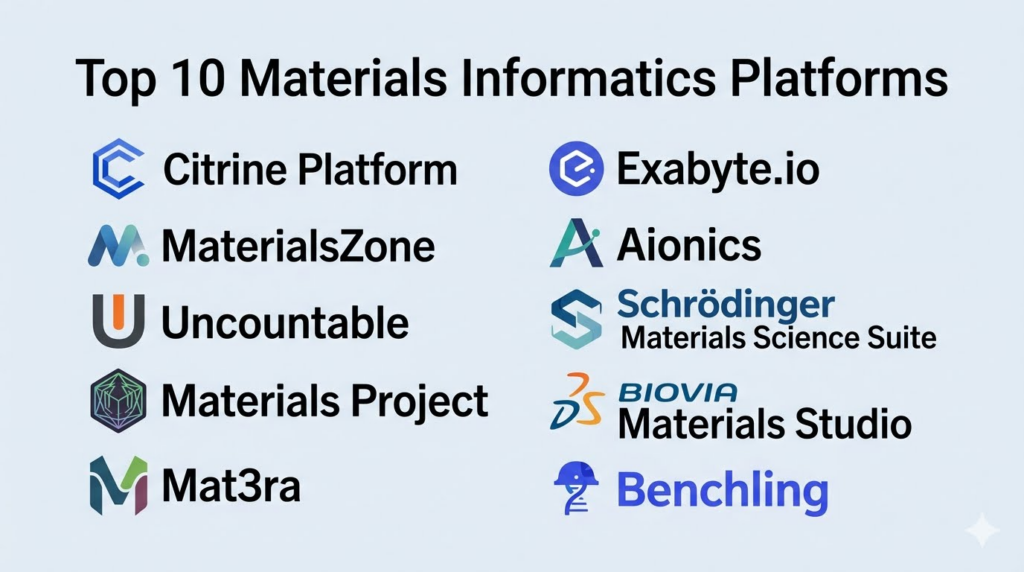
Introduction
Materials Informatics Platforms help researchers, materials scientists, R&D teams, product developers, and manufacturing organizations use data, AI, simulations, experiments, and analytics to discover, design, optimize, and manage materials faster. In simple terms, these platforms combine materials data, lab results, computational models, machine learning, structure-property relationships, and collaboration workflows so teams can make smarter decisions about materials.
This software matters because material innovation is becoming more data-driven. Companies working in batteries, semiconductors, polymers, chemicals, aerospace, automotive, energy, electronics, metals, coatings, and advanced manufacturing need faster ways to discover better-performing, safer, lighter, stronger, cheaper, and more sustainable materials. Instead of relying only on trial-and-error experiments, materials informatics platforms help teams predict properties, prioritize experiments, reduce R&D cycles, and connect scientific data across teams.
Common real-world use cases include:
- Discovering new battery, polymer, alloy, catalyst, or semiconductor materials
- Predicting material properties using machine learning and simulation data
- Managing experimental, computational, and characterization datasets
- Optimizing formulations, compositions, and process parameters
- Connecting materials R&D with lab automation and product development
What buyers should evaluate:
- Materials data management
- Machine learning and AI modeling
- Simulation and computational chemistry integration
- Experimental design and optimization
- Property prediction workflows
- Support for polymers, alloys, batteries, chemicals, catalysts, or semiconductors
- Integration with ELN, LIMS, lab instruments, and simulation tools
- Collaboration and knowledge management
- Security, IP protection, and access controls
- Ease of use for scientists and data teams
Best for: Materials R&D teams, chemical companies, battery developers, electronics manufacturers, aerospace companies, automotive suppliers, polymer companies, academic labs, national labs, semiconductor teams, and industrial innovation groups that need faster and more data-driven materials discovery.
Not ideal for: Small labs with very limited data, teams that only need simple spreadsheet tracking, organizations without enough experimental or computational data, or companies that are not ready to standardize materials data workflows.
Key Trends in Materials Informatics Platforms
- AI-driven materials discovery is becoming more practical: Materials teams are increasingly using machine learning to predict properties, suggest formulations, optimize experiments, and identify promising candidates faster.
- Data quality is becoming the foundation of success: Poorly structured experimental data, inconsistent naming, missing metadata, and disconnected files can limit AI performance, so platforms now focus heavily on clean data pipelines.
- Closed-loop R&D is gaining attention: Advanced teams are connecting AI models, experiment planning, lab automation, and results capture to create iterative discovery workflows.
- Battery materials are a major growth area: Materials informatics is being used to optimize cathodes, anodes, electrolytes, separators, solid-state materials, and degradation behavior.
- Sustainable materials development is becoming a key use case: Companies want to discover low-carbon materials, recyclable polymers, safer chemicals, and alternatives to restricted or scarce substances.
- Simulation and machine learning are becoming more connected: Platforms increasingly combine computational chemistry, molecular dynamics, density functional theory, physics-based modeling, and AI prediction.
- Formulation optimization is expanding: Polymers, coatings, adhesives, cosmetics, specialty chemicals, and food materials teams are using informatics to optimize compositions and process variables.
- Knowledge management is becoming strategic: Materials R&D teams want to preserve institutional knowledge, reduce repeated experiments, and make historical data searchable and reusable.
- Enterprise IP security is a major requirement: Materials data is highly valuable intellectual property, so buyers expect role-based access, audit logs, encryption, and strong governance.
- Interoperability with lab and data systems is now expected: Buyers want materials informatics platforms to connect with ELN, LIMS, SDMS, simulation tools, instruments, cloud data platforms, and analytics environments.
How We Selected These Tools
The tools in this list were selected using a practical buyer-focused evaluation approach:
- Market recognition in materials informatics, computational materials science, R&D data management, and AI-driven discovery
- Materials-specific capabilities rather than only generic data science platforms
- Support for machine learning, property prediction, and experiment optimization
- Ability to manage experimental, computational, and characterization data
- Fit for different industries, including batteries, polymers, chemicals, metals, semiconductors, and advanced manufacturing
- Integration potential with ELN, LIMS, lab instruments, simulation software, and analytics tools
- Collaboration and knowledge management support
- Enterprise security and intellectual property protection expectations
- Usability for scientists, informatics teams, and data scientists
- Support, documentation, onboarding, and professional services strength
Top 10 Materials Informatics Platforms
#1 — Citrine Platform
Short description:
Citrine Platform is one of the most recognized materials informatics platforms for AI-driven materials and chemicals development. It helps R&D teams organize materials data, build machine learning models, predict properties, optimize formulations, and accelerate discovery workflows. The platform is especially useful for organizations working with materials compositions, processing conditions, performance properties, and experimental outcomes. Citrine is designed for enterprise materials teams that need a structured way to turn historical and new R&D data into decision-ready insights.
Key Features
- Materials data management and structuring
- AI and machine learning model development
- Property prediction and optimization workflows
- Formulation and composition optimization
- Experiment prioritization and decision support
- Collaboration across R&D and data science teams
- Support for enterprise materials innovation programs
Pros
- Strong focus on materials and chemicals informatics
- Useful for reducing trial-and-error experimentation
- Good fit for enterprise R&D teams with valuable historical data
Cons
- Best value depends on data quality and volume
- May require onboarding support and workflow design
- Smaller teams may find it more advanced than necessary
Platforms / Deployment
Web
Cloud / Enterprise deployment options may vary
Security & Compliance
Enterprise security controls are commonly expected, but buyers should verify SSO, MFA, role-based access, encryption, audit logs, and data governance requirements directly with the vendor.
Integrations & Ecosystem
Citrine works best when connected with R&D data sources, lab systems, simulation outputs, and analytics workflows.
- ELN and LIMS systems
- Experimental datasets
- Materials property databases
- Simulation and computational data
- Data science environments
- Reporting and visualization tools
Support & Community
Citrine typically provides vendor-led onboarding, support, documentation, and professional services. Community strength is strongest among enterprise materials R&D, chemicals, and advanced manufacturing teams.
#2 — MaterialsZone
Short description:
MaterialsZone is a materials informatics platform focused on R&D data management, AI modeling, experiment planning, and materials discovery workflows. It helps teams centralize experimental data, connect results with metadata, build predictive models, and identify better materials or formulations. The platform is useful for companies working in batteries, polymers, chemicals, coatings, electronics, and advanced materials. MaterialsZone is especially valuable for teams that want to connect lab data with machine learning without building everything from scratch.
Key Features
- Materials R&D data management
- AI and machine learning model support
- Experiment planning and optimization
- Property prediction workflows
- Collaboration and data sharing
- Visualization and analytics dashboards
- Support for experimental and process data
Pros
- Strong fit for R&D teams moving from spreadsheets to informatics
- Useful for experiment optimization and materials discovery
- Practical for teams that need scientist-friendly AI workflows
Cons
- Integration depth should be validated for complex enterprise systems
- Model performance depends on data quality and completeness
- May require workflow standardization before full rollout
Platforms / Deployment
Web
Cloud
Security & Compliance
Not publicly stated in full detail. Buyers should validate SSO, MFA, RBAC, encryption, audit logs, data residency, and IP protection controls.
Integrations & Ecosystem
MaterialsZone is most valuable when connected with lab data, materials experiments, formulation records, and analytical workflows.
- ELN and LIMS platforms
- Lab instrument data
- Experimental datasets
- Formulation workflows
- Data science tools
- Reporting and dashboards
Support & Community
MaterialsZone provides vendor-led support, onboarding, and customer assistance. Community strength is focused on materials R&D and industrial innovation users.
#3 — Uncountable
Short description:
Uncountable is a materials and chemicals R&D platform designed to help teams manage experiments, formulations, properties, workflows, and data-driven product development. It is especially useful for companies working in chemicals, coatings, polymers, batteries, consumer products, food, and specialty materials. The platform combines data management, collaboration, analytics, and experiment tracking so scientists can learn from previous results and improve future experiments. Uncountable is best suited for industrial R&D teams that need a practical system for formulation and materials innovation.
Key Features
- Formulation and experiment data management
- Materials and chemicals R&D workflows
- Property tracking and performance comparison
- Collaboration across scientists and teams
- Searchable experimental knowledge base
- Analytics and optimization support
- Support for structured R&D project workflows
Pros
- Strong fit for formulation-heavy R&D teams
- Helps reduce repeated experiments and data silos
- Practical for industrial materials and chemicals development
Cons
- May not be ideal for pure computational materials science teams
- Advanced AI depth should be validated for specific needs
- Data migration from legacy spreadsheets can require effort
Platforms / Deployment
Web
Cloud
Security & Compliance
Not publicly stated in full detail. Buyers should verify SSO, MFA, role-based access, encryption, audit logs, and enterprise data protection controls.
Integrations & Ecosystem
Uncountable works well when R&D teams need to connect formulation data, experimental results, project workflows, and reporting.
- ELN and lab data systems
- Formulation databases
- Experimental records
- Analytics and reporting workflows
- Laboratory testing data
- Product development systems
Support & Community
Uncountable provides vendor support, implementation assistance, training, and customer success resources. Community strength is strongest among industrial R&D and formulation teams.
#4 — Materials Project
Short description:
Materials Project is a widely used materials data and discovery platform that provides computational materials data, property information, crystal structures, and screening workflows. It is especially useful for researchers, universities, national labs, and companies that need access to computational materials data for discovery and analysis. While it is not a full enterprise R&D workflow platform, it is highly valuable as a data resource for materials informatics and computational screening. Materials Project is best suited for teams doing research, early-stage materials discovery, computational materials science, and academic work.
Key Features
- Computational materials database
- Crystal structure and property data
- Materials screening and comparison
- API access for data-driven workflows
- Support for computational discovery
- Useful reference data for AI modeling
- Research and educational materials support
Pros
- Strong open materials data resource
- Useful for research and early discovery
- Good fit for computational materials science workflows
Cons
- Not a full enterprise materials R&D management platform
- Experimental workflow management is limited
- Commercial users may need additional internal systems
Platforms / Deployment
Web / API
Cloud-hosted public data platform
Security & Compliance
Not publicly stated for enterprise private R&D workflows. Since it is primarily a public data platform, buyers should not treat it as a private enterprise IP management system without additional controls.
Integrations & Ecosystem
Materials Project is commonly used with computational workflows, data science environments, and materials screening pipelines.
- Python and data science tools
- Computational materials workflows
- Machine learning pipelines
- Crystal structure visualization tools
- Academic research workflows
- Materials screening systems
Support & Community
Materials Project has strong academic and research community support, documentation, examples, and public resources. Enterprise-style support may vary.
#5 — Mat3ra
Short description:
Mat3ra is a materials modeling and informatics platform focused on computational materials science, simulations, workflows, data management, and collaboration. It helps teams run and manage computational experiments, organize simulation results, and accelerate materials discovery through cloud-based workflows. The platform is especially useful for researchers and companies working with electronic materials, batteries, semiconductors, nanomaterials, and advanced materials. Mat3ra is best suited for teams that need a computational materials platform rather than only experimental data management.
Key Features
- Computational materials modeling workflows
- Simulation setup and workflow management
- Materials data organization
- Cloud-based calculation support
- Collaboration for research teams
- Support for nanomaterials and electronic materials
- Integration with computational tools and data workflows
Pros
- Strong fit for computational materials science teams
- Useful for organizing simulation workflows and results
- Good for advanced materials, semiconductors, and battery research
Cons
- Less focused on formulation-heavy lab workflows
- Requires computational materials expertise
- Enterprise integration needs should be validated
Platforms / Deployment
Web
Cloud
Security & Compliance
Not publicly stated in full detail. Buyers should validate user access controls, encryption, IP protection, audit logs, and data governance requirements.
Integrations & Ecosystem
Mat3ra is useful where materials modeling, simulations, and computational data need to be connected and reusable.
- Computational chemistry tools
- Materials simulation software
- Cloud computing workflows
- Data science environments
- Research collaboration workflows
- Materials databases
Support & Community
Mat3ra provides documentation, technical resources, support, and specialist assistance. Community strength is strongest among computational materials science and advanced materials users.
#6 — Exabyte.io
Short description:
Exabyte.io is a cloud-based materials modeling and simulation platform designed for computational materials science, nanotechnology, semiconductors, batteries, and advanced materials research. It allows teams to run, manage, and analyze simulations in a cloud environment. The platform is useful for researchers and organizations that need scalable computational workflows without building all infrastructure internally. Exabyte.io is best suited for computational scientists, research teams, and companies that want to connect materials modeling with cloud-based simulation management.
Key Features
- Cloud materials simulation workflows
- Computational materials modeling
- Simulation setup, execution, and analysis
- Support for electronic structure and atomistic workflows
- Collaboration and project organization
- Scalable compute environment
- Data management for simulation outputs
Pros
- Strong fit for computational and simulation-heavy teams
- Useful for cloud-based materials modeling
- Reduces need for internal infrastructure setup
Cons
- Not designed primarily for experimental lab management
- Requires technical expertise in simulations
- Commercial workflow fit should be validated for specific industries
Platforms / Deployment
Web
Cloud
Security & Compliance
Not publicly stated in full detail. Buyers should verify access controls, encryption, data isolation, audit logs, and IP protection requirements.
Integrations & Ecosystem
Exabyte.io is commonly used in computational research and simulation workflows where cloud access and structured project management are important.
- Computational materials tools
- Cloud compute workflows
- Simulation datasets
- Research collaboration systems
- Data analysis environments
- Materials structure files
Support & Community
Exabyte.io provides technical support, documentation, and resources for computational materials users. Community strength is focused on researchers and simulation-focused teams.
#7 — Aionics
Short description:
Aionics is a materials informatics platform focused on AI-powered battery materials discovery and optimization. It helps teams analyze materials data, generate insights, and accelerate research into battery chemistries, electrolytes, additives, and performance behavior. The platform is especially relevant for companies working in energy storage, electric vehicles, battery R&D, and advanced electrochemical materials. Aionics is best suited for organizations that need domain-specific AI workflows for battery innovation rather than a generic data science tool.
Key Features
- AI-driven battery materials discovery
- Electrolyte and formulation optimization support
- Battery performance data analysis
- Materials property prediction workflows
- Experiment prioritization and screening
- Data-driven R&D decision support
- Domain-specific battery informatics workflows
Pros
- Strong fit for battery materials and energy storage R&D
- Useful for accelerating formulation and chemistry exploration
- Domain-specific focus can reduce generic platform setup
Cons
- Less suitable for non-battery materials teams
- Best value depends on availability of quality battery datasets
- Integration and deployment requirements should be validated
Platforms / Deployment
Web / Varies
Cloud / Enterprise options may vary
Security & Compliance
Not publicly stated in full detail. Buyers should validate enterprise access controls, encryption, IP protection, audit logs, and data governance.
Integrations & Ecosystem
Aionics is most valuable when connected with battery test data, materials datasets, experimental results, and R&D workflows.
- Battery testing data
- Electrochemical datasets
- Formulation records
- Experimental workflows
- AI and analytics pipelines
- R&D reporting systems
Support & Community
Support is typically vendor-led with domain-specific battery informatics expertise. Community visibility is more specialized and industry-focused.
#8 — Schrödinger Materials Science Suite
Short description:
Schrödinger Materials Science Suite is a computational modeling platform used for materials science, chemistry, polymers, catalysts, batteries, semiconductors, and molecular simulations. It helps teams understand molecular behavior, predict properties, design materials, and support computational discovery. While it is not only a data management platform, it plays an important role in materials informatics because simulation outputs can support AI models and experimental planning. It is best suited for R&D teams that need physics-based molecular modeling and computational materials insights.
Key Features
- Molecular and materials modeling
- Polymer, catalyst, battery, and semiconductor workflows
- Property prediction and simulation tools
- Quantum mechanics and molecular dynamics support
- Visualization and structure analysis
- Computational screening workflows
- Integration with research and data workflows
Pros
- Strong scientific modeling depth
- Useful for advanced materials and molecular design
- Supports simulation-driven discovery and property prediction
Cons
- Not a complete experimental R&D management platform
- Requires computational chemistry or materials modeling expertise
- Licensing may be expensive for smaller teams
Platforms / Deployment
Windows / Linux / macOS availability may vary
Desktop / Server / Enterprise deployment options may vary
Security & Compliance
Enterprise controls may be available depending on deployment. Buyers should verify access management, encryption, license governance, auditability, and IP protection.
Integrations & Ecosystem
Schrödinger Materials Science Suite works well in computational R&D environments where simulation supports materials discovery.
- Computational chemistry workflows
- Molecular dynamics simulations
- Quantum chemistry tools
- Data science pipelines
- Materials property datasets
- Research reporting workflows
Support & Community
Schrödinger provides technical support, documentation, training, scientific services, and a strong professional user community across chemistry and materials modeling.
#9 — BIOVIA Materials Studio
Short description:
BIOVIA Materials Studio is a modeling and simulation platform used for materials science, chemistry, polymers, catalysts, crystals, surfaces, and molecular modeling. It supports atomistic simulation, property prediction, structure visualization, and materials research workflows. Materials Studio is especially useful for researchers who need to model materials at molecular or atomic scales and connect simulation results with materials design decisions. It is best suited for industrial R&D, academic research, and advanced materials teams that need established computational modeling capabilities.
Key Features
- Molecular and atomistic materials modeling
- Polymer, crystal, catalyst, and surface modeling
- Property prediction and simulation workflows
- Quantum and molecular simulation support
- Structure visualization and analysis
- Computational research workflows
- Integration with broader BIOVIA scientific ecosystem
Pros
- Strong materials modeling and simulation depth
- Useful for polymers, catalysts, and advanced materials research
- Mature platform with broad scientific use
Cons
- Not primarily a full materials informatics workflow platform
- Requires computational expertise for advanced use
- Enterprise deployment and integration should be validated
Platforms / Deployment
Windows / Linux availability may vary
Desktop / Enterprise deployment options may vary
Security & Compliance
Not publicly stated in full detail. Buyers should verify user access controls, encryption, license governance, and enterprise security requirements.
Integrations & Ecosystem
BIOVIA Materials Studio works well in research environments where simulation, structure-property analysis, and scientific data management are important.
- BIOVIA scientific tools
- Computational chemistry workflows
- Materials databases
- Molecular simulation outputs
- Research data platforms
- Scientific reporting workflows
Support & Community
BIOVIA provides documentation, support, training, and enterprise scientific software services. Community strength is high among computational materials and molecular modeling users.
#10 — Benchling
Short description:
Benchling is a cloud-based R&D platform widely used for scientific data management, experiment tracking, collaboration, workflow management, and research documentation. While it is best known in life sciences, it can also support materials-focused R&D teams that need structured experiment records, sample tracking, workflow automation, and collaboration. Benchling is not a dedicated materials informatics prediction platform, but it can be useful as a digital R&D backbone for teams that need clean experimental data and better documentation. It is best suited for organizations that want strong lab data management before building advanced AI workflows.
Key Features
- Electronic lab notebook and experiment tracking
- Sample and inventory management
- Workflow and process management
- Collaboration and documentation
- Structured scientific data capture
- API and data platform capabilities
- Reporting and project visibility
Pros
- Strong R&D data management and collaboration
- Useful for standardizing experimental records
- Good foundation for cleaner data workflows
Cons
- Not a dedicated materials AI prediction platform
- Materials-specific workflows may require configuration
- Best fit depends on how the team structures experiments and data
Platforms / Deployment
Web
Cloud
Security & Compliance
Enterprise security controls are commonly expected, but buyers should verify SSO, MFA, RBAC, encryption, audit logs, data governance, and compliance needs.
Integrations & Ecosystem
Benchling works best when teams need structured experiment data, workflow management, and integration with broader research systems.
- ELN and lab workflows
- LIMS and sample tracking
- Instrument data workflows
- Data science pipelines
- Research collaboration systems
- APIs and reporting tools
Support & Community
Benchling provides documentation, support, customer success resources, implementation assistance, and a large scientific software user community.
Comparison Table
| Tool Name | Best For | Platform Supported | Deployment | Standout Feature | Public Rating |
|---|---|---|---|---|---|
| Citrine Platform | Enterprise materials AI and optimization | Web | Cloud / Enterprise varies | AI-driven materials property prediction | N/A |
| MaterialsZone | R&D data management and experiment optimization | Web | Cloud | Materials data and AI workflow platform | N/A |
| Uncountable | Formulation and industrial R&D workflows | Web | Cloud | Formulation and experiment knowledge management | N/A |
| Materials Project | Research and computational materials discovery | Web / API | Cloud-hosted public platform | Large computational materials database | N/A |
| Mat3ra | Computational materials modeling workflows | Web | Cloud | Simulation workflow and data management | N/A |
| Exabyte.io | Cloud-based materials simulations | Web | Cloud | Scalable computational materials simulation | N/A |
| Aionics | Battery materials informatics | Web varies | Cloud / Enterprise varies | AI-powered battery materials discovery | N/A |
| Schrödinger Materials Science Suite | Molecular and materials modeling | Windows / Linux / macOS varies | Desktop / Server / Enterprise varies | Physics-based materials simulation | N/A |
| BIOVIA Materials Studio | Atomistic and molecular materials modeling | Windows / Linux varies | Desktop / Enterprise varies | Molecular and atomistic materials simulation | N/A |
| Benchling | Scientific R&D data management | Web | Cloud | Structured experiment and workflow management | N/A |
Evaluation & Scoring of Materials Informatics Platforms
| Tool Name | Core 25% | Ease 15% | Integrations 15% | Security 10% | Performance 10% | Support 10% | Value 15% | Weighted Total 0–10 |
|---|---|---|---|---|---|---|---|---|
| Citrine Platform | 9.3 | 8.0 | 8.5 | 8.4 | 8.7 | 8.6 | 8.0 | 8.54 |
| MaterialsZone | 8.8 | 8.4 | 8.1 | 8.0 | 8.4 | 8.2 | 8.3 | 8.35 |
| Uncountable | 8.7 | 8.5 | 8.0 | 8.1 | 8.3 | 8.3 | 8.4 | 8.36 |
| Materials Project | 8.0 | 8.2 | 8.8 | 7.4 | 8.5 | 8.6 | 9.0 | 8.32 |
| Mat3ra | 8.4 | 7.8 | 8.3 | 7.8 | 8.5 | 8.0 | 8.2 | 8.19 |
| Exabyte.io | 8.3 | 7.9 | 8.2 | 7.8 | 8.6 | 8.0 | 8.2 | 8.18 |
| Aionics | 8.5 | 8.0 | 7.8 | 7.8 | 8.4 | 8.0 | 8.1 | 8.14 |
| Schrödinger Materials Science Suite | 8.8 | 7.5 | 8.4 | 8.0 | 8.8 | 8.7 | 7.8 | 8.35 |
| BIOVIA Materials Studio | 8.7 | 7.4 | 8.3 | 8.0 | 8.6 | 8.5 | 7.8 | 8.28 |
| Benchling | 8.0 | 8.8 | 8.7 | 8.8 | 8.5 | 8.7 | 8.1 | 8.49 |
These scores are comparative and based on materials informatics fit, AI and data workflow strength, usability, integration potential, security expectations, support strength, and practical buyer value. They are not public ratings. A higher score does not mean the platform is best for every organization. Teams focused on AI-driven material optimization may prefer Citrine, MaterialsZone, or Uncountable, while computational teams may prefer Mat3ra, Exabyte.io, Schrödinger, or BIOVIA. Teams that mainly need structured lab data may find Benchling more useful.
Which Materials Informatics Platform Is Right for You?
Solo / Freelancer
Independent researchers, consultants, and small computational materials specialists should prioritize affordability, usability, open data access, and workflow flexibility. Materials Project can be useful for accessing computational materials data, while DWS-style open or research-oriented workflows may be combined with Python-based analysis. Mat3ra and Exabyte.io can be useful for computational projects that need cloud-based simulation management. Solo users should avoid heavy enterprise platforms unless client requirements, data security, or project complexity justify the investment.
SMB
Small and mid-sized R&D companies should focus on platforms that improve data organization, experiment tracking, and faster decision-making without overwhelming teams. MaterialsZone, Uncountable, Benchling, Mat3ra, and Exabyte.io can be strong options depending on whether the work is experimental, formulation-heavy, or computational. Battery-focused startups may consider Aionics if their work aligns with electrochemical materials discovery. SMB buyers should prioritize fast onboarding, clear data structures, easy collaboration, and practical AI workflows.
Mid-Market
Mid-market materials, chemical, battery, polymer, and advanced manufacturing companies usually need stronger data governance, more integrations, and clearer links between experiments, properties, and product performance. Citrine Platform, MaterialsZone, Uncountable, Benchling, Schrödinger Materials Science Suite, and BIOVIA Materials Studio can all be relevant. These organizations should evaluate whether the platform supports both scientists and data teams. The best option depends on whether the main goal is formulation optimization, materials property prediction, simulation-driven discovery, or R&D knowledge management.
Enterprise
Large chemical companies, battery manufacturers, aerospace groups, semiconductor companies, automotive manufacturers, and global R&D organizations need scalable platforms with strong security, IP protection, integrations, governance, and support. Citrine Platform, Benchling, Schrödinger Materials Science Suite, BIOVIA Materials Studio, MaterialsZone, and Uncountable are strong enterprise candidates depending on workflow needs. Enterprises should evaluate SSO, MFA, RBAC, audit logs, cloud governance, data residency, API access, model governance, and integration with ELN, LIMS, simulation, and enterprise data platforms.
Budget vs Premium
Budget-focused buyers should avoid selecting tools only by license cost. A lower-cost or public data resource may be enough for early research, academic projects, or small computational workflows. Premium platforms can be justified when they reduce R&D cycles, prevent repeated experiments, improve property predictions, protect IP, and help teams make better materials decisions. Buyers should compare total value, including data cleanup, implementation, scientist adoption, integration cost, model accuracy, and impact on R&D productivity.
Feature Depth vs Ease of Use
Materials informatics platforms must balance scientific depth with usability. Data scientists may want flexible modeling pipelines, while bench scientists need simple experiment capture, property search, and decision support. Citrine and MaterialsZone offer stronger informatics workflows, while Uncountable and Benchling are practical for structured R&D operations. Schrödinger and BIOVIA provide deep computational modeling but require specialist expertise. The best choice depends on whether the main users are materials scientists, chemists, formulation scientists, computational researchers, or data scientists.
Integrations & Scalability
Materials informatics platforms become more valuable when they connect with ELN, LIMS, SDMS, instruments, simulation tools, databases, data lakes, analytics environments, and lab automation systems. Buyers should evaluate APIs, import/export workflows, schema flexibility, metadata handling, model governance, and data lineage. Scalability also means supporting multiple teams, projects, materials classes, test methods, property types, and historical datasets. Poor integration planning can turn a promising platform into another disconnected data silo.
Security & Compliance Needs
Materials data is often highly sensitive intellectual property. It may include proprietary formulations, experimental results, battery chemistries, polymer recipes, semiconductor materials, process parameters, simulation outputs, and product performance data. Buyers should validate role-based access, encryption, audit logs, SSO, MFA, data residency, backup policies, and IP protection. Enterprises should also define who can create, modify, approve, export, and share materials data. Strong governance is essential before scaling AI-driven materials discovery.
Frequently Asked Questions
1. What are Materials Informatics Platforms?
Materials Informatics Platforms are software systems that help teams use data, AI, simulations, and experiments to discover and optimize materials. They organize materials data, connect properties with compositions and processing conditions, and help scientists build predictive models. These platforms are used in batteries, polymers, chemicals, metals, semiconductors, aerospace, automotive, electronics, and advanced manufacturing. Their main goal is to make materials R&D faster, more structured, and more data-driven.
2. Why are Materials Informatics Platforms important?
Materials informatics platforms are important because traditional materials discovery can be slow, expensive, and heavily dependent on trial-and-error experiments. These platforms help teams learn from historical data, prioritize experiments, predict material properties, and reduce repeated work. They also help preserve institutional knowledge that may otherwise remain trapped in spreadsheets, notebooks, or individual scientists’ experience. For companies developing high-value materials, better informatics can shorten R&D cycles and improve decision quality. The value is strongest when data is well structured and actively used.
3. How much do Materials Informatics Platforms cost?
Pricing varies widely based on vendor, number of users, modules, deployment model, data volume, integrations, AI capabilities, and support needs. Some tools are enterprise platforms with custom pricing, while others are research resources or cloud simulation environments. Buyers should also budget for data cleaning, migration, model setup, training, and workflow design. The lowest software price may not be the lowest total cost if data preparation is difficult. A realistic quote should be based on actual use cases, data sources, and user roles.
4. What features should buyers prioritize first?
Buyers should prioritize features based on their R&D workflow. Experimental teams should focus on data capture, formulation tracking, property search, metadata management, and collaboration. Computational teams should prioritize simulation workflows, structure management, calculation pipelines, and data analysis. AI-focused teams should evaluate model building, property prediction, experiment optimization, and data quality tools. Enterprise teams should prioritize security, integration, governance, and scalability. The best feature set depends on whether the goal is better data management, faster discovery, or AI-driven optimization.
5. Can Materials Informatics Platforms use AI?
Yes, many materials informatics platforms use AI and machine learning to predict properties, recommend experiments, optimize formulations, classify materials, and identify promising candidates. AI can help reduce experimental search space and guide scientists toward better materials faster. However, AI performance depends heavily on data quality, data volume, metadata consistency, and scientific relevance. AI should not be treated as a magic solution. It works best when combined with expert scientific judgment, clean data workflows, and well-designed experiments.
6. What types of materials can these platforms support?
Materials informatics platforms can support many material classes, including polymers, alloys, ceramics, catalysts, coatings, batteries, electrolytes, semiconductors, composites, biomaterials, and specialty chemicals. Some platforms are broad, while others specialize in battery materials, computational modeling, formulation science, or molecular simulation. Buyers should validate whether the platform understands the data structures, properties, test methods, and workflows relevant to their material class. A platform that works well for polymers may not automatically fit semiconductors or battery electrolytes without configuration.
7. Can these platforms integrate with ELN and LIMS systems?
Yes, many materials informatics platforms can integrate with ELN, LIMS, SDMS, lab instruments, simulation tools, data lakes, and analytics environments. Integration is important because materials R&D data often comes from many different sources. Without integration, teams may still need manual uploads, duplicate entry, and spreadsheet cleanup. Buyers should validate API capabilities, data import formats, metadata mapping, user permissions, and data lineage. Strong integration helps create a reusable data foundation for AI and better R&D decisions.
8. What is the difference between materials informatics and computational materials modeling?
Materials informatics focuses on using data, machine learning, and structured workflows to discover, predict, and optimize materials. Computational materials modeling focuses on simulating materials behavior using physics-based methods such as molecular dynamics, quantum mechanics, and atomistic modeling. The two areas often work together. Simulation outputs can become training data for informatics models, and AI can help prioritize which simulations or experiments to run next. Some platforms focus more on informatics, while others focus more on simulation.
9. What are common mistakes when choosing a materials informatics platform?
A common mistake is buying an AI platform before cleaning and organizing the underlying data. Another mistake is choosing software without involving both scientists and data teams. Some organizations expect the platform to deliver results immediately without defining use cases, success metrics, or data governance. Others ignore integration with existing ELN, LIMS, simulation, and instrument systems. The best approach is to start with a clear problem, prepare representative datasets, test workflows, and run a pilot before scaling.
10. Can small R&D teams use Materials Informatics Platforms?
Yes, small R&D teams can use materials informatics platforms, but they should choose tools that match their maturity and budget. A small team may start with structured experiment management, public materials databases, or cloud simulation tools before adopting a full enterprise AI platform. The key is to avoid overcomplication. If the team has limited data, the first priority should be better data capture and organization. Once enough quality data exists, AI and optimization workflows become more valuable.
11. How do these platforms protect intellectual property?
Materials informatics platforms may protect intellectual property through access controls, role-based permissions, encryption, audit logs, secure cloud environments, data governance, and controlled sharing. Buyers should validate exactly how data is stored, who can access it, how exports are controlled, and whether activity is logged. IP protection is especially important for proprietary formulations, battery chemistries, semiconductor materials, catalysts, and manufacturing processes. Enterprises should involve legal, IT security, and R&D leadership before selecting a platform.
12. What alternatives exist to Materials Informatics Platforms?
Alternatives include spreadsheets, ELN systems, LIMS platforms, simulation software, data science notebooks, custom databases, public materials databases, and generic AI platforms. These alternatives can be useful, but they often lack materials-specific data models, property relationships, experiment optimization, and scientific workflow context. A generic machine learning tool may build models but may not understand materials metadata or R&D workflows. Dedicated materials informatics platforms are usually better when teams need structured materials data, AI prediction, collaboration, and reusable knowledge management.
Conclusion
Materials Informatics Platforms help organizations move from slow, fragmented, trial-and-error materials research to structured, data-driven, and AI-supported discovery. The best platform depends on material class, data maturity, research workflow, team size, computational needs, integration requirements, and security expectations. Citrine Platform, MaterialsZone, and Uncountable are strong choices for AI-driven materials and formulation workflows, while Materials Project, Mat3ra, and Exabyte.io are useful for computational materials research and cloud simulation. Aionics is highly relevant for battery-focused teams, while Schrödinger Materials Science Suite and BIOVIA Materials Studio provide deep molecular and atomistic modeling capabilities. Benchling is a strong option when the first priority is structured R&D data management and collaboration. Buyers should avoid searching for one universal winner and instead shortlist tools based on real datasets, scientific goals, user workflows, and IP security needs. The best next step is to define high-value use cases, prepare representative experimental or simulation data, compare three to five platforms, run a pilot with real scientists, validate integrations and security, and scale only after the platform proves measurable R&D value.
