MOTOSHARE 🚗🏍️
Rent Bikes & Cars Directly from Owners
Motoshare connects vehicle owners with people who need bikes and cars on rent. Owners earn from idle vehicles, and renters get flexible ride options.
Visit Motoshare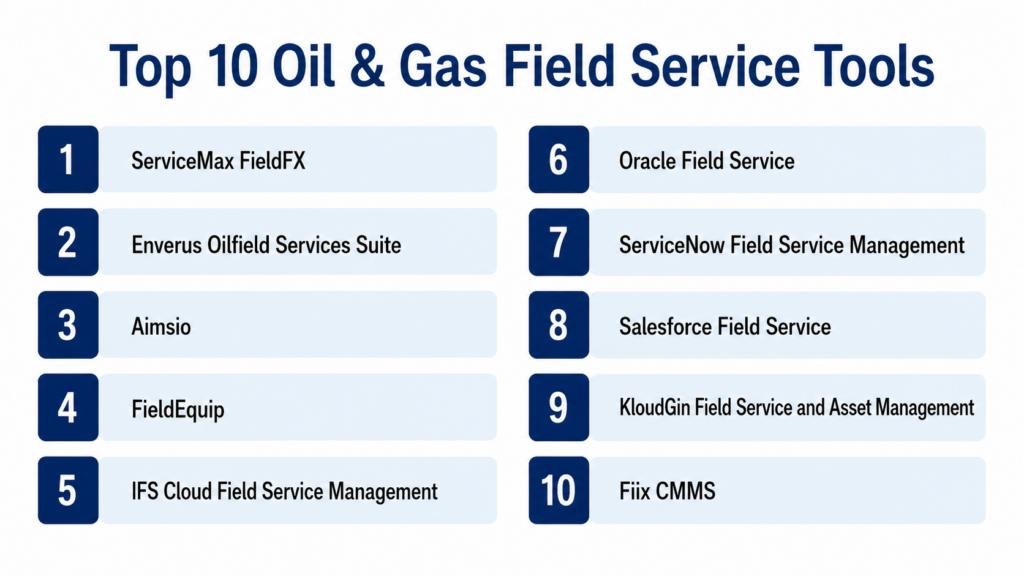
Introduction
Oil & Gas Field Service Tools help energy companies, oilfield service providers, drilling contractors, maintenance teams, and field technicians manage work happening outside the office. In plain English, these tools help schedule crews, dispatch technicians, track equipment, capture field tickets, manage safety forms, record job progress, handle approvals, and connect field activity with billing, ERP, asset management, and compliance workflows.These tools matter now because oil and gas field operations are becoming more digital, mobile, automated, and compliance-driven. Companies need better visibility into remote work, faster ticket-to-invoice cycles, safer operations, and stronger coordination between field teams and back-office teams.
Common real-world use cases include:
- Dispatching technicians to wells, rigs, pipelines, refineries, and remote assets
- Creating digital field tickets and service reports
- Managing equipment, parts, tools, and maintenance schedules
- Capturing safety forms, job site data, and customer approvals
- Connecting field work with invoicing, ERP, and asset management systems
What buyers should evaluate:
- Oilfield-specific workflows
- Offline mobile capability
- Scheduling and dispatch strength
- Digital field ticketing
- Asset and equipment tracking
- ERP and accounting integrations
- Safety and compliance forms
- Ease of use for field crews
- Security, audit logs, and role-based access
- Scalability across crews, regions, and service lines
Best for: Oilfield service companies, upstream operators, midstream service teams, equipment rental providers, maintenance contractors, drilling support teams, dispatch managers, field supervisors, finance teams, and enterprise energy organizations that need connected field-to-office workflows.
Not ideal for: Very small teams with simple job tracking needs, companies that only need basic task management, or organizations that already run field work completely inside a mature ERP, CMMS, or EAM system without needing oilfield-specific field ticketing or mobile workflows.
Key Trends in Oil & Gas Field Service Tools
- Digital field ticketing is becoming standard: Paper tickets slow down approvals, billing, and reporting. Modern tools help capture field work, signatures, equipment usage, labor, materials, and job notes directly from the field.
- Offline-first mobile apps are critical: Oil and gas crews often work in remote locations with weak or no connectivity. Strong tools support offline data capture and sync when connectivity returns.
- AI-assisted scheduling is gaining importance: Dispatch teams are using automation and intelligent recommendations to assign the right technician, equipment, and crew based on availability, location, skills, and job priority.
- Asset data is becoming more connected: Field service systems increasingly connect with EAM, CMMS, IoT, SCADA, and maintenance systems to support condition-based service and preventive maintenance.
- Safety and compliance workflows are moving into field apps: JSAs, inspections, permits, incident reports, checklists, and customer signoffs are being digitized to reduce risk and improve audit readiness.
- Integration with ERP and finance is a major buying factor: Buyers want field activity to flow into invoicing, revenue recognition, payroll, job costing, and accounting without duplicate entry.
- Platform consolidation is increasing: Large enterprises prefer field service tools that connect with broader ecosystems such as ERP, CRM, asset management, service management, and analytics platforms.
- Low-code configuration is becoming more valuable: Oil and gas workflows vary by service line, region, contract type, and customer requirements. Configurable forms, workflows, price books, and approval rules are now essential.
- Compliance, auditability, and data security expectations are rising: Buyers increasingly expect MFA, SSO, RBAC, encryption, audit logs, and strong admin controls.
- Value-based pricing pressure is growing: Buyers are comparing tools not only by license cost but also by impact on billing speed, crew utilization, rework reduction, compliance visibility, and operational efficiency.
How We Selected These Tools
The tools in this list were selected using practical buyer-focused evaluation logic:
- Market adoption and recognition in oil and gas, energy, utilities, field service, asset-intensive operations, or industrial service environments
- Feature completeness across scheduling, dispatch, mobile work execution, digital forms, ticketing, asset tracking, and reporting
- Oilfield relevance, including support for field tickets, equipment usage, job costing, safety forms, remote work, and crew-based operations
- Enterprise readiness, including scalability, admin controls, role-based access, and integration capability
- Mobile and offline usability, especially for remote field crews and technicians
- Integration ecosystem, including ERP, CRM, EAM, accounting, inventory, billing, and analytics systems
- Reliability and performance signals, including fit for high-volume work orders, multi-location operations, and field-heavy businesses
- Security posture signals, such as SSO, MFA, encryption, audit logs, and permission controls where publicly clear
- Customer fit across segments, including SMB oilfield service providers, mid-market contractors, and large enterprise energy companies
- Practical implementation fit, including configurability, onboarding complexity, partner ecosystem, and support model
Top 10 Oil & Gas Field Service Tools
#1 — ServiceMax FieldFX
Short description : ServiceMax FieldFX is one of the most oilfield-focused field service platforms in this category. It is designed for energy service companies that need digital field ticketing, job management, equipment tracking, dispatch, quote-to-cash workflows, and back-office visibility. The platform is especially useful for organizations that want to reduce paper tickets, speed up approvals, and connect field activity with billing. It supports complex oilfield workflows where crews, assets, rates, customer approvals, and job documentation must be handled accurately. FieldFX is best suited for mid-market and enterprise oilfield service providers with high-volume field operations.
Key Features
- Digital field tickets for labor, equipment, materials, and job activity
- Schedule and dispatch tools for crews, equipment, and field jobs
- Offline-capable field workflows for remote oilfield environments
- Price book and rate management for complex service billing
- Job documentation, customer approval, and field reporting
- Integration-ready workflows for invoicing and back-office systems
- Configurable forms and operational processes
Pros
- Strong fit for oilfield service companies and energy field operations
- Helps reduce billing delays and manual ticket handling
- Supports complex service lines, rate structures, and approval workflows
Cons
- May be more advanced than needed for very small contractors
- Implementation can require careful process mapping and configuration
- Best value usually comes when integrated with finance or ERP systems
Platforms / Deployment
Web / iOS / Android
Cloud / Hybrid depending on implementation
Security & Compliance
Security features vary by implementation. Common enterprise expectations include role-based access, user permissions, auditability, and secure data handling. Specific certifications should be verified with the vendor.
Integrations & Ecosystem
ServiceMax FieldFX is commonly used as part of a broader field-to-office workflow where job data must connect with billing, ERP, accounting, customer records, and operational reporting.
- ERP and accounting systems
- Billing and invoicing workflows
- Customer and contract data
- Reporting and analytics tools
- Mobile field apps
- Oilfield service operational systems
Support & Community
ServiceMax FieldFX typically fits organizations that require vendor-led implementation, onboarding, configuration support, and structured customer success. Support depth may vary based on contract, region, and partner involvement.
#2 — Enverus Oilfield Services Suite
Short description : Enverus Oilfield Services Suite is built for oilfield service companies that need digital field tickets, operational workflows, and ticket-to-invoice visibility. It is especially relevant for companies that interact with operator approval workflows and want to reduce paperwork across job completion, ticket submission, and invoicing. The platform is useful for oilfield service providers that need to manage job documentation, field activity, approvals, and cash-flow-related processes. Its strength is its industry-specific focus on oilfield ticketing and commercial workflows. It fits companies that want oilfield-focused software rather than generic field service management.
Key Features
- Digital field ticket creation and submission
- Job completion and approval workflows
- Oilfield service documentation management
- Ticket-to-invoice process support
- Integration with oil and gas commercial networks
- Field data capture from job sites
- Operational visibility for service providers
Pros
- Strong oilfield-specific workflow fit
- Helps reduce paper-based ticketing and approval delays
- Useful for companies focused on revenue leakage and billing speed
Cons
- May not replace a full enterprise FSM or ERP system
- Best fit depends on existing commercial and invoicing workflows
- Advanced customization needs should be validated before purchase
Platforms / Deployment
Web / Mobile availability varies
Cloud
Security & Compliance
Not publicly stated in full detail. Buyers should validate SSO, MFA, RBAC, encryption, audit logs, and data retention controls during procurement.
Integrations & Ecosystem
Enverus Oilfield Services Suite is most valuable when connected to back-office billing, customer approval, and accounting workflows.
- Field ticketing systems
- Invoicing and accounts receivable workflows
- Oil and gas commercial data networks
- ERP and accounting systems
- Reporting and analytics
- Customer approval processes
Support & Community
Support is typically vendor-led with onboarding and customer support depending on package and implementation scope. Community visibility is more industry-focused than open community-driven.
#3 — Aimsio
Short description :Aimsio is a field service management platform designed for industries such as oilfield services, construction, environmental services, and industrial field operations. It helps companies manage digital field tickets, timesheets, forms, job costing, dispatch, invoicing, and field documentation. Aimsio is particularly useful for service businesses that need to move from spreadsheets and paper forms to structured digital workflows. Its oilfield relevance comes from support for field tickets, equipment usage, safety forms, customer signoffs, and daily job records. It fits SMB and mid-market companies that want a practical field operations platform.
Key Features
- Digital field tickets and daily field records
- Dispatch and job scheduling workflows
- Timesheets and labor tracking
- Safety forms, checklists, and documentation
- Equipment and material usage tracking
- Invoicing and job costing support
- Mobile field data capture
Pros
- Practical fit for SMB and mid-market oilfield service companies
- Helps digitize paperwork-heavy field workflows
- Strong support for forms, tickets, and job documentation
Cons
- May require configuration for complex enterprise workflows
- Not as broad as large enterprise FSM platforms
- Integration depth should be validated for specific ERP systems
Platforms / Deployment
Web / Mobile
Cloud
Security & Compliance
Not publicly stated in full detail. Buyers should validate MFA, SSO, encryption, user permissions, audit logs, and compliance controls.
Integrations & Ecosystem
Aimsio works well when field tickets and daily operational data need to flow into administrative and financial systems.
- Accounting platforms
- ERP systems
- Payroll workflows
- Invoicing systems
- Reporting tools
- Mobile field forms
Support & Community
Aimsio generally offers vendor-led onboarding and support. Community depth is more customer and vendor-driven than large public developer-community driven.
#4 — FieldEquip
Short description : FieldEquip is a field service and asset service platform focused on equipment-heavy industries, including oilfield service operations. It helps teams manage work orders, dispatching, asset tracking, equipment utilization, service history, technician workflows, and customer service processes. The platform is useful for companies that service, rent, maintain, or deploy equipment in the field. Its configurable workflows can support oilfield-specific service processes where equipment, parts, and field crews must be tracked together. FieldEquip is best suited for companies that want a flexible field service platform with strong equipment-service orientation.
Key Features
- Work order and service request management
- Dispatch and technician assignment
- Equipment and asset tracking
- Preventive maintenance workflows
- Mobile technician workflows
- Customer and service history visibility
- Configurable forms and workflow automation
Pros
- Strong fit for equipment-centric field service operations
- Useful for managing assets, service records, and technician activity
- Flexible workflow configuration for specialized field processes
Cons
- Oilfield-specific billing workflows may need validation
- May require configuration for complex ticketing and rate structures
- Public security details should be checked during vendor review
Platforms / Deployment
Web / Mobile
Cloud
Security & Compliance
Not publicly stated in full detail. Buyers should confirm RBAC, encryption, SSO, MFA, and audit log capabilities.
Integrations & Ecosystem
FieldEquip is commonly useful where equipment service data must connect with business systems, customer records, and operational reporting.
- ERP systems
- CRM platforms
- Inventory systems
- Accounting and billing workflows
- Asset management systems
- Reporting and dashboards
Support & Community
Support appears vendor-led, with onboarding and configuration assistance depending on customer requirements. Public community presence is limited compared with large enterprise platforms.
#5 — IFS Cloud Field Service Management
Short description : IFS Cloud Field Service Management is an enterprise-grade field service platform for asset-intensive industries such as energy, utilities, manufacturing, and industrial services. It supports scheduling, dispatch, mobile work execution, workforce optimization, service contracts, asset data, parts, and service lifecycle management. For oil and gas companies, IFS is useful when field service is closely connected to assets, maintenance, inventory, contracts, and enterprise operations. It is best suited for large or complex organizations that need deep service management capabilities rather than simple job tracking. Its strength is broad enterprise field service depth.
Key Features
- Advanced scheduling and workforce optimization
- Mobile work execution for field technicians
- Asset, parts, and service lifecycle management
- Contract, warranty, and service management support
- AI-assisted optimization capabilities
- Integration with enterprise operations and asset data
- Support for complex multi-location service organizations
Pros
- Strong enterprise depth for asset-intensive operations
- Good fit for complex field service and maintenance environments
- Broad functionality beyond basic dispatch and ticketing
Cons
- May be too complex for small oilfield service providers
- Implementation can require significant planning and change management
- Pricing and deployment scope can vary widely
Platforms / Deployment
Web / Mobile
Cloud / Hybrid depending on implementation
Security & Compliance
Enterprise security capabilities are commonly expected, including role-based access, permissions, and secure cloud controls. Specific certifications and controls should be verified with the vendor.
Integrations & Ecosystem
IFS is strongest when field service needs to connect with asset management, ERP, inventory, finance, and broader enterprise systems.
- ERP and enterprise asset management
- Inventory and parts management
- Finance and billing workflows
- Service contract systems
- Analytics and reporting
- Mobile workforce tools
Support & Community
IFS typically provides enterprise support, implementation partners, documentation, and customer success services. Support depth depends on contract tier and implementation partner.
#6 — Oracle Field Service
Short description : Oracle Field Service is an enterprise field service platform used for scheduling, routing, technician enablement, workforce optimization, and service execution. It is relevant for oil and gas, utilities, energy, and asset-heavy organizations that need to dispatch technicians to remote assets, customer sites, pipelines, plants, or service locations. Oracle Field Service is strongest when connected to Oracle’s broader ecosystem, including ERP, asset, customer, and service platforms. It supports complex field operations where routing, appointment management, mobile workflows, and operational visibility are important. It is best for enterprise buyers with large-scale field teams.
Key Features
- Scheduling and route optimization
- Mobile technician work execution
- Workforce management and dispatch visibility
- Field activity tracking and updates
- Offline mobile support depending on configuration
- Integration with Oracle enterprise systems
- Analytics and operational performance monitoring
Pros
- Strong fit for large field organizations
- Good ecosystem fit for Oracle-based enterprises
- Useful for scheduling, routing, and service execution at scale
Cons
- May be too enterprise-heavy for smaller contractors
- Best results often require Oracle ecosystem alignment
- Implementation complexity can be significant
Platforms / Deployment
Web / iOS / Android
Cloud
Security & Compliance
Oracle enterprise cloud environments commonly include strong security controls such as identity management, access controls, encryption, and auditability. Buyers should validate specific compliance requirements for their deployment.
Integrations & Ecosystem
Oracle Field Service is strongest when integrated into Oracle’s broader cloud ecosystem and enterprise architecture.
- Oracle ERP and enterprise systems
- Oracle Utilities and asset systems
- CRM and customer service workflows
- Inventory and workforce systems
- IoT and asset alert workflows
- Analytics and reporting tools
Support & Community
Oracle provides enterprise-grade documentation, support options, partner ecosystem, training resources, and implementation services. Support experience depends on contract level and implementation partner.
#7 — ServiceNow Field Service Management
Short description :ServiceNow Field Service Management helps organizations manage field work through work orders, dispatching, scheduling, asset information, technician workflows, mobile execution, and service automation. For oil and gas companies, it is useful where field service connects with enterprise service management, asset maintenance, incident response, customer operations, and compliance workflows. ServiceNow is especially strong when organizations already use the Now Platform for IT, operations, risk, security, or workflow automation. It fits enterprises that want field service inside a broader workflow automation platform. It is less oilfield-specific than FieldFX but more platform-extensible.
Key Features
- Work order and task management
- Dispatch and scheduling workflows
- Mobile technician support
- Asset and service history visibility
- Workflow automation and approvals
- AI-assisted service operations depending on package
- Integration with broader ServiceNow workflows
Pros
- Strong workflow automation and enterprise platform capabilities
- Good fit for organizations already using ServiceNow
- Useful for connecting field service with operations, risk, and service management
Cons
- Oilfield-specific ticketing may need customization
- Can be expensive and complex for smaller organizations
- Requires good implementation governance to avoid over-customization
Platforms / Deployment
Web / Mobile
Cloud
Security & Compliance
ServiceNow commonly supports enterprise security controls such as SSO, MFA, role-based access, audit logs, and encryption. Specific certifications and compliance mappings should be verified during procurement.
Integrations & Ecosystem
ServiceNow has a broad integration ecosystem and is valuable when field workflows must connect with enterprise operations.
- IT service management
- Enterprise asset management
- HR, risk, security, and operations workflows
- ERP and finance systems
- APIs and integration hubs
- Reporting and dashboards
Support & Community
ServiceNow has strong enterprise documentation, training, partner support, implementation services, and a large professional ecosystem. Community support is stronger than many niche field service platforms.
#8 — Salesforce Field Service
Short description :Salesforce Field Service is a field service platform built on the Salesforce ecosystem. It supports scheduling, dispatching, technician mobile workflows, customer records, work orders, assets, service appointments, and service analytics. For oil and gas service businesses, it can be useful when customer relationship management, service contracts, field execution, and customer communication need to stay connected. It is especially suitable for companies that already use Salesforce Sales Cloud, Service Cloud, or industry-focused Salesforce solutions. It is not purely oilfield-specific, but it is highly configurable for service organizations.
Key Features
- Work order and service appointment management
- Dispatcher console and schedule optimization
- Mobile technician app
- Asset and customer record visibility
- Service contract and case connection
- Salesforce ecosystem integrations
- Reporting and dashboard capabilities
Pros
- Strong fit for Salesforce-based organizations
- Good customer-service and field-service connection
- Highly configurable for different service models
Cons
- Oilfield-specific ticketing and rate workflows may need customization
- Can become costly with multiple Salesforce products and add-ons
- Requires skilled admins or partners for advanced configuration
Platforms / Deployment
Web / iOS / Android
Cloud
Security & Compliance
Salesforce commonly provides enterprise security capabilities such as SSO, MFA, role-based access, encryption options, audit trails, and compliance controls. Specific requirements should be verified by edition and configuration.
Integrations & Ecosystem
Salesforce Field Service benefits from the Salesforce AppExchange and broader CRM ecosystem.
- Salesforce Sales Cloud and Service Cloud
- ERP and accounting systems
- Asset and inventory systems
- Customer portals
- Analytics and BI tools
- APIs and middleware platforms
Support & Community
Salesforce offers strong documentation, Trailhead learning, partner ecosystem, customer success options, and a large admin and developer community.
#9 — KloudGin Field Service and Asset Management
Short description : KloudGin provides field service, work management, and asset management capabilities for industries such as energy, utilities, construction, and infrastructure operations. It is relevant for oil and gas companies that need mobile work execution, asset inspections, maintenance workflows, scheduling, crew coordination, and compliance-oriented field documentation. KloudGin’s strength is combining field service with asset-centric work management. It can support field crews that handle distributed assets, inspections, emergency work, preventive maintenance, and operational tasks. It is best for organizations that need both field workforce and asset visibility in one system.
Key Features
- Field service and work management
- Asset inspections and maintenance workflows
- Mobile work execution
- Scheduling and crew coordination
- Digital forms and checklists
- Compliance-oriented data capture
- Analytics and operational visibility
Pros
- Strong fit for asset-heavy field operations
- Useful for energy, utilities, and infrastructure workflows
- Combines field execution with asset management context
Cons
- Oilfield-specific commercial workflows should be validated
- Public community visibility is limited compared with larger platforms
- Implementation details may vary by industry use case
Platforms / Deployment
Web / Mobile
Cloud
Security & Compliance
Not publicly stated in full detail. Buyers should validate SSO, MFA, RBAC, encryption, audit logs, and compliance controls.
Integrations & Ecosystem
KloudGin works best when connected with asset data, operational systems, and enterprise work management processes.
- ERP systems
- Asset management systems
- GIS and location systems
- Inventory and parts workflows
- Reporting and analytics
- Mobile workforce systems
Support & Community
Support is typically vendor-led with implementation assistance and customer success. Public community depth is more limited than large enterprise ecosystems.
#10 — Fiix CMMS
Short description : Fiix is a cloud-based CMMS focused on maintenance management, work orders, assets, preventive maintenance, inspections, parts, and maintenance analytics. While it is not an oilfield ticketing platform, it is highly relevant for oilfield service companies and energy operators that need to manage equipment maintenance, compliance work orders, inspections, and asset reliability. Fiix is best suited for teams that prioritize maintenance execution rather than dispatch-heavy commercial field service. It works well for maintenance teams managing pumps, compressors, vehicles, tools, facilities, and field equipment. It is a practical alternative when CMMS depth matters more than oilfield ticketing.
Key Features
- Work order management
- Preventive maintenance scheduling
- Asset and equipment tracking
- Parts and inventory support
- Maintenance request workflows
- Reporting and maintenance analytics
- Mobile maintenance execution
Pros
- Strong fit for maintenance-focused oilfield operations
- Easier to adopt than many enterprise FSM platforms
- Useful for asset reliability and preventive maintenance programs
Cons
- Not a full oilfield field-ticketing or dispatch platform
- Commercial service billing workflows may require integrations
- Best fit is maintenance management rather than end-to-end field service
Platforms / Deployment
Web / iOS / Android
Cloud
Security & Compliance
Fiix commonly supports enterprise maintenance operations with access controls and secure cloud practices. Specific security controls and compliance requirements should be verified with the vendor.
Integrations & Ecosystem
Fiix is useful when maintenance data must connect with operations, procurement, asset, and reporting workflows.
- ERP systems
- Asset management platforms
- Inventory and parts systems
- Reporting and BI tools
- Maintenance request portals
- APIs and integration platforms
Support & Community
Fiix provides documentation, support resources, onboarding assistance, and maintenance-focused learning materials. Community is stronger in the maintenance and reliability space than in oilfield-specific commercial workflows.
Comparison Table
| Tool Name | Best For | Platform(s) Supported | Deployment | Standout Feature | Public Rating |
|---|---|---|---|---|---|
| ServiceMax FieldFX | Oilfield service companies | Web, iOS, Android | Cloud / Hybrid | Oilfield digital field ticketing | N/A |
| Enverus Oilfield Services Suite | Ticket-to-invoice oilfield workflows | Web, Mobile varies | Cloud | Oilfield service ticket submission | N/A |
| Aimsio | SMB and mid-market field service teams | Web, Mobile | Cloud | Digital field tickets and forms | N/A |
| FieldEquip | Equipment-focused oilfield service businesses | Web, Mobile | Cloud | Equipment service workflow management | N/A |
| IFS Cloud Field Service Management | Enterprise asset-intensive operations | Web, Mobile | Cloud / Hybrid | Advanced scheduling and service lifecycle depth | N/A |
| Oracle Field Service | Large enterprise field workforce operations | Web, iOS, Android | Cloud | Routing, scheduling, and Oracle ecosystem fit | N/A |
| ServiceNow Field Service Management | Enterprise workflow automation | Web, Mobile | Cloud | Field service inside enterprise workflow platform | N/A |
| Salesforce Field Service | Salesforce-based service organizations | Web, iOS, Android | Cloud | CRM-connected field service | N/A |
| KloudGin Field Service and Asset Management | Asset-heavy field operations | Web, Mobile | Cloud | Field service plus asset work management | N/A |
| Fiix CMMS | Maintenance-focused oilfield operations | Web, iOS, Android | Cloud | Preventive maintenance and asset reliability | N/A |
Evaluation & Scoring of Oil & Gas Field Service Tools
| Tool Name | Core 25% | Ease 15% | Integrations 15% | Security 10% | Performance 10% | Support 10% | Value 15% | Weighted Total 0–10 |
|---|---|---|---|---|---|---|---|---|
| ServiceMax FieldFX | 9.4 | 7.8 | 8.8 | 8.4 | 8.8 | 8.5 | 8.1 | 8.62 |
| Enverus Oilfield Services Suite | 8.8 | 8.0 | 8.3 | 7.8 | 8.5 | 8.0 | 8.4 | 8.35 |
| Aimsio | 8.2 | 8.6 | 7.8 | 7.6 | 8.0 | 8.0 | 8.7 | 8.17 |
| FieldEquip | 8.1 | 8.2 | 7.7 | 7.6 | 8.0 | 7.8 | 8.2 | 7.99 |
| IFS Cloud Field Service Management | 9.2 | 7.2 | 9.0 | 8.8 | 9.0 | 8.6 | 7.6 | 8.49 |
| Oracle Field Service | 8.7 | 7.5 | 9.0 | 9.0 | 8.8 | 8.5 | 7.4 | 8.39 |
| ServiceNow Field Service Management | 8.4 | 7.7 | 9.1 | 9.0 | 8.7 | 8.7 | 7.5 | 8.38 |
| Salesforce Field Service | 8.3 | 8.0 | 9.2 | 8.8 | 8.5 | 8.8 | 7.6 | 8.38 |
| KloudGin Field Service and Asset Management | 8.0 | 8.0 | 7.8 | 7.8 | 8.0 | 7.7 | 8.1 | 7.95 |
| Fiix CMMS | 7.4 | 8.7 | 8.0 | 8.0 | 8.2 | 8.2 | 8.8 | 8.07 |
These scores are comparative and buyer-oriented, not public ratings. A higher weighted total means the tool is stronger across the selected evaluation criteria, but it does not automatically make it the best fit for every company. Oilfield-specific service providers may prioritize digital field ticketing, while enterprise operators may prioritize ERP integration, asset management, and security. SMB teams should pay close attention to ease of use, implementation effort, and price-to-value fit. Final selection should always include a pilot using real field workflows, real crews, real forms, and real integration requirements.
Which Oil & Gas Field Service Tools Tool Is Right for You?
Solo / Freelancer
Solo consultants, independent service providers, and very small field teams usually do not need a heavy enterprise field service platform. A simpler maintenance, job tracking, or field documentation tool may be enough if the work involves basic service visits, inspections, and customer updates. Fiix can be useful if the focus is equipment maintenance, while Aimsio may be more practical if digital forms, tickets, and field records are needed. The key is to avoid buying enterprise complexity before the business has enough crews, jobs, approvals, and billing volume to justify it.
SMB
SMB oilfield service companies should focus on tools that reduce paperwork, speed up field ticket approvals, and improve billing accuracy. Aimsio, FieldEquip, Enverus Oilfield Services Suite, and ServiceMax FieldFX are strong candidates depending on workflow depth. If the company needs digital field tickets, customer signoffs, equipment tracking, and job documentation, oilfield-specific platforms usually provide faster value than generic task management tools. SMB buyers should also check whether the software can integrate with their accounting or ERP system without expensive custom development.
Mid-Market
Mid-market oilfield service businesses often need a balance between oilfield workflow depth and scalable operations. ServiceMax FieldFX, Enverus Oilfield Services Suite, Aimsio, FieldEquip, and KloudGin can fit different mid-market scenarios. If revenue leakage and ticket-to-invoice delays are the main issue, prioritize FieldFX or Enverus. If equipment service, preventive maintenance, and asset tracking are more important, FieldEquip or KloudGin may be better. If the team needs maintenance discipline more than dispatch or billing workflows, Fiix may be a practical choice.
Enterprise
Enterprise oil and gas companies should evaluate platform scalability, integration depth, security, governance, and long-term architecture. IFS Cloud Field Service Management, Oracle Field Service, ServiceNow Field Service Management, Salesforce Field Service, and ServiceMax FieldFX are stronger enterprise candidates. Enterprises should run a detailed proof of concept with ERP, EAM, inventory, finance, identity management, mobile security, and reporting requirements. The best enterprise tool is usually the one that fits the existing architecture while still improving field execution.
Budget vs Premium
Budget-focused buyers should avoid selecting tools only by lowest license cost. In oil and gas field service, the real cost comes from delayed billing, missing tickets, rework, manual entry, failed integrations, and poor field adoption. A lower-cost tool may be enough for simple field records and maintenance, but premium platforms can create more value when work volume, compliance needs, and billing complexity are high. Buyers should compare total cost of ownership, implementation effort, admin workload, integration cost, and operational savings.
Feature Depth vs Ease of Use
Feature-rich platforms are valuable when field operations are complex, but they can overwhelm small teams. Field crews need simple mobile workflows, fast data entry, offline support, and minimal friction. Back-office teams need accurate job data, approvals, reporting, and billing visibility. The right tool should balance both needs. If field users reject the system, even the strongest platform will fail. During demos, buyers should test real workflows such as starting a job, adding equipment, capturing a signature, submitting a ticket, and syncing offline data.
Integrations & Scalability
Oil and gas field service tools rarely operate alone. They must connect with ERP, accounting, CRM, inventory, EAM, CMMS, payroll, BI, customer portals, and sometimes IoT or SCADA systems. Buyers should ask about APIs, middleware options, prebuilt connectors, data export, master data ownership, and integration monitoring. Scalable tools should support multiple business units, regions, currencies, rate structures, approval paths, and role-based access. Integration strategy should be planned before rollout, not after field teams are already live.
Security & Compliance Needs
Security matters because field service platforms may contain customer data, asset data, job records, pricing, safety forms, employee information, and operational details. Buyers should validate SSO, MFA, encryption, audit logs, access controls, mobile device controls, data retention, backup policies, and admin permissions. Compliance needs vary by geography, customer contracts, and operational risk. Enterprises should include IT security, legal, compliance, and operations leaders in the selection process before signing a contract.
Frequently Asked Questions
1. What are Oil & Gas Field Service Tools?
Oil & Gas Field Service Tools are software platforms that help companies manage field work across wells, rigs, pipelines, plants, yards, customer sites, and remote locations. They support scheduling, dispatching, work orders, digital field tickets, safety forms, equipment tracking, mobile data capture, and reporting. These tools help field crews record work accurately and help office teams manage approvals, billing, compliance, and operational visibility. They are especially useful in oilfield service businesses where field work directly affects revenue, safety, and customer satisfaction.
2. How much do Oil & Gas Field Service Tools cost?
Pricing varies widely based on vendor, user count, modules, deployment model, integrations, implementation scope, and support level. Some tools use subscription pricing per user or per technician, while others price by module, work volume, enterprise contract, or implementation package. Buyers should avoid focusing only on license fees because integration, configuration, training, data migration, and support can also affect total cost. The best approach is to request pricing based on real workflows, expected users, service lines, regions, and integration needs.
3. What features should buyers prioritize first?
Buyers should prioritize the workflows that create the biggest operational pain. For many oilfield service companies, that means digital field tickets, offline mobile access, customer signoffs, rate management, job documentation, and invoice readiness. For maintenance-focused teams, asset tracking, preventive maintenance, inspections, and work order visibility may be more important. Enterprise buyers should prioritize integration, security, auditability, scalability, and governance. A good selection process starts with real field scenarios rather than a generic feature checklist.
4. How long does implementation usually take?
Implementation time depends on company size, workflow complexity, number of service lines, data quality, integrations, and user training needs. A smaller company with simple digital forms and ticketing may deploy faster, while an enterprise rollout involving ERP, identity management, asset data, reporting, and multiple regions can take much longer. Buyers should plan discovery, configuration, testing, training, pilot rollout, and phased deployment. Rushing implementation often leads to poor adoption, incomplete data, and manual workarounds after go-live.
5. What are the most common mistakes when choosing a tool?
A common mistake is choosing software based only on demo appearance instead of testing real field workflows. Another mistake is ignoring offline needs, which are critical for remote oilfield work. Some buyers also underestimate integration complexity with ERP, accounting, payroll, and billing systems. Others fail to involve field crews early, leading to low adoption. The safest approach is to run a pilot with real users, real tickets, real customer approvals, and real reporting requirements before making a final decision.
6. Are these tools secure enough for oil and gas operations?
Many enterprise-grade field service tools offer strong security capabilities, but buyers should verify details instead of assuming. Important controls include MFA, SSO, role-based access, encryption, audit logs, mobile access controls, data backup, and admin permissions. Oil and gas companies should also review vendor security documentation, compliance posture, data residency options, incident response process, and contract terms. Security evaluation should include IT, compliance, legal, and operations stakeholders, especially for enterprise or regulated environments.
7. Can these tools integrate with ERP and accounting systems?
Yes, many Oil & Gas Field Service Tools can integrate with ERP, accounting, billing, CRM, EAM, CMMS, payroll, and reporting platforms. However, integration depth varies significantly by vendor and use case. Buyers should confirm whether integrations are prebuilt, API-based, middleware-driven, or custom-developed. They should also define which system owns customer data, asset data, price books, invoices, work orders, inventory, and employee data. Integration planning is one of the most important parts of a successful field service implementation.
8. Do field crews need internet access to use these tools?
Not always. Many strong field service platforms offer offline mobile functionality, which is important for oil and gas crews working in remote areas. Offline capability allows technicians to view assigned work, capture job details, complete forms, add photos, collect signatures, and submit updates when the connection returns. Buyers should test offline workflows carefully during evaluation. It is not enough for a vendor to say the app works offline; the pilot should confirm what data is available offline and how sync conflicts are handled.
9. What is the difference between field service software and CMMS?
Field service software focuses on dispatching people to jobs, managing service workflows, capturing field activity, and connecting work with customers or billing. CMMS software focuses more on maintenance management, work orders, preventive maintenance, assets, parts, and reliability. Some oil and gas companies need both. For example, an oilfield service provider may need field ticketing and dispatch, while an equipment maintenance team may need preventive maintenance and asset history. The best choice depends on whether the main problem is service execution, maintenance control, or both.
10. How do companies switch from paper tickets to digital field tickets?
Switching from paper to digital field tickets requires process mapping, form design, rate validation, mobile training, approval workflow setup, and back-office alignment. Companies should start with the most common job types and build digital forms that field crews can complete quickly. Customer approval steps, signatures, attachments, equipment usage, labor, materials, and job notes should be tested before rollout. A phased pilot is usually better than a big-bang switch. The goal is not just to remove paper but to improve accuracy, billing speed, and operational visibility.
Conclusion
Oil & Gas Field Service Tools are becoming essential for companies that want better control over field work, equipment usage, safety documentation, technician productivity, approvals, and billing accuracy. The best platform depends on the company’s operating model, not a universal ranking. ServiceMax FieldFX and Enverus Oilfield Services Suite are strong choices for oilfield-specific ticketing and commercial workflows, while IFS, Oracle, ServiceNow, and Salesforce fit enterprise organizations that need broader platform integration. Aimsio, FieldEquip, KloudGin, and Fiix offer practical options for mid-market, equipment-focused, asset-heavy, and maintenance-driven teams. Buyers should focus on real field workflows, offline capability, ERP integration, security, user adoption, and long-term scalability.
