MOTOSHARE 🚗🏍️
Rent Bikes & Cars Directly from Owners
Motoshare connects vehicle owners with people who need bikes and cars on rent. Owners earn from idle vehicles, and renters get flexible ride options.
Visit Motoshare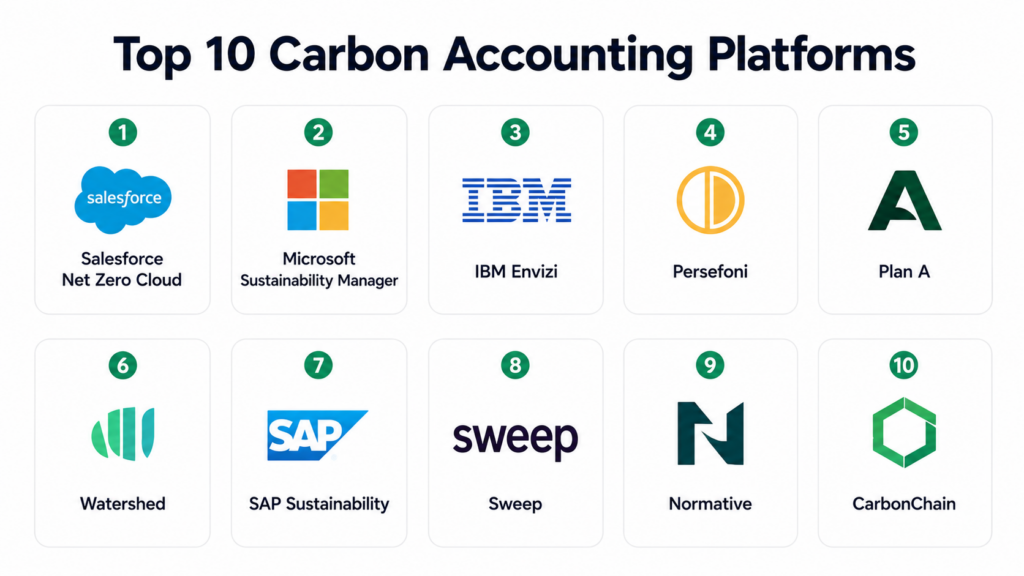
Introduction
Carbon Accounting Platforms are software systems designed to measure, track, manage, and report greenhouse gas (GHG) emissions across organizations, supply chains, and operations. These platforms convert complex activity data—such as energy usage, travel, logistics, manufacturing, and procurement—into standardized carbon emissions (CO₂e) metrics.
They are widely used by enterprises, governments, ESG teams, sustainability officers, and compliance departments to meet climate regulations, improve sustainability performance, and achieve net-zero targets.
Modern carbon accounting systems go far beyond manual spreadsheets. They use automation, AI-driven data capture, emission factor databases, IoT integration, and supply chain analytics to provide real-time carbon visibility.
Common real-world use cases include:
- Corporate ESG and sustainability reporting
- Scope 1, Scope 2, and Scope 3 emissions tracking
- Supply chain carbon footprint analysis
- Regulatory compliance (CSRD, SEC climate disclosure, etc.)
- Net-zero strategy planning and tracking
- Product-level carbon footprint calculation
Buyers evaluating Carbon Accounting Platforms should focus on:
- Accuracy of emissions calculation models
- Scope 1/2/3 coverage depth
- Integration with ERP, finance, and supply chain systems
- Automated data collection capabilities
- Emission factor database quality and updates
- Auditability and compliance reporting readiness
- AI-driven analytics and forecasting
- Supplier engagement and data collection tools
- Scalability across global operations
- Security, governance, and data transparency
Best for: Large enterprises, ESG reporting teams, manufacturing companies, financial institutions, and supply chain-heavy organizations.
Not ideal for: Small businesses with minimal emissions tracking needs or companies without regulatory ESG obligations.
Key Trends in Carbon Accounting Platforms
- AI-powered emissions estimation is reducing manual data entry
- Scope 3 supply chain tracking is becoming mandatory for enterprises
- Real-time carbon dashboards are replacing annual reporting cycles
- ERP-integrated carbon accounting is becoming standard
- Regulatory-driven ESG compliance is increasing platform adoption
- Product-level carbon tracking is gaining importance
- Automated supplier data collection is expanding rapidly
- Cloud-native ESG platforms are replacing legacy reporting tools
- Carbon intensity metrics are being embedded into financial reporting
- Climate risk analytics is merging with financial planning systems
How We Selected These Tools
The platforms listed below were selected based on ESG capabilities, emissions accuracy, enterprise adoption, and integration strength.
- Evaluated global enterprise adoption in ESG and sustainability reporting
- Assessed Scope 1, 2, and 3 emissions coverage depth
- Reviewed automation and AI-driven data capture capabilities
- Considered integration with ERP, finance, and supply chain systems
- Evaluated auditability and regulatory compliance support
- Assessed emission factor database quality and transparency
- Reviewed scalability for global organizations
- Considered supplier engagement and data collection features
- Evaluated reporting and visualization capabilities
- Reviewed vendor maturity in sustainability tech ecosystem
Top 10 Carbon Accounting Platforms
#1 — Salesforce Net Zero Cloud
Short description: Salesforce Net Zero Cloud is a leading carbon accounting and ESG management platform designed for enterprise sustainability tracking. It enables organizations to measure carbon emissions across operations, supply chains, and products. The platform integrates deeply with Salesforce CRM and enterprise systems. It is widely used for ESG reporting and net-zero strategy execution. Salesforce focuses on end-to-end sustainability data management.
Key Features
- Scope 1, 2, and 3 emissions tracking
- ESG reporting dashboards
- Supplier emissions tracking
- AI-driven carbon insights
- Automated data collection workflows
- Carbon reduction planning tools
- Integration with enterprise CRM
Pros
- Strong enterprise integration
- Comprehensive ESG coverage
- Scalable cloud platform
Cons
- Complex implementation
- High enterprise cost
- Requires Salesforce ecosystem familiarity
Platforms / Deployment
- Web / Cloud
Security & Compliance
Supports enterprise-grade encryption, RBAC, audit logs, and global ESG compliance frameworks.
Integrations & Ecosystem
- Salesforce CRM
- ERP systems
- Finance platforms
- Supply chain systems
- APIs
- Cloud data warehouses
Support & Community
Strong enterprise support and global Salesforce ecosystem.
#2 — Microsoft Sustainability Manager
Short description: Microsoft Sustainability Manager is a cloud-based carbon accounting platform that helps organizations track emissions, manage ESG data, and build sustainability reports. It integrates deeply with Microsoft Azure and enterprise data systems. The platform is widely used for regulatory ESG reporting. It is especially strong in data integration and automation. Microsoft focuses on scalable ESG intelligence.
Key Features
- Carbon emissions tracking dashboards
- ESG reporting automation
- Data ingestion from enterprise systems
- Scope 1/2/3 calculation tools
- AI-driven insights
- Emissions forecasting models
- Sustainability data visualization
Pros
- Strong Microsoft ecosystem integration
- Scalable cloud architecture
- Good ESG reporting tools
Cons
- Requires Azure dependency
- Complex configuration
- Pricing varies by usage
Platforms / Deployment
- Cloud / Web
Security & Compliance
Supports Azure security framework, encryption, RBAC, and compliance-grade governance.
Integrations & Ecosystem
- Microsoft Azure
- Power BI
- ERP systems
- IoT platforms
- APIs
- Data lakes
Support & Community
Strong enterprise cloud support ecosystem.
#3 — IBM Envizi ESG Suite
Short description: IBM Envizi is a powerful ESG and carbon accounting platform that enables organizations to track emissions, manage sustainability data, and generate regulatory reports. It is widely used in large enterprises for carbon accounting and ESG analytics. The platform is especially strong in data consolidation and Scope 3 reporting. IBM focuses on enterprise-grade ESG intelligence. Envizi supports complex sustainability data ecosystems.
Key Features
- Scope 1, 2, and 3 emissions tracking
- ESG data consolidation tools
- Automated reporting workflows
- Supplier emissions management
- Carbon performance analytics
- Data validation and auditing tools
- Sustainability dashboards
Pros
- Strong enterprise ESG capabilities
- Excellent data consolidation
- Robust reporting features
Cons
- Complex onboarding
- Enterprise-focused pricing
- Requires technical setup
Platforms / Deployment
- Web / Cloud
Security & Compliance
Supports enterprise encryption, RBAC, audit logging, and global ESG compliance frameworks.
Integrations & Ecosystem
- IBM Cloud
- ERP systems
- Finance platforms
- Supply chain tools
- APIs
- Data warehouses
Support & Community
Strong global enterprise sustainability support.
#4 — Persefoni Carbon Accounting Platform
Short description: Persefoni is a leading carbon accounting platform designed for financial-grade emissions tracking and ESG reporting. It is widely used by enterprises and financial institutions. The platform is especially strong in audit-ready carbon accounting. It focuses on transparency and regulatory compliance. Persefoni enables financial-grade climate disclosure.
Key Features
- Financial-grade carbon accounting
- Scope 1/2/3 tracking
- ESG reporting automation
- Audit-ready emissions data
- Supply chain carbon tracking
- Emissions forecasting tools
- Data validation systems
Pros
- High data transparency
- Strong audit readiness
- Good enterprise scalability
Cons
- Requires onboarding effort
- Premium pricing model
- Learning curve for users
Platforms / Deployment
- Cloud / Web
Security & Compliance
Supports enterprise-grade encryption, RBAC, audit logs, and compliance frameworks.
Integrations & Ecosystem
- ERP systems
- Finance platforms
- Supply chain tools
- APIs
- Cloud data warehouses
- ESG tools
Support & Community
Strong enterprise ESG and finance ecosystem support.
#5 — Plan A Carbon Management Platform
Short description: Plan A is a carbon accounting and decarbonization platform that helps companies measure emissions and implement reduction strategies. It combines carbon tracking with actionable sustainability insights. The platform is widely used in European ESG compliance environments. It is especially strong in carbon reduction planning. Plan A focuses on actionable climate strategy execution.
Key Features
- Emissions tracking dashboards
- Carbon reduction planning tools
- Scope 1/2/3 reporting
- ESG compliance automation
- Supplier data collection
- Sustainability scoring tools
- Decarbonization roadmaps
Pros
- Strong sustainability planning tools
- Good ESG compliance support
- Easy-to-use interface
Cons
- Limited deep customization
- Smaller ecosystem than competitors
- Requires integration setup
Platforms / Deployment
- Cloud / Web
Security & Compliance
Supports encryption, RBAC, and ESG compliance reporting standards.
Integrations & Ecosystem
- ERP systems
- Supply chain tools
- Finance systems
- APIs
- Cloud platforms
- ESG reporting tools
Support & Community
Growing enterprise ESG support ecosystem.
#6 — Watershed
Short description: Watershed is an enterprise carbon accounting platform focused on real-time emissions tracking and ESG reporting. It is widely used by global enterprises to manage sustainability programs. The platform is especially strong in Scope 3 emissions tracking. Watershed focuses on actionable carbon reduction insights. It supports fast ESG reporting workflows.
Key Features
- Real-time emissions tracking
- Scope 3 supply chain analysis
- ESG reporting dashboards
- Carbon reduction planning tools
- Supplier engagement systems
- Data automation workflows
- Sustainability analytics
Pros
- Strong Scope 3 capabilities
- Easy reporting workflows
- Good enterprise adoption
Cons
- Limited customization options
- Premium pricing
- Requires integration effort
Platforms / Deployment
- Cloud / Web
Security & Compliance
Supports enterprise encryption, RBAC, and global ESG compliance frameworks.
Integrations & Ecosystem
- ERP systems
- Finance platforms
- Supply chain tools
- APIs
- Data warehouses
- ESG systems
Support & Community
Strong enterprise sustainability support ecosystem.
#7 — SAP Sustainability Control Tower
Short description: SAP Sustainability Control Tower is a carbon accounting and ESG management platform integrated into SAP’s enterprise ecosystem. It enables organizations to track emissions and align sustainability metrics with business data. The platform is widely used by large manufacturing and enterprise organizations. It is especially strong in ERP-linked ESG reporting. SAP focuses on integrated sustainability intelligence.
Key Features
- ERP-linked carbon tracking
- ESG reporting dashboards
- Scope 1/2/3 emissions monitoring
- Sustainability KPIs tracking
- Supplier emissions data integration
- Compliance reporting tools
- Data governance controls
Pros
- Strong SAP ERP integration
- Enterprise scalability
- Reliable data governance
Cons
- Complex implementation
- SAP ecosystem dependency
- High cost
Platforms / Deployment
- Cloud / Hybrid
Security & Compliance
Supports SAP enterprise security standards, RBAC, encryption, and compliance frameworks.
Integrations & Ecosystem
- SAP ERP
- Supply chain systems
- Finance platforms
- APIs
- Cloud data systems
- ESG tools
Support & Community
Strong global enterprise SAP support ecosystem.
#8 — Sweep
Short description: Sweep is a modern carbon accounting platform that helps organizations track emissions and collaborate with suppliers for Scope 3 data collection. It is widely used in mid-market and enterprise ESG programs. The platform is especially strong in supplier engagement. Sweep focuses on collaborative carbon management. It simplifies complex ESG workflows.
Key Features
- Scope 1/2/3 emissions tracking
- Supplier engagement tools
- ESG reporting dashboards
- Carbon reduction planning
- Data automation workflows
- Emissions analytics
- Sustainability collaboration tools
Pros
- Strong supplier collaboration
- Easy ESG workflows
- Modern interface
Cons
- Smaller enterprise ecosystem
- Limited deep customization
- Requires integration setup
Platforms / Deployment
- Cloud / Web
Security & Compliance
Supports encryption, RBAC, and ESG reporting compliance standards.
Integrations & Ecosystem
- ERP systems
- Supply chain tools
- APIs
- Cloud data warehouses
- ESG platforms
- Finance systems
Support & Community
Strong growing ESG SaaS community.
#9 — Normative Carbon Accounting Platform
Short description: Normative is a carbon accounting platform focused on automated emissions calculations and compliance-grade ESG reporting. It helps companies measure and reduce carbon footprints across operations. The platform is widely used in European sustainability reporting. It is especially strong in automated carbon calculations. Normative focuses on science-based carbon accounting.
Key Features
- Automated emissions calculations
- Scope 1/2/3 reporting
- ESG compliance tools
- Supplier data integration
- Carbon footprint analytics
- Sustainability dashboards
- Reporting automation
Pros
- Strong automation features
- Good compliance alignment
- Easy reporting workflows
Cons
- Limited customization
- Smaller global ecosystem
- Requires onboarding
Platforms / Deployment
- Cloud / Web
Security & Compliance
Supports encryption, RBAC, and ESG compliance frameworks.
Integrations & Ecosystem
- ERP systems
- Finance tools
- Supply chain systems
- APIs
- ESG platforms
- Cloud systems
Support & Community
Strong European ESG support ecosystem.
#10 — CarbonChain
Short description: CarbonChain is a carbon accounting platform focused on supply chain emissions tracking and commodity-level carbon analysis. It is widely used in logistics, manufacturing, and commodity trading industries. The platform is especially strong in Scope 3 supply chain emissions. CarbonChain focuses on data-driven carbon transparency. It supports detailed emissions tracking across global supply chains.
Key Features
- Supply chain carbon tracking
- Commodity-level emissions analysis
- Scope 1/2/3 reporting
- ESG dashboards
- Supplier emissions data collection
- Carbon footprint modeling
- Regulatory reporting tools
Pros
- Strong supply chain focus
- High granularity data
- Good ESG reporting
Cons
- Complex implementation
- Industry-specific focus
- Requires integration setup
Platforms / Deployment
- Cloud / Web
Security & Compliance
Supports enterprise encryption, RBAC, and compliance-grade ESG frameworks.
Integrations & Ecosystem
- ERP systems
- Supply chain platforms
- Logistics systems
- APIs
- Cloud data warehouses
- ESG tools
Support & Community
Strong enterprise sustainability support ecosystem.
Comparison Table
| Tool Name | Best For | Platform(s) Supported | Deployment | Standout Feature | Public Rating |
|---|---|---|---|---|---|
| Salesforce Net Zero Cloud | Enterprise ESG | Web/Cloud | Cloud | CRM integration | N/A |
| Microsoft Sustainability Manager | Cloud ESG tracking | Web | Cloud | Azure integration | N/A |
| IBM Envizi | ESG reporting | Web | Cloud | Data consolidation | N/A |
| Persefoni | Financial-grade carbon | Web | Cloud | Audit-ready reporting | N/A |
| Plan A | Decarbonization | Web | Cloud | Reduction planning | N/A |
| Watershed | Scope 3 tracking | Web | Cloud | Real-time emissions | N/A |
| SAP Sustainability | ERP ESG | Web | Hybrid | ERP-linked ESG | N/A |
| Sweep | Supplier ESG | Web | Cloud | Supplier collaboration | N/A |
| Normative | Automated accounting | Web | Cloud | Auto calculations | N/A |
| CarbonChain | Supply chain carbon | Web | Cloud | Commodity tracking | N/A |
Evaluation & Scoring of Carbon Accounting Platforms
| Tool Name | Core 25% | Ease 15% | Integrations 15% | Security 10% | Performance 10% | Support 10% | Value 15% | Weighted Total |
|---|---|---|---|---|---|---|---|---|
| Salesforce Net Zero Cloud | 9.5 | 8.5 | 9.5 | 9.5 | 9.0 | 9.0 | 8.5 | 9.0 |
| Microsoft Sustainability Manager | 9.0 | 8.5 | 9.0 | 9.0 | 9.0 | 9.0 | 8.5 | 8.8 |
| IBM Envizi | 9.0 | 8.0 | 9.0 | 9.0 | 9.0 | 9.0 | 8.5 | 8.8 |
| Persefoni | 9.0 | 8.5 | 9.0 | 9.0 | 9.0 | 8.5 | 8.5 | 8.8 |
| Plan A | 8.5 | 9.0 | 8.5 | 8.5 | 8.5 | 8.5 | 8.5 | 8.6 |
| Watershed | 9.0 | 8.5 | 9.0 | 9.0 | 9.0 | 8.5 | 8.0 | 8.8 |
| SAP Sustainability | 9.5 | 7.5 | 9.5 | 9.5 | 9.0 | 9.0 | 8.0 | 8.9 |
| Sweep | 8.5 | 9.0 | 8.5 | 8.5 | 8.5 | 8.5 | 8.5 | 8.6 |
| Normative | 8.5 | 9.0 | 8.5 | 8.5 | 8.5 | 8.5 | 8.5 | 8.6 |
| CarbonChain | 8.5 | 8.0 | 8.5 | 8.5 | 8.5 | 8.5 | 8.0 | 8.4 |
Which Carbon Accounting Platform Is Right for You?
Solo / Small Organization
Normative, Sweep, and Plan A are suitable for smaller ESG teams and startups.
SMB
Watershed, Sweep, and Plan A are strong for growing sustainability programs.
Mid-Market
Persefoni, IBM Envizi, and Microsoft Sustainability Manager are ideal for scaling ESG reporting.
Enterprise
Salesforce Net Zero Cloud, SAP Sustainability, IBM Envizi, and Microsoft Sustainability Manager are best for global ESG operations.
Budget vs Premium
Budget tools focus on basic emissions tracking, while premium platforms provide audit-grade ESG reporting and AI-driven insights.
Feature Depth vs Ease of Use
Advanced systems offer deep Scope 3 tracking and ERP integration, while simpler tools focus on reporting automation.
Integrations & Scalability
Carbon platforms must integrate with ERP, finance, supply chain, IoT, and data warehouse systems.
Security & Compliance Needs
Enterprise platforms require encryption, RBAC, audit logs, and compliance with global ESG regulations.
Frequently Asked Questions
1. What is carbon accounting software?
It is a system used to measure and track greenhouse gas emissions. It converts business activity data into CO₂ equivalents. It helps organizations manage sustainability goals. It supports ESG reporting.
2. Who uses carbon accounting platforms?
Enterprises, governments, ESG teams, and sustainability officers use them. They help track emissions across operations and supply chains. They support regulatory compliance. Usage depends on sustainability goals.
3. What are Scope 1, 2, and 3 emissions?
Scope 1 refers to direct emissions, Scope 2 to indirect energy emissions, and Scope 3 to supply chain emissions. These categories define carbon footprint structure. Scope 3 is the most complex. All are important for ESG reporting.
4. Why is Scope 3 important?
It represents most of a company’s emissions. It includes suppliers and logistics. It is required in many regulations. It is critical for net-zero strategies.
5. Are these platforms automated?
Many platforms automate emissions calculations. They integrate with ERP and finance systems. AI improves accuracy. Manual input is still sometimes needed.
6. Do they support compliance reporting?
Yes, most platforms support ESG reporting standards. They align with global frameworks. They help generate audit-ready reports. Compliance support varies.
7. Can they integrate with ERP systems?
Yes, integration with ERP and finance systems is common. It improves data accuracy. It enables automated emissions tracking. It is essential for enterprises.
8. Are these tools real-time?
Some platforms offer near real-time dashboards. Others work on periodic reporting. Real-time depends on data sources. IoT improves speed.
9. What are common challenges?
Challenges include data complexity, Scope 3 tracking, integration issues, and data quality. Supplier data collection is difficult. Standardization is also a challenge. Costs can be high.
10. How to choose a platform?
Selection depends on scale, compliance needs, integration requirements, and budget. Industry type also matters. Real-world testing is important. Long-term ESG strategy should guide decisions.
Conclusion
Carbon Accounting Platforms are essential tools for organizations aiming to measure, manage, and reduce their greenhouse gas emissions in a structured and compliant way. These systems enable businesses to transform complex operational data into actionable carbon insights across Scope 1, Scope 2, and Scope 3 emissions. Enterprise leaders like Salesforce Net Zero Cloud, SAP Sustainability, IBM Envizi, and Microsoft Sustainability Manager provide deep integration and audit-ready ESG reporting, while platforms like Normative, Sweep, and Plan A offer simpler and faster decarbonization workflows. The right solution depends on organizational size, reporting complexity, and integration needs. Companies should prioritize accuracy, automation, and scalability to build effective and future-ready sustainability strategies.
