MOTOSHARE 🚗🏍️
Rent Bikes & Cars Directly from Owners
Motoshare connects vehicle owners with people who need bikes and cars on rent. Owners earn from idle vehicles, and renters get flexible ride options.
Visit Motoshare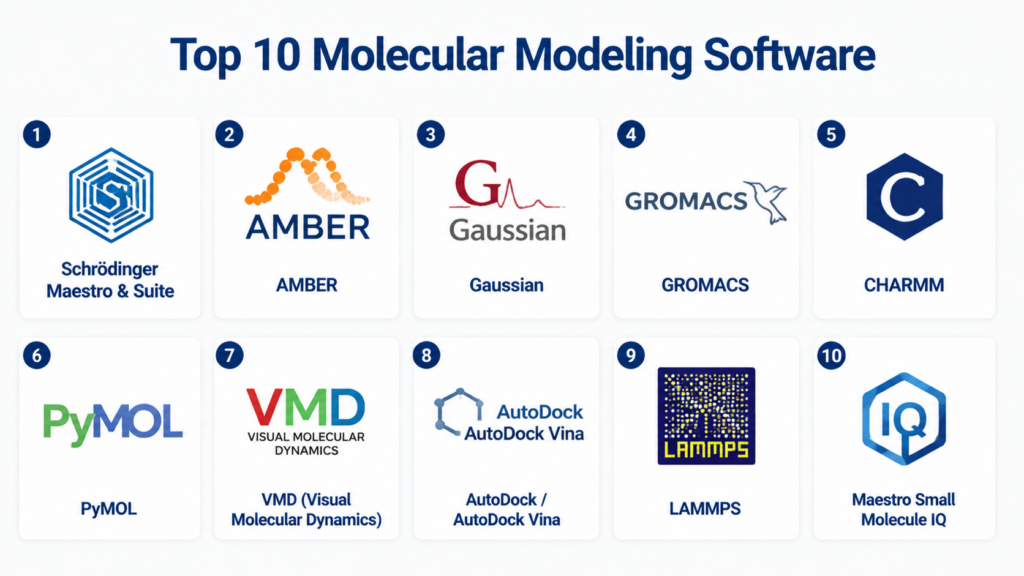
Introduction
Molecular modeling software refers to computational tools used to simulate, visualize, and analyze the structures and behaviors of molecules—ranging from small organic compounds to large biological macromolecules. These tools enable researchers to model chemical interactions, predict binding affinities, optimize candidate molecules, and explore conformational spaces, accelerating research in chemistry, biology, drug discovery, materials science, and nanotechnology.In molecular modeling has become indispensable due to advances in machine learning, high‑performance computing (HPC), cloud scale, and integration with experimental datasets. Researchers now expect real‑time predictions, intuitive visualizations, and interoperability with laboratory informatics systems like ELN, LIMS, and high‑throughput screening platforms.
Real‑world use cases:
- Predicting protein–ligand interactions and binding conformations.
- Exploring conformational energy landscapes and thermodynamics.
- Simulating molecular dynamics (MD) for macromolecules and complexes.
- Calculating physicochemical and ADME/Tox properties for small molecules.
- Optimizing lead compounds in drug discovery and materials research.
Evaluation Criteria for Buyers:
- Accuracy of force fields and quantum‑level calculations
- Support for molecular dynamics, docking, and conformational sampling
- Visualization and interactive model manipulation
- Integration with cheminformatics and bioinformatics systems
- Scalability via HPC and cloud execution
- Ease of use and scripting/customization support
- Interoperability with ELN/LIMS and screening systems
- Security and data governance features
- Licensing models (open source vs commercial)
- Support, documentation, and community activity
Best for: Computational chemists, structural biologists, medicinal chemists, materials scientists, academic researchers, and industrial R&D teams.
Not ideal for: Teams needing basic chemical drawing or simple property prediction without structural modeling needs—lighter cheminformatics tools may suffice.
Key Trends in Molecular Modeling Software
- AI‑Enhanced Predictions: Machine learning to accelerate docking, energy estimation, and conformer generation.
- Cloud‑Enabled Simulations: Cloud compute for scalable molecular dynamics and virtual screening.
- Integration with Experimental Data: Seamless links to structural biology data (cryo‑EM, NMR, X‑ray).
- Interactive Visual Analytics: Real‑time molecule manipulation and scene rendering.
- Multi‑Scale Modeling: Combined quantum mechanics/molecular mechanics (QM/MM) workflows.
- Automated Workflow Pipelines: Notebook‑style reproducibility with code + UI steps.
- High‑Performance Computing Support: GPU acceleration for large systems.
- Federated and Privacy‑Preserving Workflows: Cross‑institution collaboration without data exposure.
- Enhanced Force Fields: Improved physics models for better prediction accuracy.
- Open Ecosystems & Standards: Plugin support and open data formats for interoperability.
How We Selected These Tools (Methodology)
- Scientific credibility and accuracy of modeling engines.
- Breadth of supported computational methods (MD, docking, QM, sampling).
- Integration with experimental systems and cheminformatics platforms.
- Scalability via HPC and cloud environments.
- User experience (UI, scripting, automation).
- Security posture and data management controls.
- Community engagement and support resources.
- Suitability across research and industrial use cases.
- Extensibility via plugins/APIs.
- Licensing flexibility and value.
Top 10 Molecular Modeling Software
#1 — Schrödinger Maestro & Suite
Short description:
Schrödinger’s Maestro interface and computational suite deliver physics‑based molecular modeling, docking, dynamics, and predictive simulations for drug discovery and materials research.
Key Features
- High‑accuracy docking and scoring
- Molecular dynamics and free energy perturbation
- Quantum mechanics and hybrid QM/MM workflows
- Conformational sampling and energy landscape mapping
- Integrated visualization suite
- Workflow automation modules
Pros
- Industry‑leading physics and MD accuracy
- Scalable to large systems
- Tight integration with cheminformatics tools
Cons
- Requires training and expertise
- Licensing complexity and cost
- Resource‑intensive for large simulations
Platforms / Deployment
- Linux, Windows
- Cloud, On‑prem
Security & Compliance
- Encryption and access controls
- Not publicly stated for specific industry certifications
Integrations & Ecosystem
Schrödinger integrates with external compute and informatics platforms:
- LIMS and ELN data connectors
- HPC/Cloud compute schedulers
- Cheminformatics libraries and screening data
- REST APIs for automation
Support & Community
- Extensive documentation and structured training
- Dedicated technical support
- Active research user community
#2 — AMBER (Assisted Model Building with Energy Refinement)
Short description:
AMBER is a widely respected open‑source/classically supported suite for molecular dynamics simulations of biomolecules with strong force field support.
Key Features
- Molecular dynamics engines
- Force field libraries optimized for proteins, nucleic acids
- Free energy calculations
- Enhanced sampling techniques
- GPU acceleration support
Pros
- Excellent MD performance and community trust
- Flexible scripting for research workflows
- Open ecosystem with research extensions
Cons
- Steeper learning curve for novices
- Visualization requires external tools
- Less integrated UI than commercial suites
Platforms / Deployment
- Linux, macOS
- Cloud, On‑prem
Security & Compliance
- Not publicly stated
Integrations & Ecosystem
- Connectors to visualization tools (VMD, PyMOL)
- HPC/Cloud systems
- Scripting languages (Python)
- External data sources
Support & Community
- Strong academic community
- Documentation and mailing lists
- Research tutorials
#3 — Gaussian
Short description:
Gaussian provides quantum chemistry modeling for high‑accuracy calculations of electronic structures, molecular properties, and reaction pathways.
Key Features
- Ab initio, DFT, and semi‑empirical methods
- Electronic structure calculation
- Transition state and reaction profile tools
- Basis set libraries
- Property prediction modules
Pros
- Gold‑standard quantum chemistry tool
- High prediction accuracy
- Widely adopted in academic and industrial chemistry
Cons
- High computational cost
- Requires specialized knowledge
- Licensing cost for commercial use
Platforms / Deployment
- Linux, Windows
- On‑prem, Cloud
Security & Compliance
- Not publicly stated
Integrations & Ecosystem
- Interfaces to visualization tools
- Basis set repositories
- Scripting and batch workflows
Support & Community
- Dedicated technical support
- Forums and extensive documentation
#4 — GROMACS
Short description:
GROMACS is a high‑performance open‑source molecular dynamics package optimized for biochemical systems and large‑scale simulations.
Key Features
- Molecular dynamics engines
- GPU acceleration
- Force fields (AMBER, CHARMM, others)
- Free energy and ensemble tools
- Highly optimized performance
Pros
- Fast MD performance for large systems
- Free and community‑driven
- Scalable for HPC
Cons
- Command‑line focused
- Visual analysis needs external tools
- Less beginner‑friendly
Platforms / Deployment
- Linux, macOS, Windows (partial)
- On‑prem, Cloud
Security & Compliance
- Not publicly stated
Integrations & Ecosystem
- Visualization tools (VMD, PyMOL)
- HPC schedulers
- Force field repositories
Support & Community
- Large open‑source community
- Tutorials and mailing lists
#5 — CHARMM
Short description:
CHARMM (Chemistry at HARvard Macromolecular Mechanics) is a comprehensive MD and modeling suite with extensive force field support.
Key Features
- Molecular dynamics methods
- Extensive force field libraries
- Free energy calculations
- Multi‑scale modeling
Pros
- Long‑standing scientific credibility
- Flexible scripting
- Strong force field support
Cons
- Less integrated visualization
- High expertise required
- Complex installation
Platforms / Deployment
- Linux, macOS
- On‑prem, Cloud
Security & Compliance
- Not publicly stated
Integrations & Ecosystem
- MD analysis tools
- Visualization tools
- Scriptable workflows
Support & Community
- Academic forums and documentation
#6 — PyMOL
Short description:
PyMOL is a powerful molecular visualization tool with scripting support and plugin extensions that augment modeling workflows.
Key Features
- High‑quality 3D visualization
- Scripting in Python
- Plugin ecosystem
- Publication‑ready rendering
- Interface to external modeling engines
Pros
- Intuitive visual exploration
- Great for presentations and analysis
- Extensible via plugins
Cons
- Not a complete modeling engine alone
- Advanced features require plugins
- Licensing for full feature set
Platforms / Deployment
- Windows, macOS, Linux
- Cloud via remote desktops
Security & Compliance
- Not publicly stated
Integrations & Ecosystem
- Links to MD engines
- Structure databases
- Python scripting ecosystem
Support & Community
- Strong user community
- Tutorials and forums
#7 — VMD (Visual Molecular Dynamics)
Short description:
VMD specializes in interactive visualization and analysis of molecular dynamics trajectories and structural data.
Key Features
- MD trajectory visualization
- Scripting and analysis tools
- Plugins for advanced metrics
- Multi‑format support
Pros
- Excellent for analyzing MD results
- Open‑source and extensible
- Integrates with MD engines
Cons
- Visualization‑focused, not a modeling engine
- Steep learning curve for scripting
- Less ready‑made workflows
Platforms / Deployment
- Windows, macOS, Linux
- On‑prem, Cloud
Security & Compliance
- Not publicly stated
Integrations & Ecosystem
- MD data formats
- Analysis libraries
- Scripting pipeline
Support & Community
- User forums and tutorials
#8 — AutoDock & AutoDock Vina
Short description:
AutoDock and AutoDock Vina are widely used docking engines for predicting ligand–receptor binding poses and affinities.
Key Features
- Protein–ligand docking
- Flexible ligand and receptor options
- Scoring functions
- Batch docking workflows
Pros
- Free and widely cited
- Good for virtual screening
- Lightweight setup
Cons
- Simplified scoring relative to premium tools
- Visualization requires external tools
- Limited beyond docking tasks
Platforms / Deployment
- Windows, macOS, Linux
- On‑prem, Cloud
Security & Compliance
- Not publicly stated
Integrations & Ecosystem
- Pipeline integration with screening tools
- Visualization tools
- Scripting workflows
Support & Community
- Open‑source community
- Forums and documentation
#9 — LAMMPS
Short description:
LAMMPS (Large‑scale Atomic/Molecular Massively Parallel Simulator) is an open‑source molecular dynamics engine used in materials science and chemistry.
Key Features
- MD for materials and molecular systems
- Parallel execution and MPI support
- Custom force fields
- Plugin modules
Pros
- Highly flexible for materials research
- Scales to large multi‑processor systems
- Free and extensible
Cons
- Less beginner friendly
- Visualization requires external tools
- Not focused on biomolecular tasks
Platforms / Deployment
- Linux, macOS, Windows
- On‑prem, Cloud
Security & Compliance
- Not publicly stated
Integrations & Ecosystem
- HPC systems
- Post‑processing tools
- Field‑specific libraries
Support & Community
- Open‑source support channels
#10 — Schrodinger Maestro Small Molecule IQ
Short description:
A focused Schrödinger module delivering rapid small‑molecule modeling, conformational analysis, and property prediction with intuitive workflows.
Key Features
- Rapid conformer generation
- Small‑molecule property prediction
- Docking tools
- Visual analytics
Pros
- Easy‑to‑use small molecule workflows
- Integrated into Schrödinger ecosystem
- Balanced performance for small systems
Cons
- Not as deep as full Schrödinger suite
- Licensing cost
- Limited biomolecular tools
Platforms / Deployment
- Linux, Windows
- Cloud, On‑prem
Security & Compliance
- Not publicly stated
Integrations & Ecosystem
- ELN/LIMS connectors
- Scripting APIs
Support & Community
- Vendor support and docs
Comparison Table (Top 10)
| Tool Name | Best For | Platform(s) Supported | Deployment | Standout Feature | Public Rating |
|---|---|---|---|---|---|
| Schrödinger Maestro & Suite | Comprehensive modeling | Linux, Windows | Cloud/On‑prem | Physics‑based simulations | N/A |
| AMBER | MD simulations | Linux, macOS | Cloud/On‑prem | MD accuracy | N/A |
| Gaussian | Quantum chemistry | Linux, Windows | Cloud/On‑prem | Electronic structure | N/A |
| GROMACS | MD performance | Linux, macOS | Cloud/On‑prem | Speed & HPC | N/A |
| CHARMM | MD & force fields | Linux, macOS | Cloud/On‑prem | Force field breadth | N/A |
| PyMOL | Visualization | Windows, macOS, Linux | Cloud | Visual model exploration | N/A |
| VMD | MD trajectory analysis | Windows, macOS, Linux | Cloud | Dynamic visualization | N/A |
| AutoDock/Vina | Docking | Linux, macOS, Windows | Cloud/On‑prem | Accessible docking | N/A |
| LAMMPS | Materials & MD | Linux, macOS | Cloud/On‑prem | Parallel MD | N/A |
| Maestro Small Molecule IQ | Small molecule modeling | Linux, Windows | Cloud/On‑prem | Rapid small molecule workflows | N/A |
Evaluation & Scoring of Molecular Modeling Software
| Tool Name | Core (25%) | Ease (15%) | Integrations (15%) | Security (10%) | Performance (10%) | Support (10%) | Value (15%) | Weighted Total |
|---|---|---|---|---|---|---|---|---|
| Schrödinger Maestro & Suite | 9 | 7 | 8 | 8 | 9 | 8 | 6 | 8.15 |
| AMBER | 8 | 6 | 7 | 7 | 8 | 7 | 8 | 7.50 |
| Gaussian | 9 | 5 | 6 | 7 | 8 | 7 | 6 | 7.00 |
| GROMACS | 8 | 6 | 7 | 7 | 9 | 7 | 8 | 7.50 |
| CHARMM | 8 | 6 | 6 | 7 | 8 | 6 | 7 | 7.05 |
| PyMOL | 6 | 8 | 7 | 7 | 6 | 7 | 8 | 7.15 |
| VMD | 6 | 6 | 7 | 7 | 6 | 6 | 8 | 6.80 |
| AutoDock/Vina | 7 | 7 | 7 | 7 | 7 | 6 | 9 | 7.40 |
| LAMMPS | 7 | 5 | 6 | 7 | 9 | 6 | 8 | 7.15 |
| Maestro Small Molecule IQ | 7 | 7 | 7 | 7 | 8 | 7 | 7 | 7.35 |
Interpreting the Scores:
Weighted totals reflect how each tool balances core modeling depth, usability, interoperability, security posture, performance, support, and value. Higher scores indicate strong applicability to research workflows and scalability across use cases.
Which Molecular Modeling Software Tool Is Right for You?
Solo / Freelancer
- Tools like AutoDock/Vina, PyMOL, and GROMACS provide approachable entry points with visualization and simulation capabilities suitable for individual researchers.
SMB / Small Lab
- AMBER, GROMACS, or Maestro Small Molecule IQ strike good balances between depth and usability without requiring full enterprise licensing.
Mid‑Market / Growing Team
- Schrödinger Maestro & Suite or PyMOL paired with AMBER/GROMACS offer deep modeling workflows with collaborative execution.
Enterprise / Institutional R&D
- Schrödinger and Gaussian offer deep computational engines for complex molecular systems, supporting high‑impact research.
Budget vs Premium
- Budget: AutoDock/Vina, GROMACS, PyMOL
- Premium: Schrödinger, Gaussian
Feature Depth vs Ease of Use
- Deep simulation engines deliver high accuracy but require training. Visualization‑centric tools and lightweight docking are easier to adopt.
Integrations & Scalability
- Tools with scriptable APIs enable integration with LIMS/ELN and HPC platforms for scalable research workflows.
Security & Compliance Needs
- Confirm encryption, access control, and governance if handling restricted data or working within regulated environments.
Frequently Asked Questions (FAQs)
1. What is molecular modeling software used for?
Molecular modeling software simulates and analyzes molecular structures and interactions to predict behavior, optimize designs, and support research in chemistry, biology, and drug discovery.
2. Are these tools suitable for drug discovery?
Yes; many tools like Schrödinger, AMBER, GROMACS, and AutoDock/Vina are widely used to predict binding interactions, explore dynamics, and prioritize compounds in drug discovery pipelines.
3. Do I need a powerful computer to use these tools?
For small tasks or visualization, standard systems suffice. For large‑scale simulations and MD, access to HPC or cloud compute is recommended.
4. How do AI and machine learning fit into molecular modeling?
AI/ML can accelerate docking predictions, conformer generation, and force field predictions, augmenting traditional physics‑based simulations for more efficient research.
5. Can these tools integrate with laboratory data systems?
Many support integration with ELN, LIMS, and screening tools via APIs or data connectors, enabling smoother research workflows.
6. Are there open‑source options?
Yes; tools like AMBER (open segments), GROMACS, VMD, and AutoDock/Vina offer open‑source or free access for academic and research use.
7. How steep is the learning curve?
Commercial suites offer guided interfaces but still require domain knowledge. Open‑source tools may require scripting proficiency and deeper computational understanding.
8. What kind of data do I need to start?
Structural models from experimental data (PDB), ligand files, and force field parameters are typical starting points for simulations.
9. Can these tools predict experimental outcomes?
They provide theoretical and computational predictions that guide experimental design, but empirical validation remains essential.
10. Do these tools support collaborative research?
Cloud and scriptable tools facilitate team collaboration, reproducibility, and integration with shared data repositories.
Conclusion
Molecular modeling software is foundational for modern computational research, enabling scientists to simulate, predict, and optimize molecular behavior across disciplines. The right tool depends on your needs: lightweight docking and visualization for quick insights, robust molecular dynamics and quantum calculations for deep research, or integrated suites for enterprise R&D. Evaluate platforms based on scientific rigor, integration needs with lab informatics systems, scalability through cloud/HPC, and usability for your team. Begin with pilot workflows, validate integration with your data systems, and progressively scale your modeling pipeline for impactful discoveries and optimized research outcomes.
