MOTOSHARE 🚗🏍️
Rent Bikes & Cars Directly from Owners
Motoshare connects vehicle owners with people who need bikes and cars on rent. Owners earn from idle vehicles, and renters get flexible ride options.
Visit Motoshare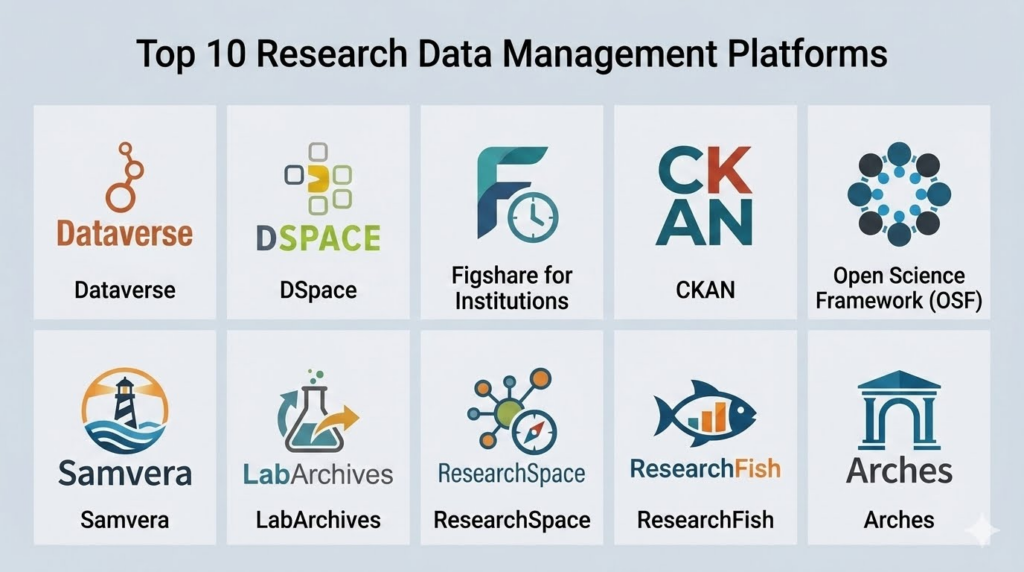
Introduction
Research Data Management (RDM) Platforms help research institutions, laboratories, universities, enterprises, and scientific teams organize, store, annotate, share, and preserve research data throughout its lifecycle. These tools support structured data documentation, metadata standards, secure storage, collaborative workflows, data versioning, provenance tracking, compliance with funder policies, and integration with analysis environments. RDM platforms reduce data silos, improve reproducibility, and enable collaboration across teams, departments, and institutions.
In the context of expanding data volumes, multidisciplinary projects, open science mandates, and reproducibility pressures, RDM platforms have become critical. Researchers must comply with funder and institutional data policies and share data securely and responsibly. Modern RDM systems also support data catalogs, FAIR (Findable, Accessible, Interoperable, Reusable) principles, APIs, and integration with analytic infrastructure.
Real-world use cases include:
- Organizing research outputs and datasets
- Managing experimental and observational data
- Ensuring reproducibility and provenance tracking
- Supporting multidisciplinary research collaboration
- Compliance with institutional and funder data policies
Evaluation Criteria for Buyers
- Support for metadata standards and controlled vocabularies
- Data catalog and discovery capabilities
- Secure storage and access controls
- Provenance and version tracking
- Collaboration and team workflow support
- API access and extensibility
- Compliance reporting
- Integration with compute and analysis tools
- Scalability across datasets and teams
- Deployment options and pricing flexibility
Best for: Research universities, labs, scientific consortia, pharma R&D teams, government research agencies, and enterprises conducting data-intensive projects.
Not ideal for: Small projects or teams with minimal data complexity that can be managed with basic file storage and spreadsheets.
Key Trends in Research Data Management Platforms
- FAIR principles adoption is increasing research transparency
- Cloud-native RDM deployments are becoming mainstream
- Metadata schema standardization enhances data reuse
- Data cataloging and discovery tools are growing in importance
- Integration with computational research workflows is expanding
- Provenance tracking and version control are standard expectations
- API-first platforms improve automation and interoperability
- Data governance and compliance reporting are critical for funding
- Collaboration features support distributed research teams
- AI-assisted metadata extraction and tagging are emerging
How We Selected These Tools
The tools below were selected based on strong research data management capabilities, community adoption, and ecosystem integrations.
- Support for structured research metadata and cataloging
- Secure access controls and compliance support
- Provenance and versioning workflows
- Scalability for large datasets
- Integration with analysis and compute environments
- Extensible APIs and data sharing capabilities
- Deployment flexibility (cloud vs self-hosted)
- Community adoption and research institution recognition
- Collaboration and workflow features
- Overall value across research organization sizes
Top 10 Research Data Management Platforms
#1 — Dataverse
Short description: Dataverse is an open-source research data repository platform widely used in academic and research institutions. It supports dataset storage, metadata standards, access controls, versioning, and data citation. Dataverse is strong where institutions need to share datasets publicly or privately while maintaining structured metadata and provenance. It is suitable for universities, government labs, and consortia.
Key Features
- Research dataset repository
- Metadata management with standards
- Versioning and provenance tracking
- Access control and permissions
- Dataset citation and DOI support
- Search and discovery tools
- API access for automation
Pros
- Open-source and extensible
- Strong academic adoption
- Good support for FAIR principles
Cons
- Requires technical setup for self-hosting
- UI may feel less modern
- Advanced integrations may require development
Platforms / Deployment
- Web
- Cloud / Self-hosted
Security & Compliance
- Role-based access
- Authentication controls
- Encryption depends on deployment
- Certifications not publicly stated
Integrations & Ecosystem
Dataverse integrates well with research workflows where structured datasets need to be cataloged and shared.
- APIs for data ingestion
- DOI and identifier systems
- Institutional authentication
- Research catalogs
- Analytics tools
Support & Community
Strong community support, documentation, and a global user base in academia.
#2 — DSpace
Short description: DSpace is a widely used open-source digital repository platform that supports research outputs, datasets, publications, and associated metadata. It helps institutions manage, archive, preserve, and share research artifacts. Many universities use DSpace for institutional repositories, data publishing, and long-term preservation.
Key Features
- Digital repository for research outputs
- Metadata schema support
- Long-term preservation and archiving
- Access control and permissions
- Search and discovery
- Versioning support
- API access
Pros
- Strong preservation features
- Flexible metadata support
- Large global community
Cons
- Not specifically RDM-focused but adaptable
- Requires technical hosting and support
- UI can feel dated
Platforms / Deployment
- Web
- Cloud / Self-hosted
Security & Compliance
- RBAC support
- Authentication controls
- Encryption depends on deployment
- Certifications not publicly stated
Integrations & Ecosystem
DSpace serves as an institutional repository and can connect to research cataloging and data sharing workflows.
- APIs
- Institutional authentication
- Metadata harvesting
- Discovery systems
- Research portals
Support & Community
Broad open-source community and vendor support options available.
#3 — Figshare for Institutions
Short description: Figshare for Institutions is a cloud-based research data management and sharing platform that supports dataset storage, metadata, collaboration, and public or private sharing. It provides modern search, DOI assignment, analytics, and compliance support. Institutions use Figshare to manage research data across teams while enabling reuse and publishing.
Key Features
- Cloud-based dataset storage
- Metadata and controlled vocabularies
- DOI assignment and citation
- Collaboration workspaces
- Search and discovery
- Analytics dashboards
- API integrations
Pros
- Modern interface
- Good sharing and publishing capabilities
- Strong analytics and compliance insights
Cons
- Cost may be high for smaller institutions
- Cloud dependency may not fit all policies
- Customization depth varies
Platforms / Deployment
- Web
- Cloud
Security & Compliance
- RBAC and authentication
- Encryption at rest and in transit
- Audit logging
- Certifications not publicly stated
Integrations & Ecosystem
Figshare connects to research workflows and publishing pipelines.
- LMS and research portals
- APIs
- DOI providers
- Analytics integrations
- Cloud storage connectors
Support & Community
Institution-level support, onboarding, and documentation provided.
#4 — CKAN
Short description: CKAN is an open-source data management and catalog platform often used for open data portals, institutional research catalogs, and data publishing. While not limited to research, it is used by research institutions and governments to catalog datasets with metadata, provide discovery tools, and support APIs. It is suitable when institutions need a flexible catalog for research data and datasets.
Key Features
- Open-source data catalog
- Metadata support and schema flexibility
- Search and discovery tools
- APIs for ingestion and querying
- Dataset versioning options
- Access control extensions
- Plugin ecosystem
Pros
- Highly extensible
- Open-source community
- Good for public and institutional catalogs
Cons
- Requires technical expertise
- Not research-specific RDM by default
- Plugins needed for advanced workflows
Platforms / Deployment
- Web
- Self-hosted / Cloud through partners
Security & Compliance
- Access control available through extensions
- Authentication not built-in by default
- Certifications not publicly stated
Integrations & Ecosystem
CKAN is used where datasets and metadata need to be cataloged and shared.
- APIs
- Public data portals
- Metadata harvesting
- Research discovery integration
- Custom extensions
Support & Community
Broad open-source community, varying support depending on deployment.
#5 — Open Science Framework
Short description: Open Science Framework (OSF) is a research collaboration and data management platform that supports project organization, data storage, versioning, workflow documentation, and sharing. It promotes open science, reproducibility, and collaborative research. OSF is used by research teams, labs, and institutions to manage project artifacts and datasets from conception through publication.
Key Features
- Project-level data and file management
- Versioning and provenance tracking
- Collaboration tools
- Metadata tagging
- Public or private sharing
- Integration with external storage
- Workflow documentation
Pros
- Strong collaboration focus
- Supports reproducibility and open science
- Simple project organization
Cons
- Not as scalable for large institutional catalogs
- Feature set may not satisfy complex RDM needs
- Cloud focus may not meet all institutional policies
Platforms / Deployment
- Web
- Cloud
Security & Compliance
- Authentication and access controls
- Encryption at rest and in transit
- Certifications not publicly stated
Integrations & Ecosystem
OSF integrates with storage and research tools to connect workflows.
- Dropbox, Box, Google Drive
- Version control systems
- APIs
- Metadata tools
- Analytical systems
Support & Community
Community support and documentation with institution-level onboarding available.
#6 — RENCI Hydra / Samvera
Short description: Samvera (formerly Hydra) is an open-source framework for building digital repository and research data management solutions that can support institutional RDM needs. It is often used by research libraries and universities to build custom RDM and discovery platforms. Samvera provides modular components, strong metadata support, and integration flexibility. It is best suited for institutions with technical development capacity.
Key Features
- Open-source RDM framework
- Controlled vocabularies and metadata
- Repository building blocks
- API access
- Customizable workflows
- Search and discovery
- Extensible plugin ecosystem
Pros
- Highly customizable foundation
- Good for institutional repositories and RDM
- Strong metadata support
Cons
- Requires technical and developer investment
- Implementation timelines can be long
- Support depends on internal or partner resources
Platforms / Deployment
- Web
- Self-hosted / Cloud through partners
Security & Compliance
- Role-based permissions available
- Authentication systems integratable
- Additional certifications not publicly stated
Integrations & Ecosystem
Samvera supports research cataloging, public access, and RDM integrations.
- APIs
- Digital repositories
- Search interfaces
- Metadata registries
- Institutional systems
Support & Community
Open-source community and vendor partners provide support options.
#7 — LabArchives
Short description: LabArchives is a research notebook and data management platform used primarily in laboratory environments. It supports electronic lab notebook workflows, structured data capture, collaboration, and secure storage. While focused on experimental lab data rather than broad institutional RDM catalogs, it integrates with lab workflows to organize research outputs and metadata. It is widely adopted in life sciences and technical research environments.
Key Features
- Electronic lab notebook
- Experimental data organization
- Collaboration tools
- Audit trails and timestamps
- Access control
- Storage integrations
- Sharing and export options
Pros
- Strong laboratory focus
- Usable notebook workflows
- Supports compliance documentation
Cons
- Not a full institutional RDM system
- Less catalog-centric for large datasets
- Focus is more on lab notes and experimental records
Platforms / Deployment
- Web / Windows / macOS / iOS / Android
- Cloud
Security & Compliance
- Access controls and audit logs
- Encryption at rest and in transit
- Certifications not publicly stated
Integrations & Ecosystem
LabArchives connects with research storage and analysis workflows.
- Storage connectors
- LMS and portals
- APIs
- Collaboration systems
- Data export tools
Support & Community
Institution-level support with documentation and onboarding resources.
#8 — ResearchSpace
Short description: ResearchSpace is a research discovery and knowledge graph platform that helps institutions model, connect, and explore research data and metadata across projects, publications, and entities. It supports linked data, semantic reasoning, discovery workflows, and federated research exploration. While not a traditional RDM repository, it enhances data connectivity for integrated research discovery.
Key Features
- Research knowledge graph
- Semantic data modeling
- Search and discovery
- Linked data support
- API access
- Integration with institutional data sources
- Visualization tools
Pros
- Strong semantic discovery
- Useful for data linkage and institutional knowledge
- Supports advanced research workflows
Cons
- Not focused on core data storage or catalog workflows
- Less suitable for general RDM repository needs
- Requires technical expertise
Platforms / Deployment
- Web
- Cloud / Hybrid
Security & Compliance
- Access controls available
- Roles and permissions
- Certifications not publicly stated
Integrations & Ecosystem
ResearchSpace integrates with institutional data and research systems.
- APIs
- Metadata sources
- Institutional repositories
- Visualization integration
- Discovery tools
Support & Community
Vendor support and documentation provided for institutional use.
#9 — ResearchFish
Short description: ResearchFish is a research outcomes reporting and impact assessment platform used by funding agencies and institutions to track research outputs, publications, collaborations, and impacts. While not a general RDM repository, it supports research data reporting, compliance reporting, and outcome tracking. It is often used where research evaluation and funder reporting are important.
Key Features
- Research outcomes tracking
- Publication and dataset reporting
- Collaboration networks
- Impact metrics
- Reporting dashboards
- Compliance reporting
Pros
- Strong evaluation focus
- Useful for funder and institutional reporting
- Collaboration insights
Cons
- Not a full RDM repository
- Less focused on dataset storage
- Feature scope is outcome reporting
Platforms / Deployment
- Web
- Cloud
Security & Compliance
- Role-based access
- Permissions
- Certifications not publicly stated
Integrations & Ecosystem
Integrates with research systems for reporting workflows.
- Institutional data sources
- Output repositories
- Analytics systems
- Collaboration tools
- Reporting connectors
Support & Community
Vendor support and onboarding resources available.
#10 — Arches
Short description: Arches is an open-source data management and cultural heritage platform that can be adapted for research data modeling, especially where linked data and ontology-based modeling is needed. While not a traditional RDM repository, it helps institutions manage structured, entity-based research datasets with strong search and semantic support. It is well suited for research domains requiring linked data and complex metadata.
Key Features
- Open-source data model framework
- Linked data and ontology support
- Search and discovery
- Customizable data models
- APIs
- Visualization options
Pros
- Strong linked data foundation
- Flexible for complex metadata
- Suitable for ontology-driven research needs
Cons
- Not a general RDM repository
- Technical investment required
- Less out-of-the-box features for general research data storage
Platforms / Deployment
- Web
- Self-hosted / Cloud through partners
Security & Compliance
- Access controls available
- Roles and authentication
- Certifications not publicly stated
Integrations & Ecosystem
Supports advanced research data modeling integrations.
- APIs
- Semantic data connectors
- Institutional systems
- Visualization tools
- Metadata registries
Support & Community
Open-source community with partner implementers.
Comparison Table
| Tool Name | Best For | Platform Supported | Deployment | Standout Feature | Public Rating |
|---|---|---|---|---|---|
| Dataverse | Academic dataset repositories | Web | Cloud, Self-hosted | FAIR-aligned dataset management | N/A |
| DSpace | Institutional research outputs | Web | Cloud, Self-hosted | Long-term preservation | N/A |
| Figshare for Institutions | Cloud RDM and publishing | Web | Cloud | Modern publishing & analytics | N/A |
| CKAN | Open data cataloging | Web | Self-hosted, Cloud partners | Flexible catalog platform | N/A |
| Open Science Framework | Project-level RDM and collaboration | Web | Cloud | Collaboration and reproducibility | N/A |
| Samvera | Custom institutional RDM | Web | Self-hosted, Cloud partners | Metadata extensibility | N/A |
| LabArchives | Lab data and notebook management | Web, Desktop, Mobile | Cloud | Lab notebook integration | N/A |
| ResearchSpace | Semantic discovery | Web | Cloud, Hybrid | Knowledge graph and discovery | N/A |
| ResearchFish | Research outcomes reporting | Web | Cloud | Impact reporting and tracking | N/A |
| Arches | Linked data research modeling | Web | Self-hosted, Cloud partners | Ontology-based data support | N/A |
Evaluation & Scoring of Research Data Management Platforms
| Tool Name | Core 25% | Ease 15% | Integrations 15% | Security 10% | Performance 10% | Support 10% | Value 15% | Weighted Total |
|---|---|---|---|---|---|---|---|---|
| Dataverse | 9 | 7 | 7 | 7 | 8 | 8 | 9 | 8.1 |
| DSpace | 8 | 7 | 7 | 7 | 8 | 8 | 8 | 7.8 |
| Figshare for Institutions | 8 | 8 | 8 | 8 | 8 | 8 | 7 | 7.9 |
| CKAN | 7 | 6 | 8 | 6 | 7 | 7 | 8 | 7.1 |
| Open Science Framework | 7 | 8 | 7 | 7 | 7 | 7 | 8 | 7.6 |
| Samvera | 8 | 6 | 8 | 7 | 8 | 7 | 8 | 7.6 |
| LabArchives | 7 | 8 | 6 | 8 | 7 | 8 | 8 | 7.7 |
| ResearchSpace | 6 | 7 | 7 | 7 | 7 | 7 | 7 | 7.0 |
| ResearchFish | 6 | 7 | 6 | 7 | 7 | 7 | 7 | 6.8 |
| Arches | 6 | 6 | 8 | 7 | 7 | 7 | 8 | 7.0 |
These scores are comparative and should be interpreted based on research organization needs. Large data-intensive institutions may prioritize deep metadata support, compliance reporting, APIs, and cataloging capabilities. Smaller labs may focus on ease of use and project collaboration. Open-source platforms such as Dataverse and DSpace provide excellent flexibility but require technical capacity. Cloud-native platforms like Figshare support modern publishing and analytics workflows.
Which Research Data Management Platform Is Right for You?
Solo / Freelancer
Individual researchers and small research teams typically need simple RDM capabilities. Platforms with easy setup such as Open Science Framework and cloud-based tools like Figshare help manage data and collaborate without requiring complex infrastructure.
SMB
Small to mid-sized research labs and departments require stronger metadata, access control, and storage capabilities. Dataverse, DSpace, and Figshare are practical options. If project collaboration is central, OSF can help organize workflow along with dataset management.
Mid-Market
Research institutions with multiple teams should consider platforms that balance ease of use with cataloging and compliance support. Dataverse and Figshare provide institutional-grade management, while Samvera allows custom platform development for metadata and workflow flexibility.
Enterprise
Large research universities, consortia, government labs, and data-intensive enterprises need systems that support FAIR principles, secure access, API extensibility, reporting, and integration with compute environments. Dataverse combined with custom federation or Samvera-based implementations can support large-scale cataloging and governance needs.
Budget vs Premium
Open-source platforms such as Dataverse, DSpace, CKAN, Samvera, and Arches offer strong flexibility and reduced licensing costs but typically require internal technical investment. Cloud-native SaaS solutions like Figshare and OSF provide managed support but may incur ongoing subscription expenses. The right balance depends on internal IT resources and long-term support strategy.
Feature Depth vs Ease of Use
Platforms such as Dataverse, Samvera, and DSpace provide deep metadata, cataloging, and preservation capabilities but may be more complex to operate. Tools like Figshare and Open Science Framework offer easier onboarding and collaboration flows for multidisciplinary teams.
Integrations & Scalability
Institutions planning broader integrations with compute environments, analysis pipelines, LMS, publication systems, or institutional repositories should evaluate API support, connectors, scalability, and identity federation capabilities. Platforms with strong API-first designs facilitate automation and extensibility.
Security & Compliance Needs
Research data may contain sensitive, proprietary, or regulated information. Institutions should prioritize role-based access control, authentication integration, encryption practices, audit trails, and compliance reporting before finalizing a platform. If certifications are not publicly stated, they should be confirmed during procurement.
Frequently Asked Questions
1. What is a Research Data Management Platform?
A Research Data Management Platform is software that helps research teams and institutions organize, store, share, and preserve datasets, metadata, and research outputs throughout the research lifecycle. These platforms support structured cataloging, collaboration workflows, provenance tracking, secure access, discovery, and compliance reporting.
2. How do RDM platforms support research compliance?
RDM platforms help institutions comply with data management plans, funder policies, and institutional requirements by supporting metadata standards, access controls, audit logs, preservation workflows, DOI assignment, citation tracking, and reporting. These capabilities ensure data governance and policy adherence across research projects.
3. Can these platforms handle large datasets?
Yes, many RDM platforms support large datasets, scalable storage, and parallel access patterns. Cloud-native systems and distributed storage integrations handle expanding data volumes. Technical architecture should be evaluated to ensure performance and scalability for larger research projects.
4. Are open-source RDM platforms a good choice?
Open-source platforms provide flexibility, extensibility, and community-driven innovation. Dataverse, DSpace, Samvera, CKAN, and Arches are good examples. These solutions fit institutions with technical capacity for deployment and maintenance. They avoid licensing costs but may require internal support resources.
5. How important is metadata in research data management?
Metadata is critical for discovery, reuse, interpretation, provenance tracking, and compliance. RDM platforms that support rich metadata schemas and controlled vocabularies enable researchers to find, interpret, analyze, share, and cite datasets. Metadata also supports automated workflows and FAIR principles adoption.
6. What integrations matter most for researchers?
Integrations with analysis environments, compute clusters, storage services, publication systems, institutional directories, LMS, APIs, and identity providers enhance RDM workflows. API-first platforms simplify automation, accelerate data ingestion, support federation, and improve interoperability across tools.
7. Can RDM platforms publish data publicly?
Yes, platforms like Figshare, Dataverse, DSpace, and CKAN can publish datasets publicly with metadata, DOIs, and discovery interfaces. Public access helps meet open science mandates, improves research visibility, and supports data reuse. Institutions should manage visibility controls and data policies.
8. How do RDM platforms handle versioning?
Versioning tracks changes to datasets, metadata, documentation, and project artifacts over time. This supports reproducibility, auditability, and traceability. RDM platforms with built-in version control help researchers manage updates, revisions, and provenance, enabling reliable long-term data stewardship.
9. What security features should institutions look for?
Key security features include role-based access control, authentication integration (SSO/LDAP), encryption at rest and in transit, audit logs, backup and recovery, permissions granularity, and compliance reporting. These controls protect sensitive research data and help manage institutional policies.
10. How should institutions evaluate RDM vendors?
Institutions should assess platform fit based on data types, researcher workflows, metadata needs, integrations, storage architecture, scalability, ease of use, compliance support, deployment options, support quality, total cost, and long-term strategy. Running pilot projects with real research data is strongly recommended.
Conclusion
Research Data Management Platforms are transforming how research institutions organize, discover, share, preserve, and govern their data assets. With increasing data volumes, interdisciplinary projects, open science expectations, and compliance mandates, choosing the right RDM solution is a strategic priority. Tools like Dataverse and DSpace deliver open-source flexibility and strong metadata frameworks, while cloud-native platforms such as Figshare and Open Science Framework make collaboration and publishing easier. Frameworks like Samvera and CKAN provide extensibility for institutions that require customized data services. Platforms such as LabArchives support specialized lab workflows, while ResearchSpace enhances discovery through semantic connections. The best choice depends on institutional data complexity, scalability needs, technical resources, collaboration goals, and compliance requirements. Research teams should shortlist options based on core requirements, test with real research datasets, validate integration needs, and confirm support expectations to ensure a sustainable long-term data management strategy.
