MOTOSHARE 🚗🏍️
Rent Bikes & Cars Directly from Owners
Motoshare connects vehicle owners with people who need bikes and cars on rent. Owners earn from idle vehicles, and renters get flexible ride options.
Visit Motoshare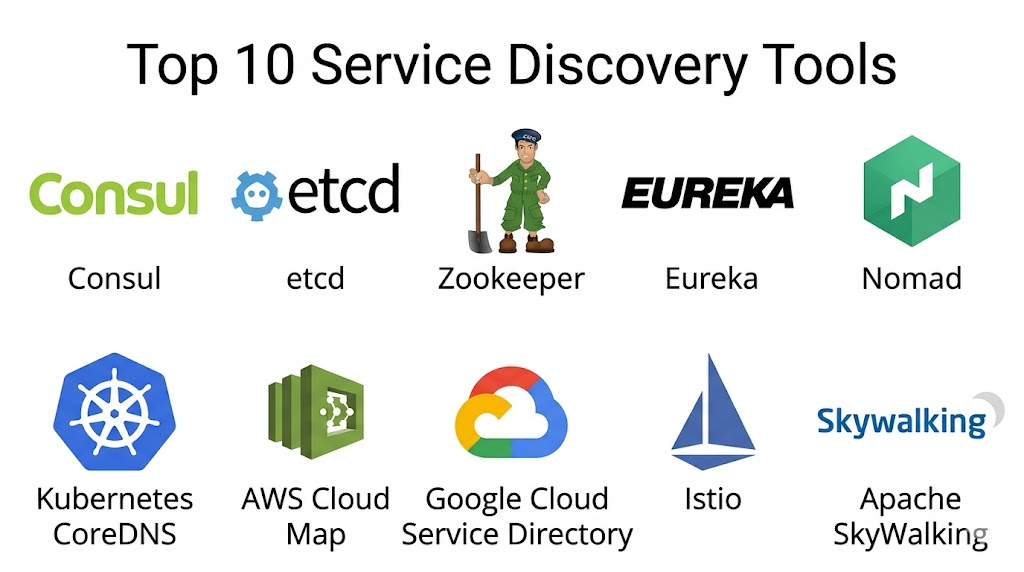
Introduction
Service Discovery Tools are software solutions that enable IT teams and developers to automatically detect, catalog, and manage services and microservices across complex infrastructure. In plain terms, they help organizations know what services are running, where they are located, and how they communicate with each other—critical for modern cloud-native and microservices architectures.In today’s hybrid and distributed computing environments, having accurate and up-to-date service visibility is essential for operational efficiency, incident response, and automated deployment pipelines. Service discovery ensures that applications can reliably locate dependencies, reduce configuration errors, and improve system resilience.
Real-world use cases:
- Dynamic registration and discovery of microservices in Kubernetes and Docker environments.
- Automated monitoring of service health and uptime across multiple cloud providers.
- Dependency mapping for change management and troubleshooting.
- Integrating service topology into CI/CD pipelines for continuous deployment.
- Optimizing load balancing and failover across distributed applications.
Evaluation Criteria for Buyers:
When selecting a service discovery tool, buyers should consider:
- Ease of deployment and configuration
- Real-time discovery and dynamic updates
- Integration with cloud, container, and orchestration platforms
- Security features, including encryption and access control
- Scalability for large service fleets
- Observability and monitoring capabilities
- API and ecosystem extensibility
- Support and community strength
- Cost structure and licensing flexibility
Best for: DevOps teams, SREs, and platform engineers in enterprises, SMBs, and cloud-native organizations that operate microservices or hybrid cloud environments.
Not ideal for: Small businesses or static environments with minimal service complexity where manual configuration suffices or simpler orchestration-native service discovery meets needs.
Key Trends in Service Discovery Tools
- Growing adoption of cloud-native service discovery integrated with Kubernetes and container platforms.
- AI-driven service mapping for predictive dependency analysis and anomaly detection.
- Expansion of multi-cloud and hybrid environment support, enabling seamless cross-cloud discovery.
- Zero-trust and encrypted service discovery to enhance security and compliance.
- Automation of service registration/deregistration to reduce human error.
- Integration with observability and monitoring platforms for end-to-end service insight.
- Increasing adoption of decentralized discovery patterns, like service mesh-enabled discovery.
- Flexible API-first designs allowing better integration with CI/CD and infrastructure-as-code pipelines.
- Focus on cost efficiency with open-source and lightweight agents for high-scale environments.
- Support for policy-driven access and governance, ensuring regulatory compliance.
How We Selected These Tools (Methodology)
- Evaluated market adoption and recognition in enterprise and cloud-native environments.
- Assessed completeness of features including dynamic discovery, registration, health checks, and dependency mapping.
- Reviewed reliability, performance signals, and scalability in large-scale service ecosystems.
- Examined security posture: encryption, authentication, audit logging, and compliance certifications.
- Considered integrations with orchestration platforms, monitoring, alerting, and CI/CD pipelines.
- Analyzed suitability across company sizes: SMBs, mid-market, enterprise, and developer-focused use cases.
- Factored in vendor support, community strength, and open-source contribution.
- Reviewed pricing models for flexibility and value for varying infrastructure scales.
- Confirmed innovation in AI/automation or emerging cloud-native patterns.
- Balanced tool selection between enterprise-ready, open-source, and hybrid solutions.
Top 10 Service Discovery Tools
#1 — Consul
Short description: A widely used service discovery and configuration tool for dynamic infrastructure, suitable for both cloud and on-premise environments.
Key Features
- Dynamic service registry and health checking
- Key/value store for configuration management
- Multi-datacenter support
- Integration with Envoy for service mesh capabilities
- Service segmentation with ACLs
- API and CLI access for automation
Pros
- Highly scalable and resilient
- Strong ecosystem and documentation
Cons
- Advanced features may require learning curve
- Self-hosted setups require careful management
Platforms / Deployment
- Linux, Windows, macOS; Cloud / Self-hosted / Hybrid
Security & Compliance
- ACLs, TLS encryption, SSO/SAML; Not publicly stated for SOC 2/ISO
Integrations & Ecosystem
Integrates with Kubernetes, Docker, AWS, and monitoring tools.
- Prometheus for metrics
- Envoy service mesh
- Terraform for IaC
- Vault for secrets management
Support & Community
Strong documentation, active open-source community, enterprise support available.
#2 — etcd
Short description: Distributed key-value store used for service discovery, configuration, and coordination, often embedded in Kubernetes clusters.
Key Features
- High-availability distributed store
- Watch API for real-time updates
- Simple REST API
- Strong consistency guarantees
- Automatic failover and leader election
Pros
- Lightweight and fast
- Native integration with Kubernetes
Cons
- Requires careful cluster management
- Limited UI and observability features
Platforms / Deployment
- Linux, macOS, Windows; Cloud / Self-hosted
Security & Compliance
- TLS encryption, authentication; Not publicly stated for SOC 2/ISO
Integrations & Ecosystem
- Kubernetes API integration
- Terraform modules
- Monitoring via Prometheus
- CI/CD pipelines
Support & Community
Open-source with active GitHub community; commercial support via cloud providers.
#3 — Zookeeper
Short description: Centralized service for configuration management and naming, widely used in distributed systems like Hadoop and Kafka.
Key Features
- Leader election and configuration management
- Naming registry for distributed applications
- Event notification mechanism
- High reliability and fault tolerance
Pros
- Mature and stable
- Strong consistency guarantees
Cons
- Can be complex to scale
- Manual setup for advanced clusters
Platforms / Deployment
- Linux, Windows; Self-hosted / Hybrid
Security & Compliance
- ACLs, authentication via Kerberos; Not publicly stated for SOC 2/ISO
Integrations & Ecosystem
- Apache Kafka
- Hadoop ecosystem
- Spark
- Monitoring via Grafana/Prometheus
Support & Community
Mature open-source community, abundant enterprise expertise available.
#4 — Eureka
Short description: Netflix-developed REST-based service registry for locating services in cloud environments, optimized for JVM-based microservices.
Key Features
- Dynamic service registration/deregistration
- Self-preservation mode for resiliency
- REST-based API
- Dashboard for service health
- Load balancing with Ribbon
Pros
- Optimized for Spring Boot and Java microservices
- Lightweight and easy to deploy
Cons
- Java-centric; less flexible for polyglot environments
- Limited advanced security features
Platforms / Deployment
- JVM; Cloud / Self-hosted
Security & Compliance
- Basic authentication; Not publicly stated for SOC 2/ISO
Integrations & Ecosystem
- Spring Cloud ecosystem
- Netflix OSS tools
- CI/CD pipelines
- Load balancers
Support & Community
Strong open-source community, well-documented for Java ecosystems.
#5 — HashiCorp Nomad
Short description: Primarily a workload orchestrator with integrated service discovery for microservices and container workloads.
Key Features
- Native service registration
- Multi-region scheduling
- Job orchestration
- Consul integration for service discovery
- Supports Docker, JVM, and custom drivers
Pros
- Simple architecture
- Works well with existing HashiCorp stack
Cons
- Not purely focused on discovery
- Smaller community compared to Kubernetes
Platforms / Deployment
- Linux, Windows, macOS; Cloud / Self-hosted / Hybrid
Security & Compliance
- TLS, ACLs; Not publicly stated for SOC 2/ISO
Integrations & Ecosystem
- Consul
- Vault
- Prometheus
- CI/CD pipelines
Support & Community
Commercial support via HashiCorp; moderate open-source community.
#6 — Kubernetes CoreDNS
Short description: Default service discovery mechanism in Kubernetes, providing DNS-based resolution for microservices.
Key Features
- DNS-based service discovery
- Automatic updates on pod/service changes
- Supports plugin extensions
- Lightweight and highly available
- Configurable caching
Pros
- Built-in for Kubernetes
- Minimal operational overhead
Cons
- Limited to Kubernetes environment
- Plugin complexity can increase maintenance
Platforms / Deployment
- Linux; Cloud / Self-hosted
Security & Compliance
- Not publicly stated
Integrations & Ecosystem
- Kubernetes API
- Monitoring tools like Prometheus
- Service meshes
Support & Community
Large Kubernetes community; strong documentation and active GitHub contributors.
#7 — AWS Cloud Map
Short description: Fully managed service registry from AWS, providing service discovery and dynamic endpoints in cloud environments.
Key Features
- Cloud-native service registry
- Health checks and endpoint tracking
- Integration with AWS resources
- API and SDK access
- Multi-VPC support
Pros
- Fully managed, scalable
- Tight AWS ecosystem integration
Cons
- AWS lock-in
- Less flexible for hybrid/on-prem environments
Platforms / Deployment
- Cloud (AWS only)
Security & Compliance
- IAM, encryption at rest/in transit; Not publicly stated for SOC 2/ISO
Integrations & Ecosystem
- AWS Lambda, ECS, EKS
- Route 53 for DNS
- CloudWatch for metrics
- CI/CD with CodePipeline
Support & Community
AWS support tiers; extensive AWS documentation and community forums.
#8 — Google Cloud Service Directory
Short description: Managed service registry for Google Cloud, enabling service discovery across cloud projects.
Key Features
- Namespace-based service catalog
- Fully managed with health checking
- API-driven registration
- Integration with GCP IAM and monitoring
- Supports cross-region endpoints
Pros
- Fully managed and secure
- GCP-native integration
Cons
- Limited to Google Cloud
- Vendor lock-in concerns
Platforms / Deployment
- Cloud (GCP)
Security & Compliance
- IAM-based access control, encryption; Not publicly stated for SOC 2/ISO
Integrations & Ecosystem
- GCP APIs
- Cloud Run, GKE
- Stackdriver monitoring
- CI/CD pipelines
Support & Community
Google Cloud support; active GCP forums.
#9 — Istio Service Mesh
Short description: Service mesh that includes service discovery as part of its microservices routing, security, and observability features.
Key Features
- Automatic service registration
- Load balancing and routing
- Telemetry and monitoring
- Security with mutual TLS
- Policy enforcement and observability
Pros
- Comprehensive service management
- Strong security features
Cons
- Complexity in setup
- Resource-intensive
Platforms / Deployment
- Linux; Cloud / Self-hosted / Hybrid
Security & Compliance
- Mutual TLS, RBAC; Not publicly stated for SOC 2/ISO
Integrations & Ecosystem
- Kubernetes
- Prometheus/Grafana
- CI/CD pipelines
- Envoy proxy
Support & Community
Large open-source community; active documentation and examples.
#10 — Apache SkyWalking
Short description: Observability platform that includes service discovery for microservice and cloud-native architectures.
Key Features
- Service mesh and topology mapping
- Automatic service registration
- Tracing, metrics, and logging
- Alerting and anomaly detection
- Plugin-based extensibility
Pros
- Integrated observability with discovery
- Supports multiple languages and protocols
Cons
- Setup can be complex
- Requires monitoring infrastructure
Platforms / Deployment
- Linux; Cloud / Self-hosted / Hybrid
Security & Compliance
- Not publicly stated
Integrations & Ecosystem
- Kubernetes, Docker
- Prometheus, Grafana
- CI/CD pipelines
- Various plugins for language/runtime support
Support & Community
Active open-source community; detailed documentation and examples.
Comparison Table (Top 10)
| Tool Name | Best For | Platform(s) Supported | Deployment | Standout Feature | Public Rating |
|---|---|---|---|---|---|
| Consul | Enterprises & DevOps | Linux, Windows, macOS | Cloud / Self-hosted / Hybrid | Multi-datacenter service registry | N/A |
| etcd | Kubernetes clusters | Linux, macOS, Windows | Cloud / Self-hosted | Distributed key-value store | N/A |
| Zookeeper | Big data & distributed apps | Linux, Windows | Self-hosted / Hybrid | Reliable distributed coordination | N/A |
| Eureka | Java microservices | JVM | Cloud / Self-hosted | REST-based registry with self-preservation | N/A |
| Nomad | Workload orchestration | Linux, Windows, macOS | Cloud / Self-hosted / Hybrid | Integrated service registration | N/A |
| Kubernetes CoreDNS | Kubernetes environments | Linux | Cloud / Self-hosted | DNS-based service discovery | N/A |
| AWS Cloud Map | AWS cloud services | Cloud | Cloud | Fully managed AWS-native registry | N/A |
| Google Cloud Service Directory | GCP cloud services | Cloud | Cloud | Multi-project service discovery | N/A |
| Istio | Microservice routing & mesh | Linux | Cloud / Self-hosted / Hybrid | Security + telemetry integrated discovery | N/A |
| Apache SkyWalking | Observability + discovery | Linux | Cloud / Self-hosted / Hybrid | Service topology + metrics + tracing | N/A |
Evaluation & Scoring of Service Discovery Tools
| Tool Name | Core (25%) | Ease (15%) | Integrations (15%) | Security (10%) | Performance (10%) | Support (10%) | Value (15%) | Weighted Total (0–10) |
|---|---|---|---|---|---|---|---|---|
| Consul | 9 | 8 | 9 | 8 | 9 | 8 | 8 | 8.7 |
| etcd | 8 | 7 | 8 | 7 | 9 | 7 | 8 | 7.8 |
| Zookeeper | 8 | 6 | 7 | 7 | 8 | 7 | 7 | 7.2 |
| Eureka | 7 | 8 | 7 | 6 | 7 | 7 | 8 | 7.2 |
| Nomad | 8 | 8 | 8 | 7 | 8 | 7 | 7 | 7.7 |
| Kubernetes CoreDNS | 8 | 9 | 7 | 7 | 8 | 8 | 8 | 8.0 |
| AWS Cloud Map | 9 | 8 | 8 | 8 | 9 | 8 | 7 | 8.2 |
| Google Cloud Service Directory | 8 | 8 | 8 | 8 | 8 | 7 | 7 | 7.7 |
| Istio | 9 | 7 | 8 | 9 | 9 | 8 | 7 | 8.3 |
| Apache SkyWalking | 8 | 7 | 8 | 7 | 8 | 7 | 7 | 7.6 |
Interpretation: Higher weighted totals indicate a strong balance of features, ease of use, integrations, security, performance, support, and value. Scores are comparative; organizations should match scores with specific environment requirements and priorities.
Which Service Discovery Tools Tool Is Right for You?
Solo / Freelancer
Lightweight tools like etcd or Kubernetes CoreDNS are ideal for personal projects or small-scale Kubernetes deployments due to minimal operational overhead.
SMB
SMBs benefit from managed solutions like AWS Cloud Map or Google Cloud Service Directory, providing ease of deployment and minimal maintenance while ensuring scalability.
Mid-Market
Hybrid solutions like Consul or Nomad offer flexibility across on-prem and cloud workloads, strong integrations, and enterprise-grade security without the full complexity of service meshes.
Enterprise
Large-scale organizations with distributed services should consider Istio or Consul, offering robust discovery, telemetry, security features, and multi-datacenter support.
Budget vs Premium
Open-source options (etcd, Zookeeper) are cost-effective but require more management. Premium managed services (AWS Cloud Map, Google Service Directory) offer lower operational overhead but at higher cost.
Feature Depth vs Ease of Use
Tools like Istio provide deep feature sets but require expertise. Lightweight DNS-based or REST-based tools provide simplicity at the expense of advanced capabilities.
Integrations & Scalability
Evaluate whether the tool integrates with your orchestration platform, CI/CD pipelines, and observability stack. Tools with strong plugin and API support scale better as infrastructure grows.
Security & Compliance Needs
Ensure encryption, access controls, and audit logging meet organizational standards. For regulated industries, prefer tools with built-in compliance and policy enforcement capabilities.
Frequently Asked Questions (FAQs)
1. What pricing models are common for service discovery tools?
Many tools are open-source and free to deploy (etcd, Zookeeper), while managed cloud services (AWS Cloud Map, GCP Service Directory) follow pay-as-you-go or subscription models based on service endpoints and usage.
2. How difficult is onboarding a service discovery tool?
Onboarding depends on deployment. Managed services offer guided setups and APIs, while open-source tools require manual configuration, agent installation, and cluster management.
3. Can these tools scale for thousands of microservices?
Yes, enterprise-grade solutions like Consul, Istio, and cloud-managed services are designed to handle high-scale environments with dynamic service registration and monitoring.
4. How secure are service discovery tools?
Security varies; most support TLS encryption, ACLs, and RBAC. Managed services integrate with cloud IAM for access control. Compliance certifications may be limited for open-source tools.
5. What are common mistakes when implementing service discovery?
Common pitfalls include underestimating configuration complexity, neglecting security controls, not monitoring service health, and improper integration with orchestration platforms.
6. Are service discovery tools compatible with CI/CD pipelines?
Yes. Most provide APIs or plugins to integrate service registry, health checks, and dependency updates into automated build and deployment workflows.
7. How do these tools handle multi-cloud environments?
Managed solutions and tools like Consul or Nomad support cross-cloud discovery. Open-source tools may require additional configuration for multi-region or multi-cloud connectivity.
8. Can I switch service discovery tools easily?
Switching requires careful planning; service registration endpoints, health checks, and configuration data must migrate. Container-native approaches like CoreDNS simplify transitions in Kubernetes.
9. Do service meshes replace service discovery tools?
Service meshes often include discovery capabilities but are broader, offering routing, telemetry, and security. Discovery-only tools may suffice in simpler environments.
10. What alternatives exist to dedicated service discovery tools?
Alternatives include built-in orchestration discovery (Kubernetes DNS), cloud-native load balancers, and configuration management platforms, depending on scale and architecture.
Conclusion
Service discovery tools are foundational for modern microservice and cloud-native environments, enabling reliable service registration, discovery, and health monitoring. Selecting the right tool depends on your scale, architecture, cloud adoption, security needs, and operational expertise. Open-source options provide flexibility and cost savings but require hands-on management, whereas managed cloud-native solutions reduce operational overhead at a premium. Enterprises benefit from feature-rich tools offering telemetry, policy enforcement, and multi-datacenter support. Next steps include shortlisting tools that align with your architecture, piloting them in test environments, and validating integrations, security, and scalability before full deployment.
