MOTOSHARE 🚗🏍️
Rent Bikes & Cars Directly from Owners
Motoshare connects vehicle owners with people who need bikes and cars on rent. Owners earn from idle vehicles, and renters get flexible ride options.
Visit Motoshare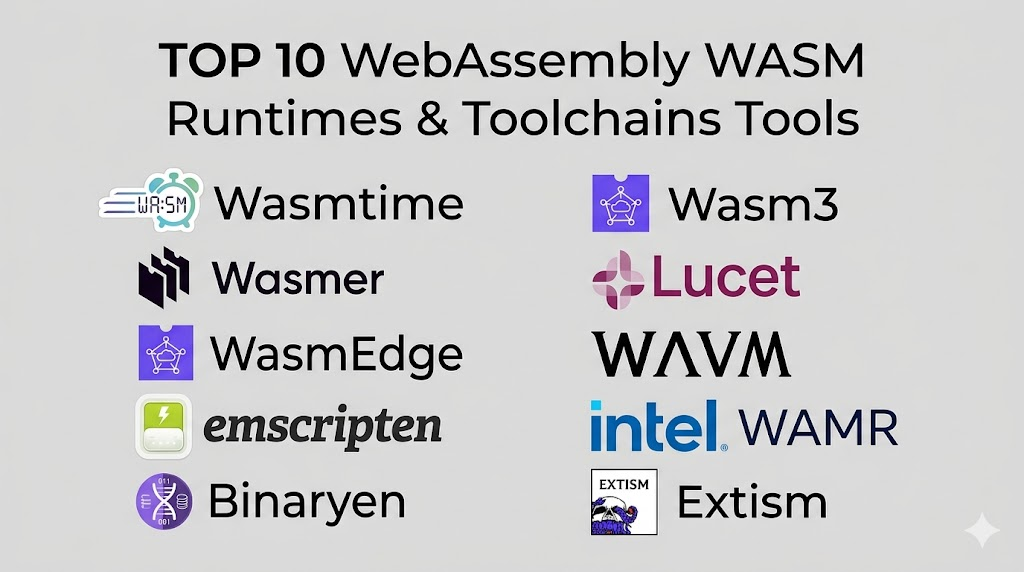
Introduction
WebAssembly WASM runtimes and toolchains are platforms and developer frameworks that allow applications written in languages like Rust, C, C++, Go, and AssemblyScript to run securely and efficiently across browsers, servers, edge networks, and embedded systems. Instead of relying entirely on JavaScript or traditional native binaries, developers can compile applications into lightweight WASM modules that execute in isolated sandboxed environments.The category has become increasingly important as organizations modernize cloud-native infrastructure, edge computing systems, and portable application architectures. WASM enables faster startup times, reduced resource consumption, and stronger workload isolation compared to many traditional deployment approaches. It is now widely used in serverless platforms, edge applications, plugin ecosystems, and AI inference workloads.
Common real-world use cases include:
- Edge computing workloads
- Serverless application execution
- Browser-based high-performance applications
- Secure plugin and extension systems
- AI and machine learning inference at the edge
Key evaluation criteria for buyers include:
- Runtime performance
- Startup latency
- Language support
- WASI compatibility
- Security isolation
- Kubernetes integration
- Developer experience
- Ecosystem maturity
- Observability and debugging
- Enterprise support availability
Best for: cloud-native engineering teams, edge infrastructure providers, SaaS platforms, DevOps teams, browser application developers, and organizations building portable workloads.
Not ideal for: organizations running legacy monolithic systems without portability requirements, teams dependent on full operating system virtualization, or businesses with limited infrastructure engineering resources.
Key Trends in WebAssembly WASM Runtimes & Toolchains
- WASI standards are accelerating server-side WASM adoption.
- Edge computing platforms increasingly support WASM-native execution.
- AI inference workloads are moving toward lightweight WASM runtimes.
- Kubernetes integrations for WASM are becoming more production-ready.
- Rust continues to dominate modern WASM development ecosystems.
- Plugin-based application architectures are rapidly growing.
- Hybrid container plus WASM deployment models are becoming common.
- Security-focused workload isolation is driving enterprise adoption.
- Observability tooling for WASM environments is improving steadily.
- Lightweight serverless execution models are expanding across cloud providers.
How We Selected These Tools Methodology
The tools in this list were evaluated using practical engineering, ecosystem, and operational criteria.
Selection factors included:
- Market adoption and developer mindshare
- Runtime performance and startup efficiency
- Ecosystem maturity and tooling quality
- Security architecture and sandbox isolation
- Integration support for Kubernetes and cloud-native systems
- Language compatibility and portability
- Documentation quality and onboarding experience
- Enterprise readiness and operational stability
- Community momentum and contributor activity
- Flexibility across browser, edge, server, and embedded workloads
Top 10 WebAssembly WASM Runtimes & Toolchains Tools
#1 — Wasmtime
Short description: Wasmtime is a high-performance open-source WebAssembly runtime developed by the Bytecode Alliance. It focuses on secure sandboxed execution, strong WASI support, and cloud-native portability. The platform is widely adopted for edge workloads, plugin systems, and server-side WASM execution. It is especially popular among Rust developers and infrastructure engineering teams.
Key Features
- WASI compatibility
- Secure sandboxed runtime
- JIT compilation engine
- Fast startup performance
- Cross-platform execution
- Embedding APIs
- Rust ecosystem integration
Pros
- Mature WASI implementation
- Strong ecosystem adoption
- Excellent runtime performance
Cons
- Advanced configuration can be complex
- Enterprise management tooling is limited
- Learning curve for beginners
Platforms / Deployment
- Windows / Linux / macOS / Web
- Cloud / Self-hosted / Hybrid
Security & Compliance
- Sandboxed execution
- Runtime isolation
- Access control support varies
- Not publicly stated for certifications
Integrations & Ecosystem
Wasmtime integrates well with modern cloud-native workflows and developer toolchains. It is heavily aligned with the Bytecode Alliance ecosystem and server-side WASI standards.
- Kubernetes
- Rust toolchains
- OCI workflows
- WASI ecosystem
- Edge computing platforms
Support & Community
Strong open-source community with extensive documentation and growing enterprise adoption.
#2 — Wasmer
Short description: Wasmer is a developer-friendly WebAssembly runtime and packaging ecosystem designed for portability across browsers, servers, and edge environments. It provides tooling for application packaging, deployment, and execution. Developers often choose Wasmer for simplified distribution and multi-platform compatibility.
Key Features
- Multi-language support
- WASIX compatibility
- Runtime package management
- CLI tooling
- Native execution optimization
- Edge deployment support
- Embeddable runtime APIs
Pros
- Excellent developer experience
- Strong packaging ecosystem
- Flexible deployment options
Cons
- Enterprise tooling still evolving
- Smaller enterprise footprint
- Advanced observability requires additional tooling
Platforms / Deployment
- Windows / Linux / macOS / Web
- Cloud / Self-hosted / Hybrid
Security & Compliance
- Sandboxed execution
- Encryption support varies
- MFA and SSO vary by deployment
- Not publicly stated for certifications
Integrations & Ecosystem
Wasmer supports modern deployment workflows and portable runtime execution across different infrastructure models.
- Docker
- GitHub Actions
- Edge platforms
- Language SDKs
- WASIX ecosystem
Support & Community
Active developer community with strong onboarding documentation and growing commercial adoption.
#3 — WasmEdge
Short description: WasmEdge is a lightweight WebAssembly runtime optimized for cloud-native infrastructure, AI inference, and edge computing environments. It is designed for low-latency execution and lightweight resource usage. Organizations often use WasmEdge for edge-native microservices and Kubernetes deployments.
Key Features
- AI inference optimization
- Kubernetes support
- OCI image compatibility
- Lightweight execution
- Fast startup times
- Plugin extension framework
- Edge-native architecture
Pros
- Excellent edge performance
- AI-focused runtime optimization
- Strong cloud-native direction
Cons
- Smaller ecosystem than major runtimes
- Enterprise tooling is maturing
- Documentation depth varies
Platforms / Deployment
- Linux / Windows / macOS
- Cloud / Self-hosted / Hybrid
Security & Compliance
- Sandboxed runtime
- Runtime isolation controls
- Audit logging varies
- Not publicly stated for certifications
Integrations & Ecosystem
WasmEdge is highly aligned with modern cloud-native and edge infrastructure ecosystems.
- Kubernetes
- OCI registries
- CNCF ecosystem
- TensorFlow Lite
- Edge serverless systems
Support & Community
Growing community adoption among cloud-native developers and edge infrastructure teams.
#4 — Emscripten
Short description: Emscripten is one of the most established WebAssembly toolchains for compiling C and C++ applications into browser-compatible WASM modules. It is widely used for browser applications, gaming engines, and legacy application portability. Developers often rely on Emscripten for high-performance browser execution.
Key Features
- C and C++ compilation
- LLVM-based compilation
- Browser optimization
- JavaScript interoperability
- OpenGL and SDL support
- Debugging tools
- Legacy application portability
Pros
- Mature developer ecosystem
- Excellent browser compatibility
- Strong documentation
Cons
- Primarily browser-focused
- Performance tuning may be complex
- Larger binary sizes possible
Platforms / Deployment
- Windows / Linux / macOS / Web
- Cloud / Self-hosted
Security & Compliance
- Browser sandboxing support
- Security varies by deployment model
- Not publicly stated for certifications
Integrations & Ecosystem
Emscripten integrates deeply into browser development workflows and frontend WASM ecosystems.
- LLVM
- Browser APIs
- JavaScript frameworks
- Game engines
- WebGL environments
Support & Community
Large and mature developer community with extensive learning resources.
#5 — Binaryen
Short description: Binaryen is a compiler and optimization toolkit designed to improve WebAssembly performance and reduce binary size. It is commonly used alongside Emscripten and other WASM compilation pipelines. Developers use Binaryen to optimize runtime execution and improve portability.
Key Features
- Binary optimization
- Code transformation tooling
- WASM validation
- Compiler optimization passes
- CLI optimization utilities
- Multi-language compatibility
- Runtime performance tuning
Pros
- Excellent optimization capabilities
- Widely integrated into WASM toolchains
- Improves runtime efficiency
Cons
- Not a standalone runtime
- Requires additional tooling
- Primarily developer-focused
Platforms / Deployment
- Windows / Linux / macOS
- Self-hosted
Security & Compliance
- Not publicly stated
- Depends on deployment environment
Integrations & Ecosystem
Binaryen acts as an optimization layer within broader WebAssembly development pipelines.
- Emscripten
- LLVM
- Browser runtimes
- CI/CD systems
- WASM compilers
Support & Community
Strong open-source reputation within the WebAssembly development ecosystem.
#6 — Wasm3
Short description: Wasm3 is an ultra-lightweight WebAssembly interpreter optimized for embedded systems, IoT devices, and low-resource computing environments. It focuses on portability and minimal memory usage. The runtime is popular for edge hardware and microcontroller deployments.
Key Features
- Tiny runtime footprint
- Embedded system optimization
- Low memory usage
- Fast interpreter engine
- Cross-platform support
- C API integration
- IoT compatibility
Pros
- Excellent for embedded devices
- Extremely lightweight
- Easy integration model
Cons
- Limited enterprise tooling
- Smaller ecosystem
- Fewer cloud-native integrations
Platforms / Deployment
- Linux / Embedded Devices / Windows / macOS
- Self-hosted
Security & Compliance
- Sandboxed execution support
- Isolation varies by deployment
- Not publicly stated for certifications
Integrations & Ecosystem
Wasm3 focuses on lightweight edge and embedded deployment scenarios.
- Embedded SDKs
- IoT systems
- C/C++ environments
- Microcontroller platforms
Support & Community
Smaller but specialized community focused on embedded runtime workloads.
#7 — Lucet
Short description: Lucet is a high-performance WebAssembly compiler and runtime focused on edge computing and low-latency serverless execution. It emphasizes ahead-of-time compilation for predictable startup performance and secure workload isolation.
Key Features
- Ahead-of-time compilation
- Secure sandboxing
- Fast startup execution
- Native code generation
- Lightweight runtime architecture
- WASI support
- Edge workload optimization
Pros
- Excellent startup performance
- Efficient edge execution
- Security-focused design
Cons
- Smaller ecosystem activity
- Limited commercial tooling
- Narrower adoption
Platforms / Deployment
- Linux / macOS
- Self-hosted / Hybrid
Security & Compliance
- Sandboxed execution
- Runtime isolation
- Not publicly stated for certifications
Integrations & Ecosystem
Lucet primarily integrates into edge execution and serverless environments.
- Edge platforms
- WASI ecosystems
- Native serverless systems
Support & Community
Moderate community activity with niche adoption in edge infrastructure.
#8 — WAVM
Short description: WAVM is a WebAssembly virtual machine focused on standards compliance, runtime embedding, and fast execution. Developers commonly use WAVM for runtime experimentation and embedded execution environments.
Key Features
- Standards compliance
- JIT execution
- LLVM integration
- Runtime embedding APIs
- Standalone execution
- WASI support
- Cross-platform compatibility
Pros
- Flexible embedding support
- Good runtime performance
- Strong standards alignment
Cons
- Smaller enterprise presence
- Limited commercial support
- Ecosystem maturity evolving
Platforms / Deployment
- Windows / Linux / macOS
- Self-hosted
Security & Compliance
- Runtime sandboxing
- Isolation controls
- Not publicly stated for certifications
Integrations & Ecosystem
WAVM fits well into experimental and developer-focused WASM environments.
- LLVM toolchains
- C++ ecosystems
- WASI modules
- Native embedding workflows
Support & Community
Community-driven project with moderate adoption among WASM developers.
#9 — Intel WAMR WebAssembly Micro Runtime
Short description: Intel WAMR is a lightweight WebAssembly runtime designed for embedded systems, edge computing, and industrial IoT deployments. It supports multiple execution modes while maintaining low resource usage. The platform is commonly used for device-level execution and lightweight infrastructure environments.
Key Features
- Embedded runtime execution
- IoT device optimization
- Interpreter and AOT modes
- Lightweight resource usage
- Cross-platform portability
- Edge deployment support
- Flexible execution engines
Pros
- Strong embedded performance
- Good IoT compatibility
- Lightweight runtime design
Cons
- Limited orchestration tooling
- Smaller community footprint
- Enterprise capabilities limited
Platforms / Deployment
- Linux / Windows / Embedded Systems
- Self-hosted / Hybrid
Security & Compliance
- Sandboxed execution
- Runtime isolation support
- Not publicly stated for certifications
Integrations & Ecosystem
WAMR integrates primarily into edge infrastructure and embedded deployment workflows.
- Intel edge platforms
- Embedded SDKs
- Native C/C++ integrations
- IoT frameworks
Support & Community
Growing adoption in industrial IoT and embedded systems communities.
#10 — Extism
Short description: Extism is a modern plugin framework built around WebAssembly for secure and portable application extensions. It enables multi-language plugin execution using isolated WASM runtimes. Developers use Extism to create flexible plugin-based architectures.
Key Features
- Plugin runtime framework
- Multi-language support
- Sandboxed plugin execution
- Lightweight embedding
- Portable extension architecture
- SDK support
- Runtime isolation controls
Pros
- Excellent for plugin systems
- Strong language interoperability
- Developer-friendly APIs
Cons
- Narrower workload focus
- Smaller ecosystem than major runtimes
- Enterprise tooling still maturing
Platforms / Deployment
- Windows / Linux / macOS
- Cloud / Self-hosted
Security & Compliance
- Sandboxed plugin isolation
- Access controls vary
- Not publicly stated for certifications
Integrations & Ecosystem
Extism focuses heavily on lightweight extensibility and portable plugin execution.
- Rust SDKs
- Go SDKs
- JavaScript integrations
- Plugin APIs
- Embedded runtime systems
Support & Community
Fast-growing community with increasing popularity among plugin-focused developers.
Comparison Table Top 10
| Tool Name | Best For | Platform(s) Supported | Deployment | Standout Feature | Public Rating |
|---|---|---|---|---|---|
| Wasmtime | Cloud-native WASI workloads | Windows, Linux, macOS | Hybrid | Mature WASI support | N/A |
| Wasmer | Portable application deployment | Web, Linux, Windows | Hybrid | WASIX ecosystem | N/A |
| WasmEdge | Edge AI workloads | Linux, Windows, macOS | Hybrid | AI inference optimization | N/A |
| Emscripten | Browser application portability | Web, Windows, Linux | Hybrid | C/C++ browser compilation | N/A |
| Binaryen | WASM optimization | Windows, Linux, macOS | Self-hosted | Binary optimization | N/A |
| Wasm3 | Embedded systems | Embedded, Linux | Self-hosted | Tiny runtime footprint | N/A |
| Lucet | Edge serverless execution | Linux, macOS | Hybrid | Ahead-of-time compilation | N/A |
| WAVM | Runtime embedding | Windows, Linux, macOS | Self-hosted | Standards compliance | N/A |
| Intel WAMR | Industrial IoT | Embedded, Linux | Hybrid | Lightweight runtime execution | N/A |
| Extism | Plugin architectures | Windows, Linux, macOS | Hybrid | Secure plugin framework | N/A |
Evaluation & Scoring of WebAssembly WASM Runtimes & Toolchains
| Tool Name | Core 25% | Ease 15% | Integrations 15% | Security 10% | Performance 10% | Support 10% | Value 15% | Weighted Total |
|---|---|---|---|---|---|---|---|---|
| Wasmtime | 9 | 7 | 8 | 9 | 9 | 8 | 8 | 8.35 |
| Wasmer | 8 | 9 | 8 | 8 | 8 | 8 | 8 | 8.10 |
| WasmEdge | 8 | 7 | 8 | 8 | 9 | 7 | 8 | 7.95 |
| Emscripten | 9 | 7 | 9 | 7 | 8 | 9 | 8 | 8.20 |
| Binaryen | 8 | 7 | 8 | 7 | 8 | 8 | 8 | 7.80 |
| Wasm3 | 7 | 8 | 6 | 7 | 8 | 6 | 9 | 7.40 |
| Lucet | 7 | 6 | 6 | 8 | 9 | 5 | 7 | 6.95 |
| WAVM | 7 | 6 | 6 | 7 | 8 | 6 | 7 | 6.85 |
| Intel WAMR | 7 | 7 | 6 | 8 | 8 | 7 | 8 | 7.35 |
| Extism | 7 | 8 | 7 | 8 | 7 | 7 | 8 | 7.45 |
These scores are comparative rather than absolute. Higher scores generally indicate stronger ecosystem maturity, runtime stability, and enterprise readiness. Some lightweight embedded runtimes may score lower overall while still being the best option for specialized edge or IoT environments. Buyers should prioritize the criteria most aligned with their workload requirements, operational model, and engineering maturity.
Which WebAssembly WASM Runtimes & Toolchains Tool Is Right for You?
Solo / Freelancer
Independent developers and small engineering teams often benefit most from Wasmer, Extism, and Emscripten. These platforms provide easier onboarding experiences, approachable tooling, and strong developer documentation. Browser-focused projects and plugin-based systems are particularly well suited to these tools.
SMB
Small and medium-sized businesses building cloud-native or edge-enabled applications should evaluate Wasmtime and WasmEdge. These platforms balance scalability, performance, and ecosystem maturity while remaining flexible enough for growing infrastructure needs.
Mid-Market
Mid-market organizations deploying distributed infrastructure or Kubernetes-based workloads should prioritize runtimes with strong orchestration compatibility and observability support. Wasmtime and WasmEdge are strong candidates for scalable cloud-native deployment strategies.
Enterprise
Large enterprises typically require strong ecosystem maturity, runtime stability, security isolation, and long-term support potential. Wasmtime, Emscripten, and WasmEdge are generally the safest choices for production-scale environments because of their broader adoption and ecosystem momentum.
Budget vs Premium
Most WASM runtimes are open-source and cost-effective compared to traditional proprietary infrastructure platforms. Organizations can begin with self-hosted deployments and expand into enterprise support models as operational requirements increase.
Feature Depth vs Ease of Use
Wasmer and Extism focus heavily on developer experience and portability, while Wasmtime and WAVM provide deeper runtime-level customization and lower-level control. Teams should balance operational simplicity against customization requirements.
Integrations & Scalability
Organizations deeply invested in Kubernetes, edge infrastructure, or OCI container ecosystems should prioritize runtimes with stronger cloud-native compatibility. WasmEdge and Wasmtime currently lead in this area.
Security & Compliance Needs
Security-sensitive workloads benefit significantly from WASM sandboxing and workload isolation. Enterprises should carefully validate runtime access controls, observability tooling, audit logging, and governance capabilities before deploying sensitive workloads.
Frequently Asked Questions FAQs
1. What makes WebAssembly different from traditional containers?
WebAssembly runtimes are generally lighter and faster to start than containers because they do not require full operating system virtualization. They provide strong sandbox isolation while reducing memory and startup overhead. Containers remain stronger for full application compatibility and legacy workloads, but WASM is increasingly preferred for lightweight edge and serverless execution.
2. Is WebAssembly only used in browsers?
No. Modern WebAssembly adoption extends far beyond browser applications. WASM is now widely used for serverless execution, edge computing, embedded systems, AI inference, plugin architectures, and cloud-native infrastructure. WASI standards have significantly expanded server-side adoption.
3. Which programming language is best for WebAssembly development?
Rust is currently the most widely adopted language for modern WASM development because of its performance and memory safety advantages. C and C++ remain extremely popular through Emscripten, while Go, TinyGo, Zig, and AssemblyScript are also growing in adoption.
4. How difficult is it to migrate existing applications to WASM?
Migration complexity depends heavily on the architecture and dependencies of the existing application. Smaller isolated workloads and portable business logic are usually easier to migrate first. Organizations should avoid attempting full monolithic migrations immediately and instead begin with targeted pilot projects.
5. Are WebAssembly runtimes secure enough for enterprise use?
WASM runtimes are generally considered highly secure because of their sandboxed execution models and restricted system access. However, security still depends on runtime implementation quality, deployment configuration, and operational controls. Enterprises should validate isolation guarantees, runtime governance, and observability features carefully.
6. What are the biggest operational challenges with WASM?
Observability and debugging remain challenging compared to mature container ecosystems. Teams may also encounter compatibility limitations depending on language support and system APIs. Runtime orchestration, logging, and monitoring strategies often require additional planning during production rollout.
7. Why is WASM important for edge computing?
WASM runtimes are lightweight and extremely fast to initialize, making them ideal for distributed edge infrastructure. Their portability and low resource usage help organizations deploy workloads closer to end users while maintaining strong isolation and scalability characteristics.
8. Can WASM replace Kubernetes or Docker completely?
Not entirely. WASM is more complementary than competitive with Kubernetes and Docker. Many organizations are adopting hybrid approaches where Kubernetes orchestrates both containers and WASM workloads together. WASM is strongest for lightweight execution and portable sandboxed workloads.
9. What should organizations evaluate before choosing a WASM runtime?
Organizations should evaluate runtime maturity, ecosystem momentum, WASI compatibility, observability support, integration capabilities, security isolation, language support, and long-term maintainability. Enterprise deployment readiness is especially important for production infrastructure.
10. Are enterprise support options available for WASM platforms?
Some WASM ecosystem vendors provide commercial support, consulting, or managed infrastructure services, though availability varies across the category. Open-source adoption remains dominant, so organizations requiring enterprise SLAs should validate support models before large-scale deployment.
Conclusion
WebAssembly WASM runtimes and toolchains are becoming an increasingly important part of modern cloud-native, edge, and portable application architectures. The ecosystem now includes lightweight embedded runtimes, browser-focused compilation frameworks, plugin execution systems, and enterprise-ready WASI runtimes optimized for scalable infrastructure. Platforms like Wasmtime and WasmEdge are leading adoption in cloud-native and edge computing environments, while tools such as Emscripten and Binaryen continue to dominate browser-oriented optimization workflows. Embedded-focused runtimes like Wasm3 and Intel WAMR demonstrate the flexibility of WASM across resource-constrained environments. The best platform ultimately depends on workload requirements, infrastructure strategy, developer expertise, and operational maturity. Organizations should shortlist a few runtimes, run controlled pilot deployments, validate integrations and security controls, and then scale gradually as their WASM adoption strategy matures.

Executing comprehensive unique sandboxed bytecode execution engine compiler compilation system software optimizes corporate edge computing application mechanics, ensuring rapid decentralized cross-platform binary code speed verification auditing and frictionless high-performance cloud architecture microservices deployment methodologies.