MOTOSHARE 🚗🏍️
Rent Bikes & Cars Directly from Owners
Motoshare connects vehicle owners with people who need bikes and cars on rent. Owners earn from idle vehicles, and renters get flexible ride options.
Visit Motoshare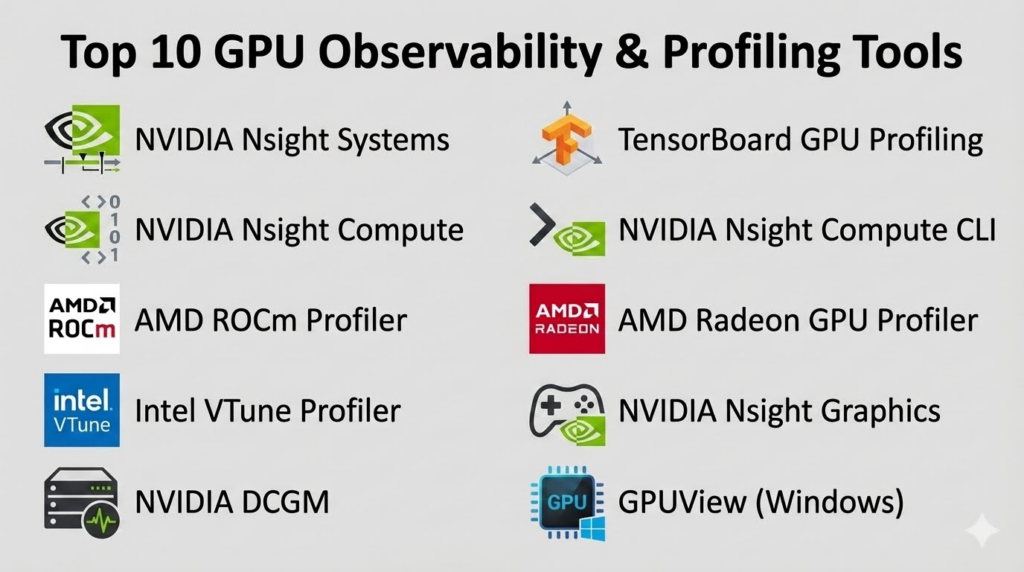
Introduction
GPU Observability and Profiling Tools are specialized software solutions designed to monitor, analyze, and optimize GPU performance in real-time. With the rise of AI, machine learning, high-performance computing (HPC), and graphics-intensive workloads, efficient GPU utilization has become critical for developers, data engineers, and IT operations teams. These tools provide metrics, traces, visualizations, and alerts to identify bottlenecks, memory usage issues, kernel inefficiencies, and overall system health, ensuring optimal performance and cost efficiency.In GPUs are central to AI model training, inference, scientific simulations, and graphics rendering. Organizations need deep insights into GPU utilization, memory consumption, and thermal behavior to maximize throughput and avoid resource wastage. Modern GPU observability tools integrate with cloud environments, container orchestration platforms, and AI frameworks, while profiling tools enable developers to optimize kernels and memory usage with precision.
Real-world use cases:
- Data scientists monitoring GPU clusters for AI model training efficiency.
- Developers profiling CUDA or OpenCL kernels to reduce execution latency.
- IT teams observing GPU health in data centers to prevent thermal throttling.
- Cloud engineers tracking GPU usage and billing for cost optimization.
- Gaming and graphics developers identifying bottlenecks in rendering pipelines.
What buyers should evaluate:
- Real-time GPU metrics and monitoring capabilities
- Profiling granularity (kernel-level, memory, PCIe bandwidth)
- Cloud and container orchestration integration
- Visualization dashboards and alerting systems
- Multi-GPU and multi-node support
- AI/ML framework compatibility (TensorFlow, PyTorch, JAX)
- Historical data retention and analytics
- Performance tuning recommendations
- Ease of deployment and configuration
- Licensing and cost scalability
Best for: AI/ML engineers, HPC system administrators, data center operators, cloud architects, and graphics developers seeking GPU performance insights.
Not ideal for: Casual desktop users or teams without GPU-intensive workloads; simple monitoring solutions may suffice in those cases.
Key Trends in GPU Observability & Profiling Tools
- AI-assisted profiling: Tools using machine learning to recommend kernel optimizations and memory usage improvements.
- Unified multi-GPU dashboards: Observing distributed GPU clusters across nodes and data centers.
- Container and orchestration integration: Kubernetes and Docker GPU monitoring for AI workloads.
- Real-time telemetry and alerts: Detecting throttling, thermal issues, and memory saturation dynamically.
- Framework-level insights: TensorFlow, PyTorch, JAX, and other ML framework-specific GPU metrics.
- Historical trend analysis: Time-series metrics for performance tuning and capacity planning.
- Lightweight agent deployment: Minimal overhead on GPU workloads while collecting accurate metrics.
- Cross-cloud and hybrid support: Monitoring GPUs across AWS, Azure, GCP, and on-prem clusters.
- End-to-end observability: Combining profiling, logging, tracing, and metrics into unified views.
- Developer-focused visualization: Flame graphs, timeline views, and kernel-level visual tools.
How We Selected These Tools (Methodology)
- Feature breadth: Evaluated monitoring, profiling, tracing, alerting, and visualization.
- Performance metrics: Precision and granularity of GPU utilization, memory, and PCIe bandwidth data.
- Framework compatibility: Support for AI/ML and HPC frameworks.
- Deployment models: Cloud-native, on-premises, agent-based, and container support.
- Ease of use: Dashboard clarity, configuration simplicity, and visualization quality.
- Scalability: Multi-GPU, multi-node, and cluster-level observability.
- Historical analysis: Ability to store and analyze performance trends over time.
- Integration ecosystem: Compatibility with logging, alerting, and orchestration tools.
- Community and support: Vendor reliability, documentation, and active user base.
- Cost/value ratio: Free vs commercial, licensing flexibility, and enterprise readiness.
Top 10 GPU Observability & Profiling Tools
#1 — NVIDIA Nsight Systems
Short description: NVIDIA Nsight Systems is a performance analysis tool for system-wide GPU profiling, providing timelines, kernel-level insights, and cross-application analysis.
Key Features
- System-wide GPU and CPU profiling
- Timeline visualization for kernels and threads
- PCIe, memory, and power usage metrics
- Integration with CUDA and graphics APIs
- Multi-node and multi-GPU support
- Trace export for offline analysis
Pros
- Deep kernel-level insights
- Cross-platform support
- Well-integrated with NVIDIA GPU drivers
Cons
- NVIDIA GPU-only support
- Steeper learning curve for beginners
- Requires updated drivers and CUDA versions
Platforms / Deployment
- Windows, Linux
- Native application
Security & Compliance
- Not publicly stated
Integrations & Ecosystem
- CUDA, OpenGL, DirectX integration
- Nsight Compute and Nsight Graphics tools
- Trace analysis pipelines
Support & Community
- NVIDIA support and forums
- Documentation and tutorials
#2 — NVIDIA Nsight Compute
Short description: Nsight Compute focuses on per-kernel GPU profiling, providing detailed metrics for performance tuning and memory optimization.
Key Features
- Kernel-level performance counters
- Memory and occupancy analysis
- Instruction-level statistics
- Guided optimization suggestions
- CSV/JSON export for further analysis
Pros
- Precise kernel-level profiling
- Performance optimization recommendations
- Supports CUDA workloads
Cons
- NVIDIA-only
- CLI may require learning
- Limited system-wide view
Platforms / Deployment
- Windows, Linux
- Native application
Security & Compliance
- Not publicly stated
Integrations & Ecosystem
- Nsight Systems interoperability
- CUDA profiling workflows
- Export to visualization tools
Support & Community
- NVIDIA support forums
- Developer documentation
#3 — AMD ROCm Profiler
Short description: AMD ROCm Profiler provides deep profiling and tracing for AMD GPUs, supporting HPC and AI workloads.
Key Features
- Kernel and memory profiling for AMD GPUs
- Performance counters and occupancy metrics
- Multi-GPU analysis
- CLI and graphical output
- Integration with ROCm toolchain
Pros
- Optimized for AMD HPC GPUs
- Supports AI and scientific workloads
- Open-source components
Cons
- AMD hardware only
- GUI is less polished than NVIDIA tools
- Limited multi-platform features
Platforms / Deployment
- Linux
- Native application
Security & Compliance
- Not publicly stated
Integrations & Ecosystem
- ROCm software stack
- TensorFlow/PyTorch ROCm backend
- Export to analysis pipelines
Support & Community
- ROCm developer forums
- GitHub documentation
#4 — Intel VTune Profiler
Short description: Intel VTune Profiler supports CPU and GPU performance profiling on Intel GPUs, providing detailed utilization, memory, and kernel-level insights.
Key Features
- GPU and CPU performance metrics
- Thread and memory profiling
- Hotspot and bottleneck analysis
- Graphical timeline views
- AI workload insights on Intel GPUs
Pros
- Intel GPU and CPU coverage
- High-resolution profiling
- Integration with Intel oneAPI
Cons
- Limited to Intel GPUs
- Complex setup for multi-node profiling
- GUI can be heavy on resources
Platforms / Deployment
- Windows, Linux
- Native application
Security & Compliance
- Not publicly stated
Integrations & Ecosystem
- oneAPI and AI frameworks
- Export to analysis tools
Support & Community
- Intel developer support
- Documentation and guides
#5 — NVIDIA DCGM (Data Center GPU Manager)
Short description: DCGM is a GPU monitoring tool for data centers, providing health, utilization, and telemetry data for multi-node GPU clusters.
Key Features
- Real-time GPU health metrics
- Telemetry for temperature, power, and memory
- Multi-node GPU cluster monitoring
- REST API and command-line interfaces
- Integration with Kubernetes
Pros
- Enterprise GPU cluster management
- Multi-GPU monitoring at scale
- NVIDIA-supported
Cons
- NVIDIA GPU-only
- CLI-centric for some features
- Requires cluster setup knowledge
Platforms / Deployment
- Linux
- Agent-based deployment in clusters
Security & Compliance
- Not publicly stated
Integrations & Ecosystem
- Kubernetes, Prometheus integration
- Telemetry export for dashboards
Support & Community
- NVIDIA enterprise support
- Documentation and examples
#6 — NVIDIA TensorBoard + GPU Profiling
Short description: TensorBoard provides GPU utilization and profiling for TensorFlow workloads, allowing model training performance analysis.
Key Features
- GPU and memory usage metrics
- Timeline of training and operations
- Profiler for kernel-level insights
- Integration with TensorFlow pipelines
Pros
- Tailored for AI/ML workloads
- Visual dashboards
- Free and open-source
Cons
- TensorFlow-specific
- Limited system-wide metrics
- Learning curve for profiling complex models
Platforms / Deployment
- Windows, Linux
- Web-based GUI
Security & Compliance
- Not publicly stated
Integrations & Ecosystem
- TensorFlow and Keras
- Data export to analysis pipelines
Support & Community
- TensorFlow community
- Documentation and tutorials
#7 — NVIDIA Nsight Compute CLI
Short description: Command-line interface version of Nsight Compute for automated profiling and integration into CI/CD pipelines.
Key Features
- Kernel-level metrics via CLI
- Automated profiling in scripts
- JSON/CSV output
- Batch analysis for multiple workloads
Pros
- Automates profiling for dev workflows
- Easy integration in pipelines
- Detailed metrics
Cons
- NVIDIA GPU-only
- CLI requires scripting knowledge
- Visualization requires external tools
Platforms / Deployment
- Windows, Linux
- CLI app
Security & Compliance
- Not publicly stated
Integrations & Ecosystem
- Nsight Systems integration
- CI/CD pipelines
Support & Community
- NVIDIA forums and guides
#8 — AMD Radeon GPU Profiler
Short description: Radeon GPU Profiler (RGP) provides detailed per-kernel profiling for AMD GPUs with timeline views and performance counters.
Key Features
- Kernel execution timelines
- Memory access profiling
- Event trace capture
- Integration with AMD Radeon software
Pros
- Detailed kernel and memory insights
- Optimized for AMD hardware
- Timeline visualization
Cons
- AMD hardware-only
- Limited multi-node support
- GUI learning curve
Platforms / Deployment
- Windows, Linux
- Native app
Security & Compliance
- Not publicly stated
Integrations & Ecosystem
- ROCm stack
- Export trace for analysis
Support & Community
- AMD forums
- Documentation
#9 — Nsight Graphics
Short description: NVIDIA Nsight Graphics focuses on GPU graphics profiling, providing shader, API, and frame-level insights for rendering workloads.
Key Features
- Frame capture and shader analysis
- GPU timeline and API tracing
- Performance counters
- VR and real-time graphics profiling
Pros
- Detailed graphics insights
- Supports Vulkan, DirectX, OpenGL
- Visual timeline analysis
Cons
- NVIDIA-only
- Complex for beginners
- Focused on graphics workloads
Platforms / Deployment
- Windows, Linux
- Native app
Security & Compliance
- Not publicly stated
Integrations & Ecosystem
- Nsight Compute/Systems interoperability
- Game engine profiling
Support & Community
- NVIDIA documentation
- Developer forums
#10 — GPUView (Windows)
Short description: GPUView is a Windows tool for low-level GPU performance visualization, suitable for driver and system-level debugging.
Key Features
- Timeline of GPU execution
- Kernel and memory visualization
- Event tracing for debugging
- Low-level Windows GPU metrics
Pros
- Free and Windows-native
- Detailed low-level analysis
- Useful for driver and graphics developers
Cons
- Windows-only
- Steep learning curve
- GUI and visualization limited compared to modern tools
Platforms / Deployment
- Windows
- Native app
Security & Compliance
- Not publicly stated
Integrations & Ecosystem
- Windows Performance Toolkit
- Export logs for analysis
Support & Community
- Microsoft developer documentation
- Forums and guides
Comparison Table (Top 10)
| Tool Name | Best For | Platforms Supported | Deployment | Standout Feature | Public Rating |
|---|---|---|---|---|---|
| NVIDIA Nsight Systems | System-wide GPU profiling | Windows, Linux | Native | Cross-application timelines | N/A |
| NVIDIA Nsight Compute | Kernel-level optimization | Windows, Linux | Native | Detailed kernel metrics | N/A |
| AMD ROCm Profiler | AMD GPU profiling | Linux | Native | HPC & AI workloads | N/A |
| Intel VTune Profiler | Intel GPU/CPU performance | Windows, Linux | Native | CPU+GPU hotspot analysis | N/A |
| NVIDIA DCGM | Data center GPU monitoring | Linux | Agent/Cluster | Multi-node GPU telemetry | N/A |
| TensorBoard GPU Profiling | AI/ML TensorFlow workloads | Windows, Linux | Web GUI | Timeline and GPU usage | N/A |
| NVIDIA Nsight Compute CLI | Automated profiling | Windows, Linux | CLI | Batch kernel analysis | N/A |
| AMD Radeon GPU Profiler | Graphics and compute profiling | Windows, Linux | Native | Memory and kernel timeline | N/A |
| NVIDIA Nsight Graphics | GPU graphics debugging | Windows, Linux | Native | Shader and frame profiling | N/A |
| GPUView (Windows) | Low-level Windows GPU analysis | Windows | Native | Event tracing and kernel visualization | N/A |
Evaluation & Scoring of GPU Observability & Profiling Tools
| Tool Name | Core (25%) | Ease (15%) | Integrations (15%) | Security (10%) | Performance (10%) | Support (10%) | Value (15%) | Weighted Total (0–10) |
|---|---|---|---|---|---|---|---|---|
| NVIDIA Nsight Systems | 9 | 7 | 8 | 8 | 9 | 8 | 7 | 8.25 |
| NVIDIA Nsight Compute | 9 | 7 | 7 | 8 | 9 | 8 | 7 | 8.1 |
| AMD ROCm Profiler | 8 | 6 | 7 | 8 | 8 | 7 | 7 | 7.6 |
| Intel VTune Profiler | 8 | 7 | 8 | 8 | 8 | 7 | 7 | 7.85 |
| NVIDIA DCGM | 8 | 6 | 7 | 8 | 8 | 7 | 7 | 7.6 |
| TensorBoard GPU Profiling | 7 | 8 | 7 | 7 | 7 | 7 | 7 | 7.3 |
| NVIDIA Nsight Compute CLI | 8 | 6 | 7 | 7 | 8 | 7 | 7 | 7.45 |
| AMD Radeon GPU Profiler | 8 | 6 | 7 | 7 | 7 | 7 | 7 | 7.35 |
| NVIDIA Nsight Graphics | 8 | 7 | 7 | 7 | 7 | 7 | 7 | 7.45 |
| GPUView (Windows) | 7 | 6 | 6 | 7 | 6 | 6 | 7 | 6.55 |
Interpretation: Higher weighted totals indicate better balance across GPU monitoring, profiling features, ease of use, integration potential, and value. Scores are comparative and context-dependent, with NVIDIA tools dominating in ecosystem integration, while AMD and Intel provide hardware-specific advantages.
Which GPU Observability & Profiling Tool Is Right for You?
AI/ML Engineers
TensorBoard GPU Profiling, Nsight Systems, and Nsight Compute provide detailed metrics for model training performance and kernel optimizations.
HPC System Administrators
NVIDIA DCGM, Nsight Systems, and VTune Profiler deliver cluster-level GPU health, utilization, and telemetry.
Graphics Developers
Nsight Graphics and Radeon GPU Profiler focus on rendering pipelines, shader performance, and frame analysis.
Multi-GPU Cloud Environments
DCGM and Nsight Systems monitor distributed GPU workloads across nodes with telemetry aggregation and alerting.
Developer Automation & CI/CD
Nsight Compute CLI enables automated kernel profiling and integration into CI/CD pipelines.
Frequently Asked Questions (FAQs)
1. Do these tools support multiple GPU vendors?
Some tools like Nsight and DCGM are NVIDIA-only, while ROCm and Radeon GPU Profiler support AMD hardware. VTune supports Intel GPUs.
2. Can I profile AI workloads?
Yes — TensorBoard, Nsight Systems, and ROCm Profiler integrate with AI frameworks like TensorFlow, PyTorch, and JAX for performance monitoring.
3. Are these tools real-time?
Most provide near real-time metrics and telemetry; however, some detailed kernel traces require post-processing.
4. Do I need specific drivers?
Yes — NVIDIA tools require updated CUDA drivers; AMD tools require ROCm; Intel VTune requires Intel GPU drivers.
5. Can I monitor GPU clusters?
Yes — DCGM, Nsight Systems, and ROCm support multi-node GPU observability with aggregated metrics.
6. Are these tools free?
Some like TensorBoard and ROCm Profiler are free/open-source; NVIDIA Nsight tools may be free but require NVIDIA GPUs; enterprise-grade monitoring may require licenses.
7. Do these tools measure memory usage?
Yes — all profiling tools provide memory footprint, bandwidth, and utilization metrics per GPU/kernel.
8. Can they help optimize code?
Yes — profiling highlights bottlenecks, underutilized memory, and kernel inefficiencies for optimization.
9. Are they cross-platform?
Most support Windows and Linux; a few support macOS (Nsight Systems, Nsight Compute, TensorBoard).
10. How do I visualize GPU traces?
Tools like Nsight Systems, Nsight Graphics, TensorBoard, and Radeon GPU Profiler provide timeline visualizations, flame graphs, and per-kernel charts.
Conclusion
GPU Observability & Profiling Tools are essential for developers, AI
/ML engineers, HPC administrators, and graphics professionals seeking maximum performance and efficiency from GPU resources. They enable insight into kernel execution, memory utilization, multi-GPU clusters, and telemetry while facilitating optimization and cost efficiency. Selecting the right tool depends on the GPU vendor, workload type, scale, and level of detail needed — from developer kernel profilers to enterprise-grade cluster observability. Start by defining workload priorities, pilot the tools on your environment, and integrate telemetry and profiling insights into your performance and optimization workflows.

Managing comprehensive unique graphics accelerator hardware core performance monitoring measurement software optimizes corporate machine learning model calculation mechanics, ensuring rapid decentralized visual processor workload efficiency verification auditing and frictionless high-performance artificial intelligence computing resource utilization methodologies.