Thanjavur City
Thanjavur was the royal city of the cholas, Nayaks and the Mahrattas. Thanjavur derives its name from Tanjan-an asura (giant), who according to local legend devastated the neighbourhood and was killed by Sri Anandavalli Amman and Vishnu, Sri Neelamegapperumal. Tanjan's last request that the city might be named after him was granted.
About Thanjavur City
Thanjavur, the legacy of the Chola Dynasty, is one of the most prosperous districts in the country. Established during the beginning of the Christian era, the glory of the Cholas is reflected in the 74 odd temples in and around Thanjavur. It is scenically one of the most enchanting districts in Tamil Nadu, and houses a World Heritage monument - the Brahadeeswara Temple.
Thanjavur (or Tanjaur) in Tamil Nadu was once the capital of mighty Cholas. It is said that the kingdom was so fertile that elephants used to thrash paddy here. To this day, one can see stately ancient buildings and their ruins on almost every street of the city. Tamil Nadu is known for nurturing literature, classical music and arts for hundreds of years. Thanjavur is not untouched by the sophistication, culture and knowledge that Tamilians are so proud of. Thanjavur paintings use semi-precious stones and gold foil to create deities in a style unique to the region. Since genuine antique Tanjore paintings are extremely rare, you will find only newer ones (perhaps with antique finish) in the market.
Thanjavur is also well-known for its Tanjore plates – brass plates with silver inlay work, the Indian musical instrument called Veena, and colourful papier mache dolls known as Thanjavur thalayatti bommais. These dolls move their heads like Bharatanatyam dancers. There is an interesting story about how the city of Thanjavur came into being. It is believed that Lord Vishnu killed a devil or asur named Thanjan on the banks of River Cauvery. Just before dying, Thanjan pleaded to Lord Vishnu that a beautiful and great town named after him should rise on the spot of his death and his wish was granted. Thus, Thanjanasur (which later became Thanjavur) came into existence.
Climate/Weather of Thanjavur City
**Summer:**Max :98 C, Min : 46C,
Winter: Max : 30C, Min : 25C
History of Thanjavur City
In 1758 AD French attacked but was retaken by British in 1773 AD. Thanjavur became a protected state under the East India Company. In 1799 AD Thanjavur became a British principality and its ruler Sarafoji II was given the fort of Thanjavur and an area outside it. Sivaji, his successor died in 1855 AD without an heir and after him Thanjavur passed directly under British. Its accquisition never costing the British the life of a single soldier, in the same manner as the Mahrattas had taken the country previously from the Nayaks.
Culture
Thanjavur Festivals:
Saint Thyagaraja Aradhana Musical Festival - January. Pongal (Tourist) Festival - 14th to 16th January. Maham Festival in Kumbakonam - February and March once in 12 year. Last held in 1992. Arulmigu Thyagarajaswamy Car Festival - March. Muthupallakku Thiruvizha - May. Annai Velannkanni Festival - August and September. Raja Raja Chola’s Birthday Sathaya Thiruvizha - October every year. Nagoor Kandoori Festival - December.
Thanjavur Culture:
Thanjavur is known for its Carnatic music. It has produced many classical musicians and Bharatnatyam dancers. It has become the second important site for the annual Natyanjali dance festival. Tiruvaiyaru, close to Thanjavur is the place where the great musician saint Tyagaraja lived. Every year in the Tamil month of Thai, the musicians from all over the country will hold Tyagaraja Aradhana. Tamil, Marathi and English are the main spoken languages of Thanjavur. Thanjavur is also known for its unique painting style called Tanjore painting. The artist use a combination of canvas background with glass, metals to depict and decorate various scenes from Hindu mythology.
Tourist Attraction of Thanjavur City
Brahadeeswarar Temple:
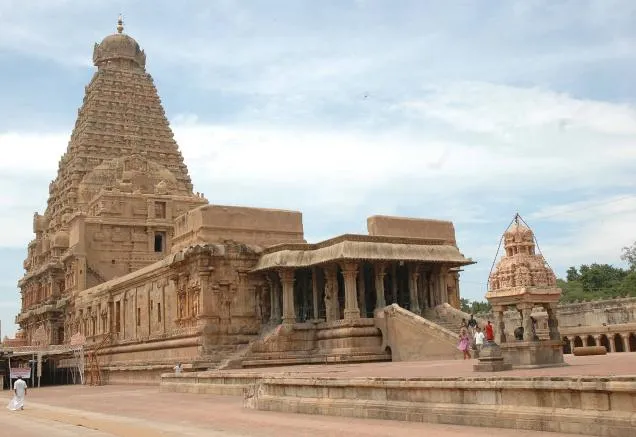
The Brahadeewarar temple, called the Big Temple, is dedicated to Lord Siva. It was built by the great Chola King Raja Raja 1 (985 -1012 A.D). it is an outstanding exmple of Chola architecture. Recognizing its unique architectural excellence, UNESCO has declared it a World Heritage Monument.
The 64. 8 Mt. tall vimanam (tower over the sanctum sanctorum) is testimony to the engineering skill of the Cholas. In keeping with the size of the temple, it has gigantic “Mahalingam” in the shrine, measuring 4 meters in height. A monolithic Nandhi chiseled out of a single rock, measures 5. 94 meters in length, 2.51 metres in breadth and 3.66 meters in height. it is the second largest Nandhi in India. The Nandhi or bull is the vehicle of Lord Siva. Beautiful Chola fresco paintings adorn the inner walls of the Temple. One of the outstanding temples in South India, the Brahadeeshwarar temple is the Chola dynast’s finest contribution to Dravidian temple architecture. What makes the construction so unique is the variation from the usual temple building style of having a tall gopuram and smaller vimanam. At the Big Temple the vimanam asoars high while the gopuram is smaller. The 64. 8m tall, 14 tier pyramid shaped vimanam raised from a square base is topped by a huge monolithic cupola carved from an 81.3 tonne block of granite. It was raised with the aid of a 6 km long inclined plane. (ph.274476).
The Palace:
Just 1 km away from the Brahadeeswarar Temple is a magnificent palace, surrounded by huge fort walls. Dating back to the 14th century A.D., it was built partly by the Nayaks and partly by the Marathas. The Maratha royal family resides in this palace. It is a fascinating building with huge corridors, spacious halls, decorated rooms, tall observation towers, beautiful stucco works, wonderful fresco painted walls and ceilings, an underground tunnel and intricate carvings. The royal family’s sacred “Chandramaulessshwarar Temple” is located within the palace walls. (P:h 223384)
Art Gallery:
The art gallery has a fabulous collection of bronze icons, stone sculpture and pieces of art. The Collection is unique for its representation of Hindu gods and goddesses, myths and legends. The exhibits are priceless for their historical association.
Saraswathi Mahal Librart:
The Thanjavur Maharaja Serfoji’s Saraswathi Mahal Library is one among the few libraries in the world with texts of the medieval period. It is a treasure house of knowledge carefully fostered and nurture by successive dynasties of Nayaks and the Marathas of Thanjavur. It contains a rare and valuable collection of manuscripts, books, maps and paintings on all aspects of Art, Culture and literature, The Encyclopedia Britannica, in its survey of the Libraries of the world, describes it as “the most remarkable Library was made a Public Library in 1918
Sangeetha Mahal (Hall of Music):
Also in the Palace in the Sangeetha Mahal, acoustically perfect music hall. It is a striking example of the engineering skill of ancient builders.
Memorial Hall:
Located in the Palace complex, it displays rate antique belonging to the Maratha Royal Family. The artefacts, manuscripts, weapons, royal robes and handicrafts made out of ivory, jade, lacquer, glass, porcelain, wood, cloth and leather are worth seeing.
Marattah Durbar Hall:
Its huge pillars, beautiful stucco paintings and fresco-painted ceiling are eye-catching.
Sharajah Madi:
This is in the eastern part of the palace, built in the Saracenic style by Raja Serfoji after his return from Varanasi. It is six-storied and well-known for its ornamental balconies. Its spacious halls bespeak the grandeur of this palace. it enables the tourists to have a panoramic view of Thanjavur City (Ph:273623).
Rajarajan Mani Mandapam:
It is in the southern part of Thanjavur. It was built during the 8th World Tamil Conference in 1995. This Manimandapam has a museum in its ground floor.
Schwartz Church:
This church was built adjacent to Siva Ganga Tank in 1779 AD by Rajah Serfoji as a token of his affection to his tutor Rev. C.VSchwartz, a Danish missionary.
Sivaganga Tank:
This water tank lies beyond the North west compound of Brahadeeswarar Temple. It is surrounded by large walls and known for it’s sweet water.
Rajagopala Beerangi (cannon):
This is a huge cannon placed at the eastern gate of the Fort. The place is called ‘Beerangi Medu’. The Cannon is amazing in size and the quality speaks of the metallurgical knowledge of the people of those times. The Beerangi is the biggest in India.
Tholkappiyar Sadukkam:
This Sadukkam (Square) was built during the 8th World Tamil Conference. One can have a panoramic view of Thanjavur town from the tower.
Hotels/Lodge/Accommodation in Thanjavur City
**Hotel Rayas:**18,19 Head Post Office Road, , Kumbakonam, Thanjavur, Tamil Nadu,Ph:0435 2423270
**Jennys Residency:**3/14 Mc Donald’s Road, Tiruchirapalli, Tamil Nadu,Ph:0431 2414414
**Hotel Sangam:**Collector Office Road, Tiruchirapalli, Tamil Nadu,Ph:0431 2414700
**Hotel Femina (P) Ltd:**Williams Rd, Tiruchchirappalli, Tiruchirappalli, Tamil Nadu,Ph:0431 2414501
**Ramyas Hotel:**Williams Rd, Tiruchchirappalli, Tiruchirappalli, Tamil Nadu,Ph:0431 4000400
**Srishty Garden Resorts:**145, old-Courtalam, Ayiraperi (P.O), Courtallam, Tamil Nadu,Ph:04633 220960
Location info
Thanjavur City,Thanjavur Districts ,Tamil Nadu,India
How to reach Thanjavur City
- **Nearest Railway Station:**There is a railway junction in Thanjavur. It’s well connected with Tiruchi, Chennai and Nagore.
**Nearest Airport:**Airport Trichy. Thanjavur is 65kms east of Tirchy. Next closest airport is at Madurai. It’s about 200 kms by road. If you come from other parts of the country you can land in Chennai airport. Thanjavur is around 350 kms south of Chennai by road.
Road Transport: Thanjavur is well linked with all the major towns in Tamil Nadu and is also connected with Kochi, Ernakulam, Thiruvananthapuram and Bangalore.
Best time to visit Thanjavur City
November to February when the weather is pleasant with lower humidity. Evenings are ideal for exploring markets and food streets. Mornings are best for temple visits and sightseeing.
Timings & opening hours
The city is accessible 24/7. Major attractions within the city have their own visiting hours. Markets are typically open 10:00 AM–9:00 PM. Temples and religious sites open early morning to late evening.
Entry fee & tickets
Entry to the city is free. Specific attractions (temples, museums, parks) have separate entry fees ranging from INR 10–100 depending on the site.
Duration needed
1–2 days to explore the main attractions. A longer stay allows for deeper exploration of the city’s culture, cuisine, and nearby areas.
Safety tips
Standard city safety precautions apply. Keep valuables secure in crowded markets and public transport. Use registered taxis or app-based cab services. Avoid isolated areas after dark. Follow local customs and dress codes at religious sites.
Things to carry
- Comfortable Walking Shoes: City sightseeing involves significant walking.
- Water Bottle: Stay hydrated.
- Sunscreen and Hat: Protect against the sun.
- Camera: Document your tour.
- Power Bank: Keep devices charged.
- ID Proof: For hotel check-in.
Nearby visiting places
Other towns and cities in Tamil Nadu, historical sites, temples, and natural attractions within a 50–100 km radius.
Nearest airport, railway & bus
Nearest airport: the city’s own airport or the nearest regional airport. The city has a railway station with express train connectivity. Well-connected by state and private bus services to all major cities.
Mobile network coverage
Airtel, Jio, BSNL, and Vi all provide coverage across Tamil Nadu. 4G is reliable in Chennai, Coimbatore, Madurai, and along major highways. Coverage may be weaker in remote sections of the Western Ghats, deep forest reserves, and certain rural interior areas. Free Wi-Fi is widely available in hotels and cafes in urban areas.
Food & restaurants nearby
Thanjavur is renowned for its traditional Tamil cuisine and rich food heritage. The famous “Thanjavur thalappakatti biryani” is a local legend. Traditional vegetarian meals served on banana leaves feature sambar, rasam, poriyal, kootu, avial, appalam, and creamy curd rice. Traditional sweets like athirasam (deep-fried jaggery snack), murukku, and payasam are local favorites available at sweet shops across the city.
Things to do at Thanjavur City
Explore the city’s historic temples and heritage buildings that showcase Tamil architecture. Visit local markets for traditional crafts, textiles, and local produce. Sample the diverse Tamil cuisine at local restaurants and street food stalls.
Things to visit & highlights
The city’s main temple or historic landmark, its bustling market areas, local parks, and cultural institutions. The surrounding residential and commercial areas reflect the city’s character and daily life.
Helpline & emergency contacts
Tourist Helpline: 1364. Police: 112. Ambulance: 108. City has government hospitals, private clinics, and 24-hour pharmacy services.
Nearest petrol pump
Multiple petrol pumps are available throughout the city. Major fuel stations (Indian Oil, Bharat Petroleum, HPCL, Reliance) operate in all parts of the city.
Frequently asked questions
What is the best time to visit Thanjavur City? November to February offers the most pleasant weather. Evenings are ideal for exploring the city’s markets and food scene.
How can I get around Thanjavur City? Local buses, auto-rickshaws, and app-based cab services are widely available. Auto-rickshaws are the most convenient for short distances.
What are the must-try local foods in Thanjavur City? Traditional Tamil dishes like idli, dosa, vada, sambar, and filter coffee are must-tries. Local specialities vary by city — ask for regional specialities.
Quick facts
- Type: Destination
- State: Tamilnadu
- Category: City
Map & location view
This section is being updated and will be available shortly.
Photo gallery of Thanjavur City
Video gallery
Related destinations
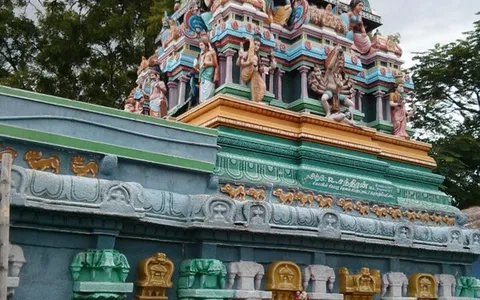
Aruppukottai City
Aruppukottai town lies 50 km south of Madurai city and 20 km East of Virudhunagar town on the Tuticorin - Madurai National Highway road Extension No.49B, being a…
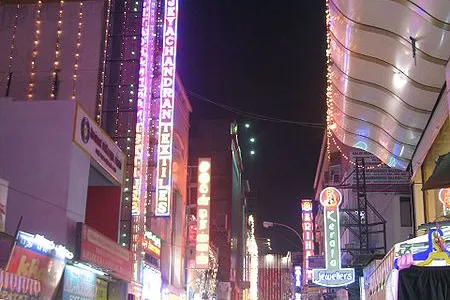
Chennai City
Chennai is the largest city in Tamil Nadu and is located on the southeastern coast of India. The city was formerly known as Madras and was established by the…
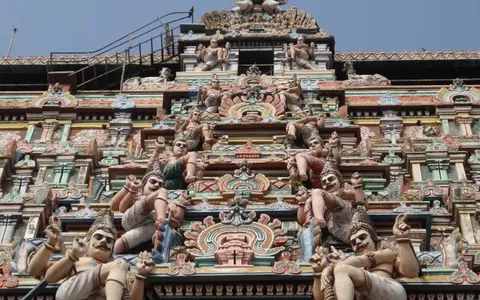
Chidambaram City
Chidambaram is 250 Kms south of Chennai. This is a medium sized town with all facilities. The value of the town is enhanced not only by the temple but also by the…