Kolam
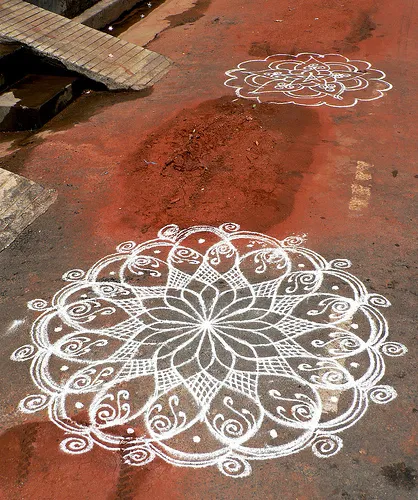
Kolam is the name given to the art of Rangoli in southern parts of the country. The Hindus residing in these parts make use of this art form on a large scale. The female members of the house usually draw Kolam designs in front of their homes, with the help of rice powder. Limestone and red brick powder are also used on special occasions. Kolam is regarded as a sort of painted prayer in South India. The design usually comprises of a symmetric line drawing, which comprises of curved loops, drawn…
About Kolam
Kolam is the name given to the art of Rangoli in southern parts of the country. The Hindus residing in these parts make use of this art form on a large scale. The female members of the house usually draw Kolam designs in front of their homes, with the help of rice powder. Limestone and red brick powder are also used on special occasions. Kolam is regarded as a sort of painted prayer in South India. The design usually comprises of a symmetric line drawing, which comprises of curved loops, drawn around a crisscross pattern of dots.
In a South-Indian home, it is believed Kolam design bestows prosperity and success. Though the design is generally drawn with the help of dry rice flour, diluted rice paste is also made use of, especially when one intends to signify longevity. At times, paints and chalks are also used to draw the design. In case of special occasions, such as marriages,ritual Kolam patterns can stretch all the way from the courtyard to the street. The patterns are often passed on from generation to generation,like from a mother to her daughter. Though less ostentatious than Rangoli, Kolam art of Tamil Nadu and Kerala is considered as outstanding in its beauty.
History
Apart from being used for decoration, Kolam serves other purposes also.One of the uses of Kolam is to provide food to the ants. Since the designs are made with the help of coarse rice flour, they provide an easy as well as readily available source of food supply for the ants. At the same time, it is said that rice powder attracts birds and other small critters. Thus, the design is a sort of invitation to all, especially Goddess Lakshmi - the Goddess of prosperity, into one’s home and everyday life.
Then, there are health benefits of Kolam. Since one has to bend down to make the pattern, it brings about an improvement in the digestive system and reproductive organs and also serves as an overall stretching exercise for the body. The ability to draw large complicated patterns without lifting the hand off the floor or unbending to stand up is believed to be a matter of pride for the South Indians.
Features
Kolams are thought to bestow prosperity to homes. Every morning in southern India, millions of women draw kolams on the ground with white rice powder. Through the day, the drawings get walked on, rained out, or blown around in the wind; new ones are made the next day. Every morning before sunrise, the floor is cleaned with water, the universal purifier, and the muddy floor is swept well for an even surface. The kolams are generally drawn while the surface is still damp so that it is held better. Occasionally, cow-dung is also used to wax the floors. Cow dung has antiseptic properties and hence provides a literal threshold of protection for the home. It also provides contrast with the white powder.
Decoration was not the sole purpose of a Kolam. In olden days, kolams used to be drawn in coarse rice flour, so that the ants don’t have to work so hard for a meal. The rice powder is said to invite birds and other small critters to eat it, thus inviting other beings into one’s home and everyday life: a daily tribute to harmonious co-existence. It is a sign of invitation to welcome all into the home, not the least of whom is Goddess Lakshmi, the Goddess of prosperity. The patterns range between geometric and mathematical line drawings around a matrix of dots to free form art work and closed shapes. Folklore has evolved to mandate that the lines must be completed so as to symbolically prevent evil spirits from entering the inside of the shapes, and thus are they prevented from entering the inside of the home
Usefull Links
wikipedia: http://en.wikipedia.org/wiki/Kolam
**culturalindia.net:**http://www.culturalindia.net/indian-art/rangoli/kolam.html
Best time to visit Kolam
November to February for comfortable weather. Check specific venue details for seasonal opening hours. Morning hours (9 AM–12 PM) are generally less crowded.
How to reach Kolam
Kolam is accessible by road from the nearest town or city. Local transport options include buses, taxis, and auto-rickshaws. The nearest railway station provides rail connectivity. Well-marked roads lead to the venue.
Timings & opening hours
Varies by establishment. Typically open during daytime hours — check locally for specific timings. Many such venues operate 9:00 AM–6:00 PM.
Entry fee & tickets
Entry fees vary depending on the specific venue. Contact the venue directly for current pricing. Some venues may offer free entry with charges for specific activities.
Duration needed
1–3 hours depending on the type of venue and visitor interest. Allow additional time for travel and nearby exploration.
Location info
Kolam is located in Tamil Nadu, South India. It is situated approximately 400 km from Chennai, accessible by road and well-connected to nearby towns and cities..
Safety tips
General safety precautions apply. Follow venue-specific guidelines. Keep valuables secure. Supervise children where applicable.
Things to carry
Standard travel essentials: water bottle, comfortable shoes, camera, appropriate clothing for the venue type.
Nearby visiting places
Other attractions, restaurants, and commercial areas in the vicinity.
Nearest airport, railway & bus
Nearest airport: Chennai International Airport (MAA) or the nearest regional airport. Nearest railway station: the nearest major railway station in Tamil Nadu, well-connected by express and passenger trains. By road: well-connected by Tamil Nadu State Transport Corporation (TNSTC) buses and state highways from nearby towns and cities.
Mobile network coverage
Airtel, Jio, BSNL, and Vi all provide coverage across Tamil Nadu. 4G is reliable in Chennai, Coimbatore, Madurai, and along major highways. Coverage may be weaker in remote sections of the Western Ghats, deep forest reserves, and certain rural interior areas. Free Wi-Fi is widely available in hotels and cafes in urban areas.
Food & restaurants nearby
Near Kolam, local restaurants and eateries serve authentic Tamil Nadu cuisine including idli, dosa, vada, sambar, and rice-based meals. Visitors can also find North Indian and Chinese options at multi-cuisine restaurants in the nearest town.
Hotels & accommodation nearby
For accommodation near Kolam, nearby towns and cities offer options ranging from budget lodges and guesthouses to mid-range hotels. During peak tourist season (December to March) and during major festivals like Pongal (January), it is advisable to book accommodation in advance. Most hotels offer basic amenities including attached bathrooms, fans/AC, and in-house vegetarian food options.
Things to do at Kolam
Explore the venue and its offerings. Depending on the type of venue, activities may include learning about local crafts, enjoying recreational facilities, or experiencing local culture.
Things to visit & highlights
The main venue facilities and any associated attractions in the immediate area. Nearby landmarks and complementary points of interest.
Climate & weather
Tamil Nadu has a tropical climate with generally hot and humid conditions year-round. The best time to visit is November to February, when temperatures are a more comfortable 20°C–28°C. March–June is very hot, with interior areas reaching 40°C+. The state receives rainfall from both the southwest monsoon (June–September, mainly in western ghats) and the northeast monsoon (October–December, bringing rain to coastal areas including Chennai). Hill stations (Ooty, Kodaikanal) are pleasant year-round.
Helpline & emergency contacts
Tourist Helpline: 1364. Police: 112. Ambulance: 108.
Nearest petrol pump
Petrol pumps are available in the nearest town and along the main approach roads.
Frequently asked questions
What are the visiting hours of Kolam? Hours vary by venue and season. Contact the venue directly or check online for current timings.
Is photography allowed? Photography policies vary by venue. Check with the venue staff before taking photos.
Is the venue suitable for children? Suitability depends on the venue type. Contact the venue in advance to determine if it is suitable for children.
Quick facts
- Type: Destination
- State: Tamilnadu
- Category: Art And Craft
Map & location view
This section is being updated and will be available shortly.
Photo gallery of Kolam
Video gallery
Related destinations

Jewellery
Tamilnadu is an important state in the southern part of India. Standing on the coasts of Bay of Bengal this state is gifted with plenty of handicrafts and master…
Metalware
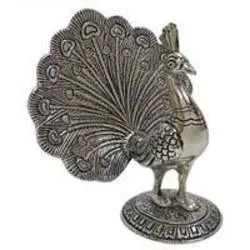
The famous brass and copper metalware has a rich and ancient tradition in Tamil Nadu. These metal objects are used for both religious and secular purposes, though…
Musical Instruments
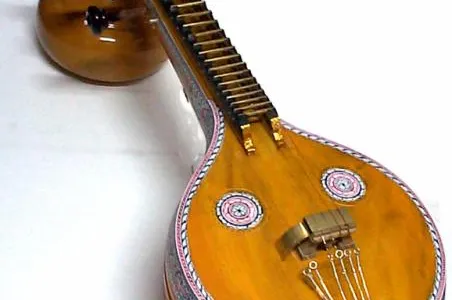
Music is deeply ingrained in Tamil Nadu’s culture, and the traditional musical instruments crafted here are a source of admiration and pride. Music and dance form…