Mulshi Dam
Mulshi is the name of a major dam on the Mula river located in the Taluka Mulshi administrative division of the Pune district of Maharashtra State, India.
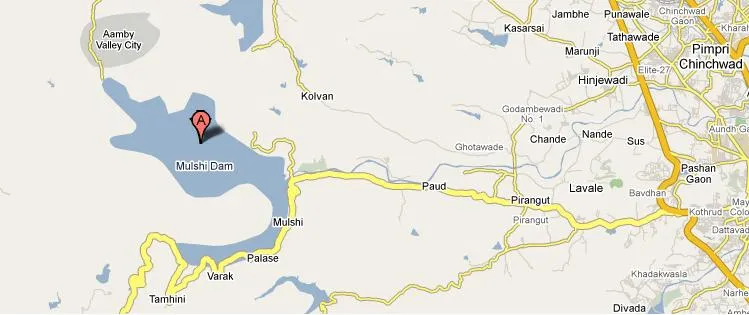
About Mulshi Dam
Water from the dam is used for irrigation as well as for producing electricity at the Bhira hydroelectric power plant, operated by Tata Power Company LTD. The station operates six 25MW Pelton turbines and was established in 1927. It mostly supplies power to Mumbai.
The Mula River is an important river in India that originates at the Mulshi Dam in Taluka Mulshi in Pune district in the Western Ghats province of the Indian state Maharashtra. In the city of Pune it converges with the Mutha River. Mula is a tributary of the Bhima River in the Deccan India and thus a distributary of Godavari. It passes through the towns of Pune and Khadki. Biologists have said that there are around 108 species of fish, 102 blossoming plant species, 130 bird species in and around the riverbanks and surrounding areas.
Mulshi is to the west of Pune and close to Lonavala as well as Konkan region. Mulshi dam and the surroundings are full of natural beauties that includes a dam, hilly region of Sahyadri’s deep forests and forts like Dhangad and Koraigadh.
Mulshi is very near to Pune and a short trip here can be arranged. One must enjoy the marvelous lake, the dam, forest and hilly region of Mulshi. If you are lucky then you can enjoy boating here as well. Thus, it is a newly developing picnic spot near Pune.
The dense forest around the Dam and lake offer the views of some rare wild animals and also views of variety of trees including Teak, sag, mango trees and oak. The forest cover and the lake are habitats of bird flora and many varieties colored birds can be spotted here. The Munshi Lake and dam are really charming for a nature loving visitor.
Interesting things to Visit
Aga Khan Palace
Aga Khan Palace is situated in the Yerwada area of Pune. Sultan Mohammed Shah, Aga Khan III, got the palace constructed in the year 1892. The aim behind the construction of the Aga Khan Palace was to provide employment to the people of the nearby areas, who were hit by famine.
Film and Television Institute of India
Film and Television Institute of India (FTII) of Pune is situated on the Law College Road, at a distance of one km from Deccan Gymkhana. Spread over an area of 21 acres, the institute was established on the recommendation of Film Enquiry Committee.
Lal Mahal
Lal Mahal (Palace), dating back to the year 1634, was constructed by Sahaji Bhonsale, Shivaji’s father. When Sahaji received territories in Pune from Bijapur Sultanat, he sent his wife, Jijabai, and his son to the city and got the palace built as their residence.
Osho Commune International
Osho Commune International is an ashram founded by Rajneesh Chandra Mohan Jain, popularly known as Osho. Situated in the Koregaon Park of Pune, Osho Ashram is mainly famous for the meditation courses it offers. Away from the hectic pace of city life, the ashram comes as a welcome relief for the people
Parvati Hill and Temple
Parvati Hill and Temple are quite famous amongst the tourists visiting Pune. The hill is situated at a distance of approximately one km from Swargate and four km from Deccan Gymkhana. The picturesque beauty of the hill is what draws tourists here.
Raj Bhavan
Raj Bhavan of Pune, also known as the Government House, dates back to the year 1866. It is situated in Ganeshkhind and was designed by the famous architect, James Trubshawe. Built under the British Raj, Raj Bhavan was originally meant to be used in summers by the government of Bombay Presidency under the British Raj.
Shaniwar Wada
Shaniwar Wada is situated in Shaniwar Peth, near the railway station of Pune. It is a fort, whose foundation was laid down by Peshwa Baji Rao in the year 1729-30. It took two years to complete the fort and later, many additions were also made to it by the successors of Baji Rao.
Shindyanchi Chhatri
One of the greatest architectural beauties of the Pune city is the Shindyanchi Chhatri, situated in Wanowrie. It is a memorial dedicated to the great soldier, Mahadji Shinde. For twenty years, between 1760 and 1780, he served as the commander-in-chief of the Maratha army under the Peshwas.
Hotels/Lodge/Accommodation
- Fariyas Group Of Hotels
- The Central Park Hotel
- Pristine Hospitalities Pvt. Ltd.
Help Line/Phone Number
Karla Caves is an complex of ancient Buddhist Indian rock-cut architecture cave shrines built over the period of 3rd to 2nd century B.C. Even though the caves were constructed over a period of time and the oldest one is believed to date back to 160 BC. Located in Karli near Lonavala, Maharashtra, the caves are on an major ancient trade route, running eastward from the Arabian Sea into the Deccan. Karli’s location in Maharashtra places it in a region that is the division between North India and South India……more
Rajmachi consists of two beautiful peaks namely ‘Shrivardhan’ and ‘Manaranjan’. Rajmachi is very famous fort near twin hill stations in Maharashtra - Lonavala and Khanadala. Rajmachi fort is nearby 18/20 Kms from Lonavala but a nice way to reach the fort is from Tungarli Lake. This trek is very good for the beginners.Shrivardhan and Manaranjan can also be considered as two separate forts. There is one small platue in between them…..more
Situated 32 km south west of Pune, and standing at an imposing 1215 m above msl overlooking Pune city, Sinhagad, even today stands testimony to the grand Maratha Regime.On top of the fort, the trekkers must try the traditional breakfast of Kanda Bhaji, a delicacy enjoyed by most. Check out Tanaji Kada, Kalyan Darwaza, Tanajis memorial…Perched on an isolated cliff of the Bhuleswar range of the Sahyadri Mountains, its height above sea-level is 1350 metres. Given natural protection by its very steep slopes, the walls and bastions were constructed at only key places; it has two gates – the Kalyan Darwaza in the south-east and the Pune Darwaza in the north-east…..more
Tikona (also known as Vitandgad) is the dominant hill fort in Maval in western India. It is located near Kamshet around 60 km from Pune The village nearest the fort is called Tikona-Peth. The 3500 ft high hill is pyramidal in shape and the name Tikona means “triangle”.The fort is a trekking destination noted for the large doors, the temple of ‘Trimbakeshwar Mahadev’, a water tank and some Satvahan caves. Trek organisers also commend the views of Pawna dam and the nearby forts of Tung, Lohagad and Visapur. There is a lake at the summit…..more
Copyright 2016 HolidayLandmark All rights reserved
Location info
-
Address:
-
District: Pune District.
-
Nearest City: Pune.
-
Best time to visit:
Things to do at Mulshi Dam
Photographers can take lots of photos of the place in and around .
How to reach Mulshi Dam
-
Nearest Railway Station:Pune.
-
Nearest Airport:Pune Airport
-
Road Transport:35 km away from Pune.
Things to carry
Carrying water is essential.Carry camera too so that u can take photos of beautiful place.
Best time to visit Mulshi Dam
July to March: post-monsoon when water levels are high. During peak summer, water levels may be low.
Timings & opening hours
Typically open from 8:00 AM to 5:00 PM. May be restricted during monsoon or high water levels.
Entry fee & tickets
Free entry or nominal fee of INR 10–30 per person. Some dams have separate parking charges.
Duration needed
1–2 hours to view the dam and surrounding area. Combine with nearby picnic spots for a half-day outing.
Safety tips
Follow safety instructions from dam authorities. Do not venture into restricted areas or deep water. Be cautious near spillways during monsoon — water levels can rise suddenly.
Nearby visiting places
Other dams in the region, nearby picnic spots, waterfalls, and temples.
Nearest airport, railway & bus
Nearest airport: depends on location. Nearest railway station: the nearest station on the Central or Konkan Railway. Accessible by state highways and district roads.
Mobile network coverage
Airtel, Jio, and Vi all provide excellent coverage across Maharashtra’s cities (Mumbai, Pune, Nagpur) and major tourist areas. 4G is reliable along highways and in most towns. Coverage may be weaker in deep forest areas of Tadoba, Melghat, and certain ghat sections. Free Wi-Fi is widely available in hotels and cafes.
Food & restaurants nearby
Food options are available in the nearest town. Maharashtrian cuisine — missal pav, vada pav, puran poli, and local thalis — is widely available.
History of Mulshi Dam
This dam was constructed to serve the irrigation and drinking water needs of the region. Many dams in Maharashtra were built in the post-independence era as part of major river valley projects. They also contribute to hydroelectric power generation.
Climate & weather
Maharashtra has a diverse climate spanning coastal Konkan, the Western Ghats, and the interior Deccan plateau. Winter (November–February) is the best time to visit: temperatures range from 12°C to 30°C depending on region. Summer (March–June) is hot, with interior areas reaching 40°C+ while hill stations (Mahabaleshwar, Lonavala) remain pleasant. The monsoon (June–September) brings heavy rainfall to the coast and ghats but transforms the landscape into lush green. October–November is pleasant post-monsoon.
Nearest petrol pump
Petrol pumps are available in the nearest town or on the approach road to Mulshi Dam. It is advisable to fill fuel before heading to remote areas, especially hill forts and wildlife sanctuaries.
Frequently asked questions
Is the dam open to the public? Most dams have designated viewing areas open to the public. Access to the dam structure itself may be restricted for security reasons.
When is the best time to visit? Post-monsoon (October–February) when the reservoir is full offers the best views. During summer, water levels may be low.
Are there any boating facilities? Some dams have boating facilities on the reservoir. Check locally for availability and safety regulations.
Accessibility
Accessibility information is not currently available for this site. Contact the venue directly or check with your accommodation for the latest accessibility details.
Rules & restrictions
Standard visitor rules apply. Check locally for any specific restrictions at this site.
Best photography spots
The best photography spots are typically during the golden hours (early morning and late afternoon). Scout the location first to identify the best angles, and consider the direction of light at different times of day.
Quick facts
- Location: Maharashtra
- Best time to visit: August to February when water levels are high
- Ideal duration: 1-2 hours
- Entry: Free entry; parking may have nominal charges
- Access: Well-connected by road; scenic drive to the location
Visitor information
- Timings: Generally open from sunrise to sunset. Verify local timings before planning your visit.
- Entry fee: Free entry. Some dams may have nominal visitor fees.
- Best time to visit: October to March for the most comfortable weather conditions.
- Duration needed: 1 to 2 hours recommended for a comfortable visit.
Map & location view
- Destination: Mulshi Dam
- State: Maharashtra, India
- Region: river valley region of Maharashtra
- How to reach: Accessible by road from nearby towns and cities. Local transport options include buses and taxis.
- Google Maps: Search for “Mulshi Dam, Maharashtra” on Google Maps for precise directions and navigation.
Photo gallery of Mulshi Dam
Photos coming soon. In the meantime, you can find images of Mulshi Dam on popular travel photography sites and social media.
Photo gallery of Mulshi Dam
Video gallery
Related destinations
Bhandardara Dam
Built in 1926, Bhandardara Dam, noted for its vantage points for nature watching, lies across the Arthur Lake in Ahmednagar District. It is one of the oldest dams…
Bhatsa Dam
The Bhatsa Dam is built on Bhatsa & Chorna rivers in Shahapur Taluka Of Thane District. Bhatsa Lake is one of the principal sources of water supply for Mumbai city…
Chaskaman Dam
Chaskaman Dam is a prominent water reservoir located in Maharashtra, India, serving as a vital source of irrigation and water supply for nearby regions. Its scenic…