Gwalior District
Gwalior has a sub-tropical climate with hot summers from late March to early July, the humid monsoon season from late June to early October and a cool dry winter from early November to late February. The highest recorded temperature was 47oC and the lowest was -1oC.
Climate/Weather
Gwalior has a sub-tropical climate with hot summers from late March to early July, the humid monsoon season from late June to early October and a cool dry winter from early November to late February. The highest recorded temperature was 47oC and the lowest was -1oC.
Summers start in late March, and along with other cities like Nagpur and Delhi are among the hottest in India and the world. They peak in May and June with average daily temperatures being around 33-35oC (93-95oF) , and end in late June with the onset of the monsoon.January is the coldest month with average lows in the 5-7oC range (40-45oF) and occasional cold snaps that plummet temperatures to close to freezing.
Gwalior can be visited from late October to early March without much discomfort, but the months from April to June should be avoided due to the extreme heat. The monsoon months see sustained, torrential rainfall and risk of disease, and should also generally be avoided.
History of Gwalior
Gwalior’s history is traced back to a legend in 8th century AD when a chief tain known as Suraj Sen was struck by a deadly disease and cured by a hermit-saint Gwalipa. As a gratitude for that incidence, he founded this city by his name. The new city of Gwalior became existance over the centuries. The cradle of great dynasties ruled the city Gwalior. With different dynasties, the city gained new dimensions from the warrior kings, poets, musicians, and saints who contributed to making it renowned throughout the country. The city is also the setting for the memorials of freedom fighters such as Tatya Tope and the indomitable Rani of Jhansi.
Erected by the Brief “De Romoanorum Pontificum” dated July 18, 1932, the Prefecture Apostolic of Jabalpur, came into existence by dismembering from the Diocese of Nagpur the districts of Jabalpur, Mandla, Narsinghpur and the tahsil of Laknadon, from the Diocese of Allahabad, the districts of Sagar, Damoh, Rewa, Siddhi, Shahdol, Satna, Panna, Chattarpur and Tikamgarh.
Gwalior was believed to be ruled by Hunas but later on it was captured by Gurjar Pratihars of Kannauj..From inscription found such as Rakhetra stone inscription, scholars assert that Gwalior was under the possession of Gurjara Pratiharas till at least 942-43 A.D.
In the 10th century, after Gurjara Pratiharas, Gwalior was taken by the Kachwaha Rajputs. Qutb-ud-din Aybak captured the city in 1196. Shamsud-din Altamsh took control of the area in 1232. By the 15th century the city had a noted singing school which was attended by Tansen. It first fell to the British in 1780, but was one of the cities taken during the Sepoy Rebellion.
Today Gwalior includes the former city of Lashkar. Laskar was the capital of Gwalior state, one of the princely states of India during the British Raj. It then served as the capital of Madhya Bharat from 1950 to 1956.
Educational Institutions in Gwalior
Gwalior education imparts quality knowledge to the students in different fields of study. The royal city of Gwalior is blessed with several well known schools, colleges and universities that bear relics to the rich cultural and educational history of the place. The schools of Gwalior are equipped with all the modern infrastructural amenities that provide world class education to the students. Supported by excellent team of teachers from various fields of knowledge, the schools help the students to acquire vast amount of theoretical and practical knowledge as well.
Maharani Laxmi Bai Government College of Excellence was founded in the year of 1899. An autonomous college of Madhya Prdaesh, Maharani Laxmi Bai Government College of Excellence provides the students with a comprehensive and cohesive knowledge in various branches of Science, Commerce, Humanities, Law and others.
Culture
Gwalior is a well acknowledged place of art, associated with historic as well as contemporary evidence. In August 2005 a mural created by Aasutosh Panigrahi and five other artists was acknowledged as World’s Largest Indoor Mural by the Guinness Book of Records.Tansen, born in Behat, trained in music at Vrindavan, served Raja Ramchandra Waghela of Bandhawgarh, then went to Agra under the patronage of Akbar. After the death of Tansen in Fatehpur Sikri and cremation in Agra, the ashes were buried in Gwalior. Tansen Samaroh is held every year in Gwalior.
Culturally Gwalior is the confluence of two rich cultures Bundeli and Braj. Bundelkhand covers Gwalior, Bhind, Morena, Sagar, Shivpuri, Guna, Sheopur and adjoining areas.Sarod Maestro Ustad Amjad Ali Khan is also from the royal city of Gwalior. His grandfather Ghulam Ali Khan Bangash became a court musician in Gwalior.
Tourist Attraction of Gwalior
Maharaj Bada,Gujari Mahal,Man Mandir Palace,Gopachal Parvat, Gurudwara Data Bandhi Chhod,Sun Temple,Sarod Ghar,Jai Vilas Palace and Museum
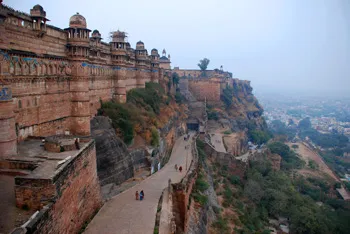
The most prominent tourist attraction in Gwalior is the Gwalior Fort. Built in the 15 th century on a hilltop by Raja Mansingh Tomar, the fort gives a breathtaking view of the city. Man Mandir, the palace built by Man Singh Tomar is a major attraction of the fort.With its intricate carvings and beautiful paintings, it is also known as Chitra Mandir or Palace of Paintings. It is a perfect reflection of Raja man Singh Tomar’s aesthetic sense. Gujari Mahal is fascinating as it portrays the King’s love and admiration for the beautiful and bold Mrignayani, which is now part of folklore. The place now converted onto a museum is known for its collection of Jain and Hindu artifacts. The Fort is also known for the temples in its precincts. The Telika Mandir is a fascinating temple built in the 9th century and is striking with its Dravidian style of architecture. Some attribute the name of the temple and its style of construction to the telangana style of Andhra Pradesh and others say it could be because it was built by telis (oil merchants). Some claim it was named after Telap Raj, the Prime minister of the region. The Sas-Bahu Temple is interestingly a misnomer. It is the name given to two adjoining temples of different sizes, the larger one displaying elaborate carvings and sculptures with intricate work. The chhatris with conical spires and heavily carved interiors in typical Bundhelkhandi style are memorial were built to commemorate the former Scindia rulers.
Other tourist attractions in Gwalior are the Surya Mandir; a replica of the famous Sun Temple in Orissa, built by the famous industrialist, G D Birla.For those interested in the history and culture of Gwalior should visit the Kala Vithika. Another must see museum is the Scindia Museum, which was once the royal palace of the Scindias, the erstwhile royalty of Gwalior.The place is a paragon of opulence with rare collections like a silver toy train whose wagons were used as serving dishes and a glass cradle from Italy used for the Lord Krishna at Janmashtami.
Hotels/Lodge/Accommodation in Gwalior
Copyright 2016 HolidayLandmark All rights reserved
Location info
Gwalior is located at Madhya Pradesh,India.
How to reach Gwalior District
-
Nearest Railway Station:Gwalior Junction(GWL)
-
Nearest Airport:Gwalior Airport
-
Road Transport:Gwalior Bus Station
Best time to visit Gwalior District
October to March (winter) for pleasant weather
Timings & opening hours
District office: 10:00 AM - 5:00 PM weekdays
Entry fee & tickets
Free entry to district areas
Duration needed
1-2 days for district exploration
Safety tips
Carry water, wear comfortable shoes, keep emergency contacts handy, supervise children
Things to carry
Comfortable clothing and shoes, water bottle, camera, sunscreen, hat, sunglasses, first aid kit
Nearby visiting places
Gwalior Fort, Jai Vilas Palace, Tansen Tomb, Sun Temple, Archaeological Museum
Nearest airport, railway & bus
Nearest airport: Gwalior Airport (12 km).
Mobile network coverage
Airtel, Jio, BSNL, and Vi all provide coverage across Madhya Pradesh. 4G is reliable in Bhopal, Indore, Gwalior, Jabalpur, and along national highways. Coverage may be weaker in deep forest areas of Kanha, Bandhavgarh, and Pench national parks. Most hotels and resorts in tourist areas offer free Wi-Fi.
Food & restaurants nearby
Food options are available in the nearest town. Madhya Pradesh cuisine — dal bafla, poha, bhutte ka kees, Bhopali kebabs, and Indori namkeen — offers distinctive regional flavours.
Things to do at Gwalior District
Maharaj Bada,Gujari Mahal,Man Mandir Palace,Gopachal Parvat, Gurudwara Data Bandhi Chhod,Sun Temple,Sarod Ghar,Jai Vilas Palace and Museum
The most prominent tourist attraction in Gwalior is the Gwalior Fort. Built in the 15 th century on a hilltop by Raja Mansingh Tomar, the fort gives a breathtaking view of the city. Man Mandir, the palace built by Man Singh
Things to visit & highlights
Gwalior Fort, Jai Vilas Palace, Tansen Tomb, Sun Temple, Archaeological Museum
Helpline & emergency contacts
Police: 100, Ambulance: 108, Fire: 101; MP Tourism Helpline: 1800-233-1111; District helpline varies by location.
Nearest petrol pump
Petrol pumps available within 1-5 km of most tourist sites; major highways have regular fueling stations every 20-30 km. In remote areas, fill up at the nearest town before travelling.
Frequently asked questions
What are the visiting hours? Typically 9:00 AM to 6:00 PM varies; check before your visit.
What is the entry fee? Entry fees vary by location; ranges from free to INR 200 per person.
What is the best time to visit? October to March provides the most pleasant weather for exploration in Madhya Pradesh.
Quick facts
- Type: Destination
- State: Madhyapradesh
- Category: Districts
Map & location view
This section is being updated and will be available shortly.
Photo gallery of Gwalior District
Video gallery
Related destinations
Alirajpur District
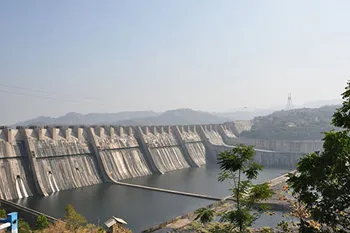
Alirajpur (also known as Ali Rajpur) is a city and a municipality in Alirajpur district in the state of Madhya Pradesh, India.
Anuppur District
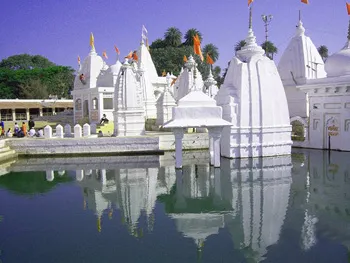
Anuppur is an administrative district of Madhya Pradesh state in central India. The district has an area of 3701 sq km, and a population of 667,155 (2001 Census)…
Ashoknagar District
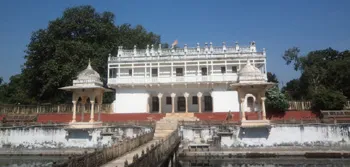
Ashoknagar is one of the 48 districts of Madhya Pradesh, situated on the north-eastern part of Malwa plateau between Parbati and the Betwa.