MOTOSHARE 🚗🏍️
Rent Bikes & Cars Directly from Owners
Motoshare connects vehicle owners with people who need bikes and cars on rent. Owners earn from idle vehicles, and renters get flexible ride options.
Visit Motoshare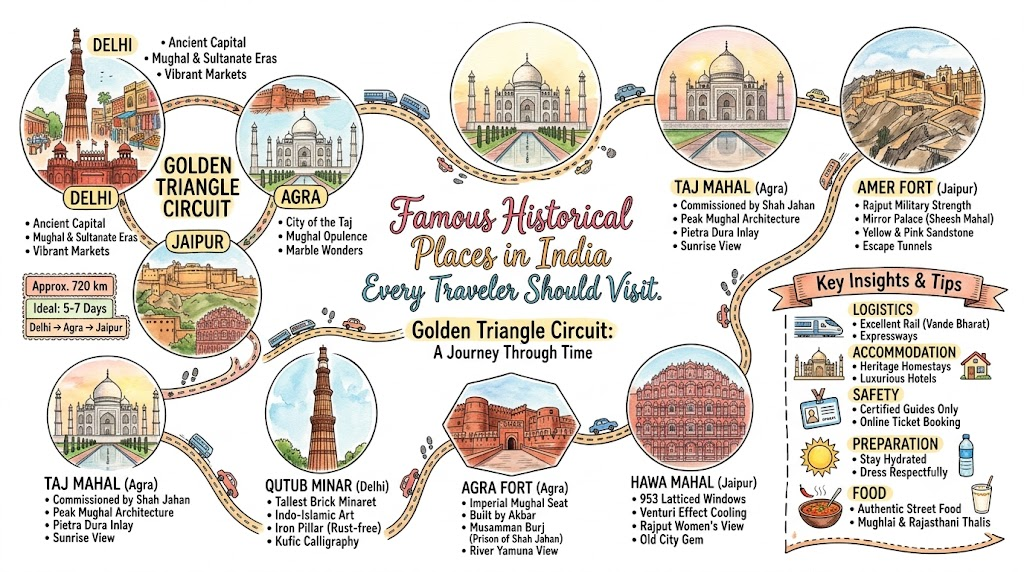
Introduction
Many travelers booking a holiday find themselves funneled toward generic, overcrowded beach resorts or hyper-commercialized modern theme parks. While those destinations offer a temporary escape, they often lack a sense of soul, leaving you with identical photos and a surface-level understanding of the region. If you are craving something deeper, it is time to pivot toward a journey that balances profound authenticity with awe-inspiring architectural scale.
India’s historical landscapes provide an intense sensory connection to the past that modern vacation hubs simply cannot replicate. Walking through thousands of years of human ambition, you will stand before towering red sandstone fortresses, intricate marble monuments, and ancient stepwells that feel alive with centuries of regional stories. This is not about passive sightseeing; it is about stepping into an active, living history where ancient traditions still shape local life every single day.
Why the Golden Triangle Circuit is a must visit city
To truly experience the most definitive chapters of Indian history within a cohesive journey, the Golden Triangle Circuit—encompassing Delhi, Agra, and Jaipur—stands as an unparalleled cultural epic. This geographic loop captures the dramatic shifts of Indian history, moving fluidly from the ancient and medieval sultanates of Delhi to the monumental Mughal opulence of Agra, and finally to the royal Rajput bravery and palace architecture of Jaipur. Rather than viewing these as isolated tourist spots, think of this circuit as a continuous, epic narrative written across the landscape of Northern India.
For travelers of all archetypes, this circuit balances high-density historical exploration with exceptionally robust modern infrastructure. The entire route is seamlessly connected by high-speed expressways and premium tourist trains like the Gatimaan Express and Vande Bharat, making it incredibly accessible for solo backpackers, couples, and multi-generational families alike. World-class hospitality networks ensure that whether you are looking for an authentic heritage homestay or a luxurious palace hotel, your base camp will always feel welcoming.
| Key Metric | Circuit Details & Insights |
| Geographic Span | Approximately 720 km across Delhi, Uttar Pradesh, and Rajasthan |
| Primary Historical Eras | Delhi Sultanate, Mughal Empire, and the Kachwaha Rajput Dynasty |
| Ideal Trip Duration | 5 to 7 days for a complete, unhurried exploration |
| Major Transit Hubs | Indira Gandhi International Airport (DEL), New Delhi Railway Station (NDLS) |
| Core Cultural Theme | Architectural evolution, royal culinary heritage, and classical arts |
The Taj Mahal at Sunrise.
Amer Fort Entryway.
Best Places or Experiences
The Taj Mahal
The Taj Mahal is a breathtaking monument that entirely redefines what human hands can create out of pure white Makrana marble. Commissioned in 1632 by the Mughal Emperor Shah Jahan to house the tomb of his favorite wife, Mumtaz Mahal, this UNESCO World Heritage site took over twenty years and twenty thousand artisans to complete. It represents the absolute pinnacle of Mughal architecture, blending Persian, Islamic, and Indian design elements into a symmetrical marvel that changes its hue depending on the hour of the day.
As you walk closer, the macro-level grandeur gives way to mind-boggling micro-details. The walls are inlaid with semi-precious stones like lapis lazuli, jasper, and malachite using the intricate pietra dura technique, forming delicate floral patterns that seem to glow when struck by light. The entire structure is flanked by four slightly tilting minarets, built with a deliberate outward slant so that in the event of a catastrophic earthquake, they would fall away from the central dome, preserving the main tomb for eternity.
- Location: Tajganj, Agra, Uttar Pradesh (Approx. 230 km from New Delhi via the Yamuna Expressway)
- Why it is worth visiting: It is the world’s most iconic architectural symbol of love, featuring flawless optical illusions and unparalleled marble inlay craftsmanship.
- Best things to do: Walk through the formal Charbagh gardens, study the fine Arabic calligraphy etched into the main arched alcoves, and view the reflection from across the Yamuna River at sunset.
- Best time to visit: Arrive at the ticket gates by 5:30 AM to catch the sunrise, when the marble shifts from a soft pinkish-grey to a brilliant, blinding white.
- Ideal for whom: Couples looking for romance, photography enthusiasts, architectural purists, and international first-timers.
- Travel tip: > Critical Security Alert: Electronics, large backpacks, chargers, and tobacco items are strictly prohibited inside the complex. Carry only your phone, camera, passport, and a bottle of water to ensure a smooth security check.
Amer Fort
Perched dramatically on the rugged hills of the Aravalli Range, Amer Fort stands as a masterclass in ancient Rajput military strategy and opulent residential design. Constructed primarily by Raja Man Singh I in the late 16th century, this massive fortress is built from resilient yellow and pink sandstone mixed with gleaming white marble. Its outer defensive walls snake wildly across the surrounding mountain ridges, creating an imposing barrier that protected the royal families of Jaipur for generations.
Once you pass through the imposing Suraj Pol (Sun Gate), you enter an interior world of absolute luxury. The fort is divided into four distinct courtyards, the most famous being the spectacular Sheesh Mahal (Mirror Palace). The walls and ceilings of this hall are completely covered in thousands of tiny, convex mirrors imported from Belgium, arranged in stunning floral mosaics. Lighting a single candle inside this room creates the mesmerizing illusion of standing beneath a brilliant, star-filled night sky.
- Location: Amer Town, 11 km north of Jaipur city center, Rajasthan
- Why it is worth visiting: It offers an incredible look into the dual nature of Rajput kings—fierce, unyielding battlefield warriors who simultaneously appreciated fine art, poetry, and architecture.
- Best things to do: Run your hands along the carved magic flower panel in the Sheesh Mahal, explore the underground escape tunnels, and watch the evening sound and light show.
- Best time to visit: Between 8:00 AM and 10:30 AM to explore the expansive stone courtyards before the intense midday desert heat sets in.
- Ideal for whom: History buffs, adventure travelers, family groups, and fans of epic military fortifications.
- Travel tip: Avoid taking the crowded elephant rides up the steep stone ramp; instead, opt for the designated authorized local electric jeeps or enjoy the scenic 15-minute uphill walk to support ethical animal tourism.
Qutub Minar Complex
The Qutub Minar is a towering monument that marks the historic dawn of Indo-Islamic architecture in Northern India. Soaring 72.5 meters into the sky, this five-story red sandstone tower was started by Qutb-ud-din Aibak in 1199 after the defeat of Delhi’s last Hindu kingdom. Each level of the minaret is separated by intricately carved balconies supported by stone brackets, with the lower three stories made of fluted red sandstone and the top storeys finished with smooth white marble.
The surrounding archaeological park is packed with historic ruins that are just as fascinating as the minaret itself. Here, you will find the ruins of the Quwwat-ul-Islam Mosque and the legendary Iron Pillar of Delhi, an engineering marvel from the 4th-century Gupta Empire. Despite standing completely exposed to the sun, wind, and monsoon rains for over 1,600 years, this iron pillar has completely resisted rust due to its unique, advanced metallurgical composition, leaving modern scientists thoroughly amazed.
- Location: Mehrauli, South Delhi, Delhi
- Why it is worth visiting: It holds the record as the tallest brick minaret in the world and serves as a literal timeline of Delhi’s layered, multi-dynastic history.
- Best things to do: Decipher the beautiful Kufic calligraphy carved into the sandstone bands, stand near the un-rusted Iron Pillar, and photograph the unfinished Alai Minar base.
- Best time to visit: Late afternoon (3:30 PM to 5:30 PM) when the warm, angled sunlight deepens the rich red tones of the ancient sandstone blocks.
- Ideal for whom: Solo explorers, archaeology fans, avid students, and travelers seeking a quiet escape from central Delhi’s traffic.
- Travel tip: The Mehrauli Archaeological Park sits right next door to the Qutub complex; it contains dozens of neglected tombs and stepwells that most hurried tourists miss entirely.
Agra Fort
Agra Fort is an incredibly powerful, sprawling walled city built from deep-red sandstone that served as the primary imperial seat of the Mughal Emperors until 1648. Originally a brick fort known as Badalgarh, it was comprehensively rebuilt by Emperor Akbar the Great in the 1560s using massive blocks of red sandstone transported from Rajasthan. Its towering double-layered defensive walls rise over 70 feet high and run for a massive 2.5 kilometers along the banks of the Yamuna River.
Within its massive walls lie gorgeous palaces that tell a poignant story of imperial power and family betrayal. It was here, inside the white marble pavilions of Musamman Burj, that Shah Jahan was imprisoned for the final eight years of his life by his ambitious son, Aurangzeb. From his gilded marble balcony, the aging emperor could only look out across the winding river at the distant outline of the Taj Mahal, the monument he built for his late wife, making it one of history’s most beautiful yet heartbreaking views.
- Location: Rakabganj, Agra, Uttar Pradesh (Roughly 5.5 km away from the Taj Mahal complex)
- Why it is worth visiting: It is arguably the finest surviving example of a heavily fortified medieval royal palace city in all of Asia.
- Best things to do: Stand in the massive courtyard of the Diwan-i-Aam, gaze out through the marble arches of Musamman Burj, and marvel at the massive stone bathtub of Jahangir.
- Best time to visit: Mid-morning (9:00 AM to 11:30 AM), immediately after finishing your early morning sunrise tour of the nearby Taj Mahal.
- Ideal for whom: Military history enthusiasts, families with kids who love exploring fort walls, and cultural photographers.
- Travel tip: Hire only government-approved guides carrying official Ministry of Tourism ID badges at the Amar Singh Gate entrance to avoid aggressive, unverified touts.
Hawa Mahal
The Hawa Mahal, widely known as the “Palace of Winds,” is an absolute marvel of classic Rajasthani architecture that looks like a beautiful, pink-hued crown rising right out of the bustling street. Built in 1799 by Maharaja Sawai Pratap Singh, this unique five-story structure was designed by Lal Chand Ustad using a striking mix of red and pink-toned sandstone. Amazingly, the entire building is only about six inches deep at its top, defying standard structural expectations with its iconic, pyramid-shaped facade.
The building features an incredible 953 small casements (jharokhas), each decorated with delicate, hand-carved stone latticework. This layout served a clever dual purpose: it allowed royal women to observe the vibrant, daily street life and colorful festivals of Jaipur without ever being seen by the public, while simultaneously generating a cooling breeze through the building using the Venturi effect. This natural air conditioning system kept the interior rooms comfortable and cool, even during the most intense, scorching summer months.
- Location: Badi Choupad, Old City Heritage Zone, Jaipur, Rajasthan
- Why it is worth visiting: It is a brilliant example of how ancient architects used smart engineering to beat desert heat while respecting strict social customs.
- Best things to do: Climb the narrow, stairless internal ramps to the top floor, peer through the colored glass windows, and take a panoramic photo from a rooftop cafe across the street.
- Best time to visit: Early morning around 7:30 AM, when the golden sunlight shines directly through the east-facing latticed windows.
- Ideal for whom: Photographers, solo travelers, textile designers, and short-term city explorers.
- Travel tip: The front facade is what everyone sees, but the actual entrance to the building is around the back. Enter through the courtyard side near the City Palace for a much calmer experience.
Offbeat Exploration: Hidden Gems Tourists Miss
The Ruins of Bhangarh Fort
Located along the border of the Sariska Tiger Reserve, Bhangarh Fort is an atmospheric, 17th-century ruined town that is widely known across India as one of the country’s most haunted locations. The Archaeological Survey of India (ASI) takes this local legend seriously, strictly banning anyone from entering the fort gates between sunset and sunrise. While the ghost stories draw plenty of thrill-seekers, the real highlight is walking past the remarkably preserved stone marketplaces, grand temples, and multi-tier royal palace ruins, all framed by dramatic, rocky cliffs.
Safdarjung Tomb
While thousands of tourists crowd the nearby Humayun’s Tomb every day, Safdarjung Tomb remains a beautifully quiet, crowd-free sanctuary in the heart of New Delhi. Built in 1754, it stands as the final grand architectural statement of the Mughal style before the empire began to fade away. The main tomb sits inside a classic, peaceful Mughal garden split by water channels, offering visitors a calm space to admire the heavy sandstone domes and arches without having to push through tourist crowds.
Abhaneri Chand Baori
Tucked away in a quiet village along the Jaipur-Agra highway, Chand Baori is one of the deepest and most visually stunning stepwells on earth. Built in the 9th century, this architectural marvel features 3,500 narrow, perfectly symmetrical steps that descend 13 stories down into a cool, green pool of water. The geometric patterns formed by the steps look like an optical illusion, showing just how brilliant ancient Indian water conservation and desert engineering really was.
Detailed Practical Guidance for Travelers
| Destination | Standard Entry Fee | General Timings | Best Local Food Options Nearby | Recommended Nearby Attractions |
| Taj Mahal | ₹50 (Indian), ₹1,100 (Foreign) | Sunrise to Sunset (Closed Fridays) | Petha (sweet ash gourd) at Panchhi Petha, Mughlai parathas | Agra Fort, Mehtab Bagh |
| Amer Fort | ₹100 (Indian), ₹550 (Foreign) | 8:00 AM – 5:30 PM (Daily) | Pyaaz Kachori at Rawat, Traditional Rajasthani Thali | Jaigarh Fort, Panna Meena ka Kund |
| Qutub Minar | ₹40 (Indian), ₹600 (Foreign) | 7:00 AM – 9:00 PM (Daily) | Mughlai Kebabs in Merauli, South Indian filter coffee | Mehrauli Archaeological Park |
| Agra Fort | ₹50 (Indian), ₹650 (Foreign) | Sunrise to Sunset (Daily) | Bedai (puffed bread) with spicy potato curry at local stalls | Itmad-ud-Daulah (Baby Taj) |
| Hawa Mahal | ₹50 (Indian), ₹200 (Foreign) | 9:00 AM – 5:00 PM (Daily) | Lassi at Lassiwala (MI Road), Mawa Kachori | City Palace, Jantar Mantar |
Logistics & On-Ground Navigation
Local Transport Options
- Railways: The Indian Railways network is the best way to travel between Delhi, Agra, and Jaipur. Booking premium, air-conditioned seats on trains like the Gatimaan Express or Shatabdi Express gives you a fast, comfortable ride complete with onboard meals.
- Auto-Rickshaws & E-Rickshaws: These open-air vehicles are ideal for short trips through busy city streets. Always agree on a fixed price before stepping inside, or use a smartphone app to check the fair local rate.
- App-Based Car Rentals: Services like Uber and Ola run reliably across Delhi, Agra, and Jaipur. Booking rides through these apps cuts out the hassle of bargaining and ensures a reliable, air-conditioned trip through the city.
Budget Planning
- Backpacking Tier (₹1,500 – ₹2,500 per day): This budget covers a clean bed in a highly rated hostel capsule, eating at legendary street food stalls, using public transit like metros and local buses, and keeping an eye on monument entry fees.
- Mid-Range Tier (₹5,000 – ₹9,000 per day): This options includes a private room in an authentic boutique heritage hotel, taking comfortable, air-conditioned app-based cabs between cities, enjoying sit-down meals at reliable local restaurants, and hiring certified local guides at major monuments.
Safety and Inclusivity Tips
- Families: When traveling with kids or older relatives, it is best to book your monument entry tickets online well in advance. This helps you skip the long, tiring ticket lines in the heat, keeping the day smooth and stress-free.
- Couples: To get a bit of peace and quiet away from the busiest crowds, head to romantic viewpoints like Mehtab Bagh at sunset for a beautiful, relaxed view of the Taj Mahal.
- General Safety: Keep a close eye on your personal belongings in busy transport hubs. If someone offers you a deal or tour that sounds a bit too good to be true, it is usually a tourist trap—politely decline and stick to your plans.
Strategic Travel Planning Guardrails
Travel Planning Tips for the Circuit
- Book Your Trains Early: High-speed express trains between Delhi, Agra, and Jaipur fill up weeks ahead, so secure your seats as soon as your dates are set.
- Go Digital with Payments: While smartphone UPI apps are used everywhere, keep a small amount of cash on hand for small street food vendors and auto-rickshaws.
- Dress Respectfully: When visiting active religious sites like temples or mosques along the route, ensure your shoulders and knees are covered, and be ready to take off your shoes.
- Stay Hydrated: The North Indian sun can be surprisingly intense; always carry a reusable water bottle and keep a few hydration salts handy during long walks.
- Hire Certified Guides: Always look for official badges from the Ministry of Tourism when picking a guide to ensure you get accurate history instead of local myths.
Common Mistakes to Avoid
- Rushing Your Schedule: Trying to see Delhi, Agra, and Jaipur in just two or three days will leave you exhausted and spending most of your time stuck in traffic.
- Skipping the Local Street Food: Relying only on safe, generic hotel buffets means you miss out on authentic culinary highlights like Agra’s bedai or Jaipur’s lassis.
- Forgetting Sun Protection: Walking across wide, open stone fortresses without a hat, sunscreen, or sunglasses can quickly lead to painful sunburns or heat exhaustion.
- Trusting Unverified Drivers: Never let an auto-rickshaw driver steer you toward a specific emporium or “special festival market”—they are usually earning a commission on marked-up prices.
- Missing the Architecture Details: Don’t just snap a quick selfie and walk away; take the time to step closer and look at the incredible artistry of the ancient marble inlays and hand-carved stone screens.
Suggested Itinerary Blueprints
1. Day Quick Dash (The Express Route)
This lightning-fast itinerary is tailored for busy travelers who are short on time but want to see the region’s absolute highlights. Take an early morning high-speed train from Delhi straight to Agra to view the Taj Mahal and explore the massive Agra Fort, then catch a late-evening connection back to the capital.
2. 3-Day Deep-Dive (The Heritage Loop)
- Day 1: Start your journey by exploring Delhi’s historic layers, taking in the towering Qutub Minar before heading south to Agra.
- Day 2: Catch the unforgettable sunrise at the Taj Mahal, tour the impressive Agra Fort, and take a scenic drive out to the majestic Amer Fort in Jaipur.
- Day 3: Spend your final day exploring Jaipur’s iconic pink city streets, visiting the beautiful Hawa Mahal and the historic City Palace before heading back.
3. Complete Weekend Travel Plan (The Royal Escape)
- Friday: Arrive in Jaipur by afternoon, check into an authentic heritage hotel, and enjoy a traditional Rajasthani dinner in the old city.
- Saturday: Head out early to explore the grand courtyards of Amer Fort, take photos at the Hawa Mahal, and browse the vibrant local textile bazaars.
- Sunday: Drive out to see the incredible, geometric steps of Chand Baori in Abhaneri on your way back, wrapping up a perfect weekend loop.
Common Tourist Mistakes to Avoid
- Geographic Blunders: Many tourists mistakenly try to explore Old Delhi’s crowded markets and South Delhi’s Qutub Minar on the same morning, wasting hours in heavy city traffic.
- Commercial Traps: Spending your limited travel time in modern, air-conditioned shopping malls rather than exploring authentic local craft markets like Jaipur’s Johari Bazaar.
- Neglecting Modern/Alternative Zones: Missing out on Delhi’s vibrant, artistic neighborhoods like the Hauz Khas Village or Shahpur Jat, which offer a great mix of indie cafes and historic ruins.
- Transport Overpayment: Getting into unmetered auto-rickshaws right outside major tourist sights; always use a ride-sharing app first to check the standard local rate.
- Luxury Dining Bias: Missing out on classic, historic street food spots like the centuries-old eateries in Old Delhi, where recipes have been perfected over generations.
Frequently Asked Questions
1. Is it safe to drink tap water along the Golden Triangle circuit?
No, tap water is not safe for direct consumption here. Always stick to sealed bottled water or use filtered water stations at reputable hotels to keep your trip running smoothly.
2. Are major historical monuments closed on specific days of the week?
Yes, the Taj Mahal is strictly closed to the general public every Friday. Keep this in mind when mapping out your itinerary to avoid a major scheduling mix-up.
3. Do I need to book my monument entry tickets online in advance?
Yes, booking your tickets online through the official government portal helps you completely bypass the long, slow-moving ticket lines at major sights.
4. What should I wear when exploring these historic forts and palaces?
Opt for lightweight, breathable cotton clothing that covers your shoulders and knees to keep you cool while staying respectful of local cultural traditions.
5. Can I easily find reliable vegetarian food options along this travel route?
Absolutely, Northern India is a fantastic destination for vegetarians, with almost every restaurant offering a wide variety of delicious, meat-free traditional dishes.
6. How do I avoid local transport and shopping scams around major sights?
Always book your rides through reliable apps like Uber or Ola, and politely decline any offers from drivers who try to steer you toward specific souvenir shops.
7. What is the absolute best time of year to plan this historical journey?
The cooler months from October to March offer beautiful, pleasant weather that is perfect for spending long afternoons walking through outdoor fortresses.
8. Are credit cards and digital wallets widely accepted at small local shops?
While large restaurants and hotels take cards, it is always a good idea to keep a bit of cash on hand for small street vendors and rickshaw rides.
9. Is it worth hiring a local guide at places like Amer Fort and Agra Fort?
Yes, hiring an officially certified government guide brings the stone walls to life with accurate, fascinating historical context that you won’t find on simple signposts.
10. Can I easily explore the entire Golden Triangle loop using public transit?
Yes, combining high-speed express trains between the main cities with local app-based cabs makes the entire loop incredibly easy to navigate on your own.
11. Are these ancient historical sites accessible for travelers with mobility challenges?
Many sites now feature smoother pathways, but the steep ramps and uneven stone steps of older hillside forts can still pose challenges for some visitors.
12. What are the best authentic local souvenirs to look for along the way?
Look for beautiful hand-block printed textiles and blue pottery in Jaipur, and delicate, authentic marble inlay workpieces from local artisans in Agra.
Conclusion
Choosing to explore India’s legendary historical landscapes is far more than a simple vacation; it is a deeply rewarding journey that challenges and inspires you all at once. Long after the tan lines from a standard beach resort have faded, the memories of standing before a sun-drenched fort or watching the morning light hit the Taj Mahal will stay with you. These timeless stone monuments invite you to slow down, look closer, and connect with centuries of human artistry, leaving you with a renewed sense of wonder and a much deeper understanding of our shared world.

One useful addition would be guidance on heritage-site etiquette, including restricted photography, touching carvings, litter control, and respecting active worship areas. Responsible visitor behavior protects fragile monuments while preserving experiences for future travelers.