MOTOSHARE 🚗🏍️
Rent Bikes & Cars Directly from Owners
Motoshare connects vehicle owners with people who need bikes and cars on rent. Owners earn from idle vehicles, and renters get flexible ride options.
Visit Motoshare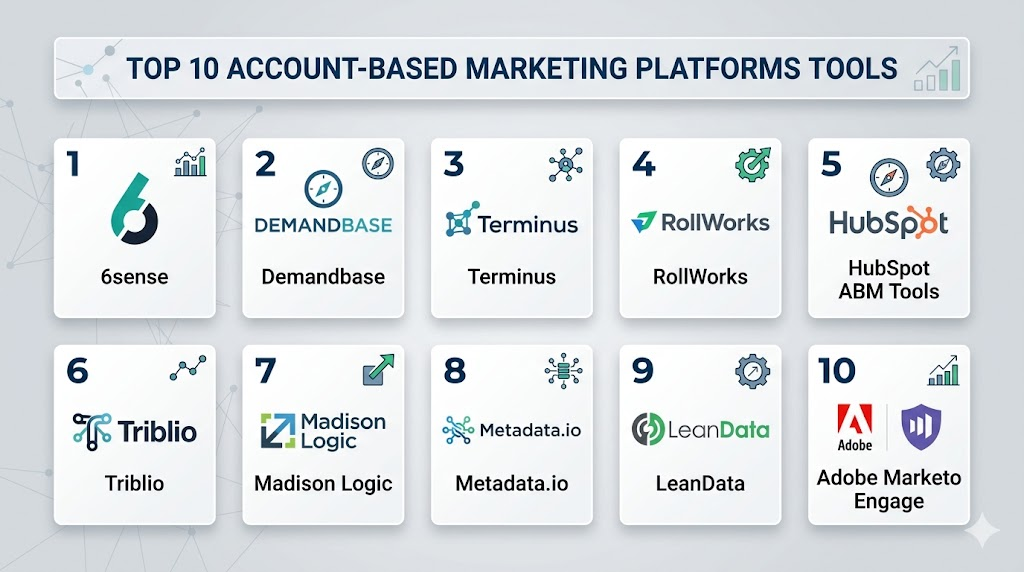
Introduction
Account-Based Marketing (ABM) Platforms help organizations identify, target, engage, and convert high-value accounts through personalized marketing and sales strategies. Instead of broad lead generation campaigns, ABM platforms focus on specific companies or buying groups that are most likely to generate revenue. These platforms combine intent data, analytics, advertising, personalization, CRM integration, and engagement tracking to align sales and marketing teams around target accounts.ABM has become increasingly important because B2B buying cycles are more complex, involve multiple stakeholders, and require highly personalized engagement. Modern ABM platforms now use AI, predictive analytics, and intent signals to help organizations prioritize accounts, personalize campaigns, and improve pipeline efficiency. Companies use these tools to improve conversion rates, shorten sales cycles, and increase deal sizes.
Common use cases include target account identification, personalized advertising, buyer intent monitoring, sales and marketing alignment, account engagement tracking, and pipeline acceleration.
Buyers should evaluate intent data quality, CRM integration depth, analytics capabilities, scalability, personalization features, AI functionality, reporting, usability, advertising integrations, and pricing structure.
Best for: B2B SaaS companies, enterprise sales teams, revenue operations teams, demand generation teams, marketing organizations, and companies focused on high-value account targeting.
Not ideal for: Small businesses with low sales complexity, companies relying mainly on transactional sales, or organizations without clear target account strategies.
Key Trends in Account-Based Marketing Platforms
- AI-driven account scoring is improving account prioritization accuracy.
- Buyer intent data is becoming central to ABM strategies.
- Sales and marketing workflow alignment is becoming more automated.
- Multi-channel personalization is expanding across email, ads, and web experiences.
- Revenue attribution and pipeline analytics are becoming more advanced.
- Predictive analytics is improving target account identification.
- CRM and marketing automation integrations are becoming mandatory.
- First-party data strategies are gaining importance due to privacy changes.
- Real-time account engagement tracking is improving campaign optimization.
- Hybrid ABM and demand generation strategies are becoming more common.
How We Selected These Tools
The tools in this list were selected using practical B2B marketing evaluation criteria focused on operational value and adoption.
- Market adoption and industry visibility
- Strength of ABM and intent data capabilities
- CRM and marketing automation integrations
- AI and predictive analytics functionality
- Reporting and attribution depth
- Multi-channel engagement support
- Enterprise scalability and reliability
- Ease of onboarding and usability
- Security and governance capabilities
- Overall balance between functionality, usability, and value
Top 10 Account-Based Marketing Platforms Tools
#1 — 6sense
Short description: 6sense is one of the leading ABM and revenue intelligence platforms designed to help organizations identify in-market buyers and prioritize high-value accounts. It combines buyer intent signals, predictive analytics, account engagement insights, and AI-driven recommendations to improve pipeline generation. The platform is widely used by enterprise B2B organizations that require deep analytics, account scoring, and sales-marketing alignment.
Key Features
- Predictive account scoring
- Buyer intent analytics
- AI-driven recommendations
- Revenue intelligence dashboards
- Account engagement tracking
- Sales prioritization workflows
- CRM synchronization
Pros
- Strong predictive analytics capabilities
- Excellent enterprise ABM functionality
- Deep account intelligence insights
Cons
- Premium enterprise pricing
- Complex implementation for smaller teams
- Advanced features may require training
Platforms / Deployment
- Web
- Cloud
Security & Compliance
Supports enterprise authentication, encryption, RBAC, and administrative access controls.
Integrations & Ecosystem
6sense integrates with CRM, marketing automation, advertising, and sales engagement platforms to centralize ABM operations.
- Salesforce
- HubSpot
- Marketo
- Outreach
- Microsoft Dynamics 365
Support & Community
Provides enterprise onboarding, implementation support, customer success programs, and ABM strategy guidance.
#2 — Demandbase
Short description: Demandbase is a comprehensive ABM platform that helps organizations identify target accounts, personalize engagement, and align sales and marketing teams. It combines intent data, advertising, analytics, and account intelligence into one ecosystem. Demandbase is especially valuable for enterprise B2B organizations with complex sales cycles and account-focused marketing strategies.
Key Features
- Account identification and scoring
- Intent data analysis
- Personalized advertising
- Revenue attribution
- Engagement analytics
- AI recommendations
- CRM synchronization
Pros
- Strong enterprise ABM ecosystem
- Excellent intent and engagement analytics
- Good sales and marketing alignment features
Cons
- Enterprise pricing structure
- May be complex for SMB teams
- Advanced customization can require expertise
Platforms / Deployment
- Web
- Cloud
Security & Compliance
Supports enterprise authentication, encryption, and governance controls. Additional compliance details vary.
Integrations & Ecosystem
Demandbase integrates with CRM, advertising, analytics, and marketing automation systems to improve account-based engagement.
- Salesforce
- HubSpot
- Marketo
- Google Ads
- Slack
Support & Community
Provides enterprise implementation assistance, customer success programs, and ABM consulting resources.
#3 — Terminus
Short description: Terminus is an ABM platform focused on account engagement, targeted advertising, analytics, and sales-marketing alignment. It helps organizations execute personalized campaigns across multiple channels while monitoring account engagement and pipeline progression. Terminus is widely used by B2B marketing teams seeking scalable account-based campaign management.
Key Features
- Multi-channel account engagement
- ABM advertising
- Intent data integration
- Engagement analytics
- Account scoring
- CRM synchronization
- Pipeline reporting
Pros
- Strong multi-channel engagement tools
- Good account analytics visibility
- Effective sales and marketing alignment
Cons
- Reporting complexity may vary
- Enterprise features may increase costs
- Smaller organizations may underutilize capabilities
Platforms / Deployment
- Web
- Cloud
Security & Compliance
Supports encryption, enterprise authentication, and administrative access management.
Integrations & Ecosystem
Terminus integrates with CRM, advertising, and marketing automation systems to centralize account engagement workflows.
- Salesforce
- HubSpot
- Marketo
- Pardot
- Slack
Support & Community
Provides onboarding assistance, implementation support, and customer enablement resources for ABM teams.
#4 — RollWorks
Short description: RollWorks is an ABM platform designed to help B2B organizations identify target accounts, run personalized advertising campaigns, and improve account engagement visibility. The platform is especially popular among SMB and mid-market businesses because of its usability and scalable deployment model. RollWorks combines intent data, retargeting, and account analytics in a user-friendly interface.
Key Features
- Account targeting
- Intent signal analysis
- Retargeting campaigns
- Engagement analytics
- Account scoring
- AI-driven recommendations
- CRM integration
Pros
- User-friendly deployment experience
- Good fit for SMB and mid-market teams
- Strong retargeting functionality
Cons
- Enterprise analytics depth is lighter
- Advanced customization may vary
- Some integrations require configuration
Platforms / Deployment
- Web
- Cloud
Security & Compliance
Supports encryption and enterprise access management capabilities. Additional certifications are not publicly stated.
Integrations & Ecosystem
RollWorks integrates with CRM, marketing automation, and advertising systems to streamline account-based workflows.
- Salesforce
- HubSpot
- Marketo
- Google Ads
- Slack
Support & Community
Provides onboarding guidance, documentation, and customer support suitable for growing ABM teams.
#5 — HubSpot ABM Tools
Short description: HubSpot offers built-in ABM functionality within its CRM and marketing ecosystem, allowing organizations to manage target accounts, personalize campaigns, and align sales and marketing operations. The platform is especially attractive for SMB and mid-market businesses already using HubSpot CRM and marketing tools. Its simplicity and centralized workflow management make it approachable for growing organizations.
Key Features
- Target account management
- CRM-based ABM workflows
- Marketing automation
- Account engagement tracking
- Personalized email campaigns
- Reporting dashboards
- Sales-marketing alignment
Pros
- Easy-to-use interface
- Strong CRM integration
- Good value for growing businesses
Cons
- Enterprise ABM depth is limited
- Predictive analytics are lighter
- Some advanced features require higher-tier plans
Platforms / Deployment
- Web / iOS / Android
- Cloud
Security & Compliance
Supports SSO, encryption, and role-based access controls. Additional compliance capabilities vary by subscription level.
Integrations & Ecosystem
HubSpot integrates with CRM, sales, advertising, and marketing systems to centralize account-based engagement workflows.
- Salesforce
- Google Ads
- Slack
- Zoom
- Microsoft Teams
Support & Community
Large customer community with extensive documentation, onboarding support, and educational resources.
#6 — Triblio
Short description: Triblio is an ABM platform focused on account personalization, intent data, and website engagement optimization. It helps organizations personalize digital experiences for target accounts while improving pipeline generation and sales alignment. Triblio is especially useful for B2B marketing teams looking to combine web personalization with account intelligence.
Key Features
- Website personalization
- Intent data analysis
- Account targeting
- Engagement tracking
- Pipeline analytics
- Campaign automation
- CRM synchronization
Pros
- Strong website personalization features
- Useful intent-based targeting
- Good pipeline visibility tools
Cons
- Smaller ecosystem than major competitors
- Enterprise customization may require support
- Reporting complexity varies
Platforms / Deployment
- Web
- Cloud
Security & Compliance
Supports enterprise authentication and encryption capabilities. Additional certifications are not publicly stated.
Integrations & Ecosystem
Triblio integrates with CRM, marketing automation, and analytics platforms to support account engagement workflows.
- Salesforce
- HubSpot
- Marketo
- Pardot
Support & Community
Provides onboarding guidance, customer success support, and implementation assistance for ABM teams.
#7 — Madison Logic
Short description: Madison Logic is an intent-driven ABM platform designed to help B2B organizations identify active buyers and accelerate pipeline generation. The platform focuses heavily on intent data, content syndication, and account engagement analytics. It is particularly useful for demand generation teams looking to improve lead quality and account prioritization.
Key Features
- Intent data monitoring
- Content syndication
- Account targeting
- Pipeline analytics
- Lead prioritization
- Engagement insights
- CRM integration
Pros
- Strong intent-driven marketing capabilities
- Useful demand generation workflows
- Good account prioritization analytics
Cons
- Narrower feature set than broader ABM suites
- Enterprise customization may vary
- Some integrations require setup effort
Platforms / Deployment
- Web
- Cloud
Security & Compliance
Supports encryption and enterprise access management features.
Integrations & Ecosystem
Madison Logic integrates with CRM and marketing systems to improve demand generation and account targeting.
- Salesforce
- HubSpot
- Marketo
- Microsoft Dynamics 365
Support & Community
Provides onboarding assistance and customer success support for B2B demand generation teams.
#8 — Metadata.io
Short description: Metadata.io is an ABM and demand generation platform focused on campaign automation, audience targeting, and paid advertising optimization. It helps organizations automate campaign experiments and improve account targeting through AI-driven workflows. The platform is commonly used by B2B marketing teams seeking advertising efficiency and campaign scalability.
Key Features
- Campaign automation
- Audience targeting
- AI-driven optimization
- Paid advertising analytics
- Account engagement tracking
- CRM synchronization
- Reporting dashboards
Pros
- Strong paid advertising automation
- Useful campaign experimentation workflows
- Good fit for demand generation teams
Cons
- Less focused on deep enterprise ABM analytics
- Limited personalization depth
- Some advanced features may require training
Platforms / Deployment
- Web
- Cloud
Security & Compliance
Supports enterprise authentication and encryption controls.
Integrations & Ecosystem
Metadata.io integrates with CRM, advertising, and marketing automation platforms to improve campaign execution.
- Salesforce
- HubSpot
- Google Ads
- Marketo
- Slack
Support & Community
Provides onboarding support, implementation resources, and campaign optimization guidance.
#9 — LeanData
Short description: LeanData focuses on account matching, lead routing, and revenue operations alignment within ABM workflows. The platform helps organizations improve account ownership, routing accuracy, and pipeline management. It is especially useful for organizations with complex lead assignment and revenue operations processes.
Key Features
- Lead-to-account matching
- Routing automation
- Revenue operations workflows
- CRM synchronization
- Pipeline analytics
- Workflow automation
- Data governance controls
Pros
- Excellent routing and matching capabilities
- Strong revenue operations alignment
- Useful for Salesforce-heavy organizations
Cons
- Less focused on advertising and personalization
- Requires CRM process maturity
- Primarily optimized for Salesforce environments
Platforms / Deployment
- Web
- Cloud
Security & Compliance
Supports enterprise authentication, encryption, and access management controls.
Integrations & Ecosystem
LeanData integrates primarily with CRM and revenue operations systems to improve account routing and alignment.
- Salesforce
- HubSpot
- Marketo
- Outreach
- Slack
Support & Community
Provides onboarding guidance, implementation support, and revenue operations consulting assistance.
#10 — Adobe Marketo Engage ABM
Short description: Adobe Marketo Engage includes ABM functionality designed for enterprise marketing organizations that require advanced automation, personalization, and campaign orchestration. It helps organizations manage target accounts, automate engagement workflows, and connect ABM campaigns with broader marketing operations. The platform is especially strong for enterprises with mature marketing automation strategies.
Key Features
- ABM campaign management
- Account engagement tracking
- Marketing automation
- Personalized content workflows
- Revenue attribution
- Lead scoring
- AI-powered recommendations
Pros
- Strong enterprise automation capabilities
- Deep marketing workflow flexibility
- Good analytics and attribution tools
Cons
- Complex implementation for smaller teams
- Requires operational expertise
- Premium enterprise pricing
Platforms / Deployment
- Web
- Cloud
Security & Compliance
Supports enterprise authentication, encryption, RBAC, and administrative governance controls.
Integrations & Ecosystem
Adobe Marketo Engage integrates with CRM, analytics, advertising, and personalization systems to support enterprise ABM workflows.
- Salesforce
- Microsoft Dynamics 365
- Adobe Experience Cloud
- Google Ads
- Zoom
Support & Community
Strong enterprise onboarding, implementation support, and extensive documentation for marketing operations teams.
Comparison Table (Top 10)
| Tool Name | Best For | Platform(s) Supported | Deployment | Standout Feature | Public Rating |
|---|---|---|---|---|---|
| 6sense | Enterprise predictive ABM | Web | Cloud | AI-driven account scoring | N/A |
| Demandbase | Enterprise account intelligence | Web | Cloud | Intent-driven engagement analytics | N/A |
| Terminus | Multi-channel ABM campaigns | Web | Cloud | Account engagement orchestration | N/A |
| RollWorks | SMB and mid-market ABM | Web | Cloud | Retargeting and account targeting | N/A |
| HubSpot ABM Tools | SMB CRM-driven ABM | Web, iOS, Android | Cloud | Native CRM workflow alignment | N/A |
| Triblio | Website personalization | Web | Cloud | Intent-driven personalization | N/A |
| Madison Logic | Intent-based demand generation | Web | Cloud | Content syndication and intent analytics | N/A |
| Metadata.io | Automated B2B advertising | Web | Cloud | Campaign automation | N/A |
| LeanData | Revenue operations routing | Web | Cloud | Lead-to-account matching | N/A |
| Adobe Marketo Engage ABM | Enterprise marketing automation | Web | Cloud | Enterprise workflow orchestration | N/A |
Evaluation & Scoring of Account-Based Marketing Platforms
| Tool Name | Core (25%) | Ease (15%) | Integrations (15%) | Security (10%) | Performance (10%) | Support (10%) | Value (15%) | Weighted Total (0–10) |
|---|---|---|---|---|---|---|---|---|
| 6sense | 9.6 | 8.2 | 9.5 | 9.2 | 9.3 | 9.0 | 7.8 | 9.0 |
| Demandbase | 9.4 | 8.1 | 9.2 | 9.1 | 9.2 | 8.9 | 7.7 | 8.9 |
| Terminus | 8.9 | 8.5 | 8.8 | 8.5 | 8.7 | 8.6 | 8.3 | 8.6 |
| RollWorks | 8.4 | 9.0 | 8.4 | 8.0 | 8.3 | 8.4 | 9.0 | 8.5 |
| HubSpot ABM Tools | 8.2 | 9.3 | 8.7 | 8.3 | 8.5 | 8.8 | 9.2 | 8.7 |
| Triblio | 8.5 | 8.2 | 8.1 | 8.2 | 8.4 | 8.3 | 8.1 | 8.3 |
| Madison Logic | 8.4 | 8.3 | 8.2 | 8.1 | 8.4 | 8.2 | 8.3 | 8.3 |
| Metadata.io | 8.3 | 8.7 | 8.4 | 8.0 | 8.5 | 8.4 | 8.8 | 8.5 |
| LeanData | 8.8 | 8.2 | 9.0 | 8.8 | 8.9 | 8.6 | 8.0 | 8.6 |
| Adobe Marketo Engage ABM | 9.2 | 7.8 | 9.1 | 9.0 | 9.1 | 8.8 | 7.5 | 8.8 |
These scores are comparative and should be interpreted based on organizational priorities. Enterprise-focused platforms generally score higher in predictive analytics, scalability, and governance controls, while SMB-oriented platforms typically perform better in usability and pricing value. Buyers should prioritize the categories that align most closely with their ABM maturity and operational goals.
Which Account-Based Marketing Platform Is Right for You?
Solo / Freelancer
Freelancers and solo consultants typically do not require full enterprise ABM platforms. Lightweight CRM-driven workflows and basic account targeting tools are often enough. HubSpot ABM tools may work for small-scale account management because of their usability and integrated CRM functionality.
SMB
SMBs usually prioritize affordability, ease of deployment, and straightforward campaign management. RollWorks, HubSpot ABM Tools, and Metadata.io are strong options for growing businesses that need account targeting and campaign automation without excessive operational complexity.
Mid-Market
Mid-market organizations often need stronger intent data, analytics, and personalization capabilities. Terminus, RollWorks, and LeanData are good choices for organizations seeking better alignment between marketing and sales operations.
Enterprise
Large enterprises typically require predictive analytics, intent intelligence, governance controls, and scalable workflow automation. 6sense, Demandbase, and Adobe Marketo Engage ABM are particularly strong for enterprise ABM programs with complex sales cycles and global teams.
Budget vs Premium
Budget-conscious organizations should evaluate HubSpot ABM Tools, RollWorks, and Metadata.io because of their usability and scalable pricing models. Premium enterprise buyers that require predictive intelligence and advanced analytics may benefit more from 6sense or Demandbase.
Feature Depth vs Ease of Use
6sense and Adobe Marketo Engage provide extensive analytics and enterprise automation but may require more implementation planning. HubSpot and RollWorks are easier to deploy and more approachable for smaller marketing teams.
Integrations & Scalability
Organizations heavily invested in Salesforce, HubSpot, Marketo, or LinkedIn should prioritize platforms with mature integrations. Enterprises should also evaluate API flexibility, workflow automation depth, and scalability for global campaigns.
Security & Compliance Needs
Organizations handling sensitive customer and account data should review authentication methods, encryption standards, RBAC, audit logging, and governance controls carefully before deployment.
Frequently Asked Questions (FAQs)
1. What is an Account-Based Marketing Platform?
An Account-Based Marketing Platform helps organizations target specific high-value accounts rather than broad audiences. These platforms combine account intelligence, intent data, advertising, analytics, and workflow automation to improve engagement with targeted companies. Sales and marketing teams use ABM platforms to align account strategies, personalize campaigns, and improve pipeline quality. The goal is to focus resources on accounts most likely to convert into revenue.
2. How do ABM platforms improve sales and marketing alignment?
ABM platforms centralize account data, engagement insights, and campaign activity so sales and marketing teams can work from the same information. Marketing teams can identify engaged accounts while sales teams prioritize outreach using intent signals and account analytics. Shared dashboards and account scoring also improve collaboration and reporting consistency.
3. What is buyer intent data in ABM?
Buyer intent data refers to behavioral signals that indicate a company may be researching or preparing to purchase a product or service. ABM platforms use intent data from content consumption, searches, engagement activity, and third-party sources to identify active buying interest. This helps organizations prioritize accounts more effectively.
4. Are ABM platforms only for enterprise companies?
No. While enterprise organizations often use advanced ABM platforms, SMB and mid-market businesses can also benefit from account targeting and personalized engagement workflows. Platforms like RollWorks and HubSpot offer more accessible deployment options for smaller organizations.
5. What integrations are most important for ABM platforms?
CRM integrations are usually the most important because account data and engagement activity need to connect directly with sales workflows. Marketing automation, advertising, analytics, and communication platform integrations are also critical for campaign execution and reporting.
6. How important is AI in modern ABM platforms?
AI has become increasingly important for account scoring, predictive analytics, personalization, and campaign optimization. AI-driven recommendations help organizations identify high-value accounts faster and automate parts of campaign management. AI also improves targeting efficiency and reporting accuracy.
7. What are the biggest implementation mistakes organizations make?
One common mistake is deploying ABM tools without defining target account criteria or sales-marketing alignment processes. Another issue is poor CRM data quality, which reduces analytics accuracy. Organizations should also avoid overcomplicating campaigns during the initial rollout phase.
8. How should organizations evaluate security and compliance?
Organizations should review authentication controls, encryption standards, RBAC, audit logs, and data governance policies carefully. Enterprises should involve legal and security teams during procurement because ABM platforms often process sensitive account and engagement data.
9. Can ABM platforms help shorten sales cycles?
Yes. ABM platforms help prioritize high-intent accounts and improve personalization, which can accelerate engagement and improve sales efficiency. Better alignment between sales and marketing teams also helps reduce delays and improve follow-up consistency throughout the buying process.
10. What alternatives exist if a company does not need a full ABM platform?
Organizations with simpler requirements may only need CRM segmentation, marketing automation tools, advertising platforms, or basic lead scoring systems. Some businesses can manage lightweight account targeting through existing CRM and marketing workflows without adopting a dedicated ABM platform.
Conclusion
Account-Based Marketing Platforms have become essential for B2B organizations that want to improve account targeting, strengthen sales and marketing alignment, and increase pipeline efficiency through personalized engagement strategies. Modern ABM platforms combine AI-driven analytics, buyer intent data, workflow automation, advertising capabilities, and account intelligence to help organizations focus on the accounts most likely to generate revenue. Enterprise organizations often benefit most from advanced platforms such as 6sense, Demandbase, and Adobe Marketo Engage ABM because of their predictive analytics and scalability, while SMB and mid-market teams may prefer more approachable solutions like RollWorks or HubSpot ABM Tools. The best platform ultimately depends on company size, ABM maturity, CRM ecosystem, budget, personalization requirements, and operational complexity. Before making a final decision, organizations should shortlist a few platforms, validate integrations with CRM and marketing systems, test account targeting workflows, review security requirements carefully, and run pilot campaigns to confirm long-term operational fit.
