Kanyakumari Districts
Kanyakumari district came in to exixtence in the year 1956 as a result of re-organisation of stateson the basis of vernacular and added in the map of Tamil nadu. It was known as the granary of Travancore due to its vast stratches of Paddy fields, rich forests and abundant mineral sands.
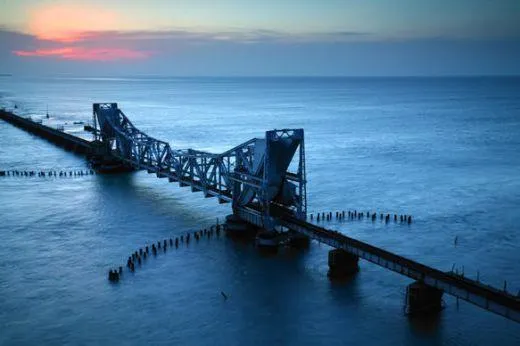
About Kanyakumari Districts
Kanyakumari is one of the 30 administrative districts of Tamil Nadu located in the southern most region of the state. The district shares common boundary with Tirunelveli District on the North and east. The South Eastern boundary is the Gulf of Mannar. On the South and the South West, the boundaries are the Indian Ocean and the Arabian Sea. On the West and North West it is bounded by Kerala state.
Kanyakumari is the smallest district in Tamil Nadu, with a land spread of 1,684 km² and has varied ecosystems - forests, wetlands, freshwater resources and marine as similar to Kerala.This district has a pleasant climate and has the advantage of both the South-West as well as North-East monsoons. The city has many a charming spot, best being the Cape-comerin, the place of meeting of Bay of Bengal, Indian Ocean and Arabian sea. The meeting point of the ocean is the where “Continent ends in a swan-song of broken rocks and mingling oceans
Kanyakumari is regarded as the southern most district of Tamil Nadu. The district lies between 77o 15` and 77o 36` of the eastern longitudes and 8o 03` and 8o 35` of the northern Latitudes.
The four boundary of the district can be described as it is bounded by Tirunelveli District on the North and the east, in South Eastern side there is the Gulf of Mannar. On the South and the South West, the boundaries are the Indian Ocean and the Arabian Sea. On the West and North West, Kerala bound it.
It was a faith that Kanyakumari district has been named after the Goddess Kanyakumari Amman, who is a well known diety of this district and over throughout the country. The legend is that the Goddess Parvathi is one of her incarnation as ‘Devi Kanya’ did penance on one of the rocks of this land’s end to obtain the hand of Lord Siva
The areas namely Agasteeswarem, Thovalai, Kalkulam and Vilavancode Taluks formed the southern divisions of the former Trivandrum District. The people of these areas were predominantly Tamil speaking. They agitated for the merger of this area with Madras State. Also the States Reorganisation Commission recommended this. Accordingly, the States Reorganization Act was passed on 1956. On 1st November 1956 the Kanyakumari District was formed, with the four Taluks, Viz., Agasteeswarem, Thovalai, Kalkulam and Vilavancode and merged with Tamil Nadu.
In 1729, Anizham Thirunal, the Travancore king expanded his kingdom dome further, after putting down the insurgency of the Ettuveettil Pillamar. He defeated the forces of the Dutch East India Company under Eustachius De Lannoy in 1741 at the Battle of Colachel. In the later part of the 18th century, Chanda Sahib, a rebel commandant related to the Nawab of Arcot attacked Nagercoil and other areas.
Travancore had to contend with such attacks and monetary demands from the Carnatic Nawabs or from their rebellious governors until the English fully supported the state of Travancore.[citation needed] In spite of the troubles encountered in the southern border of Venad, Marthanda Varma expanded the kingdom northwards to Aluva and expanded the kingdom of Travancore. As a result, the present day Kanyakumari District came to be known as Southern Travancore. In 1745, the capital was shifted from Padmanabhapuram to Thiruvananthapuram.
History of Kanyakumari Districts
Kanyakumari District consists of those parts known as locally Nanjil Nadu and Idai Nadu. The names of the villages of the district such as Azhagiapaandipuram, Bhoothapandy, Cholapuram and Kulasekaram reveal that these places were governed by several rulers at difficult periods of time.It is learnt that Nanjilnadu was under the rule of Pandiyas till the early 10th century and then under Cheras.
The Idai nadu including Kalkulam and Vilavancode taluks were under the rule of cheras. When the power of Chola declined due to the rise of Hoysalas and western Chalukyas, the venad (Travancore) Chief tains (the decondants of central Chera’s family) took advantage of the situation and gradually established their hold on considerable areas in Nanjilnadu. Veera Kerala varma one such cheif tain and style himself as “Nanjil Kuravan”. The annexation commenced by Veera Kerala Varma was to a large extent continued by his successors and completed by 1115 A.D.
For about four centuries, the Venad was ruled by powerful kings who were consistently making incursions into the pandian territories. As a result Vijayanagar kings are proceeded against venad. In 1609 Kanyakumari fell in to the mighty hands of Viswanatha Nayak of Madurai. Consequent on this, there was no series threat to Nanjilnadu, till 1634. During the regime of Ravi varma and Marthanda varma, Venad was disturbed due to the internal strife.
Sanda sahib of Arcot took advantage of this situation and attacked Nanjilnadu. Although Marthanda varma could succeed tje famous battle at Colachel defeating the Dutch armouries who helped the local faudatories, he could ot cope with the threat from Sanda sahib and made him to with draw the battle field. After Marthanda varma, Venad had very weak rulers. Therefore there was frequent interference by the British whose control was completely established over Venad and continued till 1947. From 1947 to 1956, it was under the personal rule of Maharaja of Travancore. During the period between 1956 - 1961, the administrative system has fallen in line with that of other districts in Tamil nadu.
Educational Institutions of Kanyakumari Districts
Arts & Science:
Annai Veilankanni College, Kanyakumari
Arignar Anna College, Kanyakumari
Holy Cross College, Nagercoil
Lakshmipuram College of Arts and Science, Kanyakumari
Malankara Catholic College, Kanyakumari
Muslim Arts College, Tiruvithamcode, Kanyakumari
Nesamony Memorial Christian College, Kanyakumari
Noorl Islam Arts and Science College, Kanyakumari
Pioneer Kumarasamy College, Nagercoil
S.T. Hindu College, Nagercoil
Scott Christian College, Kanyakumari
Sivanthi Adithanar College, Nagercoil
Sree Ayyappa College for Women, Kanyakumari
Sree Devi Kumari Women’s College, Kanyakumari
St. Jude’s College, Kanyakumari
Udaya College of Arts and Science, Kanyakumari
V.T.M College of Arts and Science, Kanyakumari
Vivekananda College, Agasteeswaram, Kanyakumari
Women’s Christian College, Nagercoil
Hotel Management:
Muslim Arts College, Tiruvithamcode, Kanyakumari
Dental:
Sree Mookambika Institute of Dental Sciences, Kanyakumari
Engineering:
Anna University Tirunelveli, Nagercoil Campus, Nagercoil
Annai Vailankanni College of Engineering, Azhagapapuram (PO)
Arunachala College of Engineering for Women, Nagercoil
Bethlahem Institute of Engineering, Karungal
C.S.I. Institute of Technology, Kanyakumari
D.M.I. Engineering College, Kanyakumari
Immanuvel Arasar J.J. College of Engineering, Nattalam
James College of Engineering and Technology, Kanyakumari
Jeyamatha Engineering College, Aralvaimozhi
K.N.S.K. College of Engineering, Kanyakumari
Lord Jegannath College of Engineering and Technology, Kumarapuramthoppur Post
Loyola Institute of Technology and Science, Thovalai
Maria Collge of Engineering and Technology, Thiruvattar PO
Marthandam College of Engineering and Technology, Veeyanoor
Narayanaguru College of Engineering, Kanyakumari
Noorul Islam University (Noorul Islam College of Engineering), Thuckalay
Ponjesly College of Engineering, Agesteeswaram
Sardar Raja College of Engineering, Tirunelveli
Satyam College of Engineering & Technology, Aralvaimozhi
St. Xavier Catholic College of Engineering, Chunkankadai
Sun College of Engineering and Technology, Erachakulam Post
Udaya School of Engineering, Kanyakumari
Vins Christian College of Engineering, Kalkulam Taluk
Vins Christian Women’s College of Engineering, Nagercoil
Homoeopathy:
Saradha Krishna Homoeopathy Medical College, Kanyakumari
White Memorial Homoeopathic Medical College, Kanyakumari
Culture
The culture is a mixture of Tamil Nadu and Kerala. Christianity, Hinduism and Islam are the main religions practiced, with Christians accounting to nearly half of the populace. Some of the communities in the district are Nadars, Nanjil Nadu Vellalars, Paravas, Mukthavas, Vilakki Thalanayar, Kammalar or Asari, Chackarevars, Kerala Mudalis etc.
Fairs:
The festivals of Dharmapuri are varied and add an extra spark of life to the town’s daily lives. Notable among.
Festivals:
Pongal :Like all the other regions of Tamil Nadu, Pongal is one of the most important festivals of Dharmapuri.
Mahashivaratri :If you are planning a tour to Dharmapuri, one of the best times to visit would be during February when the festivities of Mahashivaratri promise to add a dash of special flavor to your vacation.
Bow Song:
This is locally known as Villu Pattu. It is an ancient form of musical - story - telling art of southern Tamil Nadu. This art is famous particularly in Southern Tamil Nadu.
Bow or the age-old weapon of warriors paradoxically lends itself to be used as a primary musical instrument for the Villu Pattu artists. Some of the important instruments that are used in these performances can be mentioned as follows Udukku, Kudam, Thala-Kattai etc. Udukku is mentioned in the ancient Tamil literature and it is described as Thudi, which is a small drum with a slender middle portion that is held in the left hand and played by the fingers of the right hand.
This may be seen in the pictures and statues of Lord Nataraja also. Sometimes the Villu Pattu team divides itself into two groups, each trying to prove opposite view points of a subject by conducting the programme by exchange of questions and answers. This is called Lavani Pattu. The songs used by the Villu-Pattu artists are mostly traditional folk songs. This art is transformed by generation after generation. In today`s world folk art is regarded as most ethnic one and this is perfectly transmitted by bow song.
Kalial:
This is a folk dance played by group of men or boys in the countryside. A group leader sings songs and keeps time with cymbals. The players stand in a circle with sticks in their hand and dance round a lighted lamp repeating the songs sung by the leader. In course of time they turn, twist, lean forward and backward, squat and move round singing to the tune. At the beginning the steps are elaborate and at times, they are also very quick. When invited to perform in a function, the players generally begin the dance with an invocation for heavenly aid and conclude the dance with a torch -dance using lighted torches. This folk dance exhibits the artistic and recreative life of the countryside a swell. This dance is very refreshing to perform as well as to enjoy.
Kathakali Kathakali:
This is a unique form of drama, which has its origin in Travancore. Kathakali or story-dance is a relatively recent development of earlier dances. This happened during fifteenth or sixteenth century. This dance form arose out of religious expression through symbolical action. In this art form, the characters express their ideas not by words, but by significant gestures. Like eye movement, lip movement, etc. The movements are adopted from the Bharatha Natya with suitable modifications. The Bhagavathar recites the conversations between the characters as well as the narrative portion of the story in a loud voice. This is always accompanied by musical instrument. All these conversations should invariably be in verse. The action is promoted by his words.The costume and make up of the actor are also important aspects in Kathakali. There are standard make up for the different types of actors. Mainly red, yellow, green, black and white are the colours used in this art form. The headdresses are made of lightweight wood and are decorated with pieces of mirror, spangles, and colored stones. Usually, a Kathakali performance extends from eight to ten hours. With the advent of the cinema, the popularity of this art has declined. It is now played in the temples at Thiruvattar, Thirparappu, Ponmana, Kuzhithurai, Neyyoor and Munchira in the Kanyakumari District twice a year during the time of festivals. But this art form is popular worldwide and people from different parts usually come to see the presentation.
Karagam Dance:
This is a kind of dance common in the countryside. Both men and women play it during the time of festivals and marriages. This is very popular and people perform it with full of joy and energy.
Kalari:
This is also known as Adimurai in Kanniyakumari district. This is an ancient martial art, which is still preserved in the villages of this district and also in Kerala. A tradition believed to have been founded by Paraurama is known Vadakkan Kalari.
Tourist Attraction of Kanyakumari Districts
The Sangam:
Beach in Tamil Nadu, South India Beaches Sangam is the meeting point of the three major bodies of water, the Bay of Bengal, the Arabian Sea and the Indian Ocean. It is a bathing ghat, with steps leading into the water and a sort of lagoon formed between land by a series of rocks. People bathe and jump around, getting lightly battered by the remains of waves, which are washing over the rocks.
Kanyakumari Temple:
The Kumari Amman Temple also known as Kanyakumari Temple is located on the shores and is dedicated to a Goddess the incarnation of Goddess Parvati, the virgin goddess who did penance to obtain Lord Shiva as her husband. The main attraction for tourists from around the world is the scintillating view of the temple and the adjoining ghats, which are sitting pretty on the shoreline. The diamond nose-ring on the statue of the deity adds an enchanting glow to the already shining statue. Famous for its sparkling gleam, it is said to be visible even from the mid of sea.
Gandhi Mandapam:
This is the place where the urn containing the ashes of Mahatma Gandhi was kept before a portion of which was immersed in the three seas. The exemplary temple is located near to the Kumari Amman Temple and is one of the most picturesque spots in Kanyakumari. The temple is build in such a way that on October 2nd, the birth date of Mahatma Gandhi, the rays of sun fall exactly on the spot where the urn containing the ashes is kept. So if possible choose this day to visit this splendid monument and witness the magical moment right in front of your eyes.
Vivekananda Memorial Rock:
Situated some 500m away from the mainland Vivekananda Memorial Rock attracts a large number of tourists and was built in the year 1970 in memory the great Swami Vivekananda. It is built on the same spot where Swami Vivekananda spent some of his time meditating. Keeping this in mind, the temple also has a meditation hall. So if you want to get rid of all the worldly tensions, take some time out and sit in the hall meditating all your problems away. From ancient times, even before the temple was built, the rock was considered a sacred place and was known as ‘Sripada Parai’ meaning that the rock is blessed by the touch of feet of ‘Devi Kumari’. Feel the spirituality of the place by sighting the divine footprints of the Goddess, which is visible on the rock.
Padmanabhapuram Palace:
Padmanabhapuram Palace: It’s a large mansion of the Travancore Kings, located around 40kms from Kanyakumari on the road to Thiruvananthapuram. Known for its natural splendor, the main attraction of the palace is its sheer aesthetic beauty, innovative designs and time tested wooden carvings. Known for its strategic planning and military architecture, the palace dates back to 17th or 18th century. Unlike north Indian palaces, it’s made of granite and teakwood displaying a perfect combination of clean lines and gentle angles, sloping tiled roofs of various interconnecting buildings. And the Palace has a dining hall, which seated 2000 Brahmins at one time! The palace is excellently maintained by the Archeological Survey of India, which offers a guided tour through the labyrinth of 108 rooms that is expressive of sheer opulence.
Suchindram Temple:
A small sleepy village Suchindram, located 12 kms from Kanyakumari, is profusely rich in art, culture and architectural heritage. The major spotlight of the place is the famous Sthanumalayan Temple, commonly known as Suchindram temple, which is notably marked for its artistic treasures. The temple is dedicated to a deity who is the representation of the combined forces of Siva, Vishnu and Brahma. It is one of the few temples in the country where the Trinities are worshipped. The temple has a beautiful 134ft tall gopuram, musical pillars and an excellent statue of the Hanuman, apart from valuable artifacts of different periods.
Baywatch Water Amusement Park:
Baywatch Water Amusement Park The interesting water park has many different types of rides available like the Bumping Car, Crazy Chairs, Giant Wheel, Milky Way, and Multiple Splash. It’s open every day of the year and it has many different attractions for adults and children including its world famous wax museum that is the counterpart of Wax Museum at London.
Portuguese Church:
Portuguese Church The church with its beautiful archaic structure is a major monument of Christian influence. The massive towering spires and stained glass window panes contribute to the overall grandeur of the Church. The simplicity of the interiors is a sharp contrast to the ornate Gothic exteriors. A walk down to the fishing jetty behind the church is quite interesting especially if the boats have just come in with their catch.
Vattakottai Fort:
Vattakottai Fort It is one of the many forts erected a symbol of military history of India. This small yet charming circular fort on the seashore, 6 kms away from Kanyakumari is an 18th century fort. So, only the ramparts and a few broken down structures of this granite fort have withstood the ravages of time. The isolated beach lined with coconut groves and dense vegetation overlooking the blue waters makes it an idyllic hideaway.
Muttom Beach:
The famous beach at Muttom is located about 16 kms from Nagercoil and 32 kms from Kanyakumari as well. Muttom is famous for its beautiful landscaping and high rocks dipping into the sea at the beachside. The sun set viewpoint at Muttom is very famous and one of the most Panoramic view points in the district. Another attraction of Muttom is the century old lighthouse built by the British. People come and see all these with full interest.
Sanguthurai Beach:
Sanguthurai is a beautiful beach resort and is very convenient for the local population of Nagarcoil. It is only about 10 kms from the city. Unfortunately no infrastructure facilities were available in this beach. The district administration has now sanctioned a project for putting up of a children`s park, seating facility, open huts or Kudils with Terracotta roofs and lighting facility at the beach. These facilities are expected to increase the tourism in the beach site. The entire work has been completed. It is also proposed to put up a few shops for Women Self Help Groups at the site. These will provide eatables for the tourists at the beach side. All these give a colourful impression to the tourists.
Chothavilai Beach:
This beach is located at the distance of about 10 Kms from Kanyakumari. This is one of the best natural beaches of the district. The beach has shallow water and High sand dunes on the background. The tourists can reach the beach through the newly laid coastal road, which is a very beautiful drive along the sea-coast. People enjoy the place very much as they visit this with of joy.
Hotels/Lodge/Accommodation in Kanyakumari Districts
**Tri Sea Hotel:**Near Seashore,Kovalam Road, Kanyakumari, Tamil Nadu,India,Ph:04652 246586
**Sea View Hotel:**E Car St,Nagercoil, Kanyakumari, Tamil Nadu,India,Ph:04652 247841
**Uday Samudra Beach Hotel:**G V Raja Road Samudra Beach,Kovalam,Tamil Nadu,IndiaPh:0471 2485766
Links
http://en.wikipedia.org/wiki/Kanyakumari\_district
http://www.indianetzone.com/14/kanyakumari\_district.htm
http://www.collegesintamilnadu.com/Tamil-Nadu-Districts/Kanyakumari-Colleges.asp
Climate & weather
Kanyakumari has April to June the hottest with temperature reaching out to maximum 350C. November to February is the coolest period with temperature hovering around 210C. Northeast Monsoon brings gentle sweep of rains between October and December.
How to reach Kanyakumari Districts
-
**Nearest Railway Station:**Kanyakumari is connected to Trivandrum, Delhi, and Mumbai by broad-gauge railway network.
-
**Nearest Airport:**Trivandrum, 80 kms away, with regular flights to Bangalore, Mumbai, Cochin, Delhi, Goa, and Madras.
**Road Transport:**It is connected by road to Nagarcoil 19 kms, Trivandrum 86 kms and Tirunelvelli 91 kms with frequent and regular bus service. Bus service to other major tourist destinations in Kerala and Tamil Nadu are available.
Best time to visit Kanyakumari Districts
November to February when the weather is pleasant for travel and exploration. The district can be visited year-round, but summer (March–June) can be very hot.
Timings & opening hours
The district is accessible year-round. Government offices operate 10:00 AM–5:30 PM on weekdays. Tourist attractions within the district have their own hours.
Entry fee & tickets
There is no entry fee for the district. Individual attractions within the district may have separate charges.
Duration needed
1–2 days to cover the main towns and attractions within the district. A comprehensive visit exploring rural areas, temples, and natural sites may require 2–3 days.
Location info
Kanyakumari Districts is a district in Tamil Nadu, South India. It is located approximately 400 km from Chennai and is known for its cultural heritage, agricultural produce, or industrial significance..
Safety tips
Standard travel safety precautions apply. In rural areas, avoid travelling alone after dark. Keep vehicle maintained for long-distance travel within the district. Carry water, especially during summer months.
Things to carry
- Water Bottle: Stay hydrated during your visit.
- Comfortable Footwear: For walking and exploring.
- Camera: Capture memorable moments.
- Hat and Sunglasses: Sun protection.
Nearby visiting places
Neighbouring districts, major cities, and tourist attractions within a 50–100 km radius.
Nearest airport, railway & bus
Nearest airport: the nearest regional airport serving the district. The district has railway connectivity and a network of state highways. Regular bus services connect all major towns within the district.
Mobile network coverage
Airtel, Jio, BSNL, and Vi all provide coverage across Tamil Nadu. 4G is reliable in Chennai, Coimbatore, Madurai, and along major highways. Coverage may be weaker in remote sections of the Western Ghats, deep forest reserves, and certain rural interior areas. Free Wi-Fi is widely available in hotels and cafes in urban areas.
Food & restaurants nearby
Near Kanyakumari Districts, local restaurants and eateries serve authentic Tamil Nadu cuisine including idli, dosa, vada, sambar, and rice-based meals. Visitors can also find North Indian and Chinese options at multi-cuisine restaurants in the nearest town.
Things to do at Kanyakumari Districts
Explore the district’s towns and villages to experience authentic Tamil culture. Visit the district’s temples, historical sites, and natural attractions. Learn about local crafts, agricultural practices, and traditional industries.
Things to visit & highlights
The district’s main town or city, key temples and historical landmarks, local markets showcasing regional products, and rural areas offering a glimpse of traditional Tamil life.
Helpline & emergency contacts
Tourist Helpline: 1364. Police: 112. Ambulance: 108. The district headquarters has a government hospital with emergency services.
Nearest petrol pump
Petrol pumps are available at the district headquarters town and along major highways throughout the district.
Frequently asked questions
What is the best time to visit Kanyakumari Districts district? November to February offers the most comfortable weather for travel. Summer months (March–June) are very hot.
How can I travel within the district? Local buses connect major towns within the district. Taxis and auto-rickshaws are available in towns for local travel.
What is the local economy of Kanyakumari Districts district known for? The economy varies by district — some are known for agriculture, others for handlooms, textiles, or small-scale industries.
Quick facts
- Type: Destination
- State: Tamilnadu
- Category: Districts
Map & location view
This section is being updated and will be available shortly.
Photo gallery of Kanyakumari Districts
Video gallery
Related destinations
Coimbatore
When we speak of life we always speak about the positives, the interesting, the happy, joy and everlasting moments and things which have always entertained us. That…
Cuddalore Districts
Cuddalore is a fast growing industrial city located south of Pondicherry on the banks of the Bay of Bengal. The word Cuddalore literally means "Sea Town" in Tamil…
Dharmapuri Districts
Dharmapuri District is bordered by Vellore and Thiruvannamalai districts in the east, Salem District in the south, Bangalore and Chamrajnagar districts of the state…