Maanch Drama
Maanch is a lyrical folk drama and a form of operatic ballet that is very popular in Malwa region of Madhya Pradesh.As an indigenous folk-form, Maanch seems to have its beginning in the seventeenth century.
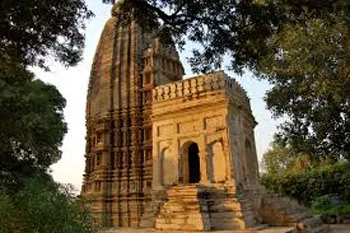
About Maanch Drama
Maanch is a lyrical folk drama and a form of operatic ballet that is very popular in Malwa region of Madhya Pradesh.As an indigenous folk-form, Maanch seems to have its beginning in the seventeenth century.
It is believed that Guru Balmokand, who died quiet an early age, started modern Maanch, during a performance of Genda Pari (“The fairy of the Marigold Flower”). The language of the Maanch is traditionally Malwi, although, now Hindi is also being used in its performance. “Maanch” means the stage or place of performance and as an indigenous & distinct folk-form.
The presentation style & technique of the Maanch, its various thematic elements, & suitable music and gaudy costumes all contribute in making this play a unique one.
Maanch is performed in open space with barest of theatrical equipments, where the stage has a round shape and is never covered from any side; nor is a curtain used as a background. Generally, most actors in Maanch are from artisan classes like Goldsmiths, Tailors, Carpenters, Gardeners, and Coppersmiths. Only men can participate in this though there was one exemption has been eccentric woman, Babajan, who appeared in heroic roles, about 20 years ago and she had worn a turban and a loose-sleeved shirt.
On both sides the seats are provided for organisers and workers. The Guru or the leader sits on the stage itself. Provision for instrumentalists is made on the left side corner of the platform. The person who joins the singing of the refrain during the performance also sits near the ‘Bara Ghant Ka Pat’ or else gets a place near the instrumentalists on the stage.
Rarely, a place is reserved near to the stage for old veterans, which is actually a seat for an expert or experienced persons. A different type of stage was also popular in Malwa in which instrumentalists used to sit on a separate platform at a considerable height. The acting platform used to be quite lower position than this platform and both the platforms are connected to each other.
The actual performance of the Maanch opens late in the evening with an invocation of gods and goddesses. Then a tribute to the founder of the Maanch mandal (group) and the scriptwriter of the drama is sung. This is followed by verses in praise of Saraswati, Lord Ganesh, Bherun and the Chousath Yogini, which is sung by the entire cast on the stage, with folded hands.
Then the Chopdar comes on stage, where he calls upon the Bhisti (water carrier) to sprinkle water on the ground. The Chopdar plays an important role at the beginning of the actual play, since he invites the performers on the stage and introduces them to the audience, after which, he even introduces the theme of the drama and sets the mood for the same. The Farrasan, who is supposed to spread a carpet, follows him and then the stage becomes ready for performance after this. Both the Bhisti and the Farrasan run on their performance, which also contains mime & singing of several songs for more than an hour.
The dialogues in the Maanch always end with the refrain line, which is sung by the performers standing together either in the corner of the stage or arranging themselves near the instrumentalists, where the dholak plays a vital part in providing the musical background.
The dholak is played with its own style and forms the base of typical folk music of the region. Even the sarangi is also used to give orchestral effects. The whole orchestra repeats the dramatic verse and enables the actor to dance in circles at the conclusion of each couplet.
The presentation style & technique of the Maanch, its various thematic elements, & suitable music and gaudy costumes all contribute in making this play a unique one. All of this is followed by a rich tradition. Actors are absolutely free to move in any direction at the time of performance. There are no rigid rules to follow and stage formalities to worry. They sometimes even sit amongst the audience when there is no stage work. However, sometimes, the characters do not leave the platform for the whole play and they just move at the back and front for their turn. There are also cases, when the certain characters make their entry from a distance walking through the audience.
Stage :
Wooden poles and bamboos are used to supply the platform (stage) a height of five to six feet or even more from the ground. The length of the stage is generally thirty feet while the width is about twenty feet.
A different type of stage was also popular in Malwa in which instrumentalists used to sit on a separate platform at a considerable height. The acting place used to be pretty below this platform.
Both the platforms were connected to each other. In such a stage-design the performers have a definite disadvantage. For the actors, who depend upon the dholak and sarangi players at proper points while singing, will need to look up and thus lose the contact with the audience so vital for this folk form.
Copyright 2016 HolidayLandmark All rights reserved
Best time to visit Maanch Drama
October to March (pleasant weather for temple visits)
How to reach Maanch Drama
By Air: Raja Bhoj Airport (Bhopal) / Devi Ahilyabai Holkar Airport (Indore) / Dumna Airport (Jabalpur) / Gwalior Airport are the nearest airports with regular flights from major Indian cities. By Rail: Well-connected via Indian Railways network with regular trains from Delhi, Mumbai, Agra, and other major cities. By Road: Regular state bus services and private taxis available from nearby cities. Madhya Pradesh has a well-maintained network of national highways.
Timings & opening hours
6:00 AM to 12:00 PM and 4:00 PM to 9:00 PM daily
Entry fee & tickets
Free entry; special puja offerings extra
Duration needed
1-2 hours
Location info
Madhya Pradesh, India.
Safety tips
Remove footwear before entering; dress modestly; photography restrictions may apply in inner sanctum
Things to carry
Modest clothing (covering shoulders and knees); camera (if allowed); prasad offerings
Nearby visiting places
Nearby temples, local markets, and town centre; other pilgrimage sites in the region
Nearest airport, railway & bus
Accommodation options available in the nearest town/city. MP Tourism hotels, private resorts, and budget lodges are available near major tourist destinations. Advance booking recommended during peak season (October-March).
Mobile network coverage
Airtel, Jio, BSNL, and Vi all provide coverage across Madhya Pradesh. 4G is reliable in Bhopal, Indore, Gwalior, Jabalpur, and along national highways. Coverage may be weaker in deep forest areas of Kanha, Bandhavgarh, and Pench national parks. Most hotels and resorts in tourist areas offer free Wi-Fi.
Food & restaurants nearby
Madhya Pradesh’s cities offer diverse cuisine. Indore is famous for street food — poha jalebi, sabudana khichdi, and bhutte ka kees. Bhopal has excellent Mughlai cuisine. Temple towns (Ujjain, Omkareshwar, Khajuraho) have traditional vegetarian thali restaurants.
Hotels & accommodation nearby
Major cities (Bhopal, Indore, Gwalior) have good accommodation from budget to luxury. Khajuraho has excellent options from backpacker to luxury, catering to international tourists.
History of Maanch Drama
Maanch is a lyrical folk drama and a form of operatic ballet that is very popular in Malwa region of Madhya Pradesh.As an indigenous folk-form, Maanch seems to have its beginning in the seventeenth century.
It is believed that Guru Balmokand, who died quiet an early age, started modern Maanch, during a performance of Genda Pari (“The fairy of the Marigold Flower”). The language of the Maanch is traditionally Malwi, although, now Hindi is also being used in its performance. “**Maanch
Things to do at Maanch Drama
Participate in aarti ceremonies, explore temple architecture, meditate in the peaceful surroundings, learn about the temple’s history from local priests, and photograph the intricate carvings and sculptures.
Things to visit & highlights
Main shrine and sanctum, temple complex, nearby temples in the region, local markets offering religious items, and other pilgrimage sites in the vicinity.
Climate & weather
Madhya Pradesh has a subtropical climate with three distinct seasons. Winter (October–March) is the best time to visit: temperatures range from 8°C to 28°C with clear skies and pleasant days — ideal for wildlife safaris and temple visits. April–June is very hot, with temperatures reaching 42–45°C in most areas. The monsoon (July–September) brings moderate to heavy rainfall, making the landscape lush green, though wildlife parks close during peak monsoon.
Helpline & emergency contacts
Emergency Services: Police - 100, Ambulance - 108, Fire - 101. District helpline numbers available at local tourist information centres. For wildlife/national park emergencies, contact the forest department control room. MP Tourism helpline: 1800-233-6500 (toll-free).
Nearest petrol pump
Indian Oil, Bharat Petroleum, and Hindustan Petroleum retail outlets are available in the nearest town or city. Major highways have fuel stations at regular intervals. It is advisable to fill fuel before entering remote areas, wildlife sanctuaries, and national parks where fuel stations may be limited.
Frequently asked questions
What are the temple timings? Temples are generally open from early morning (6:00 AM) to late evening (9:00 PM) with a break in the afternoon.
Is photography allowed inside? Photography rules vary by temple; some allow it in outer areas only.
What is the dress code? Modest clothing covering shoulders and knees is recommended.
Are there any special festivals celebrated here? Major Hindu festivals including Mahashivratri, Navratri, and Diwali are celebrated with special ceremonies.
Quick facts
- Type: Destination
- State: Madhyapradesh
- Category: Music And Dance
Photo gallery of Maanch Drama
Photos coming soon. In the meantime, you can find images of Maanch Drama on popular travel photography sites and social media.
Map & location view
This section is being updated and will be available shortly.
Photo gallery of Maanch Drama
Video gallery
Related destinations
Ahiri Dance
Ahiri Dance is a trademark of the cattle herders of Gwalior. The dance also has religious overtones, as the various communities of Gwalior who perform this dance…
Baredi or Yadav Dance
Baredi is an important folk dance of the Gwalior district. Staring from Diwali, the dance is performed till the day of 'Karthik Purnima'. A host of musical…
Chaitra festival dance
The Chaitra festival dance is another famous dance of the Gonds of Bastar district; it is performed after the harvest to thank goddess Annapurna for the harvest…