Mandu Fort
Mandu's was earlier known by the name of "Shadiabad" meaning the city of happiness (Anand Nagari), the name was given by then ruler Allauddin Khilji. Mandu city is situated at an elevation of 633 metres (2079 feet) and extends for 13 km (8 miles) along the crest of the Vindhya Range, overlooking the plateau of Malwa to the north and the valley of the Narmada River to the south. These acted as natural defences and Mandu was originally the fort-capital of Rajput Parmara rulers of Malwa. Towards…
Quick facts
| Nearest Petrol Pump | 1.Petrol Pump Bhopal, Madhya Pradesh 2.Petrol Pump Madhya Pradesh 3.Petrol Pump Narsinghgarh, Madhya Pradesh 4.Petrol Pump Shivpuri, Madhya Pradesh 5.Petrol Pump Borkhera, Kota, Rajasthan |
|---|
History
Mandu’s was earlier known by the name of “Shadiabad” meaning the city of happiness (Anand Nagari), the name was given by then ruler Allauddin Khilji. Mandu city is situated at an elevation of 633 metres (2079 feet) and extends for 13 km (8 miles) along the crest of the Vindhya Range, overlooking the plateau of Malwa to the north and the valley of the Narmada River to the south. These acted as natural defences and Mandu was originally the fort-capital of Rajput Parmara rulers of Malwa. Towards the end of the 11th century, it came under the sway of the Taranga kingdom.
In the 10th century Mandu was founded as a fortress retreat by Raja Bhoj. It was conquered by the Muslim rulers of Delhi in 1304. When, in 1401, the Mughals captured Delhi, the Afghan Dilawar Khan, governor of Malwa, set up his own little kingdom and the Ghuri dynasty was established. And thus began Mandu’s golden age.
His son, Hoshang Shah, shifted the capital from Dhar to Mandu and raised it to its greatest splendour. Hoshang’s son, Mohammed, the third and last ruler of Ghuri dynasty ruled for just one year He was poisoned by the militaristic Mohammed Khalji, who established the khalji dynasty and went on to rule for the next 33 years. He was succeeded by his son, Ghiyas-ud-din in 1469 and ruled for the next 31 years. Ghiyas-ud-din was a pleasure seeker and devoted himself to women and song.[1] He had a large harem and built the Jahaz Mahal for housing the women, numbering thousands, of his harem. Ghiyas-ud-din was poisoned, aged 80, by Nasir-ud-din, his own son.Humayun Sher Shah Suri
In 1526, Mahmud II the sixth Khalji ruler made no resistance against the invading Bahadur Shah of Gujarat who conquered Mandu March 28, 1531. In 1530 Humayun, the second Mughal Emperor, succeeded Babur. Babur had established the Mughal dynasty. Humayun had two major rivals Bahadur Shah of Gujarat and Sher Shah Suri. Humayun was engaged in a war with Sher Shah Suri when he learned of an imminent attack by Bahadur Shah of Gujarat who was being aided by the Portuguese. With an unusual swiftness Humayun attacked and defeated Bagadur Shah. Thus in 1534 Mandu came under Humayun’s rule.Humayun lost the kingdom to Mallu Khan, an officer of the Khalji dynasty. Ten more years of feuds and invasions followed and in the end Baz Bahadur emerge in the top spot.[1] By this time Humayun had been defeated by Sher Shah Suri and had fled India. Sher Shah Suri died in 1545 and his son Islam Shah died in 1553. Islam Shah’s 12 year old son Feroz Khan became the king but was killed by Adil Shah Suri within 3 days. Adil Shah appointed Hemu, also known as ‘Hemu Vikramaditya’ as his Chief of Army and Prime Minister. Hemu had a rapid rise during Sur regime. A grain supplier to Sher Shah Suri’s army and then Chief of Intelligence or Daroga-i-Chowki (Superintendent of Post) under Islam Shah, he became the Prime Minister and Commander-in-Chief of the Afghan Army (Sher Shah Suri’s army) under the reign of Adil Shah Suri. Adil Shah Suri was an incompetent ruler and many rebellions occurred against his rule. Hemu was sent to quell these rebellions. During this period Hemu attacked Mandu also and Baz Bahadur ran away from Mandu. Hemu appointed his own Governor here.
Interesting things to Visit
Jahaz Mahal, Taveli Mahal, Hindola Mahal, Champa Baoli, Jami Masjid, Ashrafi Mahal, Jain Temple, Baz Bahadur’s Palace, etc
Nearest Visiting places
The Darwazas/Gates
One of the many gateways punctuating the wall encompassing Mandu.
The wall encompassing Mandu has 12 major gates or darwazas. The present road, through which Mandu is reached passes through many of these. Also encountered are smaller gateways built to provide protection to the above-mentioned 12 gates.
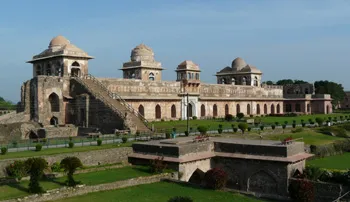
Jahaz Mehal/Ship Palace Situated between two artificial lakes, this two storied architectural marvel is so named as it appears as a ship floating in water. Built by Sultan Ghiyas-ud-din-Khilji, it served as a harem for the sultan. It is a major tourist attraction and presents many scenic views and photographic opportunities.
Jahaz Mahal
View from Jahaz Mahal-a popular tourist attraction.
Hindola Mahal
Hindola Mahal - meaning Swing palace is so named due to its sloping side walls. The Hindola Mahal might have been constructed during the reign of Hushang Shah about 1425 C.E. but may date to the end of the 15th century during the reign of Ghiyas al-Din. [8] It is one of a set buildings making up the royal palace complex at Mandu, which consists of the Jahaz Mahal, the Hindola Mahal, the Tawili Mahal, and the Nahar Jharokha.[9] The Hindola Mahal may have been used as an audience chamber.[10]There are a number of other, undated structures surrounding the palace - an evidence of the rich and glorious past.
The arches of Hindola Mahal
Hoshang Shah’s Tomb
India’s first marble structure, it is one of the most refined examples of Afghan architecture. Its unique features include the beautifully proportioned dome, intricate marble lattice work and porticoed courts and towers. It served as a template for the construction of Taj Mahal.
Jami Masjid Inspired by the great mosque of Damascus, this humongous structure is striking in both its simplicity and architectural style-with large courtyards and grand entrances.
The intricately carved dome of the Jami Masjid.
Rewa Kund
Rewa Kund - a reservoir that supplies water to Roopmati’s Pavilion
A reservoir constructed by Baz Bahadur for the purpose of supplying water to Rani Roopmati’s Pavilion. The reservoir is situated below the pavilion and hence is considered an architectural marvel.
Roopmati’s Pavilion
A large sandstone structure originally built as an army observation post it is known today as Roopmati’s Pavilion. Rani Roopmati - the love interest of Baaz Bahadur lived here and is said to have gazed at the Baz Bahadur’s Palace - situated below and also at Narmada river, flowing through the Nimar plains far below, a river which the queen revered. The Pavilion is a major tourist attraction and offers many scenic views.
Roopmati’s Pavilion.
A view of inside of Roopmati’s Pavilion - a major tourist attraction.
Baz Bahadur’s Palace
Built by Baz Bahadur this 16th century structure is famous for its large courtyards encompassed by large halls and high terraces. It is situated below Roopmati’s Pavilion and can be seen from the pavilion.
Help Line/Phone Number
Police Station:
1.Habib Ganj Police Station
MP Nagar Zone-II, MP Nagar, Bhopal, Madhya Pradesh
2.Chandpole Police Station
Sindhi Camp, Jaipur, Rajasthan
**
3.Kota Raj.**
Rajasthan
4.Devpura Police Station
Bundi, Rajasthan
**
5.Indore Central Jail**
Madhya Pradesh
Nearest Hospital:
1.Banipark Hospital
Kabir Marg, Near Collectrate Circle, Not Specified, Jaipur, 302004
2.Government Hospital
Bundi, Rajasthan
**
3.Indore**
Indore, Indore City, Madhya Pradesh 452001
**
4.Manu Hospital**
Saket Nagar, Shyam Nagar, Jaipur, Rajasthan 302019
**
5.Shekhar Hospital**
A-69, Shah Pura, Near Manisha Market, Shahpura, Bhopal, Madhya pradesh 462016
Copyright 2016 HolidayLandmark All rights reserved
Location info
-
Address:Khargone,Madhya Pradesh, India
-
District: Dhar
-
Nearest City:
-
**Best time to visit: July to September
**
Climate & weather
Will be cool and slightly hot
How to reach Mandu Fort
-
**Nearest Railway Station:**Nearest railheads are Ratlam (124 km) on the Mumbai-Delhi main line and Indore (99 km).
-
**Nearest Airport:**Nearest airport is at Indore (99 km), connected with Mumbai, Delhi and Bhopal.
-
Road Transport: Regular bus services connect Mandu with Indore, Dhar, Mhow, Ratlam, Ujjain and Bhopal
Hotels & accommodation nearby
Malwa Resort: Managed by MPSTDC. Near SADA Barrier
Malwa Retreat: Managed by MPSTDC. Near Sagar Talao
Jhira Bagh Palace: 45kms from Mandu, at Dhar.
Nearest petrol pump
1.Petrol Pump
Bhopal, Madhya Pradesh
2.Petrol Pump
Madhya Pradesh
3.Petrol Pump
Narsinghgarh, Madhya Pradesh
4.Petrol Pump
Shivpuri, Madhya Pradesh
5.Petrol Pump
Borkhera, Kota, Rajasthan
Best time to visit Mandu Fort
Will be cool and slightly hot
Timings & opening hours
9:00 AM to 5:00 PM daily; closed on Mondays
Entry fee & tickets
INR 25 for Indians, INR 300 for foreign nationals; additional INR 25 for camera
Duration needed
2-3 hours
Safety tips
Wear comfortable walking shoes; carry water; be cautious on steep steps and uneven surfaces; avoid climbing restricted areas
Things to carry
Comfortable walking shoes; sunscreen; hat; water bottle; camera; sunglasses
Nearest airport, railway & bus
Malwa Resort: Managed by MPSTDC. Near SADA Barrier
Malwa Retreat: Managed by MPSTDC. Near Sagar Talao
Jhira Bagh Palace: 45kms from Mandu, at Dhar.
Mobile network coverage
Airtel, Jio, BSNL, and Vi all provide coverage across Madhya Pradesh. 4G is reliable in Bhopal, Indore, Gwalior, Jabalpur, and along national highways. Coverage may be weaker in deep forest areas of Kanha, Bandhavgarh, and Pench national parks. Most hotels and resorts in tourist areas offer free Wi-Fi.
Food & restaurants nearby
Forts in MP (Gwalior, Mandu, Orchha) have snack stalls and chai points near the entrance. Gwalior and Mandu have the best food options near their fort complexes. The nearest town offers traditional meals — dal bafla, poha, and kebabs.
Things to do at Mandu Fort
Explore the fort ramparts and bastions, visit the palace chambers and durbar halls, photograph the architecture, watch the sound and light show (if available), and enjoy panoramic views from the top.
Frequently asked questions
What is the history of this fort? Most MP forts date back to the medieval period, built by Rajput or Maratha rulers between the 10th and 18th centuries.
How much time is needed to explore? Typically 2-3 hours for a thorough visit.
Is there a guide available? Local guides are available at the entrance; audio guides may also be available.
Are there food facilities inside? Basic refreshment stalls are usually available; full meals are available nearby.
Accessibility
Historic forts typically have uneven stone pathways, steep staircases, and no ramps. Forts are built on elevated ground — reaching them requires a climb on foot or by vehicle to the base followed by stairs. Visitors with mobility issues may find the outer grounds and lower levels more accessible than the upper ramparts. Wear sturdy footwear and allow extra time.
Rules & restrictions
Do not climb on unstable walls or beyond marked boundaries. Some bastion platforms are partially collapsed. Graffiti and defacement are illegal. Alcohol and smoking are not permitted inside most historic sites. Drones may require permission. Large bags may be checked at the entrance. Photography is permitted but tripods may need special permission. Respect heritage rules — these monuments are protected under the Ancient Monuments and Archaeological Sites and Remains Act.
Best photography spots
The ramparts offer the best panoramic views — arrive early morning or late afternoon for golden light across the landscape. The bastions and arched windows make excellent natural frames. Wide-angle lenses capture the scale of the fortifications; telephoto lenses isolate details of the stonework and distant views. Sunset silhouettes of the fort walls against the sky are iconic.
Visitor information
Please check locally for current visitor information.
Map & location view
This section is being updated and will be available shortly.
Photo gallery of Mandu Fort
Video gallery
Related destinations
Ahilya Fort
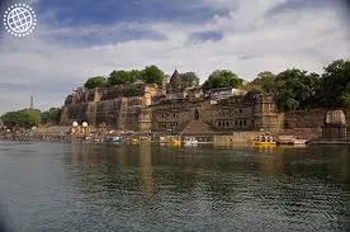
Ahilya Fort at Maheshwar (Madhya Pradesh, India) is an experience straight out of the 18th century. Situated high above the banks of the sacred Narmada River,
Alamparai Fort
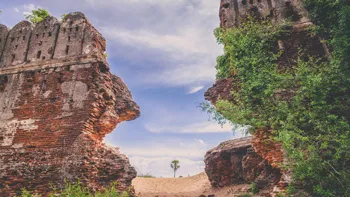
Backwaters is very scenic- Good and safe for a swim. Local fisherman offer to take you for a ride on the boat-charges will be in the range of Rs. 200-500 for 30…
Asirgarh Fort
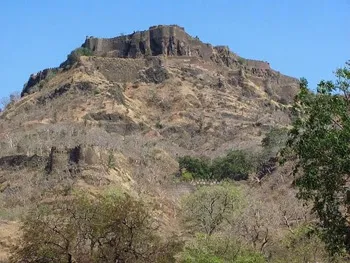
The Chanderi Fort is located in the small historical town of Chanderi in the Ashoknagar District of Madhya Pradesh. The Chanderi Fort is the most conspicuous…