Navaratri
Interesting feature of navratri is the " garba " , a circular dance Performed by women around an earthenware pot called a " garbo ", filled With water. As the dancers whirl around the pot, a singer and a drummer Provide the musical accompaniment. The dance usually starts slowly, it gets Faster and faster as the music too gets more rapid. Another dance which is Also a feature of navaratri is the " dandia - ras " or ' stick dance ', in Which men and women join the dance circle, holding small…
About Navaratri
Interesting feature of navratri is the “ garba “ , a circular dance Performed by women around an earthenware pot called a “ garbo “, filled With water. As the dancers whirl around the pot, a singer and a drummer Provide the musical accompaniment. The dance usually starts slowly, it gets Faster and faster as the music too gets more rapid. Another dance which is Also a feature of navaratri is the “ dandia - ras “ or ’ stick dance ’, in Which men and women join the dance circle, holding small polished sticks or Dandias together, adding to joyous atmosphere. The dances usually commence Late in the night and continue until early morning, testifying to their Great popularity.
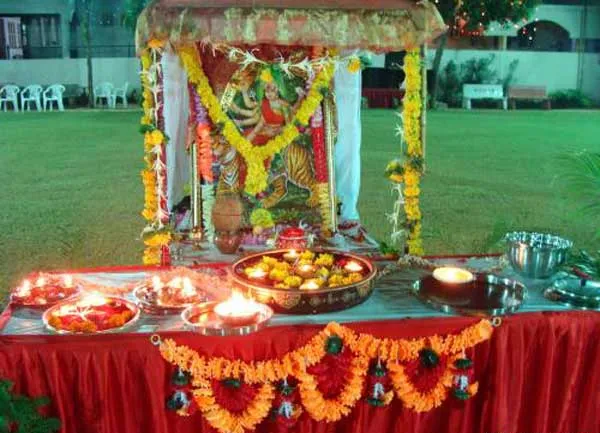
The Navratri festival is dedicated to the Mother Goddess. Known by other names such as Durga, Devi, she occupies a special place in the Hindu pantheon. She represents Shakti, the cosmic energy that animates all beings, and is also considered to be prakriti (nature), the counterpart of purusha. Together, they are responsible for the creation of the world according to the Puranas and Vedas (ancient Hindu Scriptures).
Time(indian calendar Tithi)
This festival symbolises health and prosperity, and is celebrated in a very traditional way. People perform yagna (sacrifice offered in order to procure purification through fire) or havana (symbolic ceremony involving the purifying aspects of fire). During both the ceremonies, ghee (clarified butter), paayas or kheer (rice cooked in condensed milk) and sesame seeds are poured into the holy flames to the chanting of mantras (holy verses). Each cycle of oblation culminates with the priest summoning Swaha, the consort of Agni, or fire. Some believers fast (vrat) throughout the nine days, whilst others settle for a daylong fast. Fasting is considered to be one of the most popular means of self-discipline and spiritual development. On the fifth day, known as Lalitha Panchami, it is customary to gather the books in the house and place them before a sacred lamp in order to seek the Goddess Saraswati’s blessings. Artisans also lay their tools at the feet of the Goddess for a more prosperous trade.
History of Navaratri
- The demon Mahishasur, after being given a boon by the fire god Agni that he wouldn’t be killed by weapons bearing masculine names, caused grave destruction and terror. The gods sought the help of Lord Shiva, who advised the invocation of the goddess Shakti. With the gods’ prayers, a divine luster sprang from the heart of Lord Shiva and the bodies of all the gods and formed the goddess Adhya Shakti. The gods gave her ornaments, arms and a lion as a vehicle. She fought with the evil Mahishasur for nine long days and nights, and at last, resulted in the beheading of Mahisa on the tenth. The nine nights came to be known as Navratri, while the tenth day was called Vijaya Dashami, the tenth day that brought the triumph of good over the evil.
- Sati (also known as Uma) married Lord Shiva against the wishes of her father, King Daksha Prajapati. In revenge, Daksha organized a huge yagna and invited all the gods and deities except his new son-in-law. Sati decided to attend the yagna despite Lord Shiva’s attempt to persuade her not to. The King ignored his daughter’s presence and publically abused Lord Shiva. Unable to bear her father’s insults, Sati committed suicide by jumping into the yagna fire. However, she was reborn and again won Lord Shiva as her groom and peace was restored. It is believed that since then Uma comes every year with her four children Ganesh, Kartik, Saraswati and Laxmi and two of her best friends or ‘sakhis’ called Jaya and Bijaya, to visit her parent’s home during Navratri.
Method of Celebration
One may drink beverages like tea, coffee and milk, on Navratri. Dishes made of sago and potato is generally consumed by the people, when they observe fast on Navratri. Sendha namak (rock salt) is used instead of common salt, for cooking on the festival. All fruits and foodstuff made of fruits are eaten during the seven days. Nowadays, ready-to-eat snacks are available in the stores, especially prepared for Navratri. In addition to this, certain restaurants in the northern parts of India would offer special menu for the people, who have observed fast on Navratri.
Dangs Darbar:
The annual Dangs Darbar Fair is held every year in the cool and pleasant climate of Ahwa. It is known as Darbar because during the time of British, Darbar of Rajas and Naiks of neighboring districts used to gather here. Today, it is reputed as one of the biggest fairs held in Gujarat and is also known as Janambadi Darbar.
Countless tribal people from the adjoining districts participate in the fair dressed in colourful traditional outfits and sounding the shehnai and beating their drums. the fair also attracts merchants from the far away districts of Nasik, Surat and West Khandesh. The major attractions of the fair include ras and garba performances, songs and dramas that give a close look at the local culture and traditions.
Puja Vidhi:
Certain items are required to perform the Navratri pooja. These may include the idol or picture of Goddess Durga, Durga Sapthashati book, water in Kalash (pitcher), fresh washed mango leaves, one coconut, roli (red color for tilak), moli (red sacred thread), chawal (rice), paan (betel leaves), supari (beetle nuts), cloves, cardamom, kumkum (vermilion) and gulal. You will also need few incense sticks, a deep and matchstick. The flowers used for Navratri puja may include rose, lotus and red hibiscus. Stalks of Bilwa (bael) leaves are also used for the puja. You may offer fresh pomegranate and sweets such as laddoo and peda, as prasad. You will require a Panchpatra containing spoon and water, bael leaves. Take a mat as well, to sit.
Culture of festivities
This festival symbolises health and prosperity, and is celebrated in a very traditional way. People perform yagna (sacrifice offered in order to procure purification through fire) or havana (symbolic ceremony involving the purifying aspects of fire). During both the ceremonies, ghee (clarified butter), paayas or kheer (rice cooked in condensed milk) and sesame seeds are poured into the holy flames to the chanting of mantras (holy verses). Each cycle of oblation culminates with the priest summoning Swaha, the consort of Agni, or fire. Some believers fast (vrat) throughout the nine days, whilst others settle for a daylong fast. Fasting is considered to be one of the most popular means of self-discipline and spiritual development. On the fifth day, known as Lalitha Panchami, it is customary to gather the books in the house and place them before a sacred lamp in order to seek the Goddess Saraswati’s blessings. Artisans also lay their tools at the feet of the Goddess for a more prosperous trade.
Help Line/Phone Number
Copyright 2016 HolidayLandmark All rights reserved
Climate & weather
The land relief in Gujarat is low in most parts of the state, resulting in a great diversity in the climate of Gujarat India. Gujarat experiences mild, pleasant and dry winters, with average daytime temperatures ranging around 83 °F(29 °C) and night temperatures around 53 °F(12 °C). The summers are very hot and dry, with day temperatures rising up to around 105 °F(41 °C) and night temperatures dropping to 85 °F(29 °C).
How to reach Navaratri
-
Nearest Railway Station:
-
Nearest Airport:
-
Road Transport:
Best time to visit Navaratri
September-October during the Navaratri festival.
Timings & opening hours
Nine nights in September-October (Ashwin month). Garba events typically 7:00 PM to midnight.
Entry fee & tickets
Varies by venue. Many public garba events are free.
Duration needed
2 to 3 hours per evening event. The festival lasts 9 nights.
Location info
Navaratri is celebrated across Gujarat, with major celebrations in Ahmedabad, Vadodara, Surat, and Rajkot..
Safety tips
Keep valuables secure in large crowds. Stay hydrated. Arrange transport in advance as public transport is very busy.
Things to carry
Comfortable clothing for dancing, water bottle, camera (check venue policy).
Nearby visiting places
All major cities of Gujarat host large celebrations.
Nearest airport, railway & bus
Nearest airport and railway station.
Mobile network coverage
Airtel, Jio, and Vi all provide good coverage across Gujarat’s major cities and tourist areas. 4G is generally reliable in Ahmedabad, Vadodara, Surat, and along major highways. Coverage may be weaker in remote areas of Kutch and interior Saurashtra. Most hotels and cafes in tourist areas offer free Wi-Fi.
Food & restaurants nearby
Food options are available in the nearest town. Traditional Gujarati thali restaurants and local eateries offer a range of vegetarian dishes.
Hotels & accommodation nearby
Accommodation is available in the nearest town or city. Options range from budget guesthouses to mid-range hotels. Booking ahead during major festivals (Navratri, Kutch Festival) is recommended.
Things to do at Navaratri
Participate in Garba and Dandiya Raas dances, watch the traditional aarti, enjoy Gujarati cuisine at food stalls, and witness the colourful cultural performances.
Things to visit & highlights
The vibrant Garba grounds, decorated temples, and cultural events across the state.
Nearest petrol pump
Petrol pump available in the nearest town.
Frequently asked questions
What is Navaratri? A festival celebrated in Gujarat.
When is it celebrated? Check the annual calendar.
How should I prepare? Book accommodation in advance during festival periods.
Quick facts
- Type: festivals
- Location: Gujarat, India
- Ideal for: History enthusiasts, cultural travelers, and photographers
- Best time to visit: October to March (pleasant winter season)
- Photography: Allowed at most areas; some sites may have restrictions inside sanctums
Plan your visit to Navaratri with these essential quick facts for a smooth and enjoyable trip to Gujarat.
Map & location view
Navaratri is located in the vibrant state of Gujarat, India. The destination is accessible by road and is well-connected to major cities and towns in the region, making it a convenient addition to any Gujarat travel itinerary.
How to reach
- By Air: The nearest airport is connected to major Indian cities including Mumbai, Delhi, Ahmedabad, and Vadodara with regular domestic flights.
- By Rail: The nearest railway station is connected to the Indian railway network with regular trains from major cities across India.
- By Road: State transport buses, private taxis, and self-drive options are available from nearby cities. Gujarat has a well-maintained network of state highways and national highways.
Use GPS navigation or local maps to find the exact location of this destination in Gujarat. The Gujarat Tourism website provides additional travel resources for visitors.
Photo gallery of Navaratri
Video gallery
Related destinations
Deepavali Festival
The Diwali day attire usually consists of the Jhabba (kurta) and dhotis for the men, while the women dress in Saris. However in the urban cities of Gujarat, most…
Janmashtami Festival
Janmashtami is popular as 'Gokulashtami' or 'Krishna Jayanti'. Lord Krishna is regarded as one of the main Gods among the Hindus. According to the mythology, there…
Kite Festival(Makar Sankranti)
The festival of Uttarayan is a uniquely Gujarati phenomenon, when the skies over most cities of the state fill with kites from before dawn until well after dark…