Uperkot Fort
The state of Gujarat boasts of a number of historical Forts and monuments in Junagadh. Built and rebuilt repeatedly, the Uperkot Fort, Junagadh, one of the two fortifications of the city, has of late become one of the main Tourist attractions in Junagadh. Adding to the advantage of the fort being less thronged has helped it retain the ethnicity without losing any bit of its charm.
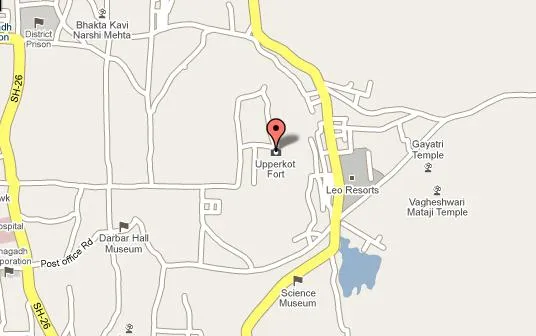
About Uperkot Fort
The fort has many interesting exhibits like the two guns placed on the western wall and believed to have been cast in Egypt. The bigger one is called the Nilamtope and the other one is known as Kadanal. In and around the fort one can find several Buddhist caves belonging to the 200 B.C. to 200 A.D era.
Visitors are allowed entry to the Uperkot Fort in Junagadh, Gujarat through a large gate. Some of the walls of the fort are as high as 20 m. To the left of the fort’s gate lies the Jama Masjid, which stands just on top of a Hindu temple. The road further leads to a rocky hill which has stone carvings with floral work. One also gets to see the Khapra Kodia Caves that lie towards the north of the fort and the Babupyana Caves to the south.
Covering an area of 2.74 lakh sq. mts, the Uperkot Fort, Junagadh is fenced high till 66 feet and lengthwise up to 3080 meters. The initial material of interest comes as the sequence of three royal gateways that welcome one into the fort inside. Next, the Nilam canon catches ones eyes immediately after entering the fort. Cast in the year 1531 in the country of Egypt, the famous canon was left back by a Turkish admiral, Sulaiman Pasha, who served as an assistant to the Sultan of Gujarat during the tensions against Diu in 1538.
The 1500 year old Baba Pyara Buddhist caves, originated in times of Ashoka, are artificially carved out , going deep into three storeys and archeologists date it back to around the 2nd century. The air conditioning system circulated through the channels of water running through the passages is unique. The 6 pillars bear beautiful carvings on them.
History of Uperkot Fort
From the little chronological information that we get regarding the historical origin of the Uperkot Fort, Junagadh, was built by Chandragupta Maurya in 319 B.C. Later, around 10th century, Rah Grahar reconstructed the entire palace out of the ruins and built the fort along with all the updated requirements of a proper one. However, according to whatever evidence is available, it can be said that the fort was erected in or around the third century or in the times of the Mahabharata.
Concrete historical pages since 875 A.D say that the Uperkot Fort had served as the capital to 20 rulers of the following dynasties: Maurya, Gupta, Mandlik, Mahipal, Khengar and Navghan, sustaining 16 assaults, the last one being in 1784 all with little success though. Further down, the fort has been put to use by the British as military quarters for the country till year 1947.
Interesting things to Visit
Ashokan Edicts:
Located at the base of the Girinagara or Urjayata Hill, the boulder bearing the edicts of Ashoka placed within a small building at the side of the road established itself at 210 31 N and 700 28 E. The first fourteen edicts here are that of Ashoka and are etched in the eastern side of the boulder. Then later Mahakshatrapa Rudradaman I in 150 A.D and Skandagupta in 450 A.D incorporated their inscriptions describing the dire straits brought about by the destruction of the embankments of Sudarshan Lake by the rivers Suvarna Sikta and Palasini. Of all the monuments and Forts in Junagadh, the edicts of Ashoka carry the philosophy in its weightiest terms.
Etched in a huge boulder, the edicts were founded by James Todd, but it was much later by 1837 that Rev. Dr. John Wilson who made them properly known to the world by copying the edicts and in 1843 they were enlisted in the Bombay branch journal by the Royal Asiatic Society.
Mahabat Maqbara:
The city of Junagadh can boast of some beautiful ancient mausoleum erected by the Nawabs of Junagadh in the 18th century in the area around Chitkana Chowk. These mausoleum are charming in their own way, with nicely designed arches, vertical columns, and intricate stone carvings. However, the mausoleum built later; or rather the newer ones are more attractive and lure a greater number of tourists who floch to this place every year. The yellow mausoleum, Mahabat Maqbara, Junagadh, is a masterpiece of it own kind. The uniqueness of the affluence of silver at the portals teemed with intricate carvings and the winding staircase encircling the four minarets attract a lot of tourists to its site. The onion shaped dome also adds to the entire beauty of the spectacle.
Durbar Hall Museum:
The Durbar Hall Museum, Junagadh actually has been a courthouse in the times of the Nawabs - where all court cases used to be put up to be fought for or against. Part of the old city palace, the court was later converted into a museum, preserving the tokens and mementos which speaks of the grandeur and glory of the past ages of Nawabs and Sultans.
Lovely diamond woven carpets, sparkling chandeliers, pictures, portraits of the rulers of Junagadh, including the one with his pet dogs, delineate the other room of the Durbar Hall Museum. One of the carpets here is the pride of the Nawabi era as it was woven in the Junagadh jail by inmates. Weapons like Nepalese kukris, shields made out of turtle shells, various daggers, sabers comprise the arms section of the museum.
Junagadh Zoo Museum:
The Junagadh Zoo Museum, Junagadh is one of the most frequented Tourist attractions in Junagadh for obvious reasons. A museum incorporated within the premises of a zoological garden is undoubtedly exclusive in its own sense. It is situated at the foothills of Mount Girnar.Set up in 1863 A.D, and situated at 4km north of the southern part of Junagadh, the Sakkar Bagh Zoo, Junagadh, is oldest of its kind in the entire state of Gujarat, set up by the Nawab with a view to keep poaching under control of the Asiatic lion. It is a well maintained animal park , home to several species of motley colored birds, including flamingos, tigers, lions, leopards and other royal beasts. In the very premises of the zoo, there exists the Junagadh Zoo Museum, Junagadh with various objects which emit cultural evidences from the past
Wellington Dam:
Built by the Britishers near the foot of Datar hill. The three sides and a garden in front it affords an enchanting view.
Wellington Dam:
Built by the Britishers near the foot of Datar hill. The three sides and a garden in front it affords an enchanting view.
Scince Museum:
Scince Museum is gujarat’s first and the only private science museum. More than 60 working science projects based on science facts. Which can be operated by visitors. Worth visiting attached one small aquarium and evening open air garden restaurant garden café serves south Indian and Punjabi dishes since 1981.
Narsinh Maheta Lake:
Narsinh Maheta Lake is a beautiful lake constructed by joint effort of the people of Junagadh near Talav Gate.
Bhavnath Mahadev:
Located at the foot hills of the Girnar Hills, the Bhavnath Mahadev Temple is one of the foremost Holy Places in Junagadh. Nothing much is known about its precise origin but there is no scope of doubt about its historicity. It has stood their since ancient times. Visited by religious minded devotees all along the year, it is however best known for being the venue of the famous Bhavnath Fair.Held in the month of Magha as per the Hindu calendar (roughly coincides with January/February) this fair is the meeting point of a large number of people and is celebrated with a great deal of mirth and good cheer. It continues for five days. Events include performances put up by folk singers and dancers. One of the most striking features of this fair hosted at the Bhavnath Mahadev Temple is the active participation of the Naga Bavas.
The worship starts at mid night on the 14th day of the dark half in the Magha month and as soon as the puja commences these sages are seen advancing towards the Bhavnath Mahadev Temple seated on elephants holding flags in their hands. The air reverberates with the sounds of the conch shells, the tungis and the turis. A strong belief is prevalent that on this day Lord Shiva himself visits the Bhavnath Mahadev Temple. The organizers serve free meals to the visitors on this auspicious occasion.
Temple of Gorakhnath:
The Temple of Gorakhnath, Junagadh, Gujarat, India is an ancient temple. However, no comprehensive records are found till date to establish the date of its construction.
Junagadh Temple of Gorakhnath is positioned at the Girnar Hill in the district of Junagadh, Gujarat. Girnar Hill lies about 5 kms to the east of Junagadh. The presiding deity at this temple is Lord Gorakhnath. In the vicinity of this beautiful temple, you would get the chance to see several other Hindu temples along with a number of Jain temples.
Neminath Temple:
This rectangular temple is devoted to Neminath, the famous 22nd Tirthankar of Jainism. The Junagadh Temple of Neminath houses a deity of Lord Neminath. This presiding deity dwells in lotus along with a conch. Carved in black stone, Lord Neminath presents an awe inspiring sight.The construction of this temple began in 1128 AD and was finished in 1159 AD. Two brothers, Vastupal and Tejpal, were the brain behind the construction of Neminath Temple. It was this duo who is also held in high esteem for Mount Abu’s Dilwara temples, a marvelous piece of architecture.
Amba Mata Temple:
The Temple of Amba Mata, Junagadh, Gujarat, India is an ancient shrine. This temple dates back to the 12th century.Junagadh Temple of Amba Mata is positioned on top of the Girnar Hill that’s 600 meter in height. The presiding deity at this Hindu temple is Goddess Amba, an incarnation of the mother Goddess. Every year, thousand of pilgrims come to this temple to offer their prayers and seek divine blessings. This temple is especially a place frequented by the newly married couples who arrive at this place to be blessed by the Goddess. It is believed that the blessings of Goddess Amba would ensure eternal conjugal bliss for the couple.
Mallinath Temple:
Actually the Junagadh Temple of Mallinath is a triple temple. The exteriors of this temple are exquisitely carved and present a stunning sight to behold. At this temple, you would be able to get a captivating insight into Jain religious rituals. Akin to a Hindu temple, pilgrims at this place also offer leaves, fruit, flowers, vermilion, sandalwood paste and grains to the deity, amidst ringing of the bells and chanting of mantras. Once the pooja gets over, these devotees adorn their foreheads with liberal daubs of vermilion as well as sandalwood paste. A generous amount of money is also offered for the upkeep of the shrine.The credit of the construction of Temple of Mallinath, Junagadh, Gujarat, India goes to two brothers named Vastupal and Tejpal. Junagadh Temple of Mallinath was erected in 1177 by this duo.
Girnar Hill:
Rising up on the outskirts of Junagadh is Mt Girnar, whose 3660 foot high summit is crowned by some of the finest and religiously most important temples. The climb is a steep one and best undertaken in the very early hours of the morning. The main entrance to the hill is in front of the Uparkot. On the hill top there are Jain and Hindu temples standing in a quadrangular courtyard. The main temple, which is surrounded by pillared cloisters containing 70 cells is dedicated to the 22nd Jain Thirthankara (God) Neminath. Further up from Neminath Temple, the Amba Temple is where newly married Hindu prays for a happy marriage.
Bazaars in Junagadh:
The bustling town of Junagadh in Gujarat carries with it a long history of tradition and heritage. This princely town has been the capital of the Mauryan and the Gupta dynasty and later on was the reigning seat of the Chudasama Rajputs from the 9th to the 15th century. It is located at the foothills of Mount Girnar and is an important Jain pilgrim points.The temples situated at Mount Girnar are some of the most frequented spots in Junagadh. The journey uphill is strenuous when you consider the 2000 steps that you have to climb but rewarding in ways more than one. The 16 shrines in the mountain top reflects the architectural splendor of Junagadh. Apart from the tourist attractions you can also visit the Bazaars in Junagadh which is a good way to spend a leisurely afternoon.
Nearest Visiting places from Uperkot Fort
Chorwad Beach:
Chorwad Beach is 66 kilometres from Junagadh and 23 kilometres from the fishing centre of Veraval, Chorwad is a delightful resort on the sunny coast of Gujarat. The only beach in India where you can live in the timeless splendour of a palace built amidst soft golden sand facing the beach. It was built by the former Nawabs of Junagadh. The nearest Airport is Keshod. An excellent road connects to Junagarh, Girnar, the Gir Forest sanctuary and the famous temple of Somnath.
Sasan Gir Forest & Sanctuary:
It is situated 65 Kms. from Junagadh via Keshod (where there is an airport). It is connected both by Rail as well as Road. Sasan Gir Sanctuary provides refuge to that rare species-the Asiatic Lion. The sanctuary covers an area of 500 sq. miles of dry, open scrubland where the lions roam freely. They can be seen on guided jeep tours through the jungles. The museum inside the sanctuary provides knowledge about environment and its relationship with human beings. Apart from the lions, the wild life includes antelope, hyena, fox, monkeys, lipard, the nilgai or black buck, chinkara, chousingha and other species of the deer family. The habitat varies from arid to semi-arid. Grasslands, scrub, savannah and dry deciduous forests are intersected by several hill and river systems.
Somnath temple :
Situated 79 Kms. from Junagadh and 30 Kms from Chorwad, the legendary shore temple of Somnath is one of the twelve most sacred Shiva shrines in India. According to the legend, Somnath is as old as creation, built by none other than Soma, the Moon God himself. Somnath was destroyed seven times, and seven times, it was rebuilt. Mehmud of Gazni having heard of its fabulous treasure, raided it in 1026 and carried away camel-loads of jewels and gold.
Madhavpur:
It is believed that Lord Krishna married Rukmini at this place. A fair is conducted every year on Chaitra Sud to mark the event of historic importance. This place is festooned with beaches lined with coconut trees.
Ahmedpur- Mandvi:
Ahmedpur- Mandvi is a beautiful sea-resort which commands a panoramic view across the creek of Diu island. This beach stretches around 6-km and provides utmost relaxation to visitors and ideal place for water sports as mentioned above and enjoying traditional food in huts decorated with local style of architecture.
Hotels/Lodge/Accommodation nearby Uperkot Fort
**Hotel Indralok:**Railway Station Road, Nr. Majevadi Gate,Junagadh, Gujarat,Ph:0285 2658511
**Hotel Shikhar Palace:**Shikhar Complex,Jayshree Road,Kalwa Chowk,Junagadh,Gujarat,Ph:0285 2626596
Help Line/Phone Number
Copyright 2016 HolidayLandmark All rights reserved
Location info
-
**Address:**Uperkot,Junagadh,Gujrat,India
-
District: Junagadh
-
Nearest City: Vanthali
-
Best time to visit: October to March
Climate & weather
Junagarh is mild with temperature summers.beatween 34-43°C in winters and 28-34°C in the
How to reach Uperkot Fort
-
**Nearest Railway Station:**Junagadh railway station,connected to Ahmedabad
-
**Nearest Airport:**Keshod 37 km & Rajkot 99 km,connected to Mumbai airport
**Road Transport:**State connect Junagarh with Bhavnagar, Ahmedabad 321 km, Gir, Rajkot 101 km , Bhuj, Dwarka, Somnath, Palitana, Surat, Vadodara, Porbandar 113 km . Taxis, Auto-rickshaws, Tongas & City Bus services are available for local transport.
Nearest petrol pump
- **HP Petrol Pump:**Nearest jayshree cinema Junagadh,Gujarat,India
Best time to visit Uperkot Fort
October to March.
Timings & opening hours
8:00 AM to 6:00 PM daily.
Entry fee & tickets
INR 15 for Indians.
Duration needed
1 to 2 hours.
Safety tips
Follow site guidelines. Wear comfortable footwear. Carry water.
Things to carry
Camera, water bottle, hat, sunscreen.
Nearest airport, railway & bus
Nearest airport and railway station in the nearest city.
Mobile network coverage
Airtel, Jio, and Vi all provide good coverage across Gujarat’s major cities and tourist areas. 4G is generally reliable in Ahmedabad, Vadodara, Surat, and along major highways. Coverage may be weaker in remote areas of Kutch and interior Saurashtra. Most hotels and cafes in tourist areas offer free Wi-Fi.
Food & restaurants nearby
Food options are available in the nearest town. Traditional Gujarati thali restaurants and local eateries offer a range of vegetarian dishes.
Things to do at Uperkot Fort
Explore the site, admire the architecture, and learn about its historical significance.
Frequently asked questions
What is Uperkot Fort? An archaeological/historical site in Gujarat.
What is the best time to visit? October to March.
What are the timings? Generally 8:00 AM to 6:00 PM.
Accessibility
Accessibility information is not currently available for this site. Contact the venue directly or check with your accommodation for the latest accessibility details.
Rules & restrictions
Standard visitor rules apply. Check locally for any specific restrictions at this site.
Best photography spots
The best photography spots are typically during the golden hours (early morning and late afternoon). Scout the location first to identify the best angles, and consider the direction of light at different times of day.
Quick facts
- Type: archeology
- Location: Gujarat, India
- Ideal for: History enthusiasts, cultural travelers, and photographers
- Best time to visit: October to March (pleasant winter season)
- Photography: Allowed at most areas; some sites may have restrictions inside sanctums
Plan your visit to Uperkot Fort with these essential quick facts for a smooth and enjoyable trip to Gujarat.
Visitor information
Planning your visit to Uperkot Fort
- Language: Gujarati is the local language; Hindi and English are widely understood at tourist sites.
- Getting around: Auto-rickshaws, taxis, and state transport buses are readily available. Hiring a private vehicle is recommended for comfort.
- What to wear: Light cotton clothing in summer; light woolens in winter. Comfortable walking shoes are essential. Modest dress is advised at religious sites.
- Photography: Check for photography restrictions before entering. Some temples and museums may charge a separate camera fee.
- Best time to visit: October to March when the weather is pleasant for sightseeing.
- Local cuisine: Don’t miss Gujarati thali — a wholesome meal with dal, rice, vegetables, roti, and sweets like dhokla, khandvi, and mohanthal.
Nearby facilities
- ATMs: Available in nearby towns and at major tourist sites.
- Medical facilities: Primary health centers and hospitals can be found in district headquarters.
- Restrooms: Public restrooms are available at major tourist spots; carry hand sanitizer and tissues.
Make your visit to Uperkot Fort comfortable and hassle-free with these practical visitor tips for Gujarat.
Map & location view
Uperkot Fort is located in the vibrant state of Gujarat, India. The destination is accessible by road and is well-connected to major cities and towns in the region, making it a convenient addition to any Gujarat travel itinerary.
How to reach
- By Air: The nearest airport is connected to major Indian cities including Mumbai, Delhi, Ahmedabad, and Vadodara with regular domestic flights.
- By Rail: The nearest railway station is connected to the Indian railway network with regular trains from major cities across India.
- By Road: State transport buses, private taxis, and self-drive options are available from nearby cities. Gujarat has a well-maintained network of state highways and national highways.
Use GPS navigation or local maps to find the exact location of this destination in Gujarat. The Gujarat Tourism website provides additional travel resources for visitors.
Photo gallery
Visual highlights of Uperkot Fort
Visitors to Uperkot Fort will find plenty of photogenic spots worth capturing. From architectural details to natural landscapes, the destination offers diverse subjects for photography enthusiasts.
What to photograph:
- Architecture: Intricate carvings, structural details, and traditional Gujarati craftsmanship
- Landscapes: Surrounding natural beauty, gardens, and panoramic views of the Gujarat landscape
- Local life: Candid moments of visitors, vendors, and daily activities around the site
- Details: Close-up shots of carvings, paintings, decorative elements, and textures
Photography tips:
- Early morning (6:00 AM – 8:00 AM) and late afternoon (4:00 PM – 6:00 PM) offer the best natural light for photography in Gujarat’s climate
- Check if photography is allowed inside buildings before taking photos
- A wide-angle lens is ideal for capturing architectural grandeur at Gujarat’s heritage sites
- Mobile phone photography works well in well-lit outdoor areas
Browse through our collection of photographs showcasing the beauty and heritage of Uperkot Fort. New images are added regularly as part of our ongoing content enrichment for this Gujarat destination.
Photo gallery of Uperkot Fort
Video gallery
Related destinations
Adalaj Vav
Built entirely of sandstone, one can enter into this step-well from three sides, which consist of octagonal landings with huge carved colonnades and intricately…

Archaeological Park
Archaeological Park is one of the notable places to visit in Gujarat.
Ashokan Edicts
Junagadh Ashokan Edicts are also known as Ashok Shilalekh. The other two epigraphs depict the breaking of the dams on the Sudarshan Lake that occurred because of a…