MOTOSHARE 🚗🏍️
Rent Bikes & Cars Directly from Owners
Motoshare connects vehicle owners with people who need bikes and cars on rent. Owners earn from idle vehicles, and renters get flexible ride options.
Visit Motoshare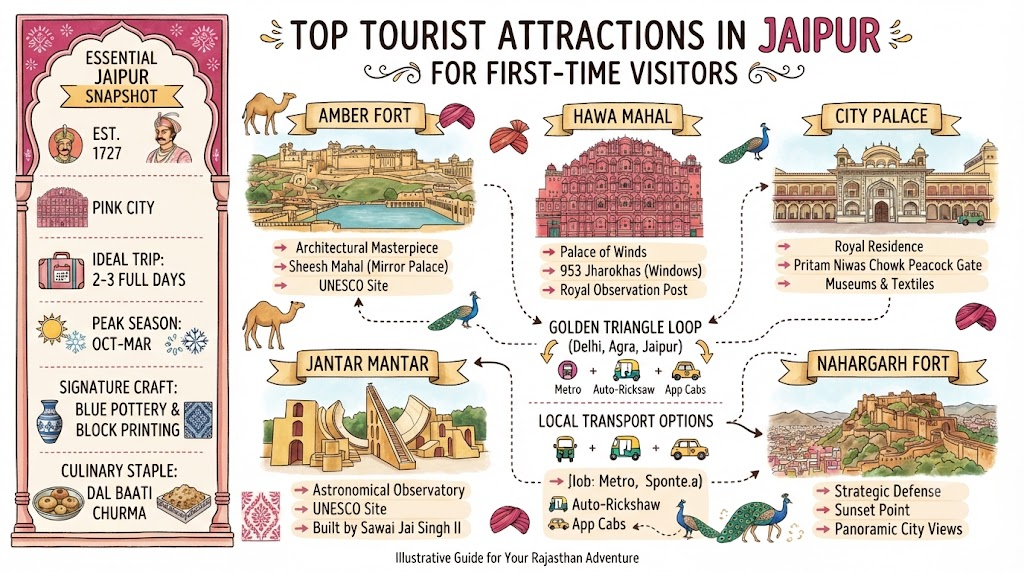
Introduction
Many first-time travelers to India fall into the trap of visiting hyper-commercialized, sterile holiday resorts that insulate them from the true heartbeat of the country. If you are looking for a destination that rejects generic tourist curation in favor of raw architectural marvels, deep-seated cultural authenticity, and thousands of years of living history, Jaipur stands ready to welcome you. Known globally as the “Pink City,” this mesmerizing capital of Rajasthan offers a sensory overload of vibrant bazaars, massive hill forts, and exquisite palaces that refuse to hide behind modern glass façades.
Why Jaipur is a must visit city
Jaipur represents an essential macro-level chapter in world travel because it was India’s first planned city, established in 1727 by the astronomer-king Maharaja Sawai Jai Singh II. Strategically nestled within the protective embrace of the rugged Aravalli Hills, the city’s grid-like urban layout was formulated using ancient Vastu Shastra principles mixed with classical European geometry. For the modern traveler, Jaipur serves as a seamless bridge between past and present; it is exceptionally accessible via the multi-lane National Highway 48, a robust broad-gauge railway network, and an international airport, ensuring an easy journey whether you are a solo backpacker or a luxury seeker.
The city serves as the cornerstone of the world-famous Golden Triangle travel circuit, which links Delhi, Agra, and Jaipur in a highly manageable geographic loop. Exploring Jaipur allows you to see how early architectural engineering solved complex climate and defense problems while maintaining an elite aesthetic standard. Below is a macro-summary of key travel indicators to keep in mind as you map out your maiden voyage to this royal capital.
| Key Metric | Travel Indicator Details |
|---|---|
| Ideal Trip Duration | 2 to 3 Full Days |
| Peak Season window | October to March (Cool winters) |
| Primary Transit Hub | Jaipur International Airport (JAI) / Jaipur Junction (JP) |
| Local Signature Craft | Blue Pottery, Block Printing, Kundan Jewelry |
| Core Culinary Staples | Dal Baati Churma, Pyaaz Kachori, Laal Maas |
Best Places or Experiences
Sheesh Mahal at Amber Fort.
Peacock Gate at City Palace.
Nahargarh Fort City View.
Amber Fort
Perched dramatically on a rugged hill overlooking the calm waters of Maota Lake, Amber Fort (Amer Fort) is an architectural masterpiece made of red sandstone and pale yellow marble. Construction began in 1592 under Raja Man Singh I, creating a formidable defense complex that reveals incredibly delicate, opulent royal residential quarters once you step inside its massive courtyards.
The undisputed crown jewel within the fort is the Sheesh Mahal, or Mirror Palace, where thousands of convex mirror shards are inlaid into the walls and ceilings in floral patterns. When a single candle is lit inside this room, the reflective glass multiplies the flame into a breathtaking, starry night sky simulation that showcases the peak of Rajput artistic ingenuity.
- Location: Amer District, located roughly 11 kilometers north of the main Jaipur city center.
- Why it is worth visiting: It is a UNESCO World Heritage site displaying an unparalleled blend of Hindu and Mughal military-royal architecture.
- Best things to do: Stand inside the shimmering Sheesh Mahal, admire the massive silver-plated doors of the Sila Devi Temple, and watch the evening Light & Sound Show.
- Best time to visit: Arrive by 8:00 AM to beat the mid-day heat and capture the soft morning sun lighting up the front ramparts.
- Ideal for whom: History buffs, architecture students, family vacationers, and photography enthusiasts.
- Travel tip: Skip the controversial elephant rides at the base; instead, take an authorized local jeep or enjoy the rewarding 15-minute uphill walk through the stone pathways.
Hawa Mahal
The Hawa Mahal, known famously as the “Palace of Winds,” is a stunning five-story pyramid of pink and red sandstone that rises directly from the edge of a bustling city bazaar. Built in 1799 by Maharaja Sawai Pratap Singh, its unique exterior resembles an intricate, symmetrical honeycomb adorned with exactly 953 tiny casements known as jharokhas.
These windows were engineered with advanced stone latticework to create a natural cooling effect via the Venturi principles, keeping the interiors airy during scorching desert summers. More importantly, it allowed the royal women of the court to safely observe daily street life and festivals below without breaking their strict customs of visual privacy.
- Location: Sireh Deori Bazaar, situated right in the center of the walled Pink City.
- Why it is worth visiting: It stands as the most iconic visual symbol of Jaipur, featuring a brilliant blend of engineering and artistic woodwork.
- Best things to do: Climb the narrow inner ramps to the top floor for a panoramic view of the bazaar, photograph the colored glass windows reflecting onto the stone floors, and view the facade from an across-the-street rooftop cafe.
- Best time to visit: Early morning at sunrise when the first golden rays of light hit the front pink facade directly.
- Ideal for whom: Street photographers, solo travelers, and culture enthusiasts.
- Travel tip: Most tourists only take photos from the busy street outside, but buying an entry ticket lets you explore the quiet, multi-tiered courtyard hidden directly behind the facade.
City Palace
Located deep within the fortified grid of the old city, the grand City Palace Complex is a sprawling network of sprawling courtyards, manicured gardens, and regal buildings. Conceived by Maharaja Sawai Jai Singh II, the palace complex reflects a flawless fusion of Rajput, Mughal, and European architecture and still serves as the official residence of Jaipur’s modern royal descendants.
The inner courtyard, known as Pritam Niwas Chowk, features four remarkably beautiful, painted doorways dedicated to the four distinct seasons of the year. The most famous of these is the Peacock Gate, which is adorned with stunning, three-dimensional mosaic patterns of peacocks that celebrate the lush imagery of the monsoon months.
- Location: Chayanis District, positioned right next to the Jantar Mantar monument in the old city.
- Why it is worth visiting: It offers an authentic look into active royal life, housing vast museums filled with rare weapons, royal textiles, and massive sterling silver vessels.
- Best things to do: Photograph the striking Peacock Gate, view the world’s largest silver jars in the Diwan-i-Khas, and tour the regal Mubarak Mahal textile museum.
- Best time to visit: Late afternoon between 3:00 PM and 5:00 PM when the crowd thins out and the inner courtyards cool down.
- Ideal for whom: Luxury travelers, royal history enthusiasts, and art collectors.
- Travel tip: If you want to see the hyper-exclusive, blue-painted room called Sukh Niwas, you must upgrade your standard ticket to the premium Royal Grandeur Tour at the counter.
Jantar Mantar
Jantar Mantar is an open-air astronomical observatory consisting of 19 massive architectural astronomical instruments built out of local stone and marble. Completed in 1734 by the scholar-king Sawai Jai Singh II, this UNESCO World Heritage site houses the Vrihat Samrat Yantra, which stands as the largest stone sundial anywhere on Earth.
These massive structures are not merely decorative statues; they are highly accurate mathematical tools designed to compute local time, track the precise movement of stars, and predict solar eclipses. The sheer scale of these geometric instruments bridges the gap between scientific precision and raw architectural beauty.
- Location: Gangori Bazaar area, situated directly opposite the main entrance of the City Palace.
- Why it is worth visiting: It is the largest and best-preserved historic astronomical observatory in the world.
- Best things to do: Watch the shadow move across the giant sundial to calculate local time, explore the distinct zodiac instruments, and read the chronological plaques at the visitor center.
- Best time to visit: Mid-day around 12:00 PM when the sun sits directly overhead, allowing you to see the instruments read shadows with absolute clarity.
- Ideal for whom: Science geeks, astronomers, minimal art fans, and curious minds.
- Travel tip: The geometric structures can look like confusing blocks of concrete without context; hiring an government-certified local guide at the gate is absolutely essential here.
Nahargarh Fort
Perched high on the rugged ridge of the Aravalli Hills, Nahargarh Fort was constructed in 1734 as a strategic northern defense bastion to safeguard the growing city below. The fort is interconnected to neighboring Jaigarh Fort via an extensive network of stone fortifications that wind gracefully along the crest of the mountain range.
Inside the fort lies the Madhavendra Bhawan, a unique two-story palace featuring nine identical, interconnected luxury suites built for the Maharaja’s nine queens. Beyond its historic rooms, the fort is loved for its vast stone ramparts that offer an uninterrupted, dizzying view of the entire Jaipur metropolis spreading out across the plains.
- Location: Brahmpuri area, accessible via a winding, scenic 14-kilometer mountain road from the city base.
- Why it is worth visiting: It provides the ultimate elevated vantage point to see the absolute scale of the Pink City’s unique urban planning.
- Best things to do: Walk through the identical royal chambers of Madhavendra Bhawan, view the massive stone stepwells within the fort, and watch the city lights twinkle from the edge of the ramparts.
- Best time to visit: Plan to arrive roughly 60 to 90 minutes before sunset to catch the golden hour over the valley.
- Ideal for whom: Couples, groups of friends, sunset seekers, and adventure lovers.
- Travel tip: Taxis and auto-rickshaws will charge a premium to drop you here; make sure to book a round-trip ride, as finding an empty vehicle up at the fort after dark is nearly impossible.
Offbeat Exploration: Hidden Gems Tourists Miss
Panna Meena ka Kund
Tucked away in a quiet residential neighborhood just a few minutes past Amber Fort sits Panna Meena ka Kund, a visually stunning 16th-century stepwell. This historic water-harvesting structure features a hypnotic, symmetrical network of crisscrossing, yellow stone staircases built across thirteen distinct levels. While it once served as a vital community hub where locals gathered to escape the summer heat, it now stands as a quiet oasis that showcases ancient structural geometry at its finest.
Geometric stairs of Panna Meena ka Kund.
Galta Ji Temple (The Monkey Temple)
Located inside a deep, rocky mountain gorge on the eastern outskirts of Jaipur lies Galta Ji, an ancient Hindu pilgrimage site famously known as the Monkey Temple. The temple complex is built around several natural freshwater springs that cascade down the cliffs to fill seven holy stone water tanks (kunds). The historic pavilions feature beautiful, fading frescoes of mythological stories and are inhabited by large, protected tribes of rhesus macaque and langur monkeys.
Patrika Gate
Serving as the grand entrance to the Jawahar Circle Public Park, the vibrant Patrika Gate is a modern architectural masterpiece that celebrates traditional Rajasthani design. The massive structure consists of a series of grand arches, with every single walkway hand-painted with detailed murals depicting royal wars, historic rulers, traditional jewelry making, and old city maps. It serves as a visual encyclopedia of the state’s cultural history, wrapped inside an incredibly colorful artistic corridor.
Detailed Practical Guidance for Travelers
The table below outlines the operational logistics, average pricing, and contextual planning metrics for Jaipur’s premier landmarks to ensure a smooth journey across the city circuit.
| Destination | Standard Entry Fee | General Timings | Best Local Food Options Nearby | Recommended Nearby Attractions |
|---|---|---|---|---|
| Amber Fort | ₹200 Indians / ₹1000 Foreigners | 8:00 AM – 5:30 PM | Jagat Shiromani Cafe (Traditional snacks) | Jaigarh Fort, Panna Meena Kund |
| Hawa Mahal | ₹50 Indians / ₹200 Foreigners | 9:00 AM – 5:00 PM | Wind View Cafe (Great view, finger foods) | Johari Bazaar, Tripolia Bazaar |
| City Palace | ₹400 Indians / ₹1000 Foreigners | 9:30 AM – 6:30 PM | The Palace Cafe (Mughlai & North Indian) | Jantar Mantar, Isarlat Tower |
| Jantar Mantar | ₹50 Indians / ₹200 Foreigners | 9:00 AM – 5:00 PM | Rawat Mishthan Bhandar (Pyaaz Kachori) | City Palace, Hawa Mahal |
| Nahargarh Fort | ₹50 Indians / ₹200 Foreigners | 10:00 AM – 5:30 PM | Padao Restaurant (Drinks with a view) | Jaigarh Fort, Charan Mandir |
| Panna Meena Kund | Free Entry | 6:00 AM – 6:00 PM | Local street vendors (Masala Chai) | Amber Fort, Anokhi Textile Museum |
| Galta Ji Temple | Free Entry (₹50 for camera) | 5:00 AM – 7:00 PM | Local sweet shops outside the valley | Sun Temple, Sisodia Rani Garden |
Logistics & On-Ground Navigation
Local Transport Options
- Metro Rail Line: Jaipur features a clean, highly efficient east-west metro line that connects Mansarovar to Badi Chopar, dropping you directly at the gates of Hawa Mahal and the historic bazaars for under ₹20.
- Auto-Rickshaws & E-Rickshaws: These open-air three-wheelers are perfect for navigating the tightly packed, congested alleys of the old walled city; always establish a firm fare before stepping inside.
- App-Based Rides (Uber/Ola): Both platforms operate reliably across Jaipur, providing air-conditioned hatchbacks and sedans for longer journeys up to the mountain forts without the stress of fare negotiations.
- Private Car Rentals: For a stress-free day of exploring, you can hire an air-conditioned car with a local driver for roughly ₹1800 to ₹2500 per day via local tour operators.
Budget Planning
- Budget / Backpacking Tier (₹1,500 – ₹2,500 per day): This allows for a comfortable bed in a highly rated social heritage hostel, meals at local street-side dhabas, traveling via the city metro or shared e-rickshaws, and using a multi-monument composite entry ticket.
- Mid-Range / Comfort Tier (₹5,000 – ₹8,500 per day): This tier covers a private room in a beautiful, family-run heritage haveli, sit-down meals at clean rooftop restaurants, hiring a private app-based cab for daily transport, and paying for professional local site guides.
Safety and Inclusivity Tips
- For Families: The vast fort complexes require significant amounts of walking over uneven stone terrain; always carry a sturdy stroller or baby carrier, and keep high-quality insect repellent handy for open-air garden ruins.
- For Couples: Jaipur is highly romantic, but public displays of affection should be kept modest to respect local cultural norms. Enjoy a quiet, private sunset dinner at the elevated fort cafes rather than crowded street corners.
- General Safety & Scams: Be highly cautious of overly friendly auto-rickshaw drivers who offer to take you to “exclusive government craft emporiums”—these are commission-heavy shops designed to sell overpriced gemstones and textiles to unsuspecting travelers.
Strategic Travel Planning Guardrails
Travel Planning Tips for Jaipur
- Secure a Composite Monument Ticket: Instead of waiting in long ticket queues at every single stop, buy a multi-monument composite ticket at your first attraction, which gives you access to five major sites over two consecutive days.
- Adopt UPI Digital Payments: While small street vendors still prefer hard cash, almost all major monuments, upscale shops, and restaurants seamlessly accept digital UPI payments or major international credit cards.
- Dress Modestly Across All Sites: To respect local religious sensibilities, ensure your shoulders and knees are fully covered when visiting places like Galta Ji or entering operational temple courtyards.
- Pack Quality Walking Shoes: The ancient hill forts and palace complexes feature long, steep uphill stone ramps and smooth, slippery marble walkways that require shoes with excellent grip.
- Stay Well Hydrated: The dry desert air of Rajasthan can cause rapid dehydration even during the cooler winter months; keep a reusable water bottle filled at all times.
Common Mistakes to Avoid
- Over-packing Daily Itineraries: Trying to cram more than three major architectural sites into a single day will lead to severe travel fatigue and prevent you from soaking in the atmosphere.
- Ignoring the Amer Sub-Region: Many tourists rush back to the city center immediately after viewing Amber Fort, completely missing the beautiful historic temples and stepwells clustered within old Amer town.
- Assuming All Rickshaws Use Meters: Drivers will rarely turn on their official digital fare meters; always agree on a fixed price before the vehicle starts moving.
- Skipping the Local Street Food Street: Sticking purely to predictable hotel buffets deprives you of tasting Jaipur’s world-class street food, like the famous spicy pyaaz kachoris at Rawat.
- Overpaying for Souvenirs: The first price quoted to you in the tourist bazaars of the old city is often inflated by 50% or more; do not hesitate to bargain politely with the shopkeepers.
Suggested Itinerary Blueprints
1. Day Quick Dash (The Heritage Express Route)
Designed specifically for time-crunched travelers, this rapid route focuses entirely on the old walled city. Start your morning at 8:00 AM capturing the sunrise facade of the Hawa Mahal, followed by a two-hour walk through the historic royal courtyards of the City Palace. Conclude your afternoon studying the massive geometric sundials of Jantar Mantar before heading out for an early evening shopping walk through the vibrant stalls of Johari Bazaar.
2. Day Deep-Dive (The Forts & Palaces Circuit)
- Day 1: Dedicate your entire morning to exploring the massive ramparts and mirror halls of Amber Fort, followed by a quick photo stop at the symmetric Panna Meena ka Kund. In the afternoon, head back toward the city to admire the floating Jal Mahal lake palace before enjoying a dramatic sunset from the high cliffs of Nahargarh Fort.
- Day 2: Spend your morning exploring the inner museums of the City Palace and Jantar Mantar. After lunch, catch a clean metro ride to the historic Albert Hall Museum before exploring the modern, colorful archways of Patrika Gate in the late afternoon.
3. Complete Weekend Travel Plan (The Royal Immersion Loop)
- Friday: Arrive in Jaipur, check into a historic heritage haveli hotel, and spend your evening enjoying a traditional Rajasthani thali dinner and folk dance performance at an authentic cultural venue like Chokhi Dhani.
- Saturday: Head out early north to Amber Fort and climb up to the neighboring Jaigarh Fort to view the world’s largest cannon on wheels. Spend your afternoon exploring the colorful lanes of Bapu Bazaar for authentic textiles and block prints.
- Sunday: Hike up through the rocky mountain gorge to the historic Galta Ji Monkey Temple in the quiet morning hours. Spend your afternoon exploring the Hawa Mahal and the towering minaret of Isarlat before catching your evening flight or train back home.
Common Tourist Mistakes to Avoid
Geographic Blunders
A frequent mistake made by first-time travelers is attempting to combine geographically opposed zones, such as scheduling a morning hike at the far eastern Galta Ji Monkey Temple and a mid-day tour of Amber Fort in the far north on the exact same day. This results in spending hours trapped in heavy city traffic rather than exploring the sites; always group your sightseeing by geographic clusters.
Commercial Traps
Avoid spending your limited vacation time wandering through modern, generic shopping malls in civil lines that look identical to malls anywhere else in the world. Instead, dive headfirst into the historic, atmospheric street markets like Kishanpole Bazaar and Tripolia Bazaar, where traditional craftsmen have been hammering brass vessels and weaving rugs for generations.
Neglecting Modern/Alternative Zones
While the old city holds the historic charm, do not ignore the quieter, artistic, and modern expansions of Jaipur like C-Scheme and Malviya Nagar. These leafy residential neighborhoods host fantastic modern art spaces, independent local designer boutiques, and beautiful specialty coffee cafes that showcase the city’s modern creative evolution.
Transport Overpayment
To avoid price gouging from local drivers, cross-reference any quoted auto-rickshaw price against active ride-sharing apps like Uber or Ola on your phone. Even if you choose to take a local rickshaw for the open-air experience, knowing the baseline digital app price gives you the leverage needed to negotiate a fair, local rate.
Local Transport Secret: If an auto-rickshaw driver offers you an incredibly low flat rate for an entire day of sightseeing, walk away immediately. They will inevitably spend the day driving you to high-pressure tourist gift shops where they receive commissions, completely derailing your sightseeing timeline.
Luxury Dining Bias
Sticking exclusively to expensive, continental hotel dining rooms will deprive you of tasting the real soul of Rajasthani cuisine. The true culinary magic of Jaipur lives in its bustling street lanes—from the piping hot, spiced lassis served in clay pots at Lassiwala to the slow-cooked, rich mutton curries served at historic local eateries.
Frequently Asked Questions
1. Is Jaipur safe for solo female travelers visiting for the first time?
Jaipur is generally a safe and highly welcoming destination for solo female travelers, provided you follow standard travel safety habits. Stick to well-lit, busy bazaar streets, avoid exploring lonely fort ruins alone after dark, use app-based cabs for late-night transport, and dress conservatively to blend in with local cultural expectations.
2. What is the multi-monument composite ticket and where can I buy it?
The composite ticket is a cost-effective pass that grants you entry to Amber Fort, Albert Hall Museum, Hawa Mahal, Jantar Mantar, and Nahargarh Fort over two consecutive days. You can easily purchase it at the main physical ticket window of any of these participating monuments for a fraction of the cost of individual tickets.
3. Can tourists still go inside the floating Jal Mahal palace?
No, the actual underwater corridors and terraces of the Jal Mahal are completely closed off to the general public due to structural preservation and environmental protection efforts. Travelers can view and photograph this stunning palace from the clean pedestrian promenade running along the edge of Man Sagar Lake.
4. How do I avoid being scammed when buying gemstones or jewelry in Jaipur?
Never buy high-value gemstones or fine jewelry from shops recommended by auto-rickshaw drivers or random street guides. Always seek out long-standing, government-certified merchants in the historic Johari Bazaar district, and insist on receiving an official, internationally recognized authenticity certificate for any purchase.
5. What is the signature local dish I must try in Jaipur, and where should I get it?
The ultimate signature dish of the region is Dal Baati Churma, which consists of hard wheat balls baked over charcoal, broken open and soaked in pure ghee, and served with a rich lentil curry. For an authentic, no-frills local experience, head to the historic Santosh Bhojanalaya near the bus stand.
6. Is English widely spoken by the locals in Jaipur?
Yes, because Jaipur is a premier international travel hub, English is widely understood and spoken by hotel staff, restaurant servers, authorized site guides, and shopkeepers in the tourist bazaars. Learning a few basic Hindi phrases like “Namaste” (Hello) and “Dhanyavad” (Thank you) is highly appreciated by the locals.
7. How far apart are Amber Fort, Jaigarh Fort, and Nahargarh Fort?
While all three historic forts sit on the same Aravalli mountain range, Amber Fort and Jaigarh Fort are closely linked by an interconnected walking pathway. Nahargarh Fort, however, sits on a distinct ridge roughly 6 kilometers away by road, requiring a separate vehicle drive or a steep cliffside hike.
8. Do I need to book entry tickets online in advance for Jaipur’s monuments?
Advance online booking is not mandatory, as standard ticket counters are open at every site; however, booking online via the official Rajasthan Tourism portal helps you completely bypass the long weekend ticket lines.
9. What should I buy as an authentic souvenir from Jaipur’s traditional markets?
Look for authentic handmade Blue Pottery, which is unique because it is crafted without using natural clay, or intricate hand-block printed cotton linens from Sanganer. Vibrant lacquer bangles inlaid with stones from the historic Maniharon Ka Rasta lane also make for great local gifts.
10. How functions the metro system in Jaipur for reaching tourist attractions?
The Jaipur Metro features a single operational line that is incredibly easy to navigate for first-time visitors. If you board the train and ride it to the terminal station at Badi Chopar, you will step out directly into the historic old city, just a two-minute walk from the Hawa Mahal.
11. What is the best month to visit Jaipur to experience local festivals?
Plan your journey around March to experience the colorful, high-energy festival of Holi, or visit during October or November to see the entire Pink City lit up with thousands of traditional oil lamps for the festival of Diwali.
12. Are drone photography and commercial cameras allowed inside the forts?
Flying recreational drones is strictly prohibited across all historic forts and palace grounds in Jaipur due to security regulations and heritage preservation guidelines. Standard still cameras are fully permitted, though you will need to pay a small nominal fee at the monument ticket counter.
Conclusion
Choosing to explore the grand, pink-washed avenues of Jaipur over a standard, predictable beach vacation is a choice that rewards you with deep intellectual and emotional fulfillment. As you stand beneath the massive stone arches of its hill forts or watch the evening sun drop behind the ancient Aravalli mountains, you are not merely looking at old stones; you are connecting with a living, breathing testament to human artistry and royal resilience. The true magic of Jaipur lies in its ability to stay deeply rooted in its royal past while warmly embracing the modern world—leaving an indelible mark on your soul long after the desert dust has settled.

First-time visitors would benefit from accessibility details, especially wheelchair access, stair difficulty, shaded rest points, and reliable toilets. These practical notes help elderly travelers and families plan realistic routes without unexpected physical strain.