MOTOSHARE 🚗🏍️
Rent Bikes & Cars Directly from Owners
Motoshare connects vehicle owners with people who need bikes and cars on rent. Owners earn from idle vehicles, and renters get flexible ride options.
Visit Motoshare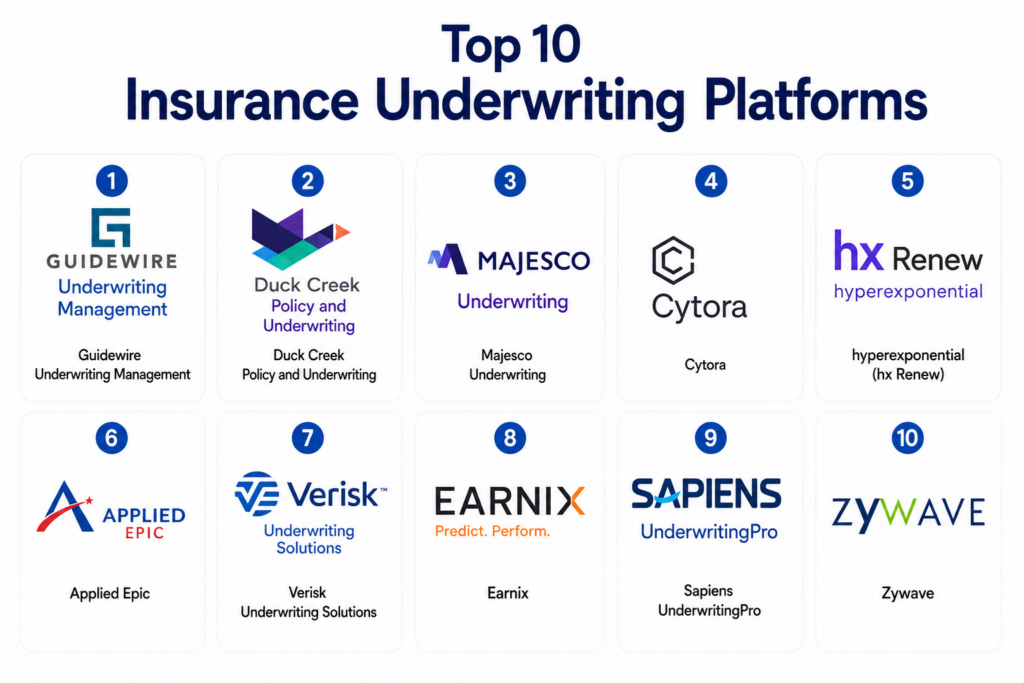
Introduction
Insurance Underwriting Platforms help insurers, MGAs, brokers, and specialty insurance providers evaluate risk, price policies, automate underwriting workflows, and improve decision-making across insurance products. These platforms support risk assessment, data enrichment, rules engines, submission intake, quote generation, document handling, collaboration, and underwriting analytics.
Modern insurers need faster underwriting decisions, better risk visibility, and stronger automation because customers and agents expect quicker responses. Traditional underwriting processes often rely on manual reviews, disconnected spreadsheets, emails, and slow document exchange. Insurance Underwriting Platforms help reduce delays, improve consistency, and connect underwriting teams with policy, claims, billing, analytics, and external data sources.
Real-world use cases include:
- Digital submission intake
- Risk scoring and underwriting decision support
- Quote and bind workflow automation
- Broker and agent collaboration
- Specialty insurance underwriting
- Portfolio risk analysis
Key evaluation criteria for buyers include:
- Workflow automation
- Risk scoring capabilities
- Data enrichment support
- Integration ecosystem
- Policy system connectivity
- Underwriter collaboration
- Reporting and analytics
- Security controls
- Scalability
- Ease of configuration
Best for: Insurance carriers, MGAs, reinsurers, specialty insurers, brokers, and digital insurance providers that need faster, more consistent, and data-driven underwriting operations.
Not ideal for: Very small agencies with simple manual quoting needs, teams that only require a basic CRM, or organizations without enough underwriting volume to justify a dedicated platform.
Key Trends in Insurance Underwriting Platforms
- AI-assisted underwriting is helping teams summarize submissions, classify risks, and identify missing information.
- Data enrichment from third-party sources is becoming more important for accurate risk assessment.
- Low-code rules engines are helping underwriting teams update appetite, rating, and eligibility rules faster.
- Digital submission intake is reducing email-heavy workflows for commercial and specialty insurance.
- API-first underwriting platforms are improving connectivity with policy administration and rating systems.
- Embedded analytics are helping insurers monitor portfolio risk and underwriting performance.
- Automated referral workflows are improving consistency between junior and senior underwriters.
- Broker portals are becoming important for faster submission communication and quote status visibility.
- Fraud and anomaly detection are becoming more connected to underwriting workflows.
- Cloud-based deployment is becoming the preferred model for insurers modernizing legacy underwriting operations.
How We Selected These Tools
The tools below were selected using practical insurance technology and underwriting modernization criteria.
- Strong relevance to underwriting operations
- Market recognition in insurance technology
- Risk assessment and workflow automation depth
- Support for commercial, specialty, personal, or life insurance workflows
- Integration capabilities with policy, rating, claims, CRM, and data platforms
- Scalability for insurers, MGAs, and enterprise insurance teams
- Configurability for underwriting rules and processes
- Reporting and analytics capabilities
- Security and governance readiness
- Fit across enterprise, mid-market, and specialty insurance use cases
Top 10 Insurance Underwriting Platforms
#1 — Guidewire Underwriting Management
Short description : Guidewire Underwriting Management helps property and casualty insurers improve underwriting workflows, risk evaluation, collaboration, and operational consistency. It is designed for insurers that already use or plan to use Guidewire’s broader insurance ecosystem. The platform supports submission handling, underwriting decision workflows, and policy-related coordination. It is best suited for enterprise insurers that need scalable underwriting processes connected to core insurance operations.
Key Features
- Underwriting workflow management
- Risk evaluation support
- Submission review coordination
- Policy ecosystem integration
- Task and referral workflows
- Reporting and operational visibility
- Collaboration tools for underwriting teams
Pros
- Strong fit for Guidewire ecosystem users
- Enterprise-scale underwriting support
- Good workflow consistency for large teams
Cons
- Best suited for larger insurers
- Implementation can be complex
- May require partner support and configuration
Platforms / Deployment
- Web
- Cloud / Hybrid
Security & Compliance
- SSO/SAML
- MFA
- RBAC
- Encryption
- Audit logs
Integrations & Ecosystem
Guidewire Underwriting Management integrates well with broader Guidewire products and insurance ecosystem tools. It is commonly connected with policy administration, claims, billing, analytics, and digital insurance workflows.
- Guidewire PolicyCenter
- Billing systems
- Claims systems
- Analytics platforms
- APIs
- Digital portals
Support & Community
Guidewire provides enterprise documentation, partner implementation resources, training programs, and professional services. Its insurance-focused partner ecosystem is a major advantage for large underwriting modernization projects.
#2 — Duck Creek Policy and Underwriting
Short description : Duck Creek supports underwriting workflows through its cloud-based insurance platform, helping insurers configure products, manage submissions, automate rules, and support quote-to-bind operations. It is commonly selected by insurers looking for cloud-first modernization and flexible insurance workflow configuration. The platform is especially useful for carriers that need strong product configuration and policy connectivity. It fits insurers that want underwriting automation as part of a broader digital insurance ecosystem.
Key Features
- Underwriting workflow automation
- Product configuration support
- Rating and rules management
- Submission and quote workflows
- Policy administration connectivity
- API-based integrations
- Cloud-native insurance operations
Pros
- Strong cloud-first architecture
- Flexible product and rules configuration
- Good fit for insurers modernizing legacy workflows
Cons
- Advanced configuration may require expertise
- Enterprise deployments need careful planning
- Some capabilities may depend on broader module adoption
Platforms / Deployment
- Web
- Cloud
Security & Compliance
- SSO/SAML
- RBAC
- Encryption
- Audit logs
Integrations & Ecosystem
Duck Creek supports connected insurance workflows across policy, billing, claims, rating, and digital distribution. Its API ecosystem helps insurers modernize underwriting without isolating core systems.
- Policy systems
- Rating engines
- Billing platforms
- Claims systems
- CRM tools
- APIs
Support & Community
Duck Creek provides onboarding support, training, documentation, implementation services, and insurance-focused customer success resources.
#3 — Majesco Underwriting
Short description : Majesco supports underwriting as part of its digital insurance platform, helping insurers manage quote, product, rating, and workflow processes. It is useful for insurers that need flexible product launches, improved digital engagement, and stronger workflow automation. Majesco is often considered by insurers modernizing legacy insurance operations across multiple lines. It works well for organizations that need underwriting connected with policy administration and digital distribution.
Key Features
- Underwriting process automation
- Product and rating configuration
- Digital quote workflows
- Policy administration connectivity
- Analytics and reporting
- Customer and agent engagement support
- Workflow orchestration
Pros
- Good fit for digital insurance transformation
- Supports multiple insurance lines
- Strong workflow automation capabilities
Cons
- Large deployments require planning
- Configuration depth may need expert support
- Enterprise-focused investment
Platforms / Deployment
- Web
- Cloud / Hybrid
Security & Compliance
- SSO/SAML
- MFA
- RBAC
- Encryption
- Audit logs
Integrations & Ecosystem
Majesco integrates with insurance core systems, distribution portals, analytics platforms, and customer experience tools. It is suitable for insurers building connected digital underwriting operations.
- Policy administration systems
- Billing tools
- Claims systems
- CRM platforms
- APIs
- Analytics tools
Support & Community
Majesco offers implementation consulting, onboarding services, training resources, and enterprise support for insurers and insurance technology teams.
#4 — Cytora
Short description : Cytora is a risk digitization and underwriting platform focused on helping commercial insurers process submissions faster and make more consistent risk decisions. It uses data ingestion, risk evaluation, and workflow automation to reduce manual underwriting effort. The platform is especially relevant for commercial insurance teams dealing with complex submissions. Cytora is useful for insurers that want to digitize intake and improve risk triage.
Key Features
- Digital risk intake
- Submission processing automation
- Risk digitization
- Data enrichment support
- Underwriting triage workflows
- Portfolio visibility
- API integrations
Pros
- Strong commercial underwriting focus
- Helps reduce manual submission processing
- Good fit for data-driven risk evaluation
Cons
- Best suited for commercial insurance workflows
- May require integration with existing core systems
- Advanced data workflows require planning
Platforms / Deployment
- Web
- Cloud
Security & Compliance
- Encryption
- RBAC
- Audit logs
- SSO/SAML
Integrations & Ecosystem
Cytora connects underwriting workflows with internal and external data sources. It is often used alongside policy administration, CRM, and analytics tools to improve risk intake and decision support.
- APIs
- External risk data sources
- Policy systems
- CRM platforms
- Analytics tools
- Workflow systems
Support & Community
Cytora provides implementation support, onboarding guidance, and insurance-focused customer success resources. Community visibility is more specialized compared with broader core insurance vendors.
#5 — hyperexponential hx Renew
Short description : hyperexponential hx Renew is a pricing and underwriting decision platform focused on specialty and commercial insurance. It helps insurers, MGAs, and reinsurers build pricing models, improve risk selection, and support more agile underwriting decisions. The platform is especially relevant for complex insurance products where pricing sophistication matters. It is a strong fit for specialty insurers needing advanced pricing and underwriting collaboration.
Key Features
- Pricing model management
- Underwriting decision support
- Portfolio analytics
- Specialty insurance workflows
- Model governance
- Data-driven pricing tools
- Collaboration features
Pros
- Strong fit for specialty insurance
- Advanced pricing and model management
- Supports underwriting agility
Cons
- Not a general-purpose core insurance platform
- Requires pricing and actuarial expertise
- May need integration with policy systems
Platforms / Deployment
- Web
- Cloud
Security & Compliance
- SSO/SAML
- RBAC
- Encryption
- Audit logs
Integrations & Ecosystem
hyperexponential supports integration with underwriting, data, pricing, and policy workflows. It is particularly useful where pricing teams and underwriters need shared visibility into complex risk decisions.
- APIs
- Data platforms
- Pricing models
- Policy systems
- Analytics tools
- Specialty underwriting workflows
Support & Community
The vendor provides onboarding, implementation support, and specialist guidance for pricing and underwriting teams. Support is focused on specialty insurance use cases.
#6 — Applied Epic
Short description : Applied Epic is an agency and brokerage management platform that supports commercial insurance workflows, client management, submissions, and policy servicing. While it is not a pure underwriting engine for carriers, it plays an important role in broker-side underwriting and submission workflows. Agencies and brokers use it to manage client data, market submissions, and coordinate insurance workflows. It is best suited for brokerages that need connected client and policy operations.
Key Features
- Client and policy management
- Submission workflow support
- Document management
- CRM-style insurance workflows
- Reporting tools
- Carrier connectivity support
- Agency operations management
Pros
- Strong agency and broker workflow support
- Good operational visibility
- Useful for commercial insurance servicing
Cons
- Not a carrier-grade underwriting engine
- Advanced risk scoring may require integrations
- Best suited for broker-side workflows
Platforms / Deployment
- Web / Windows
- Cloud / Hybrid
Security & Compliance
- SSO/SAML
- RBAC
- Encryption
- Audit logs
Integrations & Ecosystem
Applied Epic connects agency workflows with carriers, document systems, accounting tools, and customer management processes. It is useful for brokerages managing submissions and policy servicing at scale.
- Carrier connectivity tools
- Document management systems
- Accounting platforms
- CRM workflows
- APIs
- Reporting tools
Support & Community
Applied Systems provides training, documentation, customer support, and onboarding services for agencies and brokerages. Its user community is strong in the insurance agency market.
#7 — Verisk Underwriting Solutions
Short description : Verisk provides underwriting data, analytics, risk assessment, and automation tools used by insurers across multiple insurance lines. Its underwriting solutions help insurers enrich risk data, evaluate submissions, improve pricing accuracy, and reduce manual research. Verisk is especially valuable for organizations that need trusted data and analytics support within underwriting workflows. It is often used alongside core policy and underwriting systems.
Key Features
- Risk data enrichment
- Underwriting analytics
- Property and casualty risk insights
- Data-driven decision support
- Fraud and risk indicators
- Workflow integration support
- Reporting and analytics
Pros
- Strong data and analytics capabilities
- Widely used in insurance risk assessment
- Helpful for underwriting accuracy
Cons
- Not always a complete underwriting workflow platform
- May require integration with core systems
- Pricing and packaging vary by use case
Platforms / Deployment
- Web
- Cloud / Hybrid
Security & Compliance
- Encryption
- Access controls
- Audit logs
- Enterprise security options vary by product
Integrations & Ecosystem
Verisk solutions are often integrated into underwriting, policy, claims, rating, and analytics workflows. The platform is valuable where risk data quality is a key underwriting priority.
- Policy systems
- Rating engines
- Claims systems
- APIs
- Data platforms
- Analytics tools
Support & Community
Verisk provides enterprise support, documentation, onboarding, and insurance domain expertise. Support varies depending on the specific underwriting solution selected.
#8 — Earnix
Short description : Earnix is a pricing, rating, and underwriting decision platform used by insurers and financial services organizations. For insurance teams, it supports pricing optimization, rating models, underwriting analytics, and decision automation. The platform is especially relevant for insurers that want more advanced pricing intelligence connected to underwriting decisions. It is best suited for data-driven insurers with actuarial and analytics maturity.
Key Features
- Pricing optimization
- Rating model support
- Underwriting decision automation
- Analytics and simulation tools
- Personalization capabilities
- Model governance
- Integration APIs
Pros
- Strong pricing and analytics capabilities
- Useful for data-driven underwriting
- Supports advanced decision automation
Cons
- Requires analytics maturity
- Not a full policy administration platform
- Implementation may require specialist resources
Platforms / Deployment
- Web
- Cloud
Security & Compliance
- SSO/SAML
- RBAC
- Encryption
- Audit logs
Integrations & Ecosystem
Earnix integrates with policy systems, pricing engines, analytics environments, and operational insurance workflows. It is useful for insurers that need advanced pricing intelligence connected to underwriting.
- APIs
- Policy systems
- Data platforms
- Analytics tools
- Rating engines
- CRM platforms
Support & Community
Earnix provides implementation support, training, analytics guidance, and customer success services for insurance pricing and underwriting teams.
#9 — Sapiens UnderwritingPro
Short description : Sapiens UnderwritingPro supports underwriting automation for life insurance and related insurance workflows. It helps insurers streamline application intake, evidence gathering, decision rules, and underwriting case management. The platform is useful for insurers that need structured underwriting workflows and faster decision-making. It is especially relevant for life insurers modernizing underwriting operations.
Key Features
- Life underwriting automation
- Case management workflows
- Rules-based decision support
- Evidence collection support
- Application processing
- Reporting dashboards
- Integration with insurance systems
Pros
- Strong fit for life insurance underwriting
- Supports decision automation
- Improves case workflow visibility
Cons
- Less focused on P&C underwriting
- Configuration requires planning
- Best fit depends on insurance line
Platforms / Deployment
- Web
- Cloud / Hybrid
Security & Compliance
- SSO/SAML
- RBAC
- Encryption
- Audit logs
Integrations & Ecosystem
Sapiens UnderwritingPro connects with policy systems, data providers, evidence sources, and life insurance operations platforms. It helps reduce manual review and improve underwriting consistency.
- Policy administration systems
- Medical evidence sources
- Data providers
- APIs
- Reporting tools
- Workflow systems
Support & Community
Sapiens provides enterprise implementation services, onboarding support, documentation, and insurance technology expertise.
#10 — Zywave
Short description : Zywave provides insurance distribution, quoting, analytics, and workflow tools used by brokers, agencies, and insurance organizations. While it is not only an underwriting platform, it supports underwriting-adjacent workflows such as risk analysis, proposal generation, client data, and market communication. It is especially useful for brokers and agencies managing commercial insurance submissions. Zywave fits organizations that need sales, risk, and underwriting workflow support in one ecosystem.
Key Features
- Commercial insurance workflow tools
- Quoting and proposal support
- Risk analysis resources
- Broker and agency collaboration
- Client data management
- Reporting tools
- Market communication support
Pros
- Strong broker and agency ecosystem
- Useful for commercial insurance workflows
- Good proposal and client support tools
Cons
- Not a carrier-grade underwriting engine
- Advanced automation may require additional tools
- Best suited for distribution-side workflows
Platforms / Deployment
- Web
- Cloud
Security & Compliance
- Encryption
- Access controls
- Role-based permissions
- SSO/SAML availability varies by product
Integrations & Ecosystem
Zywave supports insurance distribution workflows and connects with agency, client management, and reporting processes. It is useful for broker teams coordinating submissions, proposals, and underwriting-related communication.
- Agency management systems
- CRM tools
- Reporting platforms
- Client communication tools
- APIs
- Proposal workflows
Support & Community
Zywave provides documentation, onboarding resources, customer support, and training for insurance brokers, agencies, and distribution teams.
Comparison Table Top 10
| Tool Name | Best For | Platform Supported | Deployment | Standout Feature | Public Rating |
|---|---|---|---|---|---|
| Guidewire Underwriting Management | Enterprise P&C insurers | Web | Cloud / Hybrid | Enterprise underwriting workflows | N/A |
| Duck Creek Policy and Underwriting | Cloud-first insurers | Web | Cloud | Configurable underwriting rules | N/A |
| Majesco Underwriting | Multi-line insurers | Web | Cloud / Hybrid | Digital insurance workflows | N/A |
| Cytora | Commercial insurers | Web | Cloud | Risk digitization | N/A |
| hyperexponential hx Renew | Specialty insurers and reinsurers | Web | Cloud | Pricing and underwriting decision support | N/A |
| Applied Epic | Agencies and brokerages | Web, Windows | Cloud / Hybrid | Broker-side submission workflows | N/A |
| Verisk Underwriting Solutions | Data-driven risk assessment | Web | Cloud / Hybrid | Risk data enrichment | N/A |
| Earnix | Pricing-led underwriting | Web | Cloud | Pricing optimization | N/A |
| Sapiens UnderwritingPro | Life insurers | Web | Cloud / Hybrid | Life underwriting automation | N/A |
| Zywave | Brokers and distribution teams | Web | Cloud | Commercial insurance workflow support | N/A |
Evaluation & Scoring of Insurance Underwriting Platforms
| Tool Name | Core 25% | Ease 15% | Integrations 15% | Security 10% | Performance 10% | Support 10% | Value 15% | Weighted Total |
|---|---|---|---|---|---|---|---|---|
| Guidewire Underwriting Management | 9.0 | 7.5 | 9.3 | 9.0 | 8.8 | 8.7 | 7.5 | 8.5 |
| Duck Creek Policy and Underwriting | 8.8 | 8.0 | 8.8 | 8.5 | 8.5 | 8.2 | 8.0 | 8.4 |
| Majesco Underwriting | 8.5 | 7.8 | 8.5 | 8.5 | 8.3 | 8.0 | 7.8 | 8.2 |
| Cytora | 8.5 | 8.2 | 8.3 | 8.2 | 8.4 | 8.0 | 8.0 | 8.3 |
| hyperexponential hx Renew | 8.7 | 7.8 | 8.4 | 8.5 | 8.5 | 8.0 | 7.8 | 8.3 |
| Applied Epic | 7.8 | 8.0 | 7.8 | 8.0 | 8.0 | 8.0 | 8.2 | 7.9 |
| Verisk Underwriting Solutions | 8.3 | 7.8 | 8.5 | 8.2 | 8.5 | 8.0 | 7.8 | 8.2 |
| Earnix | 8.4 | 7.5 | 8.3 | 8.3 | 8.5 | 7.8 | 7.7 | 8.1 |
| Sapiens UnderwritingPro | 8.3 | 7.8 | 8.0 | 8.2 | 8.2 | 8.0 | 7.8 | 8.1 |
| Zywave | 7.5 | 8.3 | 7.5 | 7.8 | 7.8 | 8.0 | 8.2 | 7.8 |
These scores are comparative and should be used as a starting point for evaluation. Platforms with deep enterprise capabilities often score higher in integrations, governance, and scalability, while focused tools may score better in usability or specialized underwriting value. Buyers should validate every platform with real underwriting workflows, submission samples, integration testing, and business stakeholder feedback. The right choice depends on insurance line, underwriting complexity, distribution model, and internal technology maturity.
Which Insurance Underwriting Platform Is Right for You?
Solo / Freelancer
Solo consultants and independent insurance professionals usually do not need a full underwriting platform. A basic CRM, quoting tool, or agency management system may be enough for simple workflows. If underwriting is handled by carriers, a dedicated underwriting system may add unnecessary complexity and cost.
SMB
Small and mid-sized agencies, MGAs, and insurers should prioritize usability, fast deployment, and clear workflow improvements. Applied Epic and Zywave can be useful for agency and broker-side underwriting workflows. Brite-style core platforms, Duck Creek, or Majesco may be better for insurers that need connected policy and underwriting operations.
Mid-Market
Mid-market insurers often need stronger automation, submission intake, rules configuration, and integration capabilities. Duck Creek, Majesco, Cytora, Sapiens, and hyperexponential can support more advanced underwriting modernization. These tools help reduce manual review and improve decision consistency.
Enterprise
Large insurers need scalable workflows, governance, security, analytics, and deep integration with policy administration, claims, billing, and data platforms. Guidewire, Duck Creek, Majesco, Verisk, and Earnix are strong options depending on whether the priority is workflow, pricing, data enrichment, or core insurance transformation.
Budget vs Premium
Budget-focused teams should avoid overbuying enterprise platforms if their underwriting needs are simple. Premium platforms provide stronger scalability, automation, analytics, and integration ecosystems, but they also require higher implementation effort. The best value comes from matching platform depth with underwriting volume and operational complexity.
Feature Depth vs Ease of Use
Enterprise systems offer deeper configuration, workflow automation, and governance, but they may require more setup and training. Focused tools like Cytora, Earnix, and hyperexponential can deliver strong value in specific underwriting functions. Broker-focused tools like Applied Epic and Zywave are easier to use for distribution-side operations.
Integrations & Scalability
Underwriting platforms should integrate with policy administration, rating engines, CRM systems, document management, data providers, analytics tools, and claims systems. API maturity is especially important for insurers building digital distribution or embedded insurance models. Scalability should be tested with real submission volume and workflow complexity.
Security & Compliance Needs
Insurance underwriting involves sensitive customer, business, financial, and risk data. Buyers should prioritize SSO/SAML, MFA, RBAC, encryption, audit logs, secure APIs, and strong access controls. Regulated insurers should also review vendor security documentation, data handling practices, and operational resilience policies before deployment.
Frequently Asked Questions FAQs
1. What is an Insurance Underwriting Platform?
An Insurance Underwriting Platform is software that helps insurers evaluate risk, manage submissions, apply underwriting rules, generate quotes, and support decision-making. These platforms reduce manual work and improve consistency across underwriting teams. Modern tools often include automation, analytics, data enrichment, and collaboration features. They help insurers make faster and more informed risk decisions.
2. Why do insurers need underwriting platforms?
Insurers need underwriting platforms because manual underwriting can be slow, inconsistent, and difficult to scale. A modern platform helps organize submissions, automate rules, enrich data, and improve workflow visibility. It also helps underwriters spend more time on complex decisions instead of repetitive administrative work. This improves speed, accuracy, and operational efficiency.
3. Which teams benefit most from underwriting software?
Insurance carriers, MGAs, specialty insurers, reinsurers, brokers, and underwriting teams benefit most from underwriting software. Commercial and specialty insurance teams often see strong value because submissions can be complex and document-heavy. Life insurers may benefit from evidence automation and rules-based decisioning. Brokers can also benefit from tools that improve submission and proposal workflows.
4. How is underwriting software different from policy administration software?
Underwriting software focuses on risk evaluation, submission review, quote decisioning, and underwriting workflow automation. Policy administration software manages issued policies across the full policy lifecycle, including endorsements, renewals, cancellations, and servicing. Some platforms combine both capabilities, while others specialize in one area. Buyers should understand whether they need underwriting workflow support, core policy administration, or both.
5. What integrations are most important?
Important integrations include policy administration systems, rating engines, CRM platforms, document management tools, data providers, analytics systems, and customer portals. For commercial insurance, integrations with third-party risk data sources can be especially valuable. Strong APIs help reduce manual data entry and improve workflow automation. Integration quality should be tested before purchase.
6. Can AI improve underwriting workflows?
AI can help with document intake, submission summarization, risk classification, anomaly detection, and missing information identification. It can support underwriters by reducing repetitive review work and improving triage speed. However, AI should not replace expert underwriting judgment for complex or high-risk cases. Buyers should evaluate explainability, governance, and human review controls carefully.
7. What are common mistakes during platform selection?
Common mistakes include choosing a platform based only on demos, ignoring integration complexity, underestimating data quality issues, and failing to involve underwriters early. Some organizations also over-customize workflows before understanding actual operational needs. A successful selection process should include real submission testing, stakeholder feedback, and clear workflow mapping.
8. How long does implementation usually take?
Implementation timelines depend on workflow complexity, integrations, data migration, product configuration, and team readiness. Focused underwriting tools may deploy faster, while enterprise insurance platforms require more planning. Organizations with clear underwriting rules and clean data usually move faster. A phased rollout helps reduce operational risk and improves adoption.
9. What security features should buyers prioritize?
Buyers should prioritize SSO/SAML, MFA, RBAC, encryption, audit logs, secure APIs, and strong user access controls. Underwriting platforms handle sensitive personal, financial, health, property, and business data depending on the insurance line. Regulated insurers should also validate vendor security documentation and data governance practices. Security should be reviewed before pilot expansion.
10. How should insurers choose the right underwriting platform?
Insurers should define their underwriting goals, insurance lines, submission complexity, data needs, integration requirements, and automation priorities. They should shortlist tools, test real underwriting workflows, review security controls, validate APIs, and involve underwriters in demos. The best platform is the one that improves speed and consistency without creating unnecessary operational complexity.
Conclusion
Insurance Underwriting Platforms are becoming essential for insurers, MGAs, brokers, and specialty insurance organizations that want faster decisions, better risk visibility, stronger automation, and more consistent underwriting outcomes. These platforms help teams digitize submissions, apply underwriting rules, enrich risk data, collaborate more effectively, and connect underwriting workflows with policy, claims, billing, CRM, analytics, and external data systems. The best platform depends on insurance line, company size, underwriting complexity, distribution model, and technology maturity. Guidewire, Duck Creek, and Majesco are strong choices for insurers seeking broader core insurance modernization, while Cytora, Verisk, Earnix, and hyperexponential are valuable for data-driven underwriting, pricing, and risk evaluation. Applied Epic and Zywave are useful for broker and agency-side workflows, while Sapiens UnderwritingPro is well suited for life insurance underwriting automation. The smartest next step is to shortlist tools, test real submissions, validate integrations and security, run a focused pilot, and choose the platform that improves underwriting speed, accuracy, and scalability without adding unnecessary complexity.

Thanks for making this topic so easy to understand.