MOTOSHARE 🚗🏍️
Rent Bikes & Cars Directly from Owners
Motoshare connects vehicle owners with people who need bikes and cars on rent. Owners earn from idle vehicles, and renters get flexible ride options.
Visit Motoshare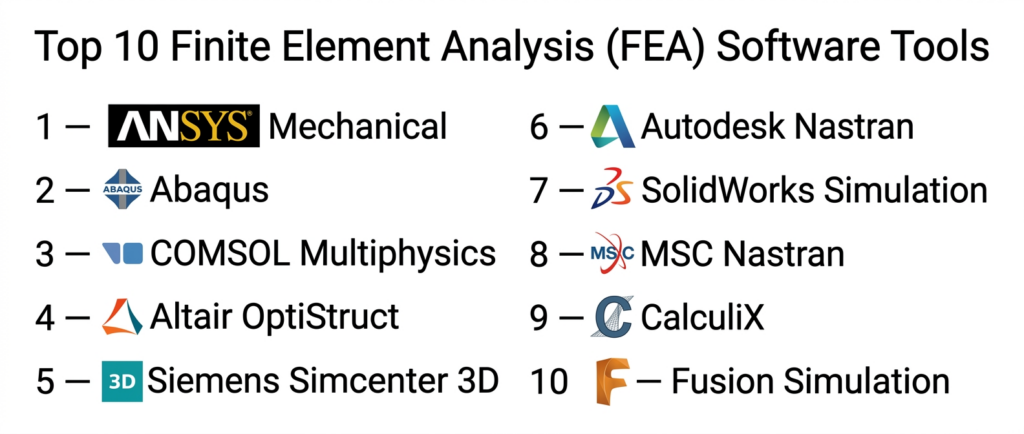
Introduction
Finite Element Analysis (FEA) software is used to simulate how physical structures and components respond to real-world forces such as stress, heat, vibration, and deformation. By breaking complex geometries into smaller elements, engineers can analyze performance, predict failures, and optimize designs without relying entirely on physical prototypes.
FEA plays a critical role in modern engineering workflows, enabling faster innovation, cost reduction, and improved product reliability. With advancements in computing power, cloud infrastructure, and AI-assisted modeling, FEA tools are becoming more efficient, scalable, and accessible across industries.
Common use cases include:
- Structural analysis in automotive and aerospace design
- Stress and fatigue analysis in manufacturing components
- Thermal analysis for electronics and systems
- Civil engineering simulations (bridges, buildings)
- Product design validation and optimization
What buyers should evaluate:
- Solver accuracy and physics capabilities
- Ease of use and learning curve
- CAD integration and workflow compatibility
- Scalability and performance (HPC support)
- Cloud vs on-premise deployment options
- Multiphysics support
- Automation and scripting capabilities
- Visualization and reporting features
- Security and compliance readiness
- Licensing and cost structure
Best for: Mechanical engineers, structural engineers, R&D teams, product designers, and enterprises in manufacturing, aerospace, automotive, and construction.
Not ideal for: Non-technical users or teams requiring simple design tools without simulation complexity. Lightweight CAD tools may be more appropriate in such cases.
Key Trends in Finite Element Analysis (FEA) Software
- AI-assisted meshing and simulation setup reducing manual effort
- Cloud-based simulation platforms enabling scalable analysis without local hardware
- GPU acceleration improving simulation speed and efficiency
- Integration with digital twins for real-time monitoring and predictive maintenance
- Automation via scripting and APIs for batch simulations
- Low-code simulation workflows making tools more accessible
- Enhanced multiphysics simulations combining structural, thermal, and fluid analysis
- Stronger CAD/PLM integration for seamless design workflows
- Subscription-based licensing models replacing perpetual licenses
- Advanced visualization and immersive simulation outputs
How We Selected These Tools (Methodology)
- Evaluated market adoption and industry recognition
- Assessed solver capabilities and feature depth
- Considered performance and scalability across workloads
- Reviewed enterprise readiness and security signals
- Analyzed integration with CAD/CAE ecosystems
- Included a mix of enterprise, mid-market, and open-source tools
- Evaluated documentation quality and onboarding experience
- Considered deployment flexibility (cloud and self-hosted)
- Prioritized tools with active development and strong communities
Top 10 Finite Element Analysis (FEA) Software Tools
#1 — ANSYS Mechanical
Short description (2–3 lines): A leading FEA solution known for high accuracy and advanced simulation capabilities. Widely used in aerospace, automotive, and industrial engineering.
Key Features
- Advanced structural and thermal analysis
- Nonlinear and dynamic simulation capabilities
- Multiphysics integration
- High-performance computing support
- Automated meshing tools
- Parametric design analysis
Pros
- Industry-leading accuracy
- Scales well for complex simulations
Cons
- Expensive licensing
- Steep learning curve
Platforms / Deployment
Windows / Linux; Self-hosted / Hybrid
Security & Compliance
Not publicly stated
Integrations & Ecosystem
Part of a broader engineering ecosystem.
- ANSYS Workbench
- CAD tools (SolidWorks, CATIA)
- Python scripting
Support & Community
Extensive documentation and strong enterprise support with a large global community.
#2 — Abaqus
Short description (2–3 lines): A powerful FEA tool from Dassault Systèmes known for nonlinear analysis and complex simulations.
Key Features
- Advanced nonlinear analysis
- Multiphysics capabilities
- Robust contact modeling
- High scalability
- Customizable simulation workflows
- Strong solver accuracy
Pros
- Excellent for complex simulations
- Strong multiphysics support
Cons
- High cost
- Requires expertise
Platforms / Deployment
Windows / Linux; Self-hosted
Security & Compliance
Not publicly stated
Integrations & Ecosystem
Integrated within Dassault ecosystem.
- CATIA
- SIMULIA platform
- APIs
Support & Community
Strong enterprise support and extensive learning resources.
#3 — COMSOL Multiphysics
Short description (2–3 lines): A versatile simulation platform combining FEA with multiphysics modeling in a unified environment.
Key Features
- Multiphysics simulation
- Customizable physics interfaces
- Application builder
- Parametric studies
- Advanced visualization
- Optimization tools
Pros
- Flexible modeling capabilities
- Strong multiphysics integration
Cons
- Expensive
- Complex setup for beginners
Platforms / Deployment
Windows / macOS / Linux; Self-hosted
Security & Compliance
Not publicly stated
Integrations & Ecosystem
Supports integration with engineering tools.
- MATLAB
- CAD imports
- APIs
Support & Community
Comprehensive documentation and enterprise-grade support.
#4 — Altair OptiStruct
Short description (2–3 lines): A simulation-driven design tool focused on structural optimization and lightweight design.
Key Features
- Structural optimization
- Linear and nonlinear analysis
- Fatigue and durability analysis
- Multiphysics support
- High-performance computing
- Automated meshing
Pros
- Strong optimization capabilities
- Efficient performance
Cons
- Learning curve
- Limited beginner-friendly features
Platforms / Deployment
Windows / Linux; Self-hosted
Security & Compliance
Not publicly stated
Integrations & Ecosystem
Part of Altair ecosystem.
- HyperWorks
- CAD integrations
- APIs
Support & Community
Enterprise support with growing community resources.
#5 — Siemens Simcenter 3D
Short description (2–3 lines): A comprehensive simulation platform combining FEA with system-level engineering capabilities.
Key Features
- Integrated CAD and simulation
- Multiphysics analysis
- Advanced meshing
- Design optimization
- High-performance computing
- Data management tools
Pros
- Strong integration with Siemens tools
- Scalable for enterprise use
Cons
- Expensive
- Complex setup
Platforms / Deployment
Windows / Linux; Self-hosted / Hybrid
Security & Compliance
Not publicly stated
Integrations & Ecosystem
Part of Siemens ecosystem.
- NX CAD
- Teamcenter
- APIs
Support & Community
Enterprise-level support and documentation.
#6 — Autodesk Nastran
Short description (2–3 lines): A widely used FEA solver for structural analysis integrated within Autodesk’s ecosystem.
Key Features
- Linear and nonlinear analysis
- Dynamic and fatigue analysis
- Automated meshing
- Cloud simulation support
- Design optimization
- CAD integration
Pros
- Strong integration with Autodesk tools
- Reliable solver performance
Cons
- Limited advanced multiphysics
- Requires Autodesk ecosystem
Platforms / Deployment
Windows; Cloud / Self-hosted
Security & Compliance
Not publicly stated
Integrations & Ecosystem
Works within Autodesk environment.
- AutoCAD
- Inventor
- Fusion
Support & Community
Good documentation and support resources.
#7 — SolidWorks Simulation
Short description (2–3 lines): An FEA solution embedded within SolidWorks for engineers needing simulation within their CAD workflow.
Key Features
- Integrated with SolidWorks
- Linear and nonlinear analysis
- Thermal simulation
- Design optimization
- Parametric studies
- Easy-to-use interface
Pros
- Seamless CAD integration
- User-friendly
Cons
- Limited advanced capabilities
- Requires SolidWorks
Platforms / Deployment
Windows; Self-hosted
Security & Compliance
Not publicly stated
Integrations & Ecosystem
Part of SolidWorks ecosystem.
- CAD integration
- Add-ons
- Simulation tools
Support & Community
Strong community and learning resources.
#8 — MSC Nastran
Short description (2–3 lines): A well-established FEA solver known for structural and dynamic analysis in aerospace and automotive industries.
Key Features
- Linear and nonlinear analysis
- Dynamic simulation
- Fatigue analysis
- High scalability
- Advanced solver technology
- Multiphysics support
Pros
- Proven reliability
- Strong for aerospace applications
Cons
- Complex interface
- Expensive
Platforms / Deployment
Windows / Linux; Self-hosted
Security & Compliance
Not publicly stated
Integrations & Ecosystem
Supports engineering workflows.
- CAD integrations
- APIs
- Simulation tools
Support & Community
Established user base and support.
#9 — CalculiX
Short description (2–3 lines): An open-source FEA solver offering capabilities similar to commercial tools for structural analysis.
Key Features
- Linear and nonlinear analysis
- Open-source flexibility
- Finite element solver
- Integration with pre/post processors
- Custom scripting
- Multiphysics support
Pros
- Free to use
- Flexible and customizable
Cons
- Limited GUI
- Requires expertise
Platforms / Deployment
Windows / Linux; Self-hosted
Security & Compliance
Not publicly stated
Integrations & Ecosystem
Open ecosystem.
- Python scripting
- Third-party tools
- Custom workflows
Support & Community
Community-driven support.
#10 — Fusion Simulation
Short description (2–3 lines): A cloud-enabled simulation tool within Autodesk Fusion, designed for product designers and engineers.
Key Features
- Cloud-based simulation
- Structural and thermal analysis
- CAD integration
- Generative design tools
- Parametric studies
- Easy setup
Pros
- Accessible and user-friendly
- Integrated design and simulation
Cons
- Limited advanced features
- Requires cloud usage
Platforms / Deployment
Web / Windows; Cloud
Security & Compliance
Not publicly stated
Integrations & Ecosystem
Part of Autodesk Fusion ecosystem.
- CAD tools
- Cloud workflows
- APIs
Support & Community
Good documentation and growing community.
Comparison Table (Top 10)
| Tool Name | Best For | Platform(s) Supported | Deployment | Standout Feature | Public Rating |
|---|---|---|---|---|---|
| ANSYS Mechanical | Enterprise simulation | Windows/Linux | Hybrid | High accuracy solvers | N/A |
| Abaqus | Complex simulations | Windows/Linux | Self-hosted | Nonlinear analysis | N/A |
| COMSOL Multiphysics | Multiphysics modeling | Win/macOS/Linux | Self-hosted | Unified physics platform | N/A |
| Altair OptiStruct | Optimization | Windows/Linux | Self-hosted | Design optimization | N/A |
| Simcenter 3D | Enterprise workflows | Windows/Linux | Hybrid | Integrated ecosystem | N/A |
| Autodesk Nastran | Designers | Windows | Hybrid | CAD integration | N/A |
| SolidWorks Simulation | CAD users | Windows | Self-hosted | Embedded simulation | N/A |
| MSC Nastran | Aerospace | Windows/Linux | Self-hosted | Proven solver | N/A |
| CalculiX | Open-source users | Windows/Linux | Self-hosted | Free solver | N/A |
| Fusion Simulation | SMB/designers | Web/Windows | Cloud | Cloud simulation | N/A |
Evaluation & Scoring of Finite Element Analysis (FEA) Software
| Tool Name | Core (25%) | Ease (15%) | Integrations (15%) | Security (10%) | Performance (10%) | Support (10%) | Value (15%) | Weighted Total |
|---|---|---|---|---|---|---|---|---|
| ANSYS Mechanical | 10 | 6 | 9 | 7 | 10 | 9 | 6 | 8.4 |
| Abaqus | 10 | 6 | 9 | 7 | 10 | 9 | 6 | 8.4 |
| COMSOL | 9 | 6 | 8 | 6 | 9 | 8 | 6 | 7.9 |
| OptiStruct | 9 | 6 | 8 | 6 | 9 | 8 | 7 | 7.9 |
| Simcenter 3D | 9 | 6 | 9 | 7 | 9 | 8 | 6 | 8.0 |
| Autodesk Nastran | 8 | 8 | 7 | 6 | 8 | 7 | 7 | 7.5 |
| SolidWorks Simulation | 7 | 9 | 7 | 6 | 7 | 8 | 7 | 7.4 |
| MSC Nastran | 9 | 5 | 7 | 6 | 9 | 7 | 6 | 7.5 |
| CalculiX | 8 | 4 | 7 | 5 | 8 | 6 | 10 | 7.2 |
| Fusion Simulation | 7 | 9 | 7 | 6 | 7 | 7 | 8 | 7.5 |
How to interpret scores:
- Scores are comparative and help identify relative strengths
- High scores indicate balanced performance across criteria
- Enterprise tools excel in performance but may be complex
- Open-source tools offer value but require expertise
- Use this as a shortlisting guide, not a final decision
Which Finite Element Analysis (FEA) Software Tool Is Right for You?
Solo / Freelancer
- Best choices: CalculiX, Fusion Simulation
- Cost-effective and flexible solutions with lower barriers to entry
SMB
- Best choices: SolidWorks Simulation, Autodesk Nastran
- Easy integration with design workflows
Mid-Market
- Best choices: COMSOL Multiphysics, Altair OptiStruct
- Balanced performance and feature depth
Enterprise
- Best choices: ANSYS Mechanical, Abaqus, Simcenter 3D
- High scalability and advanced simulation capabilities
Budget vs Premium
- Budget: CalculiX
- Premium: ANSYS, Abaqus
Feature Depth vs Ease of Use
- Deep features: Abaqus, ANSYS
- Ease of use: Fusion Simulation, SolidWorks
Integrations & Scalability
- Strong ecosystems: Siemens, ANSYS
- Flexible customization: open-source tools
Security & Compliance Needs
- Enterprise-grade: ANSYS, Siemens
- Basic: open-source tools
Frequently Asked Questions (FAQs)
What is FEA software used for?
FEA software is used to simulate how structures respond to forces, heat, and other physical effects.
How much does FEA software cost?
Costs vary from free open-source tools to expensive enterprise licenses.
Is FEA difficult to learn?
Yes, it requires engineering knowledge and training for accurate results.
Can FEA run on the cloud?
Yes, some tools support cloud-based simulation.
What industries use FEA?
Aerospace, automotive, manufacturing, civil engineering, and electronics.
Do I need high-end hardware?
For local simulations, yes. Cloud tools reduce hardware requirements.
Can FEA integrate with CAD?
Most tools support CAD integration for seamless workflows.
What are common mistakes in FEA?
Incorrect boundary conditions and poor meshing.
Is open-source FEA reliable?
Yes, but it requires expertise.
Can I switch FEA tools easily?
Switching is possible but may require retraining.
Conclusion
Finite Element Analysis (FEA) software is essential for modern engineering, enabling accurate simulations, faster product development, and improved design reliability. From enterprise-grade platforms to open-source tools, each solution offers unique strengths depending on your requirements.
